


Every kitchen knife category has at least one naming disaster, but "cleaver" might be the worst. Walk into a Western kitchen store and a cleaver is a thick, heavy slab of steel designed to split bones. Walk into a Chinese cookware shop and a cleaver is a thin, razor-sharp precision knife that handles 90% of all kitchen prep. Same word. Completely different tools. And if you buy the wrong one, you'll either chip a delicate blade on a chicken carcass or wonder why your "bone chopper" can't slice a tomato.
What Is a Cleaver and Do You Need One?
A Chinese cleaver (cai dao) is a thin, lightweight knife with a razor-sharp edge. It's designed for vegetables, boneless proteins, and precise cutting. Think of it as a giant chef knife with a flat edge profile.
A Western cleaver (meat cleaver) is a thick, heavy tool built to chop through bone using brute force. Most home cooks rarely need one.
If you cook at home and want better vegetable prep, you almost certainly want the Chinese one.
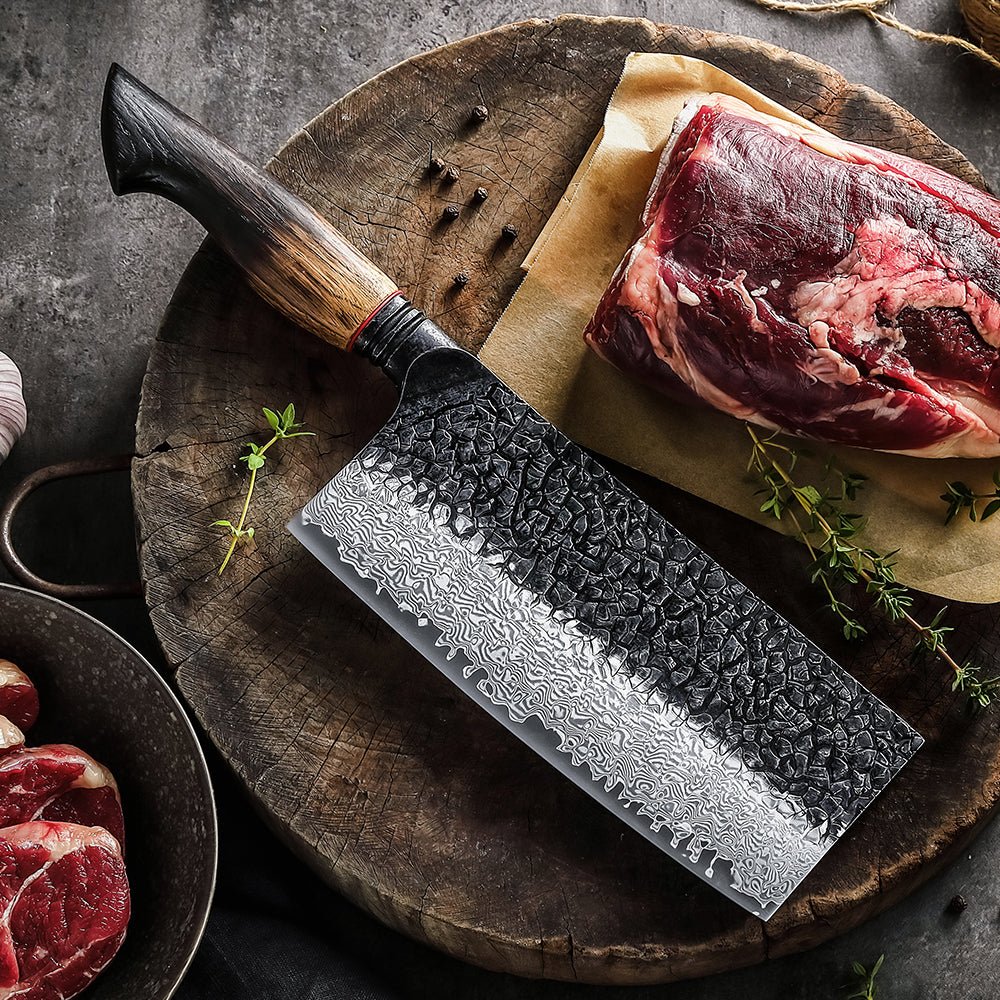
What Is a Chinese Cleaver and Why Is It So Versatile?
The Chinese vegetable cleaver looks intimidating. That big rectangular blade seems like overkill for slicing scallions. But pick one up and the first thing you notice is how light it is. A typical cai dao weighs somewhere between 220g and 320g, roughly the same as a Western chef knife. The blade is thin, usually 1.5 to 2mm at the spine, ground to a keen edge that can match any Japanese-style knife.
In Chinese kitchens, the cai dao handles everything. Mincing garlic. Paper-thin scallion shreds. Slicing boneless chicken thighs. Dicing tofu without crushing it. Scooping chopped ingredients off the board with that wide, flat blade. Chinese cooks who grew up with a cai dao sometimes find Western chef knives narrow and awkward by comparison.
The tall, rectangular blade gives massive knuckle clearance. Your fingers stay far from the cutting board even with a low pinch grip. The flat edge profile (no belly curve like a Western chef knife) is built for push-cutting and tap-chopping, the two primary techniques in Chinese cuisine. And that broad flat surface? It doubles as a bench scraper, a garlic smasher, and a way to ferry a pile of diced onion straight from the board into your wok.
What Is a Western Meat Cleaver Used For?
A Western meat cleaver is a fundamentally different object. The blade is thick, 4 to 6mm at the spine, sometimes even more. The steel is soft (52-56 HRC), chosen specifically because it flexes and absorbs shock without chipping. The edge angle is obtuse, usually 25 to 30 degrees per side, because sharpness matters less than durability when you're splitting ribs.
The weight does the work. You don't push-cut with a meat cleaver. You swing it. You raise it a foot above the cutting board and let momentum carry it through bone, cartilage, and connective tissue. The heel of the blade, which is the thickest part, takes the brunt of the impact.
Most home cooks honestly don't need one. If you buy chicken already broken down and ribs already cut by your butcher, a meat cleaver will sit in your drawer for years. A heavy chef knife or a pair of kitchen shears handles light bone work just fine. Where a Western cleaver earns its keep is whole-animal butchery: splitting pork shoulders, breaking down lamb legs at the joint, or processing a whole side of ribs into individual portions.
How Do Chinese and Western Cleavers Compare Side by Side?
Why Does Steel Composition Matter in a Cleaver?
The steel in a Chinese cleaver determines how sharp it gets, how long it stays sharp, and how it responds to sharpening. High-carbon stainless steels in the 58-62 HRC range are the sweet spot. At Xinzuo, our cai dao uses a core of high-carbon steel (like 10Cr15CoMoV or SG2 powder steel depending on the series) clad in layers of softer Damascus steel. The hard core holds a keen edge. The softer cladding absorbs lateral stress so the thin blade doesn't snap.
Chromium content above 12% makes the steel stainless, which matters for a knife that spends all day cutting watery vegetables. Vanadium and molybdenum refine the grain structure, producing a finer, more consistent edge. Cobalt improves heat resistance during the hardening process. These aren't marketing details. They directly affect how the knife performs during your thousandth carrot.
Western meat cleavers use simpler carbon steels or low-alloy stainless, usually in the 52-56 HRC range. The lower hardness is intentional. A hard, brittle steel would crack under repeated bone impacts. Soft steel deforms slightly on impact and springs back. You can straighten micro-deformations with a honing steel. You can't un-chip a snapped edge.
If you want to understand the differences between steel types and hardness ratings in more detail, our knife steel hardness guide breaks it all down.
What Handle Materials and Designs Are Best for Cleavers?
Chinese cleaver handles tend to be round or oval in cross-section, made from hardwood or composite materials. The round profile allows the knife to rotate freely in your hand, which matters during the rapid wrist movements of Chinese chopping technique. Traditional cai dao handles are cylindrical wood, often rosewood or ebony. Modern versions use stabilised pakkawood or G10 (a fibreglass-resin composite) for better moisture resistance.
The tang, which is the extension of the blade steel into the handle, varies. Cheaper Chinese cleavers use a rattail tang (a thin spike of steel driven into a wooden handle). Better ones use a full tang or broad tang with rivets or compression fittings. Full tang construction adds weight in the handle, improving balance on a wide blade that would otherwise feel front-heavy.
Western meat cleavers almost always use a full tang with riveted handle scales, usually from synthetic materials like polypropylene or Micarta. The full tang is non-negotiable here. The repeated shock of bone chopping would snap a rattail tang within weeks. The handles are typically thick and textured for a secure grip, because your hand needs to absorb vibration without the knife twisting loose.
Do You Actually Need a Cleaver?
You cook Chinese or Asian food regularly. A Chinese cleaver is worth it. The flat edge, knuckle clearance, and broad blade are optimized for the kind of prep Chinese and Southeast Asian recipes demand. If you own a nakiri or chef knife, a cai dao overlaps in philosophy but offers more height, a broader scooping surface, and a different feel in the hand.
You cook mostly Western food. A Chinese cleaver is a fun addition but not a necessity. Your chef knife already handles Western prep efficiently.
You regularly break down whole animals. Get a Western meat cleaver. It'll do in one clean strike what a chef knife struggles with.
You buy meat pre-cut. You don't need a Western cleaver. Save the drawer space.
How Do You Sharpen and Maintain a Cleaver?
These two types of cleavers need completely different sharpening approaches. Treating them the same will damage one or waste your time on the other.
Chinese Cleaver Care
A cai dao follows the same rules as any thin, hard Japanese-style knife. Hand wash after every use and dry immediately. Never put it in the dishwasher. The high-hardness steel is sensitive to lateral stress and thermal shock, and dishwasher detergents are abrasive enough to dull the edge over time.
Sharpen on a whetstone. Start with a 1000-grit stone to set the edge, then refine on a 3000 or 4000-grit stone for a polished, keen finish. Maintain the original 15 to 18 degree angle. The wide blade makes this easier than you might expect, because you can see the angle clearly against the stone. Between full sharpenings, strop on a leather strop or touch up on a finishing stone every few uses.
Avoid pull-through sharpeners and electric sharpeners. They remove too much metal, can't match the correct angle for a thin blade, and will shorten the life of your knife significantly.
Western Cleaver Care
A meat cleaver is far less demanding. The soft steel is easy to sharpen and doesn't need to be razor-sharp, just sharp enough to bite into bone without skipping. A coarse whetstone (400-800 grit) or even a bench grinder works fine. Match the 25 to 30 degree angle. You're not going for a polished edge here.
A honing steel is useful between sharpenings. Run the edge along a ceramic or steel rod a few times to straighten any micro-deformations from bone impact. This keeps the cleaver cutting straight without removing metal.
Rust prevention is the main concern. Wipe the blade dry after washing. If you won't use it for a while, apply a thin coat of food-safe mineral oil to the blade surface. Our knife care guide covers daily maintenance for all knife types.
How Do You Store Large Cleaver Blades?
Cleavers are awkward to store because of their size. A standard knife block slot usually isn't wide enough. Here are the options that work.
Magnetic wall holder: The best option for Chinese cleavers. The blade sits flat against the magnet, edges exposed to air (which prevents moisture buildup), and you can grab it with one hand. Make sure the magnet is strong enough. A thin, light cai dao holds easily, but a heavy Western cleaver may slide on weaker magnets.
Blade guard and drawer: If wall mounting isn't an option, a fitted blade guard (plastic or felt-lined) lets you store a cleaver in a drawer safely. Without a guard, the exposed edge will damage other knives and nick your fingers when you reach in.
Knife block with a wide slot: Some blocks include a slot designed for cleavers or bread knives. Insert spine-first so the edge doesn't drag against wood on the way in and out.
Dedicated cleaver hook: In Chinese kitchens, cleavers traditionally hang from a hook on the wall or a rail above the prep station. The hole in the corner of many Chinese cleaver blades exists for exactly this purpose. It keeps the blade accessible, dry, and away from other tools.
What Cleaver Options Does Xinzuo Offer?
Xinzuo's cleaver collection focuses on the Chinese vegetable cleaver, because that's the style most home cooks will actually use. The Mo Series 7" cai dao is a good starting point: 67-layer Damascus cladding over a 10Cr15CoMoV core, full tang construction with pakkawood handle scales, and a weight that balances precision with enough heft for comfortable chopping.
If you're new to cleavers and not sure whether the rectangular blade suits your cooking style, a chef knife or nakiri is a safer first purchase. The cleaver rewards cooks who commit to learning its techniques, but it's not the most intuitive shape if you've only ever used curved-edge knives.
Related Reading
- Vegetable Cleaver vs Chef Knife: Which One Do You Need?
- Best Knives for Vegetables: Buying Guide
- Knife Techniques: Rock Chop, Push Cut, and Pull Slice
- Japanese-style Knife Types Explained
- Knife Steel Hardness Guide
- How to Sharpen Knives on a Whetstone
- Knife Care and Daily Maintenance Guide
- How to Choose a Chef Knife: The Complete Buying Guide
Frequently Asked Questions
Can you use a Chinese cleaver as your only kitchen knife?
Yes, and many Chinese home cooks do exactly that. A cai dao handles slicing, dicing, mincing, smashing garlic, scooping ingredients, and even scoring. The broad flat blade doubles as a bench scraper. The only tasks it cannot do are tip work (like trimming sinew), rocking through herbs, and cutting through bone, so you may want a paring knife and a bone chopper alongside it.
What size Chinese cleaver is best for home cooking?
A 7 to 8 inch (180 to 200mm) blade suits most home cooks. Blades shorter than 7 inches feel cramped during batch prep, while anything over 8.5 inches gets hard to control on a standard chopping board. A weight around 250 to 320g gives enough heft for the blade to do the work without tiring your wrist.
Why can't you cut bones with a Chinese cleaver?
The blade is too thin and the steel is too hard. A typical cai dao has a spine thickness of 1.5 to 2mm and a hardness of 58 to 62 HRC. Hitting bone sends a shock through that thin, rigid steel and chips or cracks the edge. Chinese kitchens use a separate bone chopper (gu dao) with a 6 to 9mm thick blade and softer steel around 52 to 56 HRC for that job.
What is the difference between a cleaver and a butcher knife?
A butcher knife has a curved, pointed blade designed for separating meat from bone with slicing motions. A Western meat cleaver has a thick, blunt, rectangular blade built to chop straight through bone using weight and momentum. A Chinese cleaver (cai dao) looks similar to the meat cleaver but is thin, light, and sharp, built for precision vegetable and protein prep rather than butchery.
How do you sharpen a Chinese cleaver?
Use a whetstone at 15 to 18 degrees per side. Start on a 1000 grit stone to reset the edge, then finish on a 3000 to 4000 grit stone for a polished cutting edge. The wide blade makes holding a consistent angle easier than on a narrow knife. Avoid pull-through sharpeners, which remove too much metal and cannot match the correct angle for a thin blade.