


You've probably been burned before. A "premium Damascus chef knife" from Amazon that dulled in a week. A pattern that started wearing off after a few sharpenings. Steel so soft you could practically bend it with your hands.
That experience, multiplied across millions of disappointed buyers, is exactly why "Made in China" became a red flag for anyone shopping for chef knives. The skepticism is entirely rational.
But the full picture is more interesting than the stereotype suggests. And as a manufacturer based in Yangjiang, China's 1,400-year-old knife-making capital, we have a perspective on this topic that most knife reviewers simply don't have.
Why Does "Made in China" Have a Bad Reputation for Knives?
We should be honest about this, because it's our industry and we see it up close: the knockoff problem is massive, and it's genuinely harmful to buyers.
Scroll through Amazon or AliExpress right now and you'll find hundreds of "Damascus" knives priced between $25 and $50. They feature stunning wavy patterns, vague claims about "high-carbon Japanese steel," and review counts that seem suspiciously high for brands nobody has heard of.
What's actually going on with those knives:
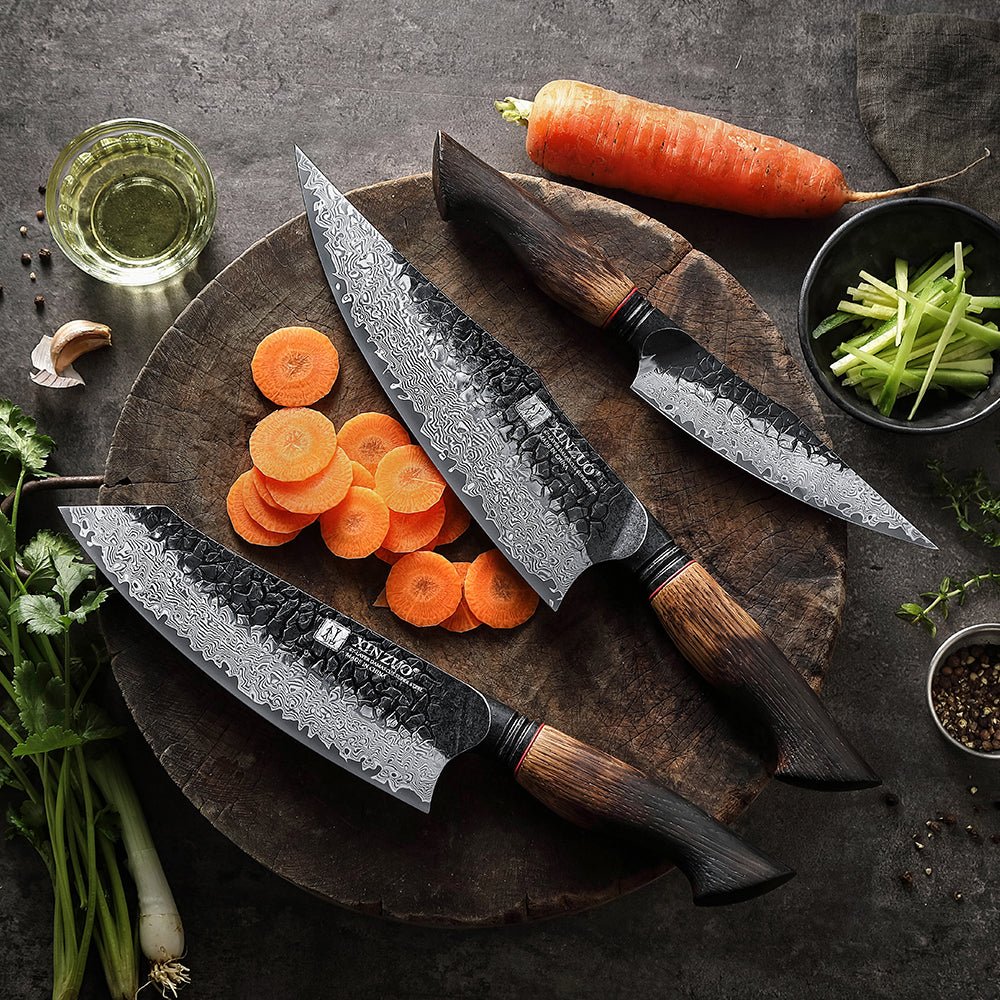
- Fake Damascus patterns laser-etched or acid-etched onto cheap single-layer steel. The pattern is purely cosmetic. It wears off with sharpening because it's not structural. Real Damascus steel requires forge-welding dozens of alternating steel layers together, which is expensive and time-consuming.
- Mystery steel marketed as premium alloy. "Japanese steel" or "German stainless steel" without specifying the actual grade. This is intentional. If the listing said "3Cr13 steel" (a commodity alloy worth a few dollars per kilogram), nobody would pay $45 for it.
- Inadequate heat treatment. Even decent steel performs badly without proper heat treatment. Cheap manufacturers use basic atmospheric furnaces that extract maybe 70% of a steel's potential. A knife might technically contain a good alloy, but if the heat treatment was rushed, it won't hold an edge.
- Fabricated reviews. Review farms generate hundreds of five-star ratings within weeks of a product launch. The listings look legitimate until you notice that most reviewers have only ever reviewed products from the same handful of sellers.
This is real, it's widespread, and it has earned every ounce of consumer skepticism toward Chinese-made knives. Anyone telling you otherwise is either naive or selling something questionable.
What Do Most People Not Know About Yangjiang?
Yangjiang sits in Guangdong Province in southern China, and it has been producing blades continuously for over 1,400 years. That predates both Solingen, Germany's famous blade city, and Seki, Japan's knife-making hub, as metalworking centres.
The numbers are staggering. Yangjiang produces approximately 70% of the world's kitchen knives by volume. The city is home to thousands of knife factories. Some are enormous industrial operations producing millions of units per year. Others are smaller workshops with a handful of skilled craftspeople focusing on premium products.
The quality range within Yangjiang mirrors the quality range you'd find in any major manufacturing region. Seki, Japan produces both exquisite hand-forged blades and mass-market knives sold at convenience stores. Solingen stamps its name on everything from Zwilling's flagship products to budget lines. Yangjiang is no different.
This isn't a conspiracy. It's standard practice in global manufacturing. But it does reveal something important about the relationship between country of origin and actual quality.
What Are the Four Quality Tiers of Chinese Kitchen Knives?
Not all Chinese knives are equal, and the differences are substantial. After years of working in this industry, this is how we'd break down the market:
The jump from bottom to mid tier is enormous. The jump from high to premium is more subtle, mostly affecting long-term edge retention and the refinement of the grind. But the key takeaway is this: a high-tier Chinese knife at $120 and a mid-range Japanese-style knife at $180 might use functionally identical steel, processed on similar equipment, to similar hardness specifications.
How Can You Tell a Good Chinese Knife from a Bad One?
This is the practical part. Whether you're evaluating Xinzuo, another Chinese brand, or any knife from any country, these six checks apply universally.
1. Named Steel with a Specific Composition
A quality manufacturer tells you the exact alloy in the blade. Not "high-carbon steel." Not "Japanese steel." The actual designation: 10Cr15CoMoV, VG-10, AUS-10, ZDP-189, 14Cr14MoVNb. If a listing uses vague terminology instead of a specific steel name, that's the single biggest red flag.
2. Stated HRC Hardness
Rockwell hardness (HRC) tells you how hard the blade has been heat-treated. Different steels achieve different hardness ranges, so a legitimate manufacturer will list different HRC values for different product lines. If every knife in a range claims "60 HRC" regardless of the steel type, someone is making numbers up. Our knife steel hardness guide explains what these numbers mean in practical terms.
3. The Damascus Verification Test
Real Damascus steel has its pattern running through the entire cross-section of the blade, because the pattern is the steel. If you sand a small area and re-etch it with ferric chloride, the pattern comes back. On a fake, sanding removes the pattern permanently because it was only on the surface. We cover this in detail in our real vs fake Damascus guide.
4. Verifiable Manufacturer
Can you find the actual factory? Do they have a website with their manufacturing process? Do they hold certifications (ISO 9001, BSCI, LFGB, FDA)? A real manufacturer has a physical presence and a verifiable history. White-label mystery brands with nothing but an Amazon storefront and a logo are a risk.
5. Vacuum Heat Treatment
This is harder to verify from a product listing, but reputable manufacturers mention it because it's expensive and they want credit for the investment. Vacuum heat treatment, often followed by cryogenic tempering (deep-freezing the blade to -196°C), extracts the full potential of premium steel. Basic atmospheric furnaces are cheaper but produce inferior results. If you want to see what this process looks like in practice, our factory guide walks through it step by step.
6. Transparent, Appropriate Pricing
A knife made with genuine VG-10 equivalent steel, real multi-layer Damascus cladding, vacuum heat treatment, and quality handle materials has a floor cost that cannot be circumvented. When you see a knife that claims all of those features for $35, the math doesn't add up. Either the steel isn't what they say, the Damascus isn't real, or the heat treatment was skipped. Quality has a cost. The question is whether you're paying for quality or for a brand name on top of that quality.
Is 10Cr15CoMoV Really a Match for VG-10?
This is a steel designation that most home cooks have never encountered, and it deserves its own discussion because it illustrates why country of origin is a poor proxy for quality.
10Cr15CoMoV is a Chinese-developed stainless steel with a composition nearly identical to Japan's famous VG-10. Both contain approximately 1% carbon, 15% chromium, plus cobalt, molybdenum, and vanadium. The Chinese designation was developed as a domestic alternative when Japanese VG-10 faced export restrictions, and the resulting alloy performs so similarly that the two are essentially interchangeable at equivalent hardness levels.
When both steels receive proper vacuum heat treatment and cryogenic processing, they perform identically in blind cutting tests. Edge retention, corrosion resistance, ease of sharpening: all effectively the same. The difference is the name on the data sheet and the price on the invoice.
We use 10Cr15CoMoV as the core steel in several of our series, and we're transparent about that. We don't call it "Japanese VG-10" because it isn't. It's a Chinese steel that performs like VG-10. Our detailed VG-10 vs 10Cr15CoMoV comparison walks through the metallurgy and testing data for anyone who wants the full technical picture.
Why Do Some Chinese Knives Cost So Much More Than Others?
This is where the conversation gets uncomfortable for parts of the knife industry.
"Made in Japan" commands a 30-50% price premium over an equivalent Chinese-made blade using comparable steel, comparable heat treatment, and comparable construction. That premium exists because of perception, not because of a measurable performance difference at the same quality tier.
Think about it this way: if Factory A in Seki, Japan and Factory B in Yangjiang, China both purchase 10Cr15CoMoV steel from the same supplier, both use vacuum heat treatment furnaces from the same German equipment manufacturer, both employ skilled grinders to create the same blade geometry, and both clad the core in 67 layers of forge-welded Damascus steel, what exactly justifies a $100 price difference between the finished knives?
The honest answer: brand recognition, consumer bias, and the assumption that Japanese manufacturing is inherently superior. Those aren't nothing. Brand trust has real value, and Japanese knife-making has a well-earned reputation built over centuries. But a buyer should understand what they're paying for. If you're paying extra for Japanese heritage and that heritage matters to you, that's a perfectly valid choice. If you think you're paying extra for better steel or better construction, you should verify that assumption rather than taking it on faith.
This is exactly where Xinzuo's value proposition sits. We use premium steels (including actual Japanese steels like ZDP-189 and Aogami Blue #2 in our higher-end series). We use the same vacuum heat treatment and cryogenic processing. We forge real multi-layer Damascus. And because we manufacture in Yangjiang and sell direct, we can offer that at a lower price point. Not because we cut corners. Because we don't carry the overhead of a century-old brand name or a chain of distributors and retailers each adding their margin.
What Should You Look for When Buying Any Kitchen Knife?
Whether you end up buying from us or from someone else entirely, these principles will serve you well. Quality knife shopping comes down to asking the right questions and recognising the red flags.
Green flags (signs of quality):
- Specific steel alloy named (10Cr15CoMoV, VG-10, AUS-10, ZDP-189)
- HRC hardness stated, varying appropriately across different product lines
- Manufacturer has verifiable factory, certifications (ISO 9001, BSCI, LFGB), and a physical presence
- Damascus layer count matches price point (67+ layers at $100+ is plausible; 67 layers at $30 is not)
- Mentions vacuum heat treatment or cryogenic processing
- Warranty and local customer support
- "High-carbon steel" or "Japanese steel" without specifying the grade
- Identical HRC claimed across all products regardless of steel type
- Damascus pattern at a price point below $80 for a chef knife
- No manufacturer information, just a brand name and an Amazon storefront
- Hundreds of five-star reviews from accounts that only review products from the same seller
- Product photos that look identical across multiple different brand listings
The single most reliable indicator, across any country of origin, is transparency. A manufacturer confident in their product will tell you exactly what's in it. One that isn't will hide behind vague marketing language and hope you don't ask questions.
Why Did We Write This Article?
We're a Chinese knife manufacturer writing about the problems with Chinese knives. That might seem counterintuitive, but we think it's necessary.
The knockoff manufacturers flooding Amazon with fake Damascus and mystery steel aren't just ripping off consumers. They're poisoning the well for every legitimate Chinese manufacturer trying to compete on quality. Every time someone buys a $30 "Damascus" knife, gets burned, and swears off Chinese knives forever, that's a potential customer we've lost to a bad actor we have no connection to.
We'd rather give you the tools to evaluate any knife, from any country, on its actual merits. If that evaluation leads you to a Japanese-style knife that fits your budget and your needs, genuinely, good for you. A great knife is a great knife regardless of where it was forged.
But if you've been avoiding Chinese-made knives purely because of where they're from, it might be worth reconsidering what you're actually paying for when you choose a blade. The gap between "Chinese" and "Japanese" at the same quality tier is narrower than most people think, and the gap between good Chinese and bad Chinese is far wider than most people realise.
The quality is in the steel, the heat treatment, the construction, and the honesty of the manufacturer. Everything else is marketing.
Related Reading
- Real Damascus Steel vs Fake: How to Tell the Difference
- VG-10 vs 10Cr15CoMoV: The Complete Steel Comparison
- Kitchen Knife Steel Hardness Guide: What HRC Actually Means
- How Xinzuo Knives Are Made: Inside Our Yangjiang Factory
- Xinzuo Series Comparison Guide
Frequently Asked Questions
Why are Chinese knives so much cheaper than Japanese-style knives?
Lower labour costs, massive production scale in Yangjiang (over 1,000 factories), and direct-to-consumer sales without distributor markups. A Chinese factory using the same vacuum furnace and VG-10 equivalent steel as a Seki workshop has far lower overheads. The price difference reflects manufacturing economics, not a gap in materials or capability.
Do any well-known knife brands secretly manufacture in China?
Yes. Brands including Henckels, Victorinox, Kershaw, Spyderco, and Cuisinart produce lines in Yangjiang factories. Only about 5% of Yangjiang manufacturers sell under their own name. The remaining 95% do OEM or ODM work for other brands, many of which market themselves as Japanese or German designed.
Is 10Cr15CoMoV steel as good as Japanese VG-10?
In blind cutting tests with proper heat treatment, they perform the same. Both contain roughly 1% carbon, 15% chromium, plus cobalt, molybdenum, and vanadium, reaching 60 to 62 HRC. 10Cr15CoMoV was developed as a domestic Chinese equivalent when VG-10 faced export restrictions. The composition overlap is near-identical and edge retention is comparable.
How can I tell if a cheap Damascus knife is fake before buying?
Check the price first. A genuine 67-layer Damascus chef knife cannot be produced for under $80 retail due to material and labour costs alone. Next, look for a named core steel (like 10Cr15CoMoV or AUS-10) and a stated HRC value. If the listing says only "high-carbon steel" with no grade, the Damascus pattern is almost certainly laser-etched onto single-layer commodity steel.
Are Chinese-made kitchen knives safe to use for food preparation?
Knives from certified manufacturers are safe. Look for LFGB (European food contact), FDA (US food contact), or ISO 9001 certification. These confirm the steel and handle materials meet food-safety standards. Uncertified knives from unknown sellers may use handle adhesives or blade coatings that have not been tested for food contact.