


Why Is the Bunka Japan's Most Underrated Kitchen Knife?
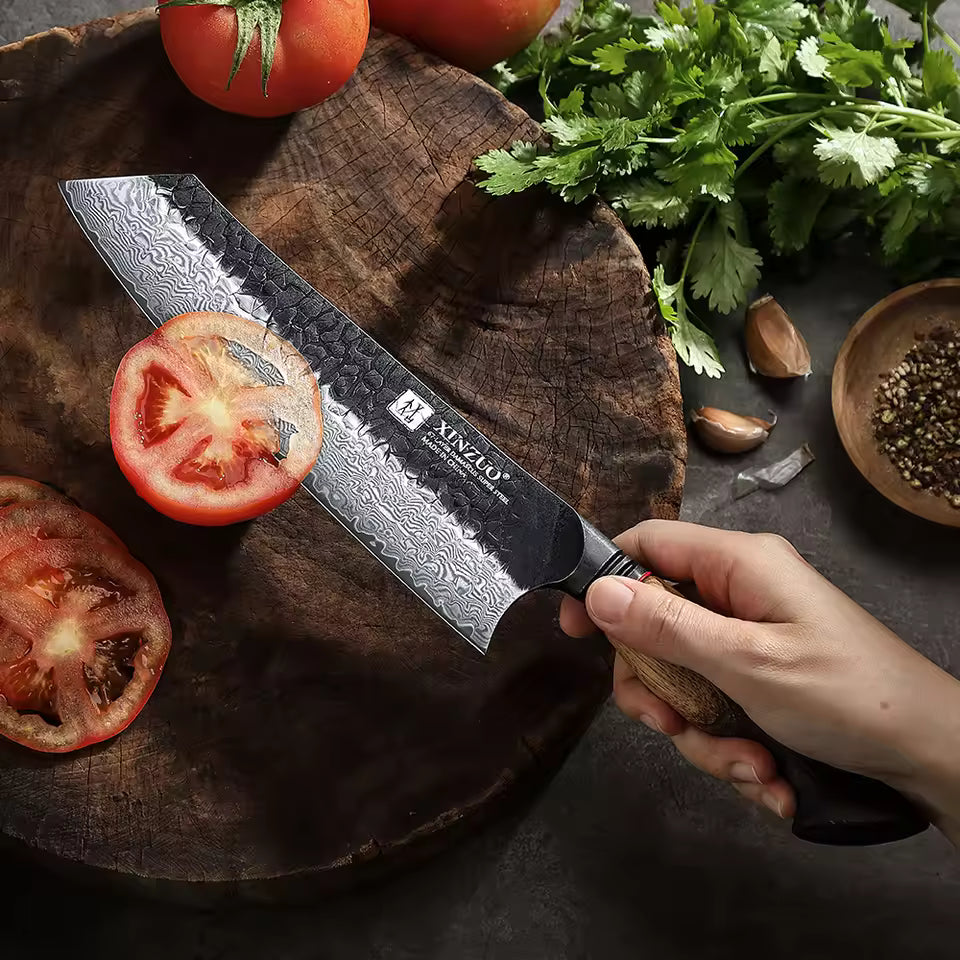
If you've spent any time looking at Japanese-style knives, you've probably noticed one that looks like a santoku that got into a fight and came out with a sharper attitude. That angular, almost aggressive tip. The flat belly. The slightly taller blade. That's a bunka, and it might be the most interesting all-purpose knife most Western cooks have never heard of.
The name itself is a clue. "Bunka" translates to "culture knife" in Japanese, and it earned that name because it represented the cultural shift in Japanese home cooking during the early-to-mid 20th century. As Western ingredients and techniques mixed with traditional Japanese cuisine, home cooks needed a knife that could handle both worlds. The bunka was the answer: a knife built for vegetables (like a nakiri) but with a pointed tip that could handle proteins and detail work too.
What Makes a Bunka a Bunka?
Three things define a bunka knife and separate it from everything else in the knife block:
The k-tip. This is the big one. Where a santoku has a gently rounded "sheep's foot" tip, the bunka has what's called a k-tip, short for kiritsuke-style tip. It's an angular, reverse-tanto point where the spine drops down at an angle to meet the edge. Think of it as a chisel point on your knife. It gives you a precise, sharp tip that can do things a rounded santoku simply cannot.
The flat belly. Like a santoku or nakiri, the bunka has a relatively flat cutting edge. This makes it a natural push-cutter. Instead of rocking the blade (the way you'd use a Western chef's knife), you push through ingredients in a single downward motion. If you've ever watched a Japanese cook blast through a pile of green onions at alarming speed, they're using that flat profile to their advantage.
The blade height. Bunka blades typically run 165mm to 180mm long, putting them in the same size category as a santoku. But the blade is often slightly taller (measured from spine to edge), which gives you more knuckle clearance and a bigger surface for scooping up ingredients and transferring them to the pan.
Good to Know
The term "k-tip" comes from "kiritsuke," a traditional single-bevel Japanese-style knife reserved for head chefs. Modern bunka knives borrow that angular tip geometry but use a double bevel, making them far more approachable for home cooks and professionals alike.
How Does a Bunka Compare to a Santoku?
This is the comparison most people want. Both knives live in the same size range. Both are Japanese all-purpose knives. Both use a flatter profile than a Western chef's knife. So why pick one over the other?
| Feature | Bunka | Santoku |
|---|---|---|
| Tip shape | Angular k-tip (reverse tanto) | Rounded sheep's foot |
| Blade height | Slightly taller | Standard |
| Precision tip work | Excellent | Limited |
| Vegetable prep | Excellent (flat belly) | Excellent (flat belly) |
| Rock chopping | Not ideal | Not ideal |
| Best for | Cooks who want precision + versatility | Cooks who want pure simplicity |
The honest answer: if you never use the tip of your knife for anything, buy a santoku. It's a brilliant, proven design. But if you find yourself wishing your santoku could score the skin on a duck breast, make precise cuts around a mango seed, or pierce into a pepper to deseed it, the bunka does all of that while matching the santoku everywhere else.
Why Might a Bunka Be Better Than a Gyuto?
The gyuto (Japanese chef's knife) is longer, typically 210mm or more, with a pronounced curve along the belly. That curve is what lets you do a rocking chop, and the extra length gives you more blade to work with on large proteins or cabbages.
The bunka takes the opposite approach. At 165-180mm, it's more compact. The flatter profile means more of the edge contacts the cutting board at once, which is a genuine advantage for push-cutting and tap-chopping through vegetables. And in a smaller kitchen (or on a smaller cutting board), the shorter blade is just easier to manoeuvre.
I think of it this way: the gyuto is the knife you reach for when you're breaking down a whole chicken or slicing through a watermelon. The bunka is the knife that lives on your board when you're doing the actual cooking, the mise en place, the fine detail prep that takes up 80% of your time in the kitchen.
What Does the K-Tip on a Bunka Knife Actually Do?
A lot of people look at the k-tip and assume it's purely aesthetic. It's not. That angled point gives you real functional advantages that show up in everyday cooking:
Scoring. Whether you're scoring the fat cap on a pork belly, cross-hatching the skin on a salmon fillet, or making shallow cuts in bread dough, the k-tip lets you control exactly how deep you go. A rounded tip slides and skips. The k-tip bites in where you put it.
Piercing. Need to cut a slit in a chilli to deseed it? Open a bag of flour? Start a cut in the centre of a vegetable? The pointed tip initiates cuts with almost zero effort.
Detail work. Trimming the silver skin off a tenderloin, removing eyes from potatoes, cutting around the stem of a capsicum. These are all tip-forward tasks, and the sharper, more defined point of the bunka gives you noticeably more control than a rounded santoku tip.
The "scoop and slide." The wider blade and angular tip work together as a built-in bench scraper. Chop your aromatics, tilt the blade flat, and slide everything into the pan. It's a small thing, but you'll notice it ten times a session.
Tip
Because the k-tip comes to a finer point than a santoku, treat it with a bit more care. Avoid twisting or prying with the tip, and don't use it to scrape the cutting board edge-down. The point is strong for its intended purpose, but it's thinner steel than the rest of the blade.
What Tasks Are Bunka Knives Best At?
Every knife has a sweet spot, the tasks where it outperforms everything else in the drawer. For a bunka, that list is surprisingly long:
Vegetable prep. The flat belly is purpose-built for this. Onions, carrots, garlic, herbs. Push-cut through a stack of basil leaves and you'll get clean cuts instead of the bruised mess you get from a rocking motion. The tall blade gives you a guide for your knuckles and a surface for transporting ingredients.
Boneless proteins. Chicken thighs, fish fillets, slicing steak for stir-fry. The k-tip lets you start cuts precisely, and the flat edge gives you clean, even slices. You won't break down a whole chicken with a bunka (that's what your gyuto or a pair of shears is for), but for portioning and trimming, it's excellent.
Precision garnish work. Julienning ginger, chiffonading herbs, making fine brunoise cuts. The combination of the flat profile (full board contact), the sharp tip (precision starts), and the tall blade (knuckle clearance) makes this kind of work faster and more controlled.
General daily cooking. In Japanese home kitchens, the bunka is often the only knife on the counter. It handles 90% of what most people cook on a weeknight: vegetables, boneless meats, tofu, noodle ingredients, salad prep. It earned the name "culture knife" because it fit the culture of everyday cooking.

Who Should Buy a Bunka and Who Should Get a Santoku Instead?
Get a bunka if you:
- Already own a gyuto or chef's knife and want a shorter, more precise companion for daily prep
- Cook a lot of vegetables and want that flat-profile push-cutting efficiency
- Do detail work regularly: scoring, trimming, fine cuts
- Prefer the Japanese push-cut technique over Western rock-chopping
- Want something that looks and feels different from every other knife in the drawer
Get a santoku if you:
- Want the simplest possible all-purpose knife with zero learning curve
- Rarely use the tip of your knife for precision tasks
- Are buying your first Japanese-style knife and want the most forgiving option
- Prefer a rounder, softer aesthetic
Neither choice is wrong. They're both outstanding all-purpose designs. The bunka just gives you that extra dimension of tip work that the santoku trades away for simplicity.
What Should You Look for in Bunka Steel and Construction?
Because the bunka's k-tip is a defining feature, the quality of the steel matters even more than usual. A soft steel tip will roll or deform quickly. You want a blade with enough hardness to hold that fine point, but enough toughness that it won't chip if you catch a stray bone fragment or a hard squash skin.
For bunka knives, the sweet spot is typically 58-62 HRC on the Rockwell hardness scale. At this range, the steel takes a very keen edge, holds it through extended prep sessions, and can be resharpened at home on a whetstone without too much effort.
Damascus cladding (the layered, patterned steel you see on premium Japanese-style knives) serves a real purpose beyond aesthetics. The hard cutting core is sandwiched between softer, more corrosion-resistant outer layers. This gives you the best of both worlds: a hard, sharp edge that's protected by a tougher body. On a bunka, this matters at the tip especially, where the steel tapers to its thinnest point.
Other things to look for: a comfortable handle with good balance (the knife should feel neutral or slightly blade-forward in your hand), a thin blade geometry behind the edge for clean cuts, and a grind that lets food release easily rather than sticking to the flat of the blade.
Which Xinzuo Bunka Knives Are Available?
Xinzuo offers bunka knives across different series, each built with high-carbon Damascus steel and designed for serious daily use:
| Model | Steel | Layers | Handle |
|---|---|---|---|
| Mo Series Bunka | 10Cr15CoMoV (HRC 60±2) | 67-layer Damascus | Ebony wood |
| Zhen Series 8.3" Bunka | 10Cr15CoMoV (HRC 60±2) | 67-layer Damascus | Rosewood |
Both use a 10Cr15CoMoV high-carbon stainless steel core, which hits that 60 HRC sweet spot: hard enough to hold the k-tip edge through heavy prep, stainless enough to resist corrosion with basic care. The 67-layer Damascus cladding isn't just for looks (though it does look stunning). Those layers create micro-serrations in the steel surface that help food release during cutting.
The Mo Series pairs the blade with an ebony wood handle and a hammered (tsuchime) finish that adds extra food release. The Zhen Series opts for a rosewood handle and a slightly longer 8.3" blade, bridging the gap between a bunka and a larger chef's knife. Both are full-tang for balance and durability.
Explore the Full Bunka Collection
Hand-forged Damascus steel, built for precision and daily performance.
SHOP BUNKA KNIVESHow Should You Care for and Maintain a Bunka Knife?
A bunka doesn't need special treatment beyond what any quality Japanese-style knife requires:
- Hand wash and dry immediately. Never put it in the dishwasher. The combination of heat, harsh detergent, and banging against other items will damage the edge and the handle.
- Use a wooden or plastic cutting board. Glass, marble, ceramic, and steel boards will destroy any knife edge, but they're especially punishing on harder Japanese steels.
- Sharpen on a whetstone. A 1000/3000 grit combination stone will keep the edge in excellent condition. Honing rods work for Western knives, but they can chip harder Japanese steel. Stick to stones.
- Store it properly. A magnetic knife strip, a knife guard, or a slotted knife block. Never toss it loose in a drawer with other utensils.
- Protect the tip. Because the k-tip is the bunka's signature feature, pay extra attention to how you store and handle it. A magnetic sheath or blade guard is a worthwhile investment.
What Is the Final Word on Bunka Knives?
The bunka occupies a unique spot in the knife world. It has the flat, vegetable-friendly profile of a santoku with a tip that can actually do precision work. It's shorter and more agile than a gyuto but covers nearly as much territory for everyday cooking. In Japanese home kitchens, this knife was the default choice for decades before the santoku overtook it in popularity, and there's a strong argument that the bunka is the more capable design.
If your cooking involves a lot of vegetable prep, if you appreciate the precision of a pointed tip, and if you want a single knife that can genuinely handle 90% of what you do in the kitchen, the bunka belongs on your shortlist. It's not trying to replace your chef's knife. It's the knife you'll reach for when you don't need the chef's knife, which, if you're honest about your cooking, is most of the time.
Related Reading
- → Santoku vs Chef Knife: Which One Should You Buy?
- → Japanese-style Knife Types Explained
- → Nakiri Knife Guide: The Vegetable Specialist
- → Kiritsuke Knife Guide: The Japanese Multi-Purpose Blade
- → How to Choose a Chef Knife: The Complete Buying Guide
- → Knife Steel Hardness Guide
- → Xinzuo Series Comparison Guide
- → Knife Techniques: Rock Chop, Push Cut, and Pull Slice
Frequently Asked Questions
What is the difference between a bunka and a kiritsuke?
Both share the angular k-tip, but they differ in almost every other dimension. A bunka is a compact home-cook knife, typically 165 to 180mm with a wide, flat blade and a double bevel. A traditional kiritsuke is a single-bevel professional knife running 240 to 300mm, designed for long slicing strokes rather than chopping. Modern double-bevel kiritsuke-style gyutos borrow the k-tip but keep the longer, slimmer profile, so they still handle quite differently from a bunka.
Can you rock chop with a bunka knife?
Not well. The bunka's flat edge profile is built for push-cutting and tap-chopping, where the blade moves straight down through the ingredient. Because there is very little curve along the belly, a rocking motion tends to pivot on a single point rather than rolling smoothly across the board. If rock-chopping is your main technique, a gyuto or Western chef knife with a curved belly will feel much more natural.
Is a bunka knife good for beginners?
It can be, with one caveat. The flat edge actually makes it easier to learn push-cutting technique and simpler to sharpen on a whetstone, since you can hold a consistent angle across the whole blade. The k-tip does require a bit more care than a rounded santoku tip, though, because the finer point is more prone to chipping if you twist or pry with it. If you are buying your very first Japanese-style knife and want the most forgiving option, a santoku has a gentler learning curve. If you already feel comfortable with basic knife handling, a bunka is a strong choice.
What size bunka knife should I get?
Most bunka knives fall between 165mm and 180mm (roughly 6.5 to 7 inches), and a 170mm blade is the most common starting point. That length covers everyday vegetable prep, boneless proteins, and herbs without feeling cramped. Longer options around 200 to 210mm exist and bridge the gap toward a small gyuto, but they sacrifice some of the compact agility that makes the bunka appealing in the first place.
What is the difference between a k-tip santoku and a bunka?
A k-tip santoku grafts the angular kiritsuke-style tip onto a standard santoku blade shape, which is typically a little thinner and narrower than a bunka. A true bunka has a taller blade with more knuckle clearance, a flatter edge profile, and was originally designed around that k-tip from the start rather than having it added as a variation. In practice, a k-tip santoku behaves more like a regular santoku with a pointier nose, while a bunka feels noticeably wider and more stable against the board.