

What Is a Nakiri Knife and Should You Get One?
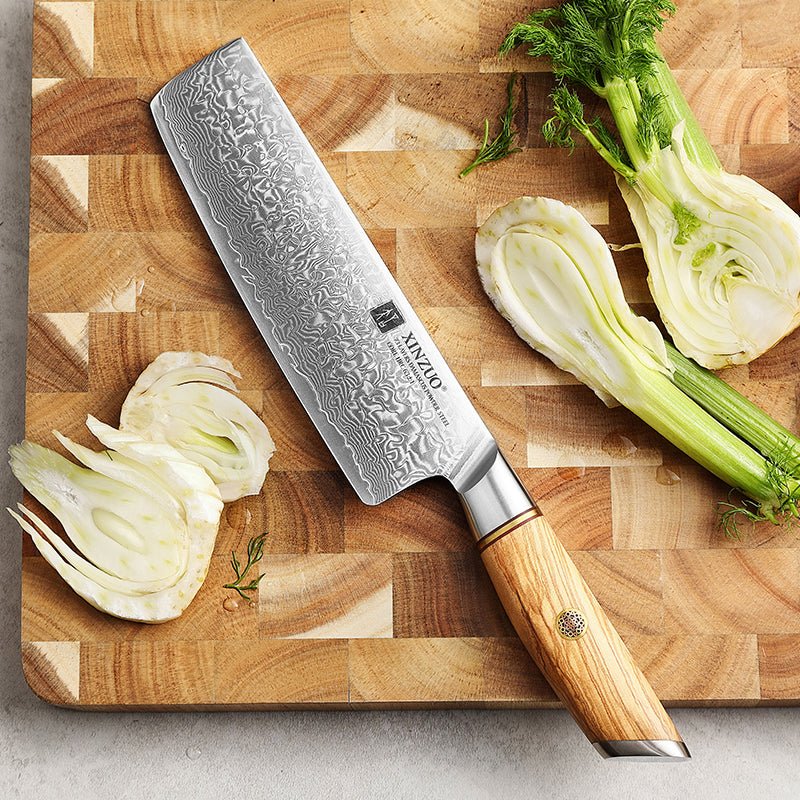
A nakiri is a Japanese vegetable knife with a completely flat cutting edge, a tall rectangular blade, and no pointed tip. The name translates to "leaf cutter," and it does exactly that, with extraordinary precision.
If you cook vegetables regularly and already own a chef knife or gyuto, a nakiri will genuinely transform your prep speed and cut quality. If you're buying your first kitchen knife, get a santoku or gyuto instead. The nakiri is a specialist, not a generalist.
I want to explain why that advice matters, because the nakiri occupies a unique position in the knife world. It's not trying to do everything. It's trying to do one category of work, vegetable prep, better than any other blade shape can. And it succeeds.
What Makes a Nakiri Different from Other Knives?
Pick up a nakiri and three things are immediately obvious. The edge is completely flat from heel to tip. The blade is tall, usually 45-55mm from spine to edge. And there's no pointed tip at all, just a squared-off or gently rounded end.
Each of these features exists for a specific functional reason.
The flat edge means the entire cutting edge contacts the board simultaneously in a single downward stroke. No rocking required. No need to drag the blade forward or back. You push straight down, every millimetre of edge meets the board at the same time, and the cut is done. This produces cuts of uniform thickness across the full width of whatever you're slicing.
The tall blade gives you two advantages. First, generous knuckle clearance. Your fingers stay well above the board even when gripping the ingredient. Second, that wide face works beautifully as a bench scraper, scooping diced onion or minced garlic directly off the board and into the pan.
The absent tip is the honest trade-off. You can't pierce, score, or do fine detail work. But removing the tip allowed Japanese blacksmiths to make the blade thinner and lighter overall, because there's no fragile point that needs structural reinforcement.
Nakiri vs Usuba: A Common Confusion
The usuba looks similar at first glance, another tall rectangular vegetable blade, but the construction is fundamentally different. Usuba knives use a single bevel grind (sharpened on one side only, like a chisel). Nakiri knives use a double bevel grind (sharpened symmetrically on both sides).
This distinction matters more than it might seem.
The usuba is a professional tool designed for katsuramuki, the technique of rotary-peeling a daikon radish into a paper-thin continuous sheet. It requires years of practice and precise sharpening at asymmetric angles. Unless you're training in a traditional Japanese kitchen, the nakiri is what you want.
Both knife types emerged during the Edo period (1603-1868), when plant-based cooking became central to Japanese household cuisine. The nakiri was always the home cook's version: approachable, forgiving, and effective.
What Does a Nakiri Do Best?
The nakiri excels at a specific category of work, and within that category, nothing else comes close.
Precision Vegetable Cuts
Julienne, brunoise, chiffonade, paper-thin slices. The flat edge and thin blade geometry make these cuts almost mechanical. You're not fighting the blade's curve or compensating for a rocking motion. You place the edge where you want the cut, push down, and the cut happens exactly where you placed it.
Cucumbers, radishes, and shallots sliced translucent-thin. Herbs cut into ribbons that stay bright green for hours rather than turning dark. Carrots julienned into matchsticks of genuinely uniform width.
The Food Science of Clean Cuts
This is where things get interesting, and where the nakiri's advantage becomes measurable rather than just subjective.
When you cut through a vegetable cell, two things can happen. A sharp, clean downward cut slices through with minimal cell wall disruption. A rocking or tearing cut crushes adjacent cells, rupturing their membranes and releasing enzymes.
Those released enzymes, particularly polyphenol oxidase, trigger enzymatic browning. It's the reason sliced apples turn brown, cut avocado darkens, and shredded lettuce gets those rust-coloured edges. A cleaner cut means fewer ruptured cells, which means less browning and longer-lasting freshness.
This isn't abstract kitchen trivia. If you've ever wondered why your basil chiffonade turns black within minutes, or why your pre-sliced onions seem more pungent than they should be, the answer is cellular damage from your cutting technique. The nakiri's flat edge, used with a straight push-cut, minimises that damage by design.
Stir-Fry and Salad Prep
For Australian home cooks who regularly prep Asian-style stir-fries or large salads with market-fresh produce, the nakiri is particularly valuable. Breaking down bok choy, slicing spring onions, shredding cabbage, dicing capsicum: these are all tasks where the nakiri's flat edge and rapid tap-chopping motion genuinely save time.
The wide blade doubles as a scoop. Cut your vegetables, then slide the blade flat under the pile and transfer everything straight to the wok. It's a small workflow detail that adds up across a week of cooking.
Meal Prep Efficiency
If you batch-prep vegetables on a Sunday (roasting trays of sweet potato, prepping containers of salad ingredients, dicing onions for the week), the nakiri earns its place faster than almost any other knife purchase. The up-and-down tap motion is less fatiguing than rocking cuts over extended prep sessions, because you're using your arm weight rather than wrist rotation.
What Can't a Nakiri Do?
No knife guide is worth reading if it doesn't tell you where the tool fails. The nakiri has real limitations, and ignoring them leads to frustration or, worse, a damaged blade.
No tip work. The squared-off end means you cannot pierce, score fish skin, devein prawns, core tomatoes from the stem end, or do any task that requires poking into an ingredient. For all of that, you need a pointed blade.
No rocking motion. If your muscle memory relies on rocking a curved blade back and forth to mince garlic or herbs, the nakiri will feel wrong. Its flat edge doesn't rock. You need to retrain toward a tap-chop or push-cut motion. (This takes about a week to become natural, for what it's worth.)
No bone, no frozen food, no hard squash. Nakiri blades are thin and hard. They're optimised for clean cuts through yielding ingredients. Hitting bone, frozen chicken, or an uncooked butternut pumpkin risks chipping the edge. A thicker Chinese cleaver or Western chef knife handles those tasks safely.
No meat work. The nakiri won't carve a roast, break down a chicken, or portion a brisket. It's not designed for any protein work beyond slicing soft items like tofu.
The honest recommendation: The nakiri is a specialist partner to your main knife, not a replacement for it. If you own a gyuto or chef knife and want to level up your vegetable prep, add a nakiri. If you only own one knife, that one knife should be a santoku or gyuto, not a nakiri.
How Does a Nakiri Compare to a Santoku and Chef Knife?
This is the comparison most people actually need to make before buying. All three can cut vegetables. The difference is how well each handles the full range of kitchen tasks.
The pattern is clear. The santoku and chef knife are generalists that handle the full range of kitchen work. The nakiri is a specialist that outperforms both on vegetable tasks but can't fill their broader role.
Buy a nakiri if: You already own a gyuto, chef knife, or santoku, and you want faster, more precise vegetable prep. You cook a lot of plant-heavy meals, stir-fries, salads, or roasted vegetable dishes. You do weekly meal prep.
Buy a santoku instead if: This is your first quality knife. You need one blade that handles vegetables, fish, and boneless meat. You want versatility over specialisation. Browse our santoku collection for options.
How Do You Choose the Right Nakiri?
Size: 165mm vs 180mm
Nakiri blades generally come in two lengths. The choice is simpler than you might expect.
165mm (6.5") suits smaller cutting boards, compact kitchens, and cooks with smaller hands. It's nimble and easy to control, with plenty of blade for most vegetables.
180mm (7") is the more common size and the one most cooks prefer. The extra 15mm provides noticeably better knuckle clearance and covers wider ingredients (a whole capsicum, a large onion) in fewer strokes.
Steel
Nakiri knives use the same steel types as other Japanese-style knives. The most common options:
VG-10 / 10Cr15CoMoV: High-carbon stainless steel. Excellent edge retention, stain resistant, and easy to resharpen at home. This is the practical choice for most home cooks and the steel used in XINZUO's forged blades.
Powder steel (SG2/R2): Even harder, holds an edge longer, but more brittle and typically more expensive. Best if you're comfortable with careful handling and whetstone maintenance.
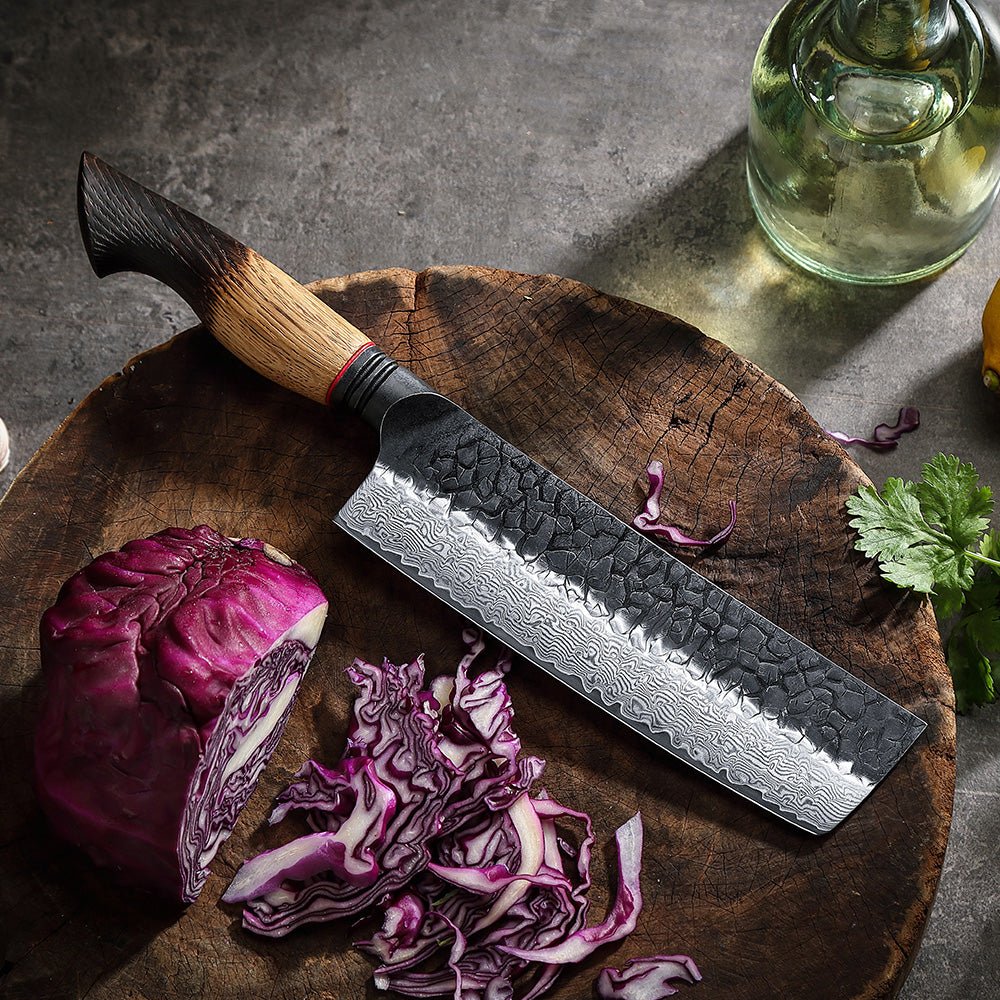
Damascus cladding: The distinctive wavy pattern you see on premium Japanese-style knives. Damascus layers protect the hard core steel, add corrosion resistance, and reduce food sticking. It's functional and beautiful, though the core steel matters more for cutting performance than the cladding does.
Handle
Japanese-style (wa) handles are lighter and typically octagonal or D-shaped, which naturally indexes your grip in the correct orientation. Western-style handles add a bit more heft and feel familiar if you're coming from European knives. Neither is objectively better. Go with whatever feels right in your hand.
Weight
Lighter matters for the nakiri more than for most knives. The rapid tap-chopping motion that defines nakiri technique depends on speed and repetition, not downward force. A lighter blade (under 180g for a 180mm nakiri) reduces fatigue during extended prep sessions and lets you maintain a faster rhythm.
Shop Nakiri Knives Browse All Japanese-style Knives
What Techniques Get the Most from Your Nakiri?
The nakiri rewards good technique more than most knives, because the flat edge amplifies both precision and mistakes. Three motions to learn, two mistakes to avoid.
The Push-Cut
Place the edge on the ingredient. Push the blade straight down and slightly forward in one smooth motion, so the edge contacts the board along its full length simultaneously. Lift, reposition, repeat. This is your primary cut for slicing and produces the cleanest results.
The Tap-Chop
For rapid rough chopping (dicing onions, breaking down leafy greens), use a straight up-and-down motion with your wrist and forearm. The blade lifts 2-3cm off the board between chops. Speed comes from rhythm, not from swinging hard. Keep the motion compact and controlled, and let the blade's weight and sharpness do the work.
The Scoop
After cutting, tilt the blade flat (edge away from you) and slide it under the pile of chopped ingredients. The tall, wide blade acts as a built-in bench scraper. Transfer directly to a bowl or pan. This is one of the nakiri's most practical daily advantages and the reason many cooks reach for it even when a chef knife could technically make the same cut.
Two Common Mistakes
Rocking the blade. If you rock a flat-edged knife, only a small portion of the edge contacts the board at any time. You end up with uneven cuts and accordion-sliced vegetables still connected at the bottom. Commit to the push-cut or tap-chop. The flat edge is designed for straight vertical motion.
Twisting through hard ingredients. If the blade feels stuck partway through a dense carrot or sweet potato, don't twist the handle to lever it through. The thin blade can chip or crack under lateral stress. Instead, lift and re-cut, or switch to a thicker blade for very dense produce.
Grip
Use a pinch grip. Place your thumb on one side of the blade just above the heel and your index finger on the other side. Wrap your remaining fingers around the handle. This grip positions the blade as an extension of your hand and gives you far more control than a handle-only grip. It feels strange for about three days, then you'll never go back.
How Do You Care for and Maintain a Nakiri?
Nakiri blades are thin and hard, which means they hold an edge well but demand a bit of respect in return.
Daily care: Hand wash with warm soapy water and dry immediately. Never put a nakiri in the dishwasher. The combination of high heat, harsh detergent, and rattling against other utensils will dull and potentially chip the edge. This applies to all Japanese-style knives, not just nakiris.
Cutting surface: Use wood or rubber cutting boards only. Glass, ceramic, marble, and bamboo boards are all harder than the blade's edge and will dull it rapidly. End-grain wood boards are ideal because they absorb the blade's impact rather than resisting it.
Honing: A ceramic honing rod realigns the edge between sharpenings. A few passes every second or third use keeps the blade performing at its best. Avoid grooved steel rods, which are too aggressive for hard Japanese steel.
Sharpening: When honing no longer restores performance (you'll notice the blade starts crushing rather than slicing through tomato skin), it's time for a whetstone. A 1000/3000 grit combination stone handles both repair and polishing. The double bevel grind makes the nakiri one of the easier Japanese-style knives to sharpen at home, since you simply match the same angle on both sides.
For a detailed walkthrough, see our complete whetstone sharpening guide and daily knife care guide.
Storage: A magnetic knife rack, a knife guard, or a dedicated slot in a knife block. Tossing a nakiri loose in a drawer with other utensils is the fastest way to damage the edge (and your fingers).
Where Does the Nakiri Fit in Your Kitchen?
The most practical way to think about a nakiri is as the second knife in a two-knife setup. Your gyuto or chef knife handles the broad range of tasks: proteins, large produce, anything requiring a tip. The nakiri handles the high-volume vegetable work where speed and precision matter most.
If you eat a predominantly plant-based diet, or if you regularly cook cuisines that demand serious vegetable prep (Japanese, Chinese, Thai, Korean, Vietnamese), the nakiri might end up being the knife you reach for most often. Not because it replaced your chef knife, but because the majority of your cutting work falls squarely in its area of expertise.
That's not a marketing claim. It's just geometry. A flat edge meeting a flat board, with a sharp blade and a clean downward cut, will always produce more uniform results on vegetables than a curved edge that contacts the board at a single point at a time. The nakiri was designed around that principle four centuries ago, and the physics haven't changed.
Shop Nakiri Knives Compare Santoku Knives
Related Reading
- Japanese-style Knife Types Explained
- Santoku vs Chef Knife
- Best Knife for Vegetables: Buying Guide
- How to Sharpen Knives with a Whetstone
- Knife Care: Daily Maintenance Guide
Frequently Asked Questions
Can you cut meat with a nakiri knife?
A nakiri can slice boneless proteins like raw chicken breast, fish fillets, and tofu, but it is not designed for meat work. The thin blade (typically 1.5 to 2mm at the spine) risks chipping on bone or cartilage, and the squared-off tip makes tasks like trimming sinew or scoring skin impossible. Use a gyuto or santoku for proteins.
Is a nakiri knife worth buying if I already own a chef knife?
Yes, if you cook vegetables regularly. The nakiri's fully flat edge contacts the entire cutting board in one downward stroke, producing cleaner, more uniform slices than a curved chef knife can. Cooks who batch-prep stir-fries, salads, or roasted vegetables typically find the nakiri becomes their most-used knife within a few weeks.
How do you sharpen a nakiri knife?
Use a whetstone, starting with 1000 grit to reset the edge and finishing on 3000 grit to polish it. The double bevel grind means you sharpen both sides at the same angle, usually 12 to 15 degrees per side for Japanese steel. Avoid pull-through sharpeners, which remove too much material and can't maintain a consistent bevel on hard steel rated above 58 HRC.
Is a nakiri knife good for beginners?
The nakiri is one of the easiest Japanese-style knives to learn because the straight up-and-down chopping motion requires no rocking technique. The blunt tip also makes it safer than pointed knives during fast prep work. That said, it should not be a beginner's only knife, since it cannot handle meat, tip work, or dense produce like whole pumpkin. Pair it with a santoku or gyuto for a complete setup.
Do I need a nakiri if I already have a santoku?
They serve different roles. The santoku is a versatile all-rounder that handles vegetables, fish, and boneless meat, while the nakiri is a vegetable specialist with a taller blade and fully flat edge that delivers noticeably faster, more precise cuts on produce. If more than half your prep time is spent on vegetables, herbs, and leafy greens, adding a nakiri will make a real difference.