


A sharp knife is a safe knife. You've heard that before, probably from someone who then handed you a blade that couldn't cut warm butter. The statement is true, but it's incomplete. A sharp knife is also a better knife. It gives you cleaner cuts, more control, less fatigue, and (according to recent research) even better-tasting food.
Whetstone sharpening is one of those skills that looks intimidating from the outside but is genuinely straightforward once you understand what's actually happening at the edge. You're not performing surgery. You're rubbing metal on a rock until it gets pointy again. The technique matters, but it's learnable in an afternoon.
What Is the Basic Whetstone Sharpening Process?
Short version: You need a 1000/3000 combination whetstone, 15 to 20 minutes, and some practice. Soak the stone, hold a consistent angle (15 degrees per side for Japanese-style knives, 20 degrees for Western), make smooth strokes across the full surface, feel for the burr, remove it, and test. That's the entire process. The technique is simple. Getting consistent takes a few sessions, and that's completely normal.
What Do You Need to Sharpen with a Whetstone?
- A whetstone. A 1000/3000 grit combination stone handles everything most home cooks will ever need. The 1000 side does the real sharpening. The 3000 side refines it.
- A stone holder or wet towel. The stone must not move while you're working. A silicone holder works well. A damp kitchen towel folded under the stone works just as well.
- A bowl of water. You'll splash the stone periodically to keep the surface wet.
- A towel. For drying the knife and cleaning up.
- Your knife.
- Optional: an angle guide. Clip-on guides that attach to the spine help beginners maintain a consistent angle. They're training wheels, not a crutch. Use them until muscle memory takes over.
- Optional: a leather strop. For finishing and burr removal. Not essential, but nice to have.
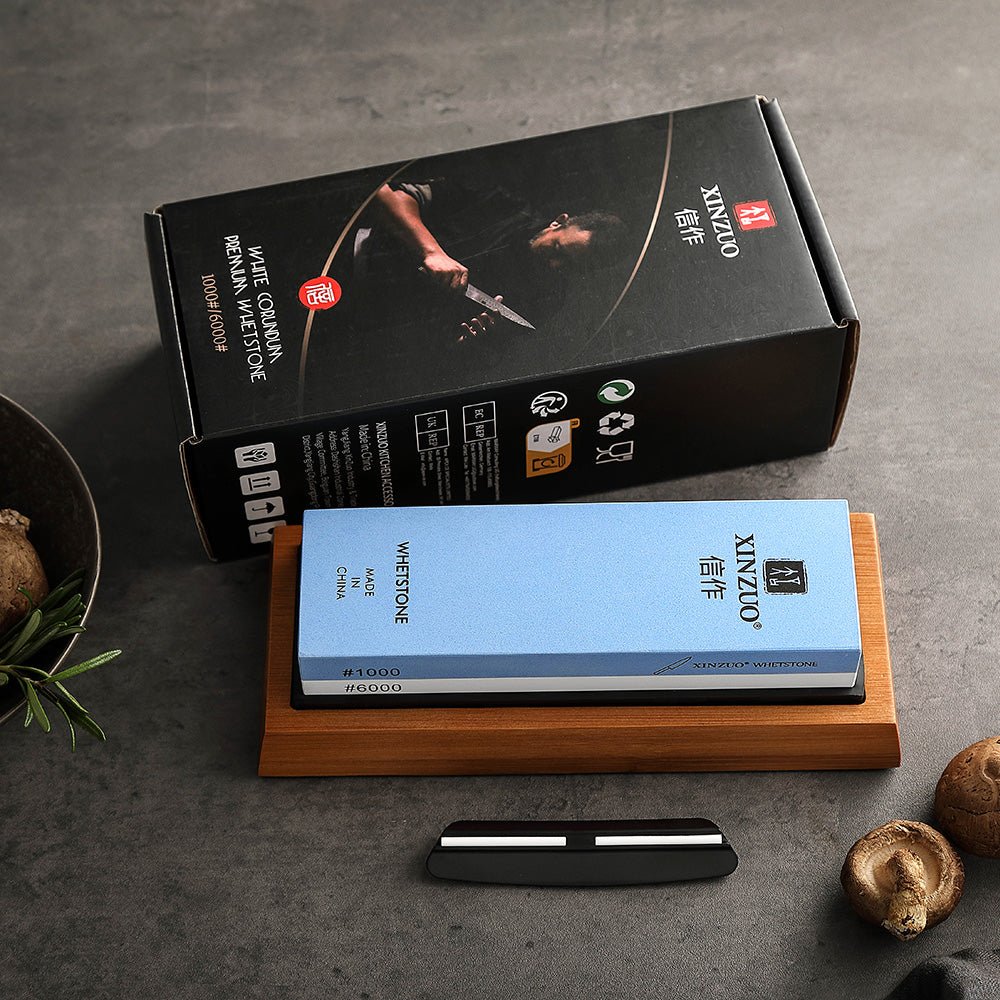
What Do Whetstone Grit Numbers Mean?
Grit numbers tell you how fine the abrasive particles are. Lower numbers mean coarser, more aggressive cutting. Higher numbers mean finer, more polished results. Think of it like sandpaper for your knife's edge.
Japanese water stones are softer than many synthetic alternatives. They dish (develop a concave surface) faster, but they also cut more efficiently because the surface constantly breaks down and exposes fresh abrasive particles. That breakdown creates a slurry on the stone's surface, and the slurry is actually doing a significant portion of the sharpening work. Don't rinse it all away.
How Do You Find the Right Sharpening Angle?
The correct sharpening angle depends on the type of knife you're working with.
15 degrees per side is standard for Japanese-style knives. Japanese-style blade steels are typically hardened to 58 HRC or higher, which means the steel is hard enough to support a thinner, more acute edge without deforming.
20 degrees per side is standard for German and Western-style knives. These use softer steel (54 to 58 HRC), so they need a wider angle for durability.
How do you actually find 15 degrees without a protractor? Two practical methods:
- The coin stack method. Place the spine of your knife on the stone, then raise it until the spine is roughly two stacked coins' height above the surface. For most chef knives, that gets you close to 15 degrees.
- The pinky spacer. Lay the blade flat on the stone, then raise the spine until you can just fit your pinky finger sideways between the spine and the stone. Approximately 15 degrees for a standard-width chef knife.
What actually matters: consistency beats precision. Data from Knife Steel Nerds' CATRA testing shows that reducing edge angle from 25 to 15 degrees per side results in roughly five times more cutting cycles before dulling on the same steel. That's a massive improvement. But those gains only materialize if the angle is consistent. A steady 17 degrees per side produces a better working edge than wobbling between 13 and 20.
Clip-on angle guides are genuinely useful for beginners. They remove the guesswork while you develop the feel for it. After three or four sessions, most people can ditch the guide and maintain angle by muscle memory.
What Is the Step-by-Step Sharpening Process?
Read through the entire process once before you start.
Step 1: Soak the Stone
Submerge your whetstone in water for 5 to 10 minutes. You'll know it's ready when air bubbles stop rising from the surface. The water fills the pores in the stone and prevents metal particles from clogging the abrasive surface.
Step 2: Set Up a Stable Surface
Place the stone on its holder, or lay it on a folded damp towel on your countertop. The stone should not slide or rock at all. Any movement while you're sharpening will wreck your angle consistency.
Step 3: Find Your Angle
Hold the knife with your dominant hand gripping the handle. Place the blade on the stone, edge facing away from you. Raise the spine until you reach your target angle (15 or 20 degrees). Lock your wrist. Your elbow and shoulder will drive the motion, not your wrist.
Step 4: Sharpen the First Side
Place the fingertips of your non-dominant hand on the flat of the blade, near the edge. These fingers provide gentle, even pressure and guide the blade across the stone.
Push the blade away from you in a smooth stroke, moving from the heel of the knife to the tip as you go. Imagine you're trying to slice a very thin layer off the top of the stone. Use the full length of the stone's surface. At the end of each stroke, lift the blade and return to the starting position.
Apply moderate pressure on the forward stroke. Light pressure on the return. Somewhere around 20 to 30 strokes is a reasonable starting point for a knife that's dull but not damaged.
Keep the stone wet. Splash water on it every 10 strokes or so. You'll notice a grey slurry forming on the surface. That's a mixture of water, stone particles, and steel. Leave it. The slurry helps the sharpening process.
Step 5: Feel for the Burr
After working one side, gently run your thumb across the edge from the spine toward the edge on the opposite side from where you were sharpening. You should feel a slight roughness, a tiny lip of metal running along the full length of the edge. That's the burr. It means you've sharpened all the way to the apex.
If you feel a burr along the entire edge, move to the next step. If there are sections without a burr, those spots need more work.
Step 6: Switch Sides
Flip the knife over and repeat the process on the other side. Same angle, same stroke count, same pressure. You're now sharpening the opposite bevel and pushing the burr back to the first side.
Step 7: Remove the Burr
This is the step most people skip. Don't. (More on this in the next section.)
Make alternating light strokes, one on each side, with very minimal pressure. Start with 5 strokes per side, then 3, then 1. Each pass should be lighter than the last. You're gradually thinning the burr until it breaks away cleanly.
Step 8: Move to Finer Grit (Optional)
If you have a combination stone, flip to the finer side (3000 or 6000) and repeat the process with lighter pressure and fewer strokes. This refines the edge and smooths out the scratch pattern left by the coarser grit.
An interesting note: extremely polished edges (6000+ grit) can actually feel less aggressive on certain foods compared to a slightly toothy 1000-grit finish. A tomato's skin, for example, benefits from those micro-serrations left by a 1000-grit stone. Whether you refine further depends on what you're cutting most often.
Step 9: Test for Sharpness
Wipe the blade clean and dry it thoroughly. Then test using the methods below.
What Is a Burr and Why Does Your Edge Fail After One Use?
If you've ever sharpened a knife, thought it felt razor-sharp, then found it dull again after cutting a single onion, the burr is almost certainly the reason.
When you sharpen one side of a blade, you're grinding steel away to form a new edge. But the very last bit of metal at the apex doesn't detach cleanly. Instead, it gets pushed over to the opposite side, forming a thin, fragile flap of metal called a burr or wire edge. This burr can make the knife feel sharp to the touch because it's incredibly thin. But it's also weak and poorly attached. The first time you cut something, it folds over or breaks off unevenly, leaving you with a ragged, dull edge.
Removing the burr properly is the single most important step in sharpening. More important than your choice of stone, your grit progression, or your stroke technique.
Four ways to remove a burr effectively:
- Alternating light strokes on the stone. The standard method, described in Step 7 above. Progressively lighter strokes on alternating sides.
- Stropping on leather. Draw the edge backward (spine first) along a leather strop or even a piece of cardboard. A few passes on each side.
- Cutting into end-grain wood. Make a few light slicing cuts into the end grain of a wooden cutting board. The wood's fibres pull the burr away cleanly.
- Drawing through a wine cork. Slice the edge through a cork a few times. The cork's soft, grippy texture catches and removes the burr without damaging the edge.
How Do You Test if Your Knife Is Sharp Enough?
Four tests, from easiest to most demanding:
The paper test. Hold a single sheet of newspaper or printer paper by one corner, letting it hang freely. Slice downward into the top edge. A sharp edge cuts cleanly with a satisfying zip. A dull edge catches, tears, or pushes the paper away.
The tomato test. Rest the blade on the skin of a ripe tomato and draw it across with almost no downward pressure. A sharp knife will bite into the skin immediately. A dull knife will compress the tomato before cutting.
The fingernail test. Gently place the edge on your thumbnail at roughly a 45-degree angle. A sharp edge will bite in and stay put. A dull edge will skate across the nail. Do this carefully and with almost zero pressure.
The arm hair test. Try shaving a small patch of arm hair. If the blade cleanly shaves hair, you have a genuinely refined edge. This tests for a level of sharpness beyond what most kitchen tasks require, but it tells you the edge is truly finished.
What Is the Difference Between Honing and Sharpening?
Honing uses a rod to realign a bent or rolled edge. It doesn't remove metal. Think of it as straightening, not sharpening. A knife edge is so thin that normal use bends it microscopically to one side. Honing pushes it back to centre. You should hone before every cooking session, or at least every few uses.
Sharpening uses an abrasive (a whetstone) to remove metal and create an entirely new edge. This only needs to happen every few months for a home cook.
Important for Japanese-style knife owners:
If your knives are Japanese steel (58+ HRC), use a ceramic honing rod rather than a traditional steel rod. Hard Japanese steel is more brittle than softer German steel, and the aggressive surface of a steel honing rod can create microchips along the edge. Ceramic rods are smoother and gentler. For German knives (54 to 58 HRC), a traditional steel honing rod works perfectly well.
How Often Should You Sharpen?
These are guidelines, not rigid rules. The real answer is: sharpen when the knife stops performing. When your tomato test fails or the paper test produces tears, it's time.
If you need additional motivation: a 2025 study by Wu et al. published in PNAS measured the aerosol released when cutting onions with blades of varying sharpness. A dull blade (tip radius greater than 13 micrometres) produced 40 times more tear-inducing droplets than a sharp one (tip radius under 1 micrometre). Keeping your knives sharp is not just a performance preference. It's a measurable food quality issue.
What Are the Most Common Whetstone Sharpening Mistakes?
- Inconsistent angle. The most common problem. Even a few degrees of variation across your strokes creates a rounded bevel instead of a clean edge. Focus on locking your wrist and driving the motion from your elbow and shoulder.
- Too much pressure. Pressing harder doesn't sharpen faster. It dishes the stone unevenly, can crack softer stones, and makes it harder to maintain your angle. Let the abrasive do the work.
- Not soaking the stone. A dry water stone clogs with metal particles almost immediately and stops cutting. If you see the stone drying out mid-session, splash more water on it.
- Not removing the burr. The most common cause of "I sharpened it but it's still dull" frustration. See the dedicated section above.
- Ignoring blade curvature. Most kitchen knives have a curved belly near the tip. If you sharpen with a straight, flat stroke, you'll miss the curved section. As you approach the tip, lift the handle slightly to follow the blade's contour.
- Using only the centre of the stone. This creates a dish (a concave hollow) in the middle. A dished stone makes it impossible to hold a consistent angle. Use the full surface. Flatten your stone periodically with a flattening plate or by rubbing it against wet/dry sandpaper on a flat surface.
SHOP WHETSTONES SHOP KITCHEN KNIVES
Sources
- Larrin Thomas, Knife Steel Nerds. CATRA edge retention testing: edge angle and cutting performance data. knifesteelnerds.com
- Wu, Z. et al. (2025). "Droplet outbursts from onion cutting." Proceedings of the National Academy of Sciences, 122(42).
Related Articles
- Knife Steel Hardness Guide: What HRC Means for Your Kitchen
- Honing Steel Guide: Maintaining Your Edge Between Sharpenings
- Daily Knife Care and Maintenance Guide
- Knife Sharpening Angle Guide
- Whetstone Grit Guide for Kitchen Knives
- How to Choose a Chef Knife
Frequently Asked Questions
How long does it take to sharpen a knife on a whetstone?
About 5 to 10 minutes for a routine touch-up on a 1000 grit stone, or 15 to 20 minutes if you follow up with a finer grit for polishing. A badly neglected knife that hasn't been sharpened in over a year may take 20 to 30 minutes because you need to remove more steel to re-establish the edge. Beginners should expect their first few sessions to run longer while they build consistency.
Can you over-sharpen a knife on a whetstone?
You cannot sharpen too frequently, but you can remove too much steel in a single session by using excessive pressure or spending too long on a coarse stone. Each sharpening grinds away a small amount of metal, so unnecessary sessions shorten the blade's lifespan over years. Sharpen only when honing no longer restores the edge, and let the weight of the knife do most of the work against the stone.
Is a whetstone better than a pull-through sharpener?
Yes, for edge quality and blade longevity. A whetstone lets you control the exact angle and pressure, producing an even bevel that lasts weeks. Pull-through sharpeners use fixed carbide or ceramic slots that strip away excess steel unevenly and can chip thin Japanese-style blades rated above 58 HRC. A pull-through might feel sharp for a day or two, but the edge degrades faster and the blade wears down much sooner.
What is the burr when sharpening and why does it matter?
The burr is a thin flap of metal that forms along the opposite side of the edge as you sharpen. You can feel it by running your thumb gently from spine to edge on the unsharpened side. It confirms you have ground all the way to the apex. Removing the burr with alternating light strokes is the most important finishing step, because a leftover burr folds over on first use and makes the knife feel dull within minutes.
Do you push or pull the knife when using a whetstone?
Push the blade away from you with the edge leading, applying moderate pressure on the forward stroke. Use lighter pressure or lift the blade on the return. Some sharpeners use pressure in both directions, which also works. The stroke should cover the full length of the stone while moving from heel to tip across the blade, so the entire edge contacts the abrasive evenly.