


How Can You Quickly Tell Real Damascus from Fake?
You can figure this out in about ten minutes with a piece of sandpaper and a bottle of ferric chloride. That's it. Everything else is detail.
The Only Test That Matters
Real Damascus steel is made from multiple layers of different alloys forged together. The pattern goes all the way through the metal, not just across the surface.
Sand a small area with 400-grit sandpaper until the pattern disappears. Apply ferric chloride solution. Wait five minutes. Rinse.
Real Damascus: The pattern comes back, exactly as before. It will always come back, because the layers extend through the entire cross-section of the steel.
Fake Damascus: The pattern is gone permanently. You just sanded off a surface treatment that was never more than a few microns deep.
If you don't want to sand your knife, there's also a simpler (though less definitive) observation: real Damascus patterns fade gradually with regular use and sharpening. That natural fading is actually proof of authenticity. If your pattern looks factory-fresh after two years of daily use, something is off.
If you want to understand why this test works, what "Damascus" actually means in 2026, and whether those layers do anything for cutting performance (the honest answer may surprise you), keep reading.
What Does "Damascus Steel" Actually Mean?
The term "Damascus steel" gets used to describe two completely unrelated materials. This causes enormous confusion, and knife marketers are not exactly rushing to clear it up.
The Historical Material: Wootz
The original Damascus steel was a crucible steel produced in India and Sri Lanka, traded through Damascus (hence the name), and forged into blades across the Islamic world from roughly the 3rd century through the mid-1700s. It was a single material, not layers of different steels welded together. The distinctive watered-silk pattern came from carbide segregation within the steel itself, driven by trace impurities.
In 1998, metallurgist John Verhoeven and bladesmith Alfred Pendray published research in JOM identifying the mechanism. Trace amounts of vanadium and other carbide-forming elements, sometimes as little as 40 parts per million, caused carbon to segregate into bands of cementite particles during the slow cooling process. That's what created the visible pattern. When the specific ore sources with the right trace chemistry were exhausted, the technique was effectively lost.
Then in 2006, Reibold et al. published a paper in Nature reporting carbon nanotubes and cementite nanowires in a 17th-century Damascus sabre. The finding generated headlines about "nanotechnology in ancient swords," though subsequent analysis has questioned whether the nanostructures were incidental to the forging process rather than responsible for the steel's properties. It's an interesting footnote, not a settled conclusion.
The Modern Material: Pattern-Welded Steel
What we call "Damascus" today is pattern-welded steel. Two or more different steel alloys are stacked, forge-welded together at high temperature, then folded and re-welded repeatedly to create dozens or hundreds of alternating layers. When the finished blade is etched with acid, the different alloys react at different rates, revealing the layered pattern.
This is a completely different process from historical wootz. Neither is "fake." They're distinct materials that happen to produce visually similar results. The actual fakes are knives that contain no layers at all, just a pattern applied to the surface of ordinary mono-steel.
How Are Kitchen Damascus Knives Actually Made?
This is where most "real vs fake Damascus" articles fall short. They describe the general concept of pattern welding and move on. But kitchen Damascus knives have a specific construction that matters if you want to understand what you're buying.
It's Cladding, Not a Solid Damascus Billet
Most quality kitchen Damascus knives are not solid Damascus steel from edge to spine. They use a construction called san mai (Japanese for "three layers") or multi-layer cladding. A high-performance core steel forms the actual cutting edge. This core is sandwiched between outer layers of Damascus-patterned cladding (a construction called san mai) that form the visible sides of the blade.

The core steel is where the engineering happens. VG-10, 10Cr15CoMoV, AUS-10, SG2/R2: these are the steels that determine edge retention, toughness, and how the knife actually performs on a cutting board. (Our HRC hardness guide explains why these numbers matter.) The Damascus cladding protects the core and provides the visual pattern.
This distinction matters. When someone says "67-layer Damascus," they mean 67 layers of cladding around a different core steel, not that the cutting edge itself is made from 67 alternating layers.
What Happens to Those Layers During Forging
There's a widespread belief that Damascus blades have alternating "hard" and "soft" layers that somehow improve cutting. Verhoeven and Clark's 1998 research on carbon diffusion in modern pattern-welded blades tells a different story.
Carbon equalizes between layers in under half a second at forge-welding temperatures. After the forging process, there are no distinct hard and soft layers in terms of carbon content. The layers are still there, and they're still chemically different, but the difference is in slower-diffusing elements like nickel, manganese, and chromium. That's what makes the pattern visible when you etch it. The acid reacts with those different alloy compositions at different rates, creating contrast.
How the Pattern Is Revealed
After grinding and polishing, a Damascus blade looks like plain steel. The pattern only becomes visible through acid etching, typically with ferric chloride (FeCl₃). The acid attacks each alloy at a slightly different rate, creating microscopic differences in surface height and color between the layers. Some layers etch darker. Some stay brighter. The result is that distinctive flowing, organic pattern.
Different folding and twisting techniques during forging create different pattern styles: ladder, raindrop, twist, feather, random. The specific pattern is determined by how the smith manipulates the billet, not by different materials.
What Are the Three Ways Damascus Gets Faked?
Now we get to the actual counterfeits. These are single-steel blades with no layers at all, decorated to look like Damascus.
1. Laser Etching ("Fauxmascus")
A laser burns a Damascus-like pattern onto the surface of ordinary stainless steel. This is the most common method on cheap knives sold through Amazon and AliExpress. The giveaway is precision. Laser-etched patterns are often too regular, too uniform, too perfect. Real Damascus patterns have organic variation because they're formed by physical deformation of metal, not a computer file.
The etching is only microns deep. Normal use will wear it off unevenly, creating bald spots. On a real Damascus blade, use wears the pattern uniformly and it can be re-etched.
2. Acid Resist / Screen Printing
A stencil or screen-printed resist (essentially a chemical mask) is applied to the blade surface in a Damascus-like pattern. The blade is then dipped in acid, which etches the exposed areas but not the masked areas. Remove the resist and you have a pattern that looks somewhat like Damascus. It's the knife equivalent of a temporary tattoo.
3. Chemical Etching on Mono-Steel
Similar to the screen printing method, but done by hand. Nail polish, wax, or another acid-resistant material is painted onto the blade in a pattern, then the blade is etched. Some sellers who do this actually disclose it as "etched" or "cosmetic Damascus." Many don't.
Red Flags When Shopping Online
How Do You Test Whether Damascus Steel Is Real?
If you already own a knife and want to confirm whether it's genuine Damascus, this is the procedure. It's simple, it's non-destructive (in any practical sense), and it gives you a clear answer.
What You Need
- 400-grit sandpaper (or finer)
- Ferric chloride solution (available from electronics suppliers, used for PCB etching)
- Cotton swab or small brush
- Latex gloves
- Well-ventilated area
Step 1: Choose a small, inconspicuous area on the blade flat, roughly 1-2cm square. Near the spine, close to the handle, is ideal.
Step 2: Sand the area with 400-grit paper until the pattern completely disappears. You should see bare, featureless steel. On a real Damascus blade, you'll notice this takes some effort because you're actually sanding through the etched surface topography. On a fake, the pattern vanishes very quickly because the etching was only microns deep.
Step 3: Clean the sanded area with isopropyl alcohol to remove any oils or residue.
Step 4: Apply ferric chloride to the sanded area with a cotton swab. Let it sit for 3-5 minutes. The solution will darken and you may see a reaction.
Step 5: Rinse with water and neutralize with a baking soda solution. Dry the area.
Result: If the pattern returns, your knife is genuine Damascus. The layers extend through the steel and will always produce a pattern when etched, no matter how many times you repeat this process. If the sanded area remains plain, the original pattern was surface-applied. The layers don't exist.
Does Damascus Actually Perform Better? (The Honest Answer)
No. Not in any way that metallurgical testing can measure.
I know that's not what most articles on this topic say. And I know it might seem odd for a brand that sells Damascus kitchen knives to say it plainly. But if we're going to help you tell real from fake, we should also be straight about what "real" gets you.
Edge Retention
Larrin Thomas at Knife Steel Nerds has done extensive CATRA testing (Cutlery and Allied Trades Research Association, the industry standard for measuring edge retention). His data consistently shows that Damascus construction does not improve edge retention compared to equivalent mono-steel. A 67-layer Damascus knife with a VG-10 core performs, at the cutting edge, like a VG-10 knife. Because at the cutting edge, it is a VG-10 knife.
This should make intuitive sense once you understand the cladding construction. The Damascus layers are on either side of the core. The thin strip of core steel that forms the actual cutting edge is the same material regardless of what's wrapped around it.
Layer Count
Whether a knife has 49, 67, or 73 layers of Damascus cladding is an aesthetic decision. More layers create a finer, more detailed pattern. Fewer layers create a bolder, more dramatic one. Neither cuts better. Anyone telling you that 73 layers outperforms 67 layers is selling you something.
Food Release
You'll see claims that the textured surface of Damascus blades reduces friction and improves food release compared to smooth polished steel. Some users report a slight difference. Others notice nothing. There's no peer-reviewed research supporting the claim. Blade geometry, grind angle, and blade thickness matter far more for food release than surface texture. (We covered this in more detail in our santoku vs chef knife comparison.) A thin-ground knife with a flat grind will release food better than a thick, convex-ground knife regardless of whether either one has a Damascus pattern.
What Damascus Genuinely Provides
Visual beauty. Every pattern-welded blade is genuinely unique, the result of physical processes that cannot be identically replicated. There's real craftsmanship in the forging, folding, and etching. The patterns are beautiful in the way wood grain is beautiful: organic, unrepeatable, evidence of material and process.
The cladding also provides practical corrosion resistance for reactive core steels. A carbon steel or semi-stainless core wrapped in stainless Damascus cladding gets the edge-retention benefits of the core steel with better corrosion resistance on the blade flats.
That's the honest framing. You buy Damascus for the craft and the visual character. You buy a good core steel for cutting performance. A well-made Damascus kitchen knife gives you both, but they're doing different jobs.
What Should You Look for When Buying Damascus Knives?
If you're shopping for a Damascus kitchen knife and want to avoid counterfeits, the most reliable signal is transparency. Manufacturers who actually forge Damascus have nothing to hide about their materials and process. The ones selling fakes tend to be vague.
The Checklist
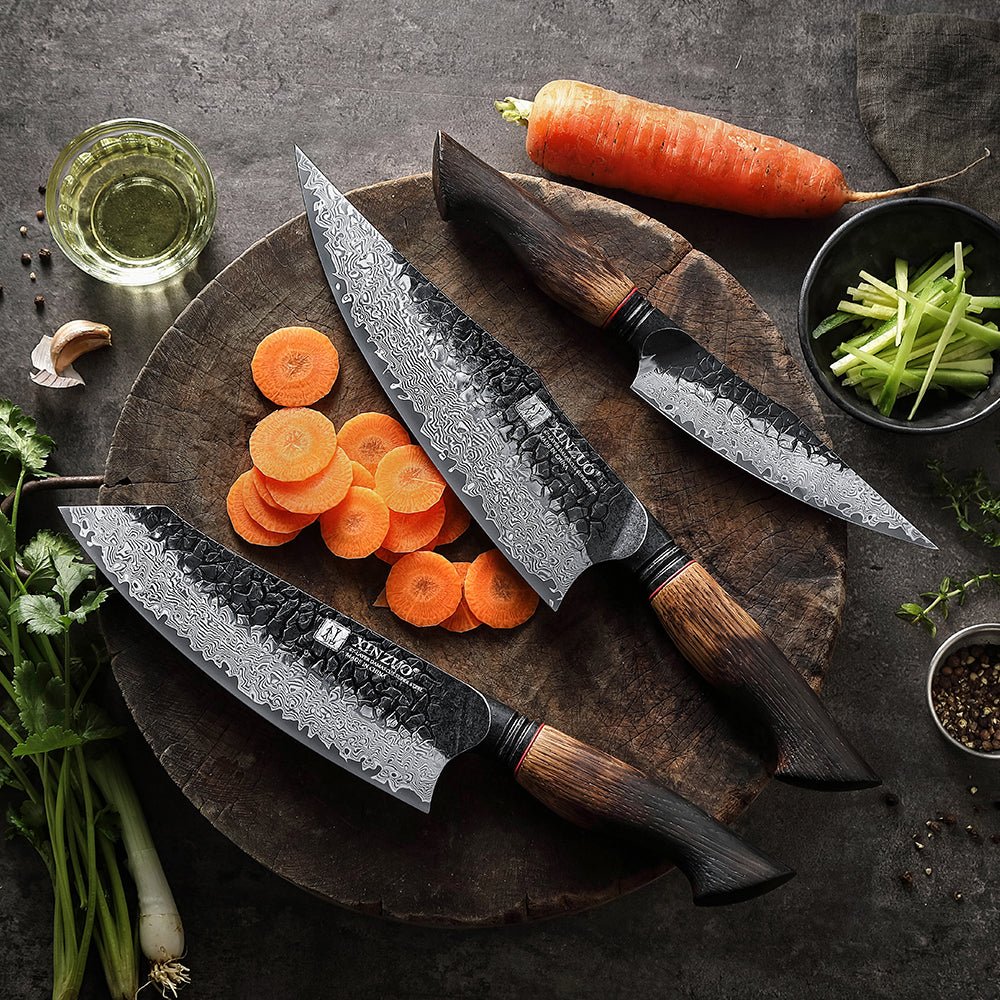
As an example of what transparent specs look like: Xinzuo's Mo Series uses a 10Cr15CoMoV core with 67 layers of Damascus cladding at 60±2 HRC. The Lan Series uses a 14Cr14MoVNb core with 73 layers at 62±2 HRC. You don't have to guess. The core steel, layer count, and hardness are stated because they're real.
That level of specificity is what you should expect from any manufacturer selling Damascus kitchen knives at a legitimate price point. If a seller can't or won't tell you what the core steel is, keep looking.

How Do You Care for Damascus Steel Patterns?
Real Damascus patterns are permanent in the sense that they can always be restored, but they're not permanent in the sense that they'll look factory-fresh forever without maintenance. Understanding this is actually useful for authentication: if your Damascus pattern never changes despite regular use, it's probably etched onto very hard stainless steel (or laser-etched) rather than genuinely layered.
Why Patterns Fade
The visible pattern is a surface effect created by acid etching. The layers are always there inside the steel, but the visible contrast between them exists because different alloys were etched to slightly different depths and colours. Over time, sharpening removes material from the edge bevel, cutting board contact polishes the lower portion of the blade, and cleaning gradually evens out the etched surface. The pattern fades. This is normal.
Re-Etching at Home
You can restore the pattern yourself. It's the same process used in the authenticity test.
- Clean the blade thoroughly and sand with 800-1500 grit paper until the old pattern is removed evenly.
- Clean with isopropyl alcohol to remove all oils.
- Apply ferric chloride solution evenly across the blade flat with a cotton ball or by dipping. Wear gloves.
- Check every 2-3 minutes. Longer exposure creates deeper, more dramatic contrast.
- Rinse with water, then neutralize with a baking soda and water solution.
- Apply a thin coat of food-safe mineral oil.
Most people find 5-10 minutes of etching produces a good result. You can experiment on a small area first.
Daily Care
Hand wash with mild soap and dry immediately. This is good advice for any quality kitchen knife, but it's especially important for Damascus because prolonged moisture contact can cause uneven oxidation that obscures the pattern.
Never put a Damascus knife in the dishwasher. The combination of harsh detergent, high heat, and jostling against other items will damage the pattern, the edge, and the handle.
Sources
- Reibold, M. et al. (2006). "Carbon nanotubes in an ancient Damascus sabre." Nature, 444, 286. doi:10.1038/444286a
- Verhoeven, J.D., Pendray, A.H., & Dauksch, W.E. (1998). "The Key Role of Impurities in Ancient Damascus Steel Blades." JOM, 50(9), 58-64.
- Verhoeven, J.D. & Clark, H.F. (1998). "Carbon Diffusion Between the Layers in Modern Pattern-Welded Damascus Blades." Materials Characterization, 41(5), 183-191.
- Thomas, L. (2018). "Five Myths About Damascus Steel." Knife Steel Nerds. knifesteelnerds.com
- Thomas, L. (2023). "Does Damascus Outperform Super Steels?" Knife Steel Nerds. knifesteelnerds.com
Where Can You Find Genuine Damascus Kitchen Knives?
BROWSE ALL DAMASCUS KNIVES SHOP DAMASCUS KNIFE SETS
Related Reading
- 67-Layer vs 73-Layer Damascus: Does Layer Count Matter?
- How to Care for Damascus Steel Knives
- VG-10 vs 10Cr15CoMoV: Kitchen Knife Steel Compared
- Knife Steel Hardness Guide: What HRC Means for Your Kitchen
Frequently Asked Questions
Does Damascus steel rust easily?
It depends on the steel composition. Damascus cladding made from stainless alloys (like the nickel-containing layers in most kitchen knives) resists rust well, but high-carbon cores such as VG-10 or 10Cr15CoMoV can develop spots if left wet. Hand wash, dry straight away, and apply a light coat of food-safe mineral oil for storage. That's enough to prevent rust entirely.
Why are Damascus kitchen knives so expensive?
The cost comes from the forging process. Pattern welding requires stacking, heating, hammering, and folding multiple steel alloys dozens of times, then grinding, heat-treating, and acid-etching the blade. A single billet can take hours of forge work before the knife is even shaped. Combined with a high-performance core steel like VG-10 or SG2, quality Damascus chef knives typically start around $100 to $150 AUD.
Does the number of layers in a Damascus knife affect performance?
No. Layer count is purely aesthetic. A 67-layer knife and a 73-layer knife perform identically at the cutting edge because the Damascus layers are cladding around a separate core steel that does all the cutting work. More layers produce a finer, more detailed pattern. Fewer layers give a bolder, more dramatic look. Neither cuts better than the other.
Can a fake Damascus knife still be a good knife?
Yes, if the base steel is decent. A mono-steel knife with a laser-etched pattern is dishonest marketing, but the blade underneath might still be functional stainless steel. The problem is that sellers who fake the Damascus pattern rarely invest in quality materials or proper heat treatment either, so most fakes perform poorly across the board.
Are cheap Damascus knives on Amazon and AliExpress real?
Most under $50 AUD are not genuine pattern-welded steel. They typically use laser etching or acid-resist printing on ordinary stainless steel to mimic the look. A real Damascus chef knife requires skilled forge work and quality alloys that cannot be produced at that price point. Look for a named core steel (such as VG-10 or 10Cr15CoMoV), a stated layer count, and a Rockwell hardness rating before buying.