

What Does San Mai Actually Mean?
San mai (三枚) translates literally to "three flat things" in Japanese. That's it. Three layers. The name describes exactly what it is: a blade made from three distinct pieces of steel forged together into a single billet.
The construction is straightforward. A hard core steel (called hagane in traditional Japanese smithing) is sandwiched between two outer layers of softer steel (called jigane). The hard core forms the cutting edge. The soft outer layers form the cheeks of the blade, protecting and supporting that hard core.
Traditional Japanese san mai used white or blue carbon steel for the core and mild iron for the cladding. Modern san mai typically uses high-carbon stainless steels like VG-10 or 10Cr15CoMoV for the core and softer stainless steel for the outer layers. The principle hasn't changed in centuries. Only the materials have.

How Does San Mai Work Mechanically?
Think of san mai like a pencil. The graphite core is hard and brittle on its own, but wrap it in wood and you can drop it, flex it, even step on it without the graphite shattering. The wood absorbs the shock and transfers stress away from the brittle core.
San mai works the same way. The hard core steel (typically 60+ HRC on the Rockwell scale) is capable of taking an extremely fine, acute edge. But at that hardness, steel becomes brittle. It can chip or crack if it hits a bone, twists in a cut, or gets dropped on a hard surface.
The softer outer layers (typically 45-55 HRC) solve this. They do three things:
- Absorb lateral stress. When you rock a knife through an onion or twist it slightly during a cut, the soft cladding flexes and absorbs that force before it reaches the hard core.
- Resist chipping. The transition zone where hard and soft steels meet acts as a crack arrestor. Even if a micro-chip starts at the edge, it won't propagate up into the body of the blade.
- Provide corrosion resistance. In modern san mai, stainless cladding protects the blade body from rust and staining, even when the core steel is a reactive high-carbon alloy.
The result is a blade that cuts like a hard steel knife but handles like a tough one. You get the best properties of both materials in a single blade.
⚡ Key Principle: San mai isn't about making a blade look pretty. It's an engineering solution. Hard steel at the edge where you need cutting performance, soft steel everywhere else where you need toughness and flexibility. Form follows function.
Why Does San Mai Beat Mono-Steel?
A mono-steel knife is made from a single piece of steel throughout. Every part of the blade, from the edge to the spine, is the same hardness and composition. That sounds simple and elegant, but it forces a compromise.
If the manufacturer uses hard steel (say, 62 HRC), the knife will take and hold an incredible edge, but the entire blade is brittle. If they use softer steel (56 HRC), the knife is tough and forgiving, but the edge dulls quickly and can't be sharpened to the same acute angle.
Most mass-market Western knives split the difference at 56-58 HRC. That's... fine. It's a compromise that works for most people. But it means you never get truly exceptional edge retention or truly exceptional toughness. You get "good enough" at both.
| Property | Mono-Steel (Soft) | Mono-Steel (Hard) | San Mai |
|---|---|---|---|
| Edge Hardness | 56-58 HRC | 60-62 HRC | 60-62 HRC |
| Edge Retention | Moderate | Excellent | Excellent |
| Toughness | Good | Poor | Very Good |
| Chip Resistance | Very Good | Poor | Good |
| Corrosion Resistance | Varies | Varies | High (stainless clad) |
| Ease of Sharpening | Easy | Difficult | Moderate |
| Best For | General use | Precise cutting | All-round performance |
San mai eliminates the compromise. The hard core runs along the cutting edge where hardness matters, and the soft cladding handles everything else. You get a 60-62 HRC edge with the lateral toughness of a much softer knife. It's not magic. It's just good engineering.
What Is the Difference Between San Mai and Damascus?
This is where things get confusing for a lot of people, so let me be specific.
San mai is three layers: one hard core, two soft cladding layers. That's the definition. Three layers, distinct materials, clear functional purpose for each.
Damascus steel (in the modern kitchen knife context) is a multi-layer laminate. Instead of three layers, Damascus uses many layers of alternating steel types, typically 33, 45, 67, or 73 layers. These layers are folded and forge-welded together, then etched with acid to reveal the characteristic wavy pattern.
Here's what's important: Damascus is essentially an evolved form of the same laminated construction principle as san mai. Both use multiple layers of steel bonded together. Both typically have a hard core steel at the centre that forms the cutting edge. The difference is in the number and arrangement of those outer layers.
| Feature | Traditional San Mai (3 layers) | Damascus (67-73+ layers) |
|---|---|---|
| Layer Count | 3 | 33-73+ |
| Hard Core Steel | Yes | Yes |
| Visible Pattern | Subtle line at core/clad transition | Prominent wavy pattern |
| Cutting Performance | Determined by core | Determined by core |
| Aesthetic Appeal | Minimal | Striking |
| Price Point | Lower | Higher |
The critical point: in both san mai and Damascus knives, cutting performance is determined almost entirely by the core steel. A 67-layer Damascus knife with a mediocre core will cut worse than a simple three-layer san mai with a premium core. The extra layers in Damascus improve toughness marginally and add visual appeal, but they don't make the edge sharper.
Why Does the Core Steel Matter Most?
I cannot stress this enough. When you're evaluating any laminated knife, whether it's three layers or seventy-three, the single most important specification is the core steel.
The core steel determines:
- Maximum achievable hardness (and therefore edge retention)
- How fine an edge you can put on it (grain structure)
- How it responds to sharpening (carbide size and distribution)
- How long between sharpenings (wear resistance)
A san mai knife with a VG-10 core (60-62 HRC) will dramatically outperform a mono-steel knife at 56 HRC. The same VG-10 core in a 67-layer Damascus configuration will perform identically to the three-layer version. More layers don't mean a sharper knife.
This is why reputable manufacturers always specify their core steel. If a brand markets "Damascus steel" without telling you what the core is made of, be cautious. The pattern is decoration. The core is performance.
�� Tip: When comparing two laminated knives at similar price points, always look at the core steel specification first. A knife with a 10Cr15CoMoV core at 60 HRC will outperform one with a generic "high carbon steel" core at 56 HRC, regardless of how many Damascus layers surround it.
What Are the Most Common San Mai Steel Combinations?
Different core and cladding combinations serve different purposes. Here are the most common pairings you'll find in quality kitchen knives:
Traditional Japanese (carbon core): White #2 or Blue #2 carbon steel core with soft iron cladding. Exceptional edge quality and ease of sharpening, but the core is highly reactive and requires immediate drying after use. The soft iron cladding develops a grey patina over time. Found primarily in traditional single-bevel Japanese-style knives and some artisan double-bevel gyutos.
Modern stainless san mai: VG-10 or 10Cr15CoMoV core with SUS410 or similar stainless cladding. The most practical combination for home cooks. The core takes a very keen edge at 60-62 HRC while the stainless cladding resists corrosion and staining. This is what most mid-range to high-end Japanese-style knives use.
Powder steel san mai: SG2, R2 and HAP40 cores explained. The premium tier. Powder metallurgy steels have extremely fine grain structures that allow for very acute edge angles and exceptional edge retention. The stainless cladding protects these high-performance (and often expensive) core steels from damage.
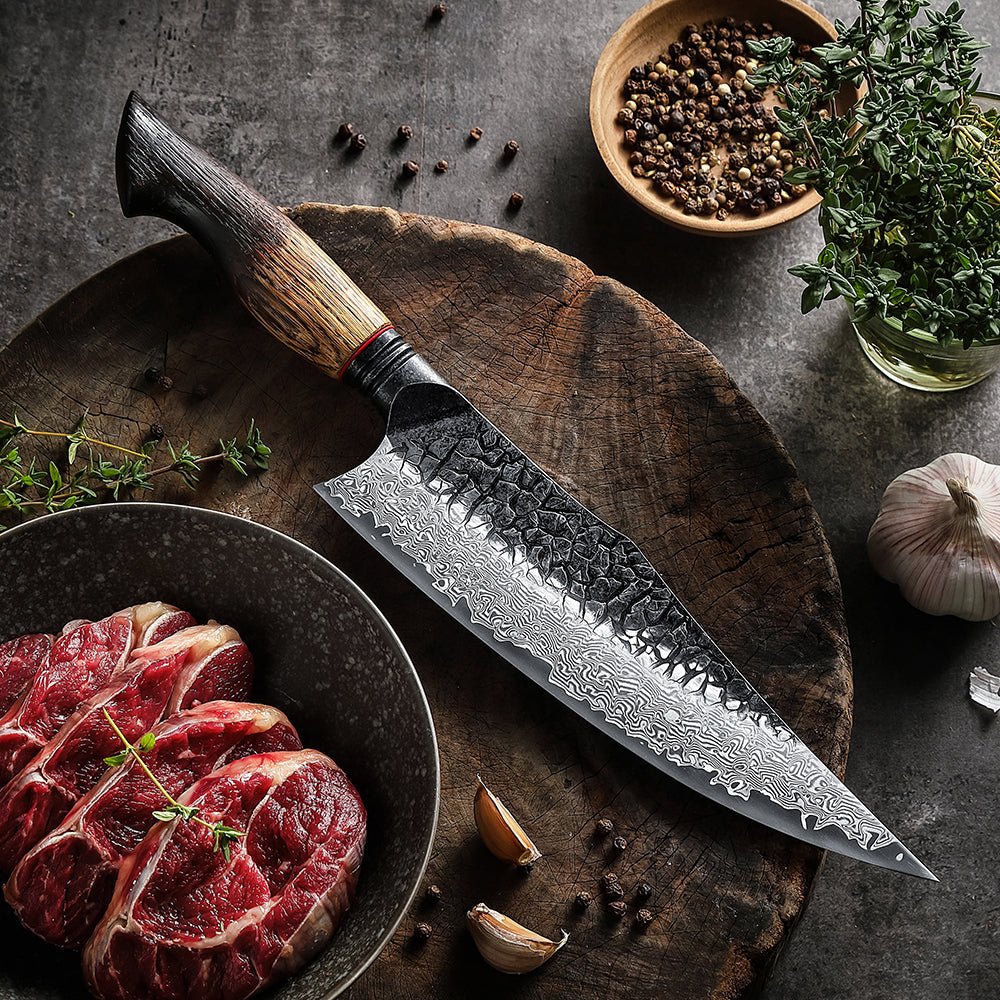
Damascus-clad san mai: Hard core steel with multi-layer Damascus cladding instead of plain stainless. This is the evolution of san mai that combines the functional benefits of laminated construction with the visual drama of Damascus patterning. The core still does all the cutting work, but the outer layers look spectacular.
How Do You Identify San Mai Construction?
Spotting san mai on a knife is straightforward once you know what to look for:
Look at the edge. On a san mai knife that has been sharpened a few times, you can often see where the hard core steel meets the softer cladding. There's a visible line running parallel to the edge, typically 2-4mm up from the cutting edge. This line is called the lamination line or cladding line.
Check for differential patina. On carbon-core san mai knives, the core steel will develop a dark patina faster than the cladding. This creates a visible two-tone effect along the blade.
Look at the spine. On some san mai knives, you can see the three-layer sandwich clearly when looking at the spine or the choil (the unsharpened area where the blade meets the handle). The core appears as a thin bright line between the two darker cladding layers, or vice versa.
Check the specifications. Any reputable manufacturer will clearly state whether a knife uses laminated or mono-steel construction and will specify the core steel type.
For Damascus-clad knives, identification is obvious: the wavy patterned layers are visible across the blade face, with the core steel exposed only at the very edge.
What Is XINZUO's Approach to San Mai Construction?
XINZUO's knives represent the modern evolution of san mai thinking. Rather than a simple three-layer construction, XINZUO uses 67-layer or 73-layer Damascus cladding over a hard-wearing core steel. It's the san mai principle taken to its logical endpoint: protect a high-performance core with layers that add both toughness and visual distinction.
The core steels across XINZUO's range include 10Cr15CoMoV (heat-treated to 60 HRC) and composite powder steel, depending on the series. Both are high-carbon stainless steels chosen specifically for their edge-holding ability and corrosion resistance. The Damascus cladding serves the same function as traditional san mai cladding (shock absorption, corrosion protection) while adding the distinctive flowing pattern that makes each blade unique.
What makes this approach practical is that you get the full cutting performance of the core steel without any of its vulnerabilities. The 60+ HRC core holds an edge through extended prep sessions. The Damascus cladding means you're not babying a reactive steel or worrying about chips during everyday use. And because the cladding layers are themselves alternating stainless steels, the entire blade is low-maintenance.
Across the Damascus knife range and chef knife collection, every blade uses this laminated construction. Whether you're looking at a petty knife or a 10-inch chef knife, the engineering principle is the same: hard core for cutting, layered cladding for everything else.
Experience Laminated Steel Construction
Every XINZUO blade pairs a high-hardness core with Damascus cladding for knives that cut precisely and last.
Browse the Damascus Collection →Why Does San Mai Construction Balance Performance and Price?
There's an economic argument for san mai that doesn't get discussed enough. High-performance steel is expensive. Powder metallurgy steels like SG2 can cost ten times more per kilogram than basic stainless steel. If you make an entire blade from SG2, that cost gets passed directly to the buyer.
San mai and its Damascus variants use premium steel only where it matters: at the cutting edge. The bulk of the blade is made from less expensive (but still high-quality) cladding steel. This means a san mai knife with an SG2 core costs significantly less than a mono-steel SG2 knife would, while delivering identical cutting performance.
It's the same reason that good woodworking chisels have always used laminated construction. You put the expensive, high-performance material at the working edge and support it with affordable, functional material everywhere else. It's not cutting corners. It's intelligent material allocation that has been proven over centuries of bladesmithing.
For the person buying the knife, this translates directly: you get a harder, sharper, longer-lasting edge at a lower price point than would be possible with mono-steel construction of equivalent core quality. That's the real reason san mai dominates the mid-range to high-end kitchen knife market. It delivers the best ratio of performance to cost.
Related Reading
- Real Damascus Steel vs Fake: How to Tell the Difference
- 67-Layer vs 73-Layer Damascus: Does the Layer Count Matter?
- Knife Steel Hardness Guide: Understanding HRC Ratings
- Carbon Steel Knife Guide: Care, Maintenance, and Performance
- VG-10 Steel vs 10Cr15CoMoV: Which Is Better for Kitchen Knives?
- XINZUO Knives Review and Brand Guide
- Full Tang vs Partial Tang: What Actually Matters in a Kitchen Knife
- How to Choose a Chef Knife: The Complete Buying Guide
Frequently Asked Questions
What does san mai mean in knife making?
San mai is Japanese for "three flat things" and describes a blade made from three layers of steel forged together. A hard core steel (typically 60+ HRC) forms the cutting edge, sandwiched between two softer outer layers (45 to 55 HRC) that absorb shock and resist chipping. The construction dates back to around 1300 AD and remains one of the most common methods for building high-performance kitchen knives.
Does san mai cut better than a single-steel knife?
The cutting edge performs identically to a mono-steel knife made from the same core steel at the same hardness. Where san mai wins is durability. A mono-steel knife hardened to 62 HRC is brittle across its entire body, while a san mai knife at the same edge hardness has soft cladding that absorbs lateral stress and stops cracks from spreading beyond the edge. You get the same sharpness with better resistance to chipping.
Is Damascus the same as san mai?
Not exactly, but they share the same principle. San mai uses three layers: one hard core and two soft cladding layers. Damascus uses many more layers (commonly 67 or 73) of alternating steels folded together. Both protect a hard core with softer surrounding steel. Cutting performance in both is determined almost entirely by the core steel. The extra Damascus layers add toughness at the margins and the distinctive wavy pattern, but do not make the edge sharper.
How can you tell if a knife is san mai construction?
Look at the blade near the cutting edge. On a san mai knife that has been sharpened a few times, a visible line (the lamination line) runs parallel to the edge about 2 to 4mm up from it, marking where the hard core meets the softer cladding. On carbon-core san mai, the core develops a darker patina faster than the cladding, creating a two-tone effect. On Damascus-clad versions, the wavy pattern stops at the core steel exposure near the edge.
Why is san mai cheaper than mono-steel made from the same premium steel?
Because san mai uses expensive core steel only at the cutting edge, not throughout the entire blade. Powder metallurgy steels like SG2 cost roughly ten times more per kilogram than basic stainless cladding. Building the full blade from SG2 would push the price up significantly with no improvement in cutting performance. San mai puts the premium material where it does the work and uses affordable steel everywhere else.