


Why Is Sharpening Angle So Misunderstood?
I've watched a lot of people sharpen knives. At cooking classes, at friends' houses, at pop-up events. And the single biggest problem isn't technique or equipment or even laziness. It's that most people have no idea what angle their knife is sharpened at, why it matters, or how to maintain it.
They'll spend $200 on a beautiful knife, then drag it across a whetstone at some random angle they vaguely remember from a YouTube video. Or worse, they'll take a Japanese-style knife sharpened at 15° per side and grind it down at 20° because that's what their dad taught them to do with his old Wusthof.
The result? A knife that's simultaneously duller than it should be and more damaged than it needs to be.
So let's talk about what sharpening angle actually means, why it's the single most important variable in knife sharpness, and how to get it right every time.
What Does "Sharpening Angle" Actually Mean?
When someone says a knife is sharpened at 15°, they almost always mean 15° per side. That's the angle between the blade and the whetstone surface when you're sharpening one side at a time. The inclusive angle (also called the total angle or the edge angle) is both sides combined. So a knife sharpened at 15° per side has a 30° inclusive angle.
This distinction matters more than you'd think. I've seen product listings, sharpening guides, and even knife manufacturers use "15° angle" without specifying whether they mean per side or inclusive. A 15° inclusive angle would be absurdly acute, like a surgical scalpel. A 15° per-side angle is a sharp but practical kitchen knife edge.
Quick reference: 15° per side = 30° inclusive. 20° per side = 40° inclusive. When this article says "15°" or "20°", it means per side, unless stated otherwise.
Think of the edge geometry like a wedge. A narrow wedge (acute angle) slices through food more easily because there's less material forcing the food apart. A wide wedge (obtuse angle) is thicker behind the edge, which makes it tougher and more resistant to chipping but requires more force to cut.
Why Does the Sharpening Angle Make Such a Big Difference?
The relationship between angle and performance is pretty simple in theory. More acute angles produce sharper edges. More obtuse angles produce tougher edges. But the practical implications are significant.
A knife sharpened at 12° per side will glide through a ripe tomato with almost no pressure. It'll make paper-thin slices of fish for sashimi. It will feel, genuinely, like a different tool compared to the same knife at 20°.
But that 12° edge is also thinner, which means the steel at the very tip of the edge is supporting less material above it. If you twist the blade while cutting through a butternut squash, or accidentally hit a bone, or use a rocking motion on a hard cutting board, that thin edge is more likely to chip or roll.
A 20° edge on the same knife won't feel as effortlessly sharp. You'll notice slightly more resistance when slicing. But it'll handle rough treatment better, stay sharp longer between sharpenings, and forgive the occasional bad habit.
Neither angle is "better." They're trade-offs. And the right trade-off depends on three things: the steel, the task, and the user.
What Are the Standard Sharpening Angles by Knife Type?
Japanese-style Knives: 12-15° Per Side
Traditional Japanese-style knives (and modern Japanese-style knives) are typically sharpened between 12° and 15° per side. This is possible because Japanese-style knives tend to use harder steels, often 60 HRC and above. Harder steel holds a thinner edge without deforming. It's the same reason you can sharpen a piece of glass to a razor edge but not a piece of rubber.
At this angle range, you get exceptional cutting performance. Clean, precise cuts with minimal effort. The trade-off is that these edges are more susceptible to chipping if used incorrectly, and they require more careful technique to sharpen properly.
Western and German Knives: 17-20° Per Side
European-style knives from brands like Wusthof and Zwilling are traditionally sharpened between 17° and 20° per side. Their steels are typically softer (56-58 HRC), which means the edge would deform and roll at more acute angles. The wider angle compensates for the softer steel, creating a durable edge that holds up well to the rocking cuts and heavy-handed use that Western cooking tends to involve.
Some newer European knives have started shipping at 15° as steel quality improves, but the traditional 20° is still the standard for most Western kitchen knives.
Cleavers: 25-30° Per Side
Cleavers are designed to chop through bones, joints, and tough cartilage. Sharpness is secondary to durability. A 25-30° per-side angle creates a thick, robust edge that can handle repeated impact without chipping or deforming. You wouldn't want to fillet a fish with a cleaver edge, but you also wouldn't want to chop chicken bones with a 15° sashimi knife.
What Sharpening Angle Do Xinzuo Knives Use?
Xinzuo knives are sharpened at 12-15° per side from the factory. This is consistent with their steel composition. Xinzuo uses high-carbon steels at 60+ HRC hardness, which means the steel is hard enough to support and maintain that acute edge geometry.
If you've been using Western knives your whole life and switch to a Xinzuo, the difference in cutting feel at 15° versus your old knife at 20° is immediately noticeable. Less effort, cleaner cuts, better precision. But it also means you need to respect the edge. No twisting through hard vegetables, no scraping food off the board with the blade edge-down, no tossing it loose in a drawer.

How Do You Find and Maintain the Right Angle on a Whetstone?
This is where most people struggle. Knowing that your knife needs 15° is one thing. Actually holding the knife at 15° consistently while moving it across a stone is another.
The Coin Stack Method (For Beginners)
Stack two Australian dollar coins under the spine of your knife while the edge rests on the stone. This gets you roughly in the 15° range for most chef knives. It's not precise, but it gives your hand a reference point to memorize. Do a few strokes with the coins there, then remove them and try to maintain the same angle from feel.
The Marker Trick (For Everyone)
This is the best way to verify your angle, and I use it every time I sharpen. Take a permanent marker (Sharpie works perfectly) and colour the entire bevel of your knife. Both sides. Now make a few passes on the whetstone at the angle you think is correct.
Look at where the marker has been removed:
- Marker removed evenly across the whole bevel: Your angle is correct. You're matching the existing edge geometry.
- Marker only removed near the edge tip: Your angle is too low (too acute). You're only hitting the very bottom of the bevel.
- Marker only removed near the spine side of the bevel: Your angle is too high (too obtuse). You're grinding the shoulder of the bevel but not reaching the edge.
Reapply the marker and adjust until you're removing it evenly. This takes maybe three or four attempts the first time. After that, your hands start to learn the angle.
Finger Placement and Pressure
Place your index and middle finger on the flat of the blade, close to the edge, directly above the section you're sharpening. This gives you the most control over both angle and pressure. Move your fingers along the blade as you work different sections. Don't try to sharpen the entire edge in one pass with your fingers in one spot.
Pressure should be moderate on the push stroke (away from you) and light on the pull stroke (toward you). Or, if you prefer, apply even pressure in both directions. What matters is consistency. Heavy pressure doesn't make the knife sharper faster. It just removes more steel and makes it harder to hold a steady angle.
Building Muscle Memory
The honest truth is that consistent angle control takes practice. Maybe 5-10 sharpening sessions before it starts feeling natural. Don't get frustrated if your first few attempts produce uneven results. Use the marker trick every time, and you'll improve quickly.
Can You Change a Knife's Sharpening Angle?
Yes. And sometimes it makes sense to do so.
If you bought a German knife that came at 20° per side and you want a sharper edge, you can reprofile it to 17° or even 15°. But understand what you're doing. You're thinning the edge geometry, which means the steel behind the edge is now supporting less material. If the knife uses a softer steel (56-58 HRC), that thinner edge might not hold up. It could roll or deform during normal use, and you'll find yourself sharpening more frequently than before.
Going the other direction (from acute to obtuse) is less risky. If you have a Japanese-style knife at 12° that keeps chipping because of your cutting style or your cutting board, moving to 15° will make the edge more durable with only a small sacrifice in sharpness. This is a perfectly reasonable thing to do.
Reprofiling takes more time than regular sharpening because you're removing more material. Start with a coarser stone (400-800 grit), use the marker trick to verify you're hitting the new angle, and expect to spend 15-20 minutes per side on the initial reprofile. After that, maintenance sharpening at the new angle is no different from normal.
What Are the Most Common Sharpening Mistakes?
Inconsistent Angle
This is the number one problem. Your wrist rocks slightly during each stroke, or you change your grip partway through, and the angle varies by 3-5° across different passes. The result is a rounded, convex bevel instead of a clean flat bevel. The edge might feel okay, but it won't be as sharp as it could be and it won't hold that edge for long.
Fix: Lock your wrist. Move from your shoulders, not your hands. Use the marker trick to check your work.
Too Much Pressure
Pressing hard doesn't speed things up meaningfully. What it does is make it harder to maintain a consistent angle (because the blade flexes and your wrist compensates unpredictably) and removes more steel than necessary. Light to moderate pressure, more passes. That's the formula.
Sharpening Too Often
A well-maintained knife on a good cutting board (wood or rubber, not glass or bamboo) only needs sharpening on a whetstone every 2-4 months for home use. If you're sharpening every week, something else is wrong. Usually it's the cutting board, or the knife is being stored improperly, or the technique is removing the edge faster than it's building one.
Regular honing with a ceramic or leather strop between sharpenings will keep the edge aligned and extend the time between full sharpening sessions significantly.
Ignoring the Burr
When you sharpen one side of a knife sufficiently, a small burr (a thin flap of metal) forms on the opposite side. You can feel it by running your thumb gently across the edge, perpendicular to the blade, from spine to edge. If you don't feel a burr, you haven't sharpened enough on that side. If you feel a burr, flip the knife and work the other side until the burr switches. Then do a few light alternating passes to remove it.
Skipping this step leaves a ragged edge that feels sharp initially but dulls within a day or two.
Angle Guides and Jigs: Do They Help?
Clip-on angle guides that attach to the spine of the knife and rest against the stone can be genuinely useful for beginners. They physically prevent you from exceeding a certain angle, which eliminates the biggest variable in freehand sharpening.
The downsides: they can scratch the blade face, they don't account for blade curvature (the belly of a chef knife has a different geometry than the heel), and they can become a crutch that prevents you from developing freehand skill.
My recommendation? Use a guide for your first 3-5 sharpening sessions to build a feel for what 15° actually looks like and feels like. Then ditch it and go freehand with the marker trick. You'll be better off in the long run.
Fixed-angle jig systems (like those from Edge Pro or Hapstone) are a different category entirely. They hold the knife in a clamp and move the stone at a precisely controlled angle. They produce excellent results and are great for people who sharpen infrequently and want guaranteed consistency. The trade-off is cost (they're not cheap) and setup time (significantly more involved than pulling out a whetstone).
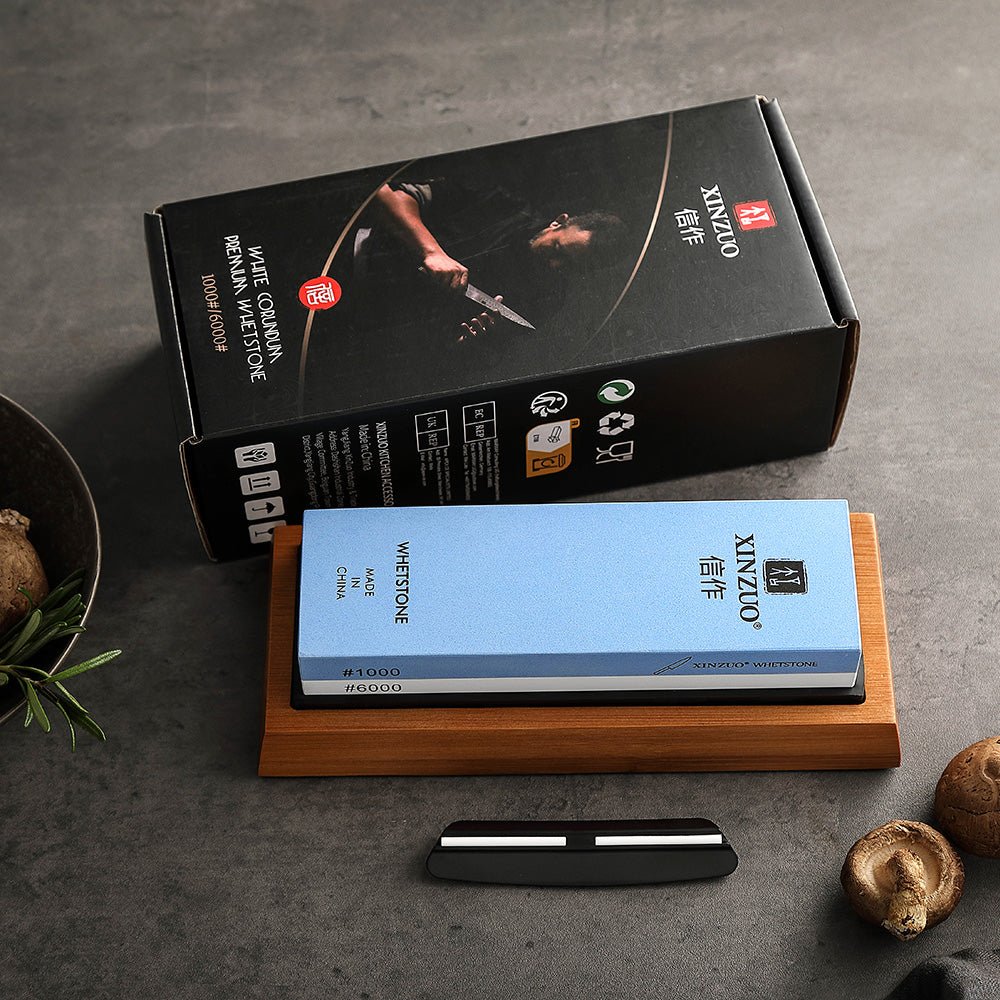
The simplest path: If you own a Xinzuo knife, sharpen at 15° per side on a 1000-grit whetstone. Use the marker trick to verify your angle. Finish on a 3000-6000 grit stone. Strop between sharpenings. That's it. You don't need complicated jigs or systems.
How Do You Put Your Sharpening Knowledge Into Practice?
Sharpening angle isn't complicated once you understand what it is and why it matters. Know your knife's intended angle (for Xinzuo, that's 12-15° per side). Use the marker trick to verify you're hitting it. Apply moderate, consistent pressure. Check for the burr. Finish on a fine stone. Strop between sessions.
The difference between a knife sharpened at the right angle with decent technique and a knife sharpened at a random angle with random technique is enormous. It's the difference between a tool that makes cooking easier and a tool that fights you at every step.
Get the angle right and everything else about sharpening gets easier.
Related Reading
- How to Sharpen Knives with a Whetstone
- Whetstone Grit Guide for Kitchen Knives
- Knife Steel Hardness Guide
- Honing Steel Guide: Knife Edge Maintenance
- Knife Care and Daily Maintenance Guide
- German vs Japanese-style Kitchen Knives
- Knife Edge Types Guide
- How to Choose a Chef Knife: The Complete Buying Guide
Frequently Asked Questions
What does sharpening angle per side mean vs inclusive angle?
"Per side" is the angle between the blade and the whetstone when sharpening one side. "Inclusive" (or total) angle is both sides combined. A knife sharpened at 15 degrees per side has a 30 degree inclusive angle. Most sharpening guides and manufacturers quote the per-side number, so when someone says "sharpen at 15 degrees" they mean 15 on each side, not 15 total.
Can you change the sharpening angle on a knife?
Yes. Going from 20 degrees per side down to 15 degrees makes the edge sharper but thinner, so the steel must be hard enough to support it. Steels at 60+ HRC (like 10Cr15CoMoV or VG-10) handle 15 degrees well. Softer steels at 56 to 58 HRC may roll or chip at that angle. Reprofiling requires a coarse stone (400 to 800 grit) and takes 15 to 20 minutes per side for the initial change.
How do you hold the correct angle on a whetstone without a guide?
The marker trick is the most reliable method. Colour the entire bevel with a permanent marker, make a few strokes on the stone, then check where the ink was removed. If it was removed evenly across the bevel, your angle matches the existing edge. If only the tip or shoulder lost ink, adjust up or down. After three or four corrections, your hands learn the position.
Is 15 degrees or 20 degrees better for a kitchen knife?
15 degrees per side produces a noticeably sharper edge that requires less cutting force, but it chips more easily on bone or hard produce. 20 degrees per side is more durable and forgiving of rough technique. Match the angle to your steel: Japanese-style knives at 60+ HRC are designed for 12 to 15 degrees, while German knives at 56 to 58 HRC perform better at 17 to 20 degrees.
Does inconsistent angle ruin a knife edge?
It does not damage the knife permanently, but it wastes your sharpening effort. Wobbling between 13 and 20 degrees across strokes creates a rounded, convex bevel instead of a clean flat one. The edge will cut, but not as sharply or for as long as a consistent bevel would. Locking your wrist and driving the stroke from your shoulder is the fastest way to improve angle stability.