

What Is Damascus Steel in Modern Kitchen Knives?
If you've shopped for kitchen knives in the last five years, you've seen the swirling, wavy patterns on blades marketed as "Damascus steel." They're beautiful. They look expensive. And there's a good chance at least half of what you've read about them is wrong.
The original Damascus steel, properly called wootz steel, was a crucible steel produced in India and forged in the Middle East from around 300 BC to the 1700s. That production method was lost centuries ago. Nobody is making wootz steel kitchen knives today, no matter what their marketing copy says.
Modern Damascus steel is something different entirely. It's pattern-welded steel, made by forge-welding multiple layers of two or more steel alloys together, then folding and hammering them repeatedly. When the finished blade is etched in acid, the different steel types react at different rates, revealing the layered pattern. The visual effect is striking, but the process itself is an engineering decision, not just a decorative one.
Quick summary: Modern "Damascus" kitchen knives are pattern-welded steel, not the historical wootz steel. The visible pattern comes from forge-welding alternating layers of two or more steel alloys. The pattern is real and structural, but its purpose is different from what most marketing suggests.
What Are the Different Damascus Pattern Types?
The pattern you see on a Damascus blade depends on how the smith manipulates the billet during forging. Different techniques produce different visual effects, and some are significantly harder to execute than others.
All five patterns use the same basic process of layering and forge-welding. The difference is what the smith does to the billet between folding steps. A random pattern happens naturally during standard forging. Ladder and raindrop patterns require extra machining steps. Twist and feather patterns demand more skill and take more time, which is why they tend to cost more.

Does Damascus Steel Actually Make a Knife Cut Better?
This is probably the most misunderstood thing about Damascus kitchen knives, and it's worth being direct about it. The Damascus pattern on the outside of your blade has almost nothing to do with how well the knife cuts.
Think about how a Damascus kitchen knife is actually constructed. In most quality Damascus knives, the blade is built as a sandwich. There's a hard core steel running down the centre of the blade, right at the cutting edge. Then there are softer Damascus-patterned cladding layers on either side of that core. When you sharpen the knife, you're sharpening the core steel. When you cut an onion, the core steel is doing the work.
The Damascus layers? They never touch your food at the cutting edge. They're the outer jacket, not the engine.
This matters because I've seen marketing that implies Damascus layering creates a sharper edge, or that the alternating hard and soft steel layers produce a micro-serrated cutting surface. In a traditional hand-forged blade where the pattern runs all the way to the edge, there might be a tiny amount of truth to this. But in modern laminated construction (which covers the vast majority of Damascus kitchen knives on the market), the core steel alone determines edge sharpness, edge retention, and cutting performance.
What Does Damascus Cladding Actually Do?
So if Damascus cladding doesn't make the knife cut better, why bother with it? There are a few real, measurable benefits beyond looking good on your magnetic knife rack.
Structural support and flexibility. Hard core steels (like VG-10 at 60-62 HRC or SG2/R2 at 63-64 HRC) are excellent at holding an edge, but they're also brittle. If you made an entire blade from VG-10, it would chip more easily under lateral stress. The softer Damascus cladding absorbs shock and provides flex, protecting that hard, thin cutting edge from damage.
Corrosion protection for the core. Many high-performance core steels have lower chromium content, which means they're more prone to corrosion. Wrapping them in stainless Damascus cladding creates a protective barrier. The core steel only contacts food and moisture at the very thin cutting edge, not across the entire blade face.
Food release. This one is debated, but there's a reasonable physical argument for it. The micro-texture created by the different steel layers (particularly after acid etching) creates tiny surface irregularities. These small pockets of air between the blade face and the food being cut may reduce the suction effect that causes food to stick to a flat blade. Is it dramatic? No. Is it zero? Probably not.
Weight distribution. Using softer, lighter cladding steel on the sides of the blade allows knifemakers to use denser, harder core steel without making the overall blade too heavy. This is a real engineering benefit that affects how the knife feels in your hand.
How Do You Spot Fake Damascus Steel?
The unfortunate reality is that fake Damascus knives are everywhere, particularly in the $20-60 price range on marketplaces. These are single-steel blades with a pattern applied through acid etching or laser printing. They look like Damascus, but the pattern is purely cosmetic and provides none of the structural benefits of genuine pattern-welded steel.
Here's how to tell the difference:
The acid etch test. On a genuine Damascus blade, the pattern is structural. It goes all the way through the steel. If you were to sand off the surface and re-etch the blade, the pattern would come back (possibly slightly different, but still there). On a fake, sanding removes the pattern permanently because it was only surface-deep.
Check the edge. Look at the blade in profile, right at the cutting edge. On a genuine laminated Damascus knife, you should be able to see where the cladding layers meet the core steel. It often looks like a thin line running along each side of the edge bevel. Fake Damascus shows no such transition because the entire blade is one steel.
Price flags. A genuine Damascus knife with a quality core steel requires expensive materials and time-intensive forging. If someone is selling a "67-layer Damascus VG-10 chef knife" for $35, something doesn't add up. The raw materials alone for that knife would cost more than that.
Pattern consistency. Examine the pattern closely. On genuine Damascus, the pattern flows naturally around curves and has organic variation. On printed or etched fakes, the pattern often looks too uniform, too perfect, or repeats in a way that natural forge-welding wouldn't produce. Also check whether the pattern continues onto the spine of the blade. On genuine Damascus, it should.
Red flags for fake Damascus: Pattern stops abruptly at the spine or chovel. Pattern is perfectly symmetrical. Price is under $60 AUD for a full-size chef knife. No core steel line visible at the edge. Seller can't name the core steel type.
Does a Higher Layer Count Mean a Better Knife?
Marketing loves big numbers. "67-layer Damascus" sounds more impressive than "33-layer Damascus," and "73-layer" sounds better still. But the layer count has almost no bearing on how well the knife performs.
Remember: the cutting edge is determined by the core steel. Whether you wrap that core in 16 layers of cladding per side or 36 layers per side, the knife cuts the same.
What does change with layer count is the pattern refinement. More layers produce finer, more detailed patterns because each individual layer is thinner. A 33-layer blade has bolder, more visible lines. A 73-layer blade has finer, more subtle patterning. Neither is objectively better. It's a visual preference.
Why Does Core Steel Matter More Than Anything Else?
If you take one thing from this entire article, it should be this: when comparing Damascus kitchen knives, compare the core steel first. Everything else is secondary.
The core steel determines how sharp the knife can get, how long it holds that edge, how resistant it is to chipping, and how easy it is to resharpen. Two knives can look identical on the outside, with the same layer count and the same pattern, and perform completely differently because one has a VG-10 core and the other has 10Cr15CoMoV.
Common core steels you'll see in Damascus kitchen knives, roughly in order of performance:
A $120 Damascus knife with a 10Cr15CoMoV core will not outperform a $200 Damascus knife with a VG-10 core, regardless of how many layers the cheaper knife has. The core steel is where your money should go.
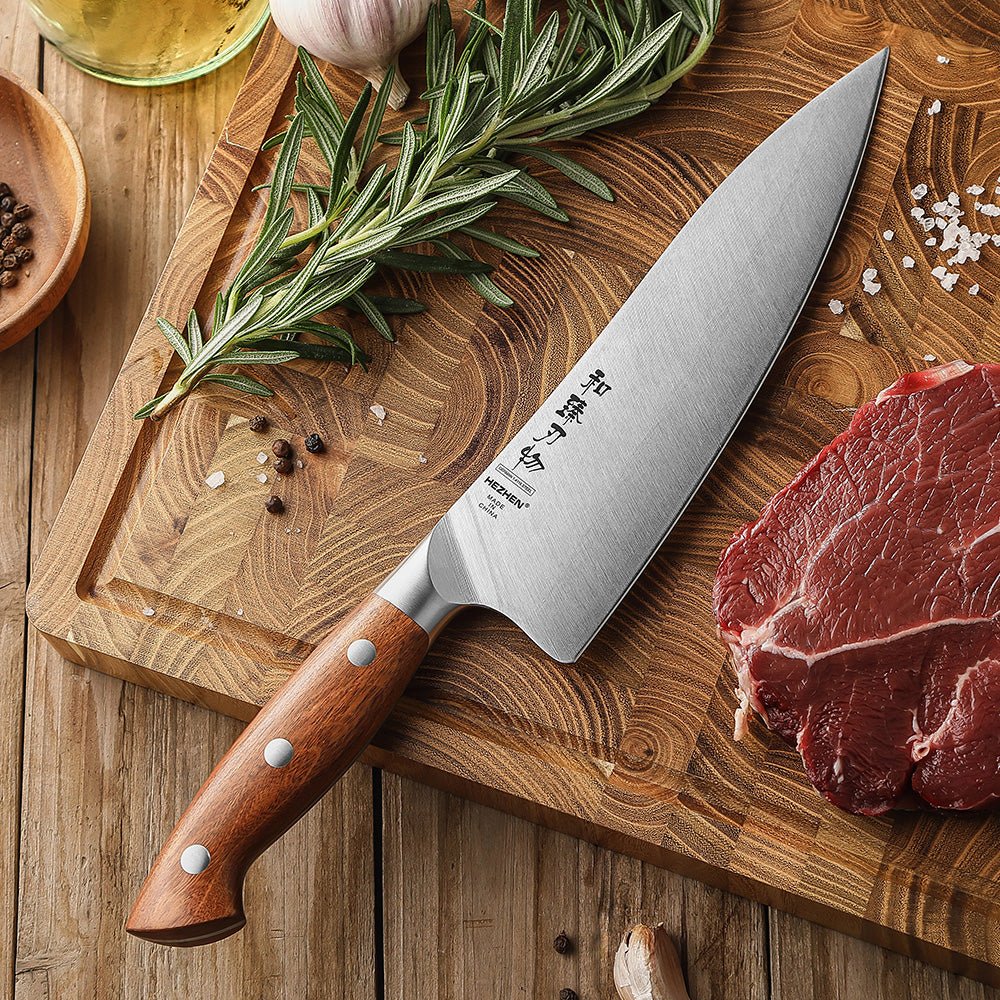 Damascus chef knife showing the layered pattern and core steel line at the edge" style="max-width: 100%; height: auto; margin: 16px 0;" loading="lazy">
How Much Should You Pay for a Damascus Chef Knife in Australia?
Prices for Damascus chef knives in Australia vary widely, and the range tells you a lot about what you're actually getting. Here's a realistic breakdown of what to expect at each price tier.
How Do You Care for a Damascus Pattern?
The pattern on a Damascus blade is permanent in the sense that it's structural, but it can fade over time if you don't take care of it. Here's what you actually need to do (and what you can skip).
Wash and dry immediately after use. This is the single most effective thing you can do. Water, particularly water with dissolved food acids, will cause differential corrosion between the steel layers. That's actually how the pattern is revealed in the first place (acid etching), but uncontrolled exposure will make the pattern blotchy and uneven. A quick wash with dish soap and immediate towel drying takes ten seconds and prevents 90% of pattern problems.
Never put a Damascus knife in the dishwasher. The combination of high heat, aggressive detergent, and prolonged water exposure will destroy the pattern finish and can cause pitting. Dishwashers are the number one killer of Damascus knife aesthetics.
Oil the blade occasionally. A thin coat of food-safe mineral oil or camellia oil after cleaning helps maintain the contrast between layers. You don't need to do this every time, once a week is plenty for a knife in regular use. If you're storing the knife for an extended period, definitely oil it first.
Re-etching is possible. If the pattern does fade significantly, you can re-etch it at home with ferric chloride or instant coffee (yes, really). Submerge the blade for 5-10 minutes, neutralise with baking soda, and the pattern comes back. For a detailed guide on this process, see our Damascus care guide.
Use a wooden or plastic cutting board. Glass, ceramic, and stone boards will dull any knife quickly, but they're especially rough on Damascus edges because the harder core steel is more brittle. Stick to end-grain wood or quality plastic boards.
How Do You Choose the Right Damascus Chef Knife?
Choosing a Damascus chef knife comes down to separating what matters from what just looks impressive on a product page. The pattern is beautiful, and it's part of why these knives feel special to own and use. But the pattern isn't what makes or breaks the knife's performance in your kitchen.
Ask three questions before you buy. What core steel does this knife use? Is the Damascus genuine (check price, check the edge, ask the seller)? And does the knife feel right in your hand?
A 67-layer Damascus knife with a VG-10 core, a comfortable handle, and good balance will serve you better than a 73-layer knife with an unnamed steel that doesn't feel right when you pick it up. The best knife is the one that makes you want to cook.
Related Reading
- Real Damascus Steel vs Fake: How to Tell the Difference
- 67-Layer vs 73-Layer Damascus: Does It Matter?
- San Mai Construction Guide: Three-Layer Blade Basics
- Knife Steel Hardness Guide: Understanding HRC Ratings
- VG-10 Steel vs 10Cr15CoMoV: What's the Difference?
- How to Care for Damascus Steel Knives
- Xinzuo Knives Review: Complete Brand Guide
- How to Choose a Chef Knife: The Complete Buying Guide
Ready to buy a matched set rather than build one blade by blade? Browse our Damascus knife sets.
Frequently Asked Questions
Which Damascus pattern is the hardest to make?
Mosaic Damascus is the most difficult. It requires cutting and welding multiple coloured steel billets into precise geometric arrangements before forging, and even a small misalignment ruins the design. Twist and feather patterns rank next in difficulty because the smith must manipulate the hot billet by hand during forging. Random (wild) Damascus is the simplest, as the pattern forms naturally from standard folding.
Does a Damascus pattern make a knife cut better?
No. On modern laminated Damascus knives, the patterned cladding layers sit on either side of a separate core steel that forms the cutting edge. The cladding never contacts food at the edge, so the pattern has no effect on sharpness or edge retention. Cutting performance is determined entirely by the core steel grade, its heat treatment, and the blade's grind geometry.
What core steel should I look for in a Damascus kitchen knife?
VG-10 (60 to 62 HRC) is the industry benchmark for mid-range to high-end knives. 10Cr15CoMoV performs very similarly at 30 to 40% lower cost because the raw material is cheaper. SG2/R2 (63 to 64 HRC) is the step up for users who want the longest possible edge retention and don't mind paying more. Avoid any listing that says only "stainless steel" or "high-carbon steel" without naming the specific grade.
Why do some Damascus knives cost $100 and others cost $500?
The price gap comes from four factors: core steel quality (SG2 costs significantly more than 10Cr15CoMoV), handle materials (stabilised wood and G10 vs. cheap plastic), fit and finish (hand-ground bevels vs. machine-ground), and pattern complexity (twist or feather patterns take more forge time than random). Layer count alone does not justify a higher price if the core steel is the same.
Is a higher Damascus layer count better?
Not for performance. A 33-layer, 67-layer, and 73-layer knife with the same core steel will cut identically because the cladding layers never form the cutting edge. Higher layer counts produce finer, more detailed patterns with thinner individual lines. Lower counts create bolder, more dramatic contrast. Pick the look you prefer.