


What Are the Key Differences Between German and Japanese Kitchen Knives?
Japanese-style knives are sharper, lighter, and cut with measurably less effort. German knives are tougher, more forgiving, and easier to maintain.
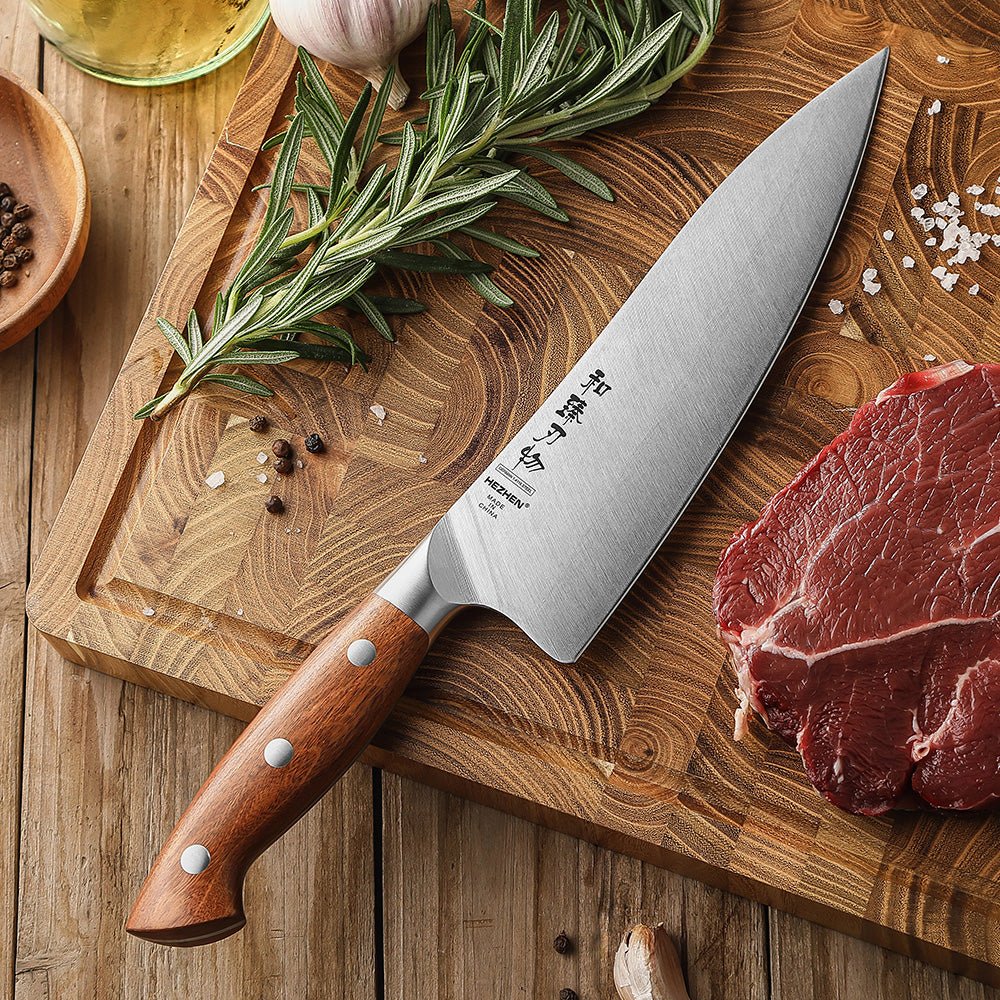
For most Australian home cooks who are in the kitchen 3+ nights a week and take reasonable care of their tools, a Japanese-style knife is the better investment. You'll notice the difference every single time you pick it up.
For rough-and-ready cooks who want zero maintenance and don't mind a heavier hand, German is the pragmatic choice. Neither style is objectively better. They're built for different approaches to cooking.
What Are the Real Differences Between German and Japanese-Style Knives?
What Those Numbers Mean in Practice
The edge angle difference is the single most important line in that table. CATRA testing data from Knife Steel Nerds shows that reducing edge angle from 25 degrees to 15 degrees results in roughly five times the edge retention on identical steel. That means edge geometry matters more than the steel itself for day-to-day cutting performance.
A Japanese-style knife sharpened to 12 degrees per side with a 1.8mm spine is doing dramatically less work to push through food than a German knife at 20 degrees with a 2.8mm spine. Less material displacing the food. Less force required. Cleaner cuts. Less crushing of delicate cell walls, which is why your herbs don't turn black and your tomatoes don't weep all over the board.
The hardness difference (HRC) is what makes those acute angles possible. Softer German steel would fold over at 12 degrees. Harder Japanese steel holds that acute edge because the crystalline structure is more rigid. The trade-off: rigid steel is also more brittle.
How Do German and Japanese-Style Knives Feel in the Kitchen?
Weight and fatigue
A typical German 8-inch chef knife weighs 250-320 grams. A Japanese 210mm gyuto comes in at 170-220 grams. That 80-100 gram difference sounds trivial until you've been prepping vegetables for 30 minutes.
Ergonomics research backs this up. Claudon and Marsot (2006) found that sharper blades produce lower muscle activation throughout the upper limb. McGorry et al. (2005) demonstrated that well-finished, sharper blades reduce required grip force by over 20% and overall cutting effort by nearly 30%. Over thousands of cuts in a cooking session, the cumulative difference is something you feel in your body.
Cutting technique
German knives have a pronounced belly curve. This lends itself to rocking: anchor the tip on the board, pivot the blade up and down. If you learned to cook from European or American sources, this is probably how you use a knife already.
Japanese-style knives have a much flatter profile. They're designed for push-cutting: push the blade forward and down through the food in a single smooth stroke. This produces cleaner cuts and gives you more board contact per stroke. Most people adapt to push-cutting within a week of switching.
The tomato test
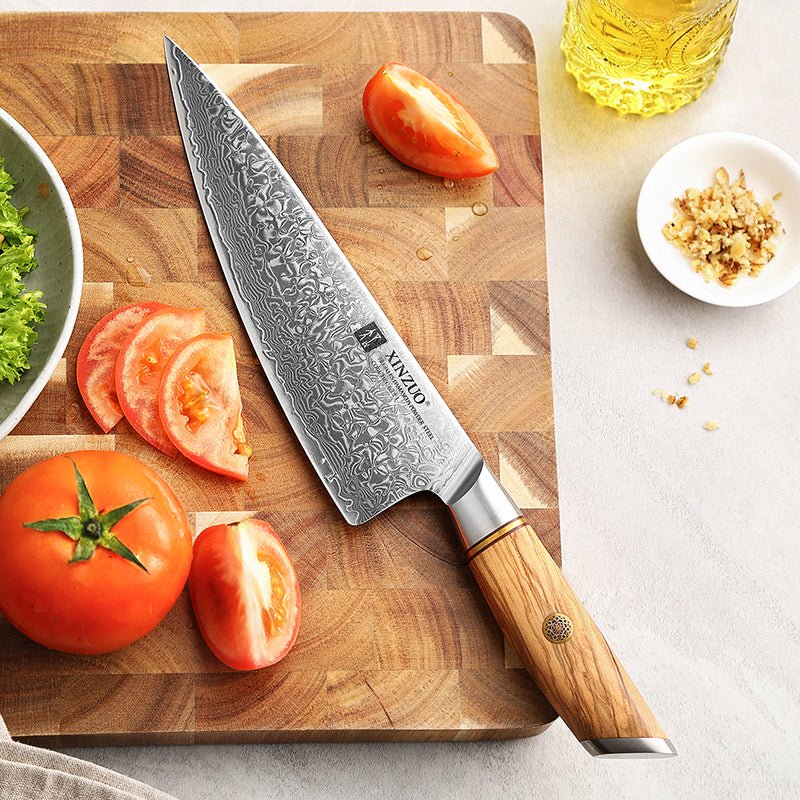
A sharp Japanese-style knife will glide through a tomato under its own weight with zero downward pressure. A new German knife will do this too, but the Japanese-style knife will still be doing it months later while the German edge has started to require force.
How Does Maintenance Differ Between German and Japanese-Style Knives?
German knife maintenance
Run the blade along a steel honing rod every few uses. Takes 15 seconds. When the edge gets properly dull (every few months), sharpen with whatever you have: pull-through sharpener, electric sharpener, whetstone, or professional service. German steel is forgiving enough that pretty much any method works.
Total annual time: maybe 20 minutes.
Japanese-style knife maintenance
Do not use a traditional steel honing rod. The hard steel can chip rather than flex. Use a ceramic honing rod instead. When the knife needs sharpening, a whetstone is the best option. A basic 1000 and 3000 grit setup and 10-15 minutes of practice gets the edge back to factory sharpness.
Total annual time: 30-45 minutes spread across 3-4 sessions.
Can You Use Japanese-Style Knives on Bone, Frozen Food, and Rough Tasks?
Japanese-style knives will chip on bone and frozen food. That harder steel that holds such a fine edge is also more brittle. Hit a chicken bone at the wrong angle or try to cut through a frozen sausage, and you'll get a chip that requires whetstone repair.
German knives handle this without complaint. The softer steel flexes and absorbs impact rather than chipping.
The practical answer: keep one cheap, thick, German-style knife for the rough work. Use your Japanese-style knife for everything else. This is exactly what professional kitchens do.
Which Style Suits Australian Home Cooks?
Australian home cooking in 2026 doesn't look like it did 20 years ago. The average weeknight dinner is as likely to be a stir-fry, a poke bowl, or a Thai curry as a roast or a meat pie. Our cooking has become genuinely multicultural, and that shift has practical implications for which knives work best.
Stir-fries, sushi bowls, Thai salads, dumplings: you're doing a lot of precise vegetable prep. Julienning carrots, fine-slicing spring onions, mincing ginger. Japanese-style knives are purpose-built for this work.
Sunday roasts, slow-cooked stews, schnitzels: you're breaking down larger cuts and dealing with bones more frequently. German knives handle this well.
Both, plus weekend BBQ: this is most Australian households. A good Japanese-style knife for the daily prep work. A German or German-style knife for the heavy stuff.
What Is a Hybrid Knife with Japanese Steel in a Western Shape?
There's a third option that often gets overlooked: the gyuto.
A gyuto is a Japanese-style knife that uses a Western chef knife profile. You get the harder steel, thinner grind, sharper edge angle, and lighter weight of a Japanese-style knife, but in the familiar curved shape of a Western chef knife. You can rock-chop with it. You can push-cut with it. It's comfortable for people coming from a German knife background, but it cuts like a Japanese-style knife because the steel and geometry are Japanese.
The gyuto is the most popular professional chef's knife worldwide because it bridges the gap between German and Japanese design. If you're torn between the two styles, a gyuto made with hard Japanese-type steel is almost certainly the right starting point.
Which Should You Buy?
My recommendation for someone starting from zero:
Get one good Japanese-style gyuto (210mm) as your primary knife. Use it for 90% of your cooking. Keep your existing cheap knife for bone, frozen stuff, and any task that feels like it might damage a thin edge. Learn to use a whetstone when you're ready.
SHOP CHEF KNIVES SHOP JAPANESE-style KNIVES
Sources
- Larrin Thomas, Knife Steel Nerds. CATRA edge retention testing: edge angle vs cutting performance.
- Claudon, L. and Marsot, J. (2006). "Effect of knife sharpness on upper limb biomechanical stresses." International Journal of Industrial Ergonomics, 36(3), 239-246.
- McGorry, R.W., Dowd, P.C. and Dempsey, P.G. (2005). "The effect of blade finish and blade edge angle on forces used in meat cutting operations." Applied Ergonomics, 36(1), 71-77.
Related Reading
- Santoku vs Chef Knife: Which One Should You Buy?
- How to Choose a Chef Knife
- Japanese-style Knife Types Explained
- Knife Steel Hardness Guide
- The Truth About Chinese Kitchen Knives
- How to Sharpen Knives on a Whetstone
Frequently Asked Questions
Can you use a Japanese-style knife for everything in the kitchen?
A Japanese-style gyuto handles about 90% of kitchen tasks, including slicing, dicing, and mincing vegetables, fish, and boneless meat. Where it falls short is bone-in cuts, frozen food, and heavy splitting jobs like whole pumpkin, where the thinner blade (1.5 to 2mm spine) risks chipping. Keep a cheap German-style knife for those tasks.
Do Japanese-style knives stay sharp longer than German knives?
Yes, significantly. The harder steel (58 to 62 HRC vs 54 to 58 HRC) and more acute edge angle (12 to 15 degrees vs 18 to 22 degrees) mean a Japanese-style knife holds a working edge three to four times longer than a German knife under the same use. CATRA testing data shows that reducing edge angle from 25 to 15 degrees alone results in roughly five times the edge retention.
Can you rock chop with a Japanese-style knife?
Yes, if you use a gyuto. The gyuto has a curved profile similar to a Western chef knife, so it handles rocking cuts comfortably. Flatter Japanese-style knives like the santoku and nakiri are designed for push-cutting and do not rock well. Avoid heavy lateral force when rocking with any Japanese-style knife, as the harder steel can chip under sideways stress.
Are Japanese-style knives harder to maintain than German knives?
The extra effort is about 15 to 20 minutes per year. German knives need a quick honing rod pass every few uses and any sharpener works. Japanese-style knives need a ceramic honing rod instead of steel, and a whetstone (1000 and 3000 grit) for sharpening three to four times a year. The trade-off is a knife that cuts noticeably better for the hundreds of hours you spend cooking.
What is a gyuto knife and how is it different from a chef knife?
A gyuto is a Japanese-style knife built in a Western chef knife shape. It has the curved blade profile familiar to European cooks but uses harder steel (58 to 62 HRC), a thinner grind (1.5 to 2mm spine), and a more acute edge angle (12 to 15 degrees). The result is a knife that weighs 170 to 220g instead of 250 to 320g and cuts with measurably less effort, while still allowing both rocking and push-cutting techniques.