


What Is the Most Important Thing When Choosing a Chef Knife?
If you just want a recommendation:
For most Australian home cooks, an 8-inch chef knife with Japanese-style stainless steel (VG-10 or equivalent, 58-62 HRC) in the $80-$150 AUD range is the sweet spot. It's sharp enough to make cooking genuinely easier, tough enough to handle daily use, and doesn't require professional-level maintenance. If that sounds right, browse our chef knife collection and pick something that feels good in your hand. If you want to understand why, keep reading.
What Actually Matters When Choosing a Chef Knife?
There's a lot of marketing noise around kitchen knives. Damascus patterns, exotic steels, celebrity endorsements. Most of it is irrelevant to how a knife actually performs on a cutting board. Here's what matters, in order of importance:
- Blade geometry (grind, thickness behind the edge). This is the single biggest factor in how a knife feels when it cuts. More important than steel, more important than brand.
- Steel and hardness. Determines how long your edge lasts between sharpenings and how fine that edge can get.
- Size and weight for your hands. A great knife that's too heavy or too long for you is a bad knife for you.
- Handle comfort. You're holding this thing for 20-40 minutes at a time. It needs to feel right.
Everything else, the Damascus cladding, the box it comes in, the story about the blacksmith, is secondary. Some of those things are genuinely nice. None of them make food taste better.
What Size and Weight Chef Knife Should You Pick?
Chef knives come in four practical sizes. Each one suits a different cook and a different kitchen.
If you're unsure between two sizes, go with the larger one. Most people who switch from a 6-inch to an 8-inch wish they'd done it sooner. The extra blade length means fewer strokes through an onion and more knuckle clearance on the board.
Weight Ranges (Actual Numbers)
Weight is where you'll feel the biggest difference between knife styles. A German 8-inch chef knife typically weighs 250-320g. A Japanese-style gyuto in the same length comes in at 170-220g. Go with a traditional Japanese wa-handle and you're looking at 140-170g. That's almost half the weight of a German knife, and you will notice it during a 30-minute onion-and-garlic session.
People with smaller hands tend to do better with lighter Japanese profiles. Not because they can't physically handle a heavier knife, but because a lighter knife gives more control and less wrist strain over time. Research from Claudon and Marsot (2006) on knife sharpness and upper limb musculoskeletal stress supports this: reducing the force needed to cut (through either sharper edges or lighter weight) measurably decreases muscle load in the forearm and shoulder.
What Are the Different Chef Knife Steel Types?
Steel is the second most important factor after geometry, and the one that gets the most marketing hype. Here's what you actually need to know.
The key number is HRC (Rockwell Hardness). Higher HRC means the steel can take and hold a finer edge, but it also means the blade is more brittle and harder to sharpen. Every steel is a tradeoff.
Most home cooks land happily in the second row. The 10Cr15CoMoV steel (a near-identical equivalent to Japanese VG-10) hits 60+ HRC, takes a razor edge, and doesn't chip under normal use. We wrote a detailed comparison of the two steels if you want the chemistry.
Geometry Beats Steel
Larrin Thomas at Knife Steel Nerds has published CATRA testing data showing that reducing the edge angle from 25 degrees per side to 15 degrees per side can improve edge retention by roughly 5x on the same steel. Same steel, different grind, five times the performance.
What this means: a well-ground mid-range steel will outperform a poorly-ground premium steel. When you're evaluating a knife, the grind matters more than the steel stamp on the blade.
Related: thickness behind the edge is the single best predictor of how a knife feels when it cuts. A blade can be apex-sharp but still feel dull if the metal 1-2mm behind that edge is thick. This is why a thin Japanese-style gyuto at 58 HRC can feel dramatically sharper than a thicker German knife at the same sharpness level. The blade doesn't wedge food apart. It slides through.
Should You Choose a German or Japanese Blade Profile?
The shape of the blade determines how you'll use it. Both profiles work well. It's about matching the knife to how you actually cut food.
German Profile
The classic German chef knife has a pronounced belly curve running from heel to tip. The spine is thick, usually 2.5-3mm at the heel. The whole knife is heavier and built to be rocked back and forth on the board. If you already rock-chop (keeping the tip on the board and pivoting the blade through your ingredients), a German profile will feel immediately natural.
Japanese-style Gyuto
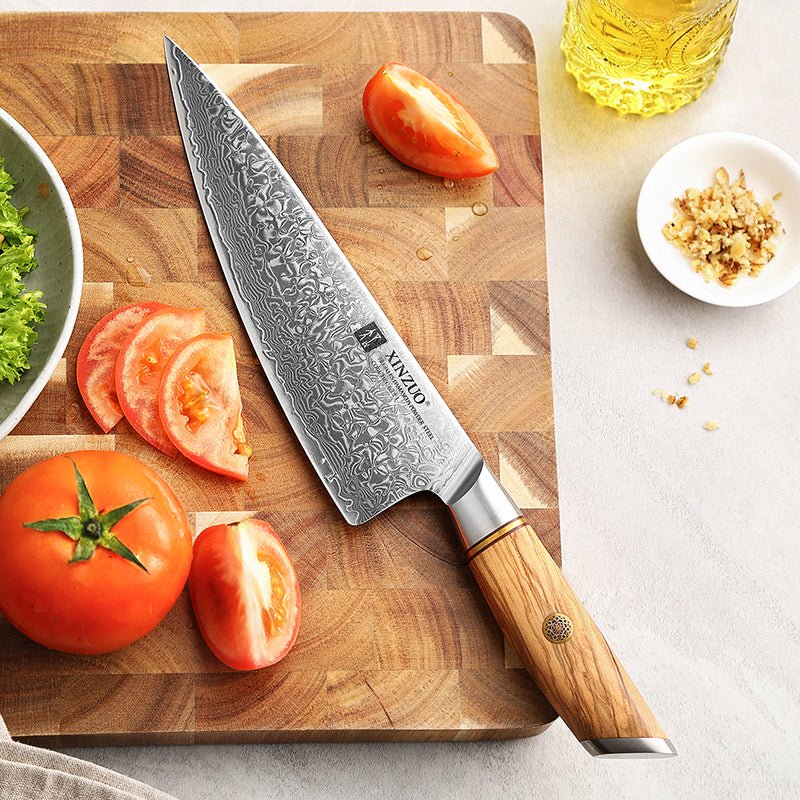
A gyuto is the Japanese interpretation of a French chef knife. The profile is flatter, with less belly curve. Spine thickness runs 1.5-2mm, and the blade tapers more aggressively toward the tip (this is called distal taper, and it's a big part of why gyutos feel nimble). Gyutos are designed for push-cutting: you push the blade forward and down through the food in a single motion. It's more efficient than rocking because the flat profile makes full contact with the board in one stroke.
If you push-cut already, or want to learn a more efficient cutting technique, a Japanese-style gyuto is the better choice. The Lan Series 8.5" Chef Knife is a good example: Japanese profile and thinness, but with a western-style handle that feels familiar if you're coming from German knives. For a deeper comparison, see our article on santoku vs chef knife, which covers push-cutting vs rocking in more detail.
What Handle Types Are Available for Chef Knives?
There are two main categories, and they feel genuinely different.
Handle preference is personal. That said, research on knife ergonomics (Stone et al., 2018, Human Factors and Ergonomics Society) found that lighter handle configurations measurably reduce grip force and forearm muscle activation during extended use. If you cook for more than 20-30 minutes at a stretch, a wa-handle or lightweight western handle is worth trying.
Our Retro Series uses traditional wa-style handles in rosewood and buffalo horn. The Mo Series uses western-style handles with a Japanese-style blade profile, which is a good middle ground.
How Much Should You Spend on a Chef Knife?
Knife pricing follows a curve of diminishing returns. The jump from $30 to $100 is enormous. The jump from $200 to $400 is measurable but much smaller.
$30-60 AUD: Entry Level
German-style stainless steel at 54-57 HRC. These knives work. They'll cut food, they'll hold a serviceable edge, and they're almost indestructible. The steel is soft enough that a honing rod keeps them going for months between proper sharpenings. Good for someone who's learning to cook and isn't sure yet whether they care about knife performance.
$80-150 AUD: The Sweet Spot
This is where you start getting Japanese-style stainless steel (10Cr15CoMoV, VG-10 equivalent) at 58-62 HRC, thinner blade geometry, and noticeably better edge retention. The difference between a $40 knife and a $120 knife is something you will feel the first time you slice a tomato. The blade glides instead of crushing.
$150-300 AUD: Enthusiast
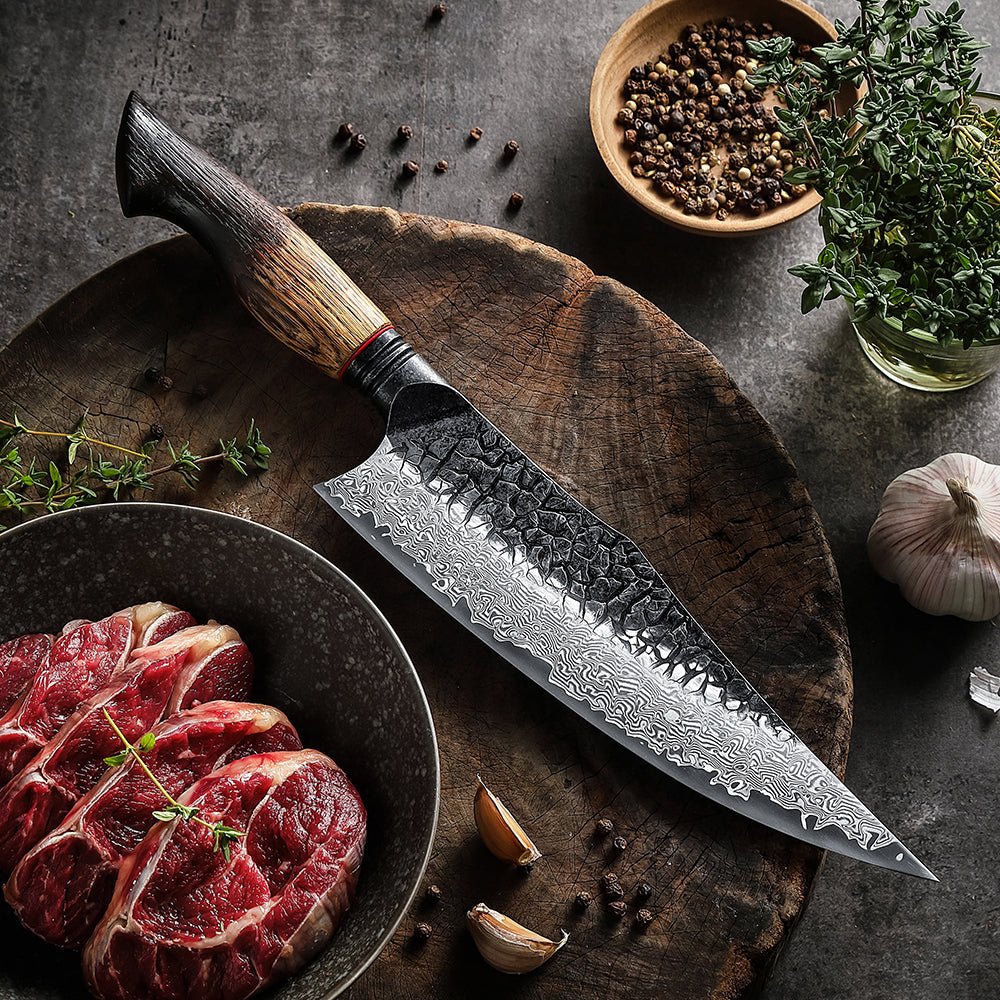
Powder metallurgy steels, premium handle materials, better fit and finish. The Lan Series 8.5" Chef Knife sits in this range, using 14Cr14MoVNb powder steel at 62-64 HRC with 73-layer Damascus cladding. You're paying for tighter tolerances, better distal taper, and handle materials that age well.
$300+ AUD: Specialist
ZDP-189, R2/SG2 powder steel, custom handles. These are genuinely excellent tools, and the performance ceiling is real. But the practical gap between a $150 knife and a $400 knife is much smaller than the gap between a $40 knife and a $150 knife. Buy into this tier because you enjoy the craft of sharp things, not because you think it'll make your stir-fry better.
Where to start?
If you're buying your first good chef knife, start in the $80-$150 range with a Japanese-style stainless steel chef knife. Spend the savings on a decent whetstone. A sharp mid-range knife outperforms a dull expensive one every single time.
How Do You Spot a Bad Chef Knife?
Vague steel descriptions. "Made from high carbon steel" or "premium stainless steel" with no actual steel grade or HRC rating listed. Any manufacturer proud of their steel will tell you exactly what it is.
Damascus at $30. Real Damascus cladding costs money to produce. A "Damascus" knife at $30-40 AUD is almost certainly etched or printed to look like Damascus. We wrote a full guide on how to tell real Damascus from fake.
No HRC rating anywhere. Hardness is the most basic performance specification for a blade. If the listing doesn't mention it, that's a red flag.
"Never needs sharpening." Every knife needs sharpening. Every single one. Any claim to the contrary is either ignorance or dishonesty.
What Is the Three-Knife Kitchen Setup?
You don't need a 15-piece knife block. You need three knives:
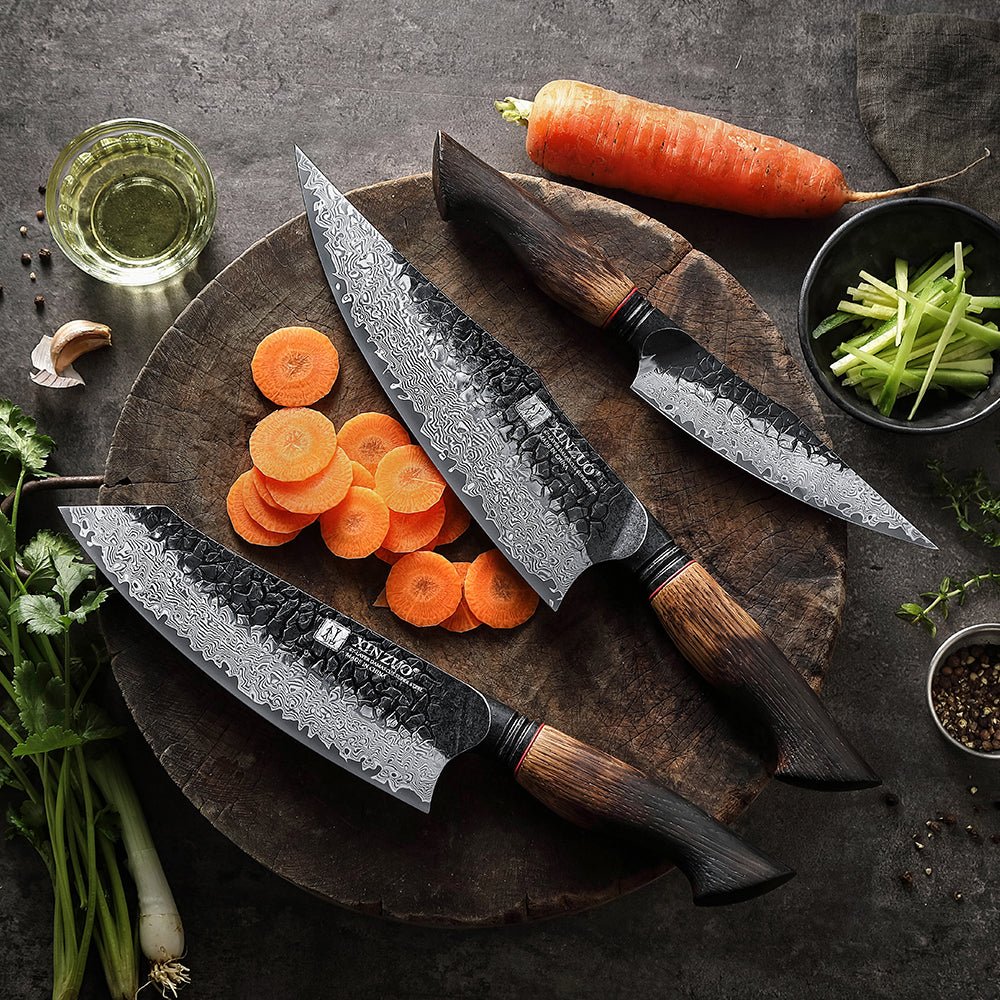
- A chef knife (8" or gyuto 210mm). This does 80-90% of all your cutting.
- A paring knife or petty knife (3-5"). For everything too small for a chef knife. Peeling, deveining prawns, hulling strawberries.
- A bread knife (9-10", serrated). Bread, cakes, anything with a hard exterior and soft interior.
Spend your money on one excellent chef knife rather than spreading it across seven mediocre ones.
How Do You Keep Your Chef Knife Sharp?
A good knife that you never maintain is just an expensive dull knife. Here's a concrete schedule.
Before Each Use: Hone
Run the blade along a honing rod 5-10 times per side at your sharpening angle (15 degrees for Japanese, 20 degrees for German). This straightens the microscopic burr that develops during use. For Japanese steel at 58+ HRC, use a ceramic honing rod. A traditional steel rod is too aggressive on harder steels and can cause micro-chipping.
Every 3-6 Months: Sharpen
This is where you actually remove metal to create a new edge. A 1000-grit whetstone is the only stone most home cooks need. If you want a finer finish, follow with a 3000 or 6000-grit. Our whetstone sharpening guide walks through the full process. If you don't want to learn freehand sharpening, a professional service costs $10-20 per knife.
Daily Care
- Hand wash with soap and water. Dry immediately.
- Use wood or plastic cutting boards only. Glass and ceramic boards destroy edges.
- Store on a magnetic strip, in a knife guard, or in a block. Never loose in a drawer.
SHOP CHEF KNIVES SHOP WHETSTONES
Sources
- Larrin Thomas, Knife Steel Nerds. CATRA edge retention testing data, carbide distribution research, and edge geometry analysis.
- Stone, R. T., et al. (2018). "Ergonomic Analysis of Modern Day Kitchen Knives." Proceedings of the Human Factors and Ergonomics Society Annual Meeting.
- Claudon, L. and Marsot, J. (2006). "Effect of knife sharpness on upper limb biomechanical stresses." International Journal of Industrial Ergonomics, 36(3), 239-246.
Related Articles
- Santoku vs Chef Knife: Which Should You Buy?
- Real Damascus Steel vs Fake: How to Tell the Difference
- German vs Japanese-style Kitchen Knives
- Knife Steel Hardness Guide (HRC Explained)
- How to Sharpen Knives with a Whetstone
Frequently Asked Questions
How much should you spend on a good chef knife?
Between $80 and $150 AUD gets you a genuinely good chef knife with Japanese-style stainless steel (58 to 62 HRC), thin geometry, and proper heat treatment. Below $60 you are paying for soft steel that dulls fast. Above $200 you hit diminishing returns unless you specifically want powder steel or premium handle materials.
What size chef knife is best for home cooking?
An 8-inch (200mm) chef knife suits most home cooks. It is long enough to handle large vegetables and proteins but short enough to feel controlled. If you have smaller hands or a compact kitchen, a 6-inch works for lighter prep. If you cook for four or more regularly, consider an 8.5-inch gyuto for the extra reach.
Are expensive chef knives worth the price?
Up to about $150 AUD, yes. Each price jump buys better steel, thinner blade geometry, and longer edge retention. Past $200, the improvements are smaller and more about handle materials, aesthetics, and niche steel properties. A $100 knife with proper care will outperform a $300 knife that gets thrown in a drawer.
Should I buy a Japanese or German chef knife?
Japanese if you want a lighter, sharper knife that excels at precision cutting and holds its edge longer. German if you want a heavier, more durable knife that tolerates rough use and lateral force. Most home cooks who prep vegetables and boneless proteins daily prefer Japanese-style blades. If you regularly break down bone-in cuts or want a knife that forgives bad technique, go German.
What Rockwell hardness (HRC) is best for a chef knife?
58 to 62 HRC is the sweet spot for home use. Below 56 HRC (most German knives) the edge dulls within a few days of regular use. Above 62 HRC the steel holds an edge for weeks but chips more easily if you twist the blade or hit bone. Xinzuo's 10Cr15CoMoV steel sits at 60 to 62 HRC, which balances edge retention with toughness.