


What Are the Main Types of Japanese Kitchen Knives?
First Japanese-style Knife? Start Here.
If you're buying your first Japanese-style knife, get a 210mm (8-inch) gyuto or a 180mm (7-inch) santoku. Either one handles 80 to 90 percent of kitchen tasks. The gyuto is more versatile overall. The santoku is lighter and better suited to vegetable-heavy cooking. Everything else on this page is a specialist tool you add later, if and when you actually need it.
What Are the Actual Differences Between Japanese and Western Knives?
Japanese-style blades are made from harder steel, ground thinner, and sharpened to a more acute angle. This means they cut with less effort and produce cleaner slices. The tradeoff is that they're less forgiving. You can't torque them sideways through a butternut squash or use them to crack open a lobster shell without risking a chipped edge. They reward good technique and punish bad habits.
The weight difference is the thing that surprises most people. Pick up a 210mm gyuto after years of using a heavy German chef knife and it feels almost dangerously light. That lightness translates directly to less fatigue during long prep sessions, which is why professional cooks tend to gravitate toward Japanese steel once they try it.
Which Japanese Knife Types Are Most Useful?
I've organised these not alphabetically but by how likely you are to actually use them in a home kitchen. The essential knives get the most detail. The specialist ones get honest assessments of whether you need them.

Tier 1: The Essential Japanese-style Knives
These are the knives that do real, daily work. If you're building a Japanese-style knife collection, start here and don't move to Tier 2 until you've genuinely outgrown what these can do.
Gyuto (The Japanese-style Chef Knife)
Length: 210-240mm | Profile: Curved belly, pointed tip | Bevel: Double
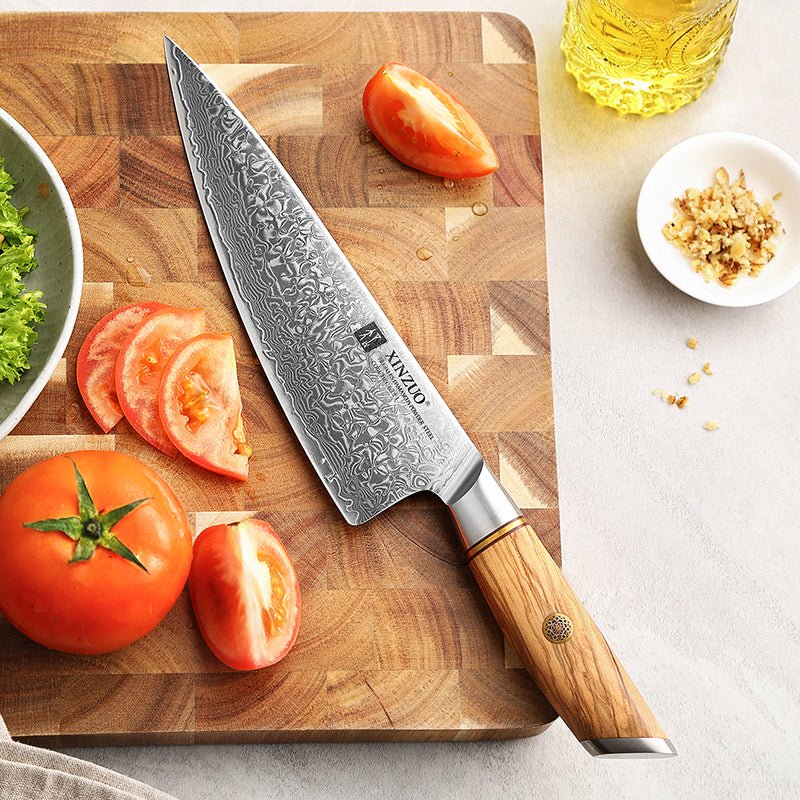
The gyuto is the Japanese interpretation of the French chef knife, originally developed during the Meiji period (1868-1912) when Japanese swordsmiths began adapting Western blade designs using their own metallurgy and grinding techniques. The result was a knife that kept the versatile curved profile of a European chef knife but made it thinner, lighter, and sharper.
A 210mm gyuto handles about 90% of what happens on a cutting board. Dicing onions, breaking down herbs, slicing proteins, mincing garlic, cutting through dense root vegetables. The curved belly allows for a gentle rocking motion when you want it, while the flatter profile (compared to a German chef knife) also suits push-cutting.
For a deeper comparison of the gyuto against Western chef knives, see our chef knife buying guide.
Santoku ("Three Virtues")
Length: 165-180mm | Profile: Flatter belly, sheepsfoot tip | Bevel: Double
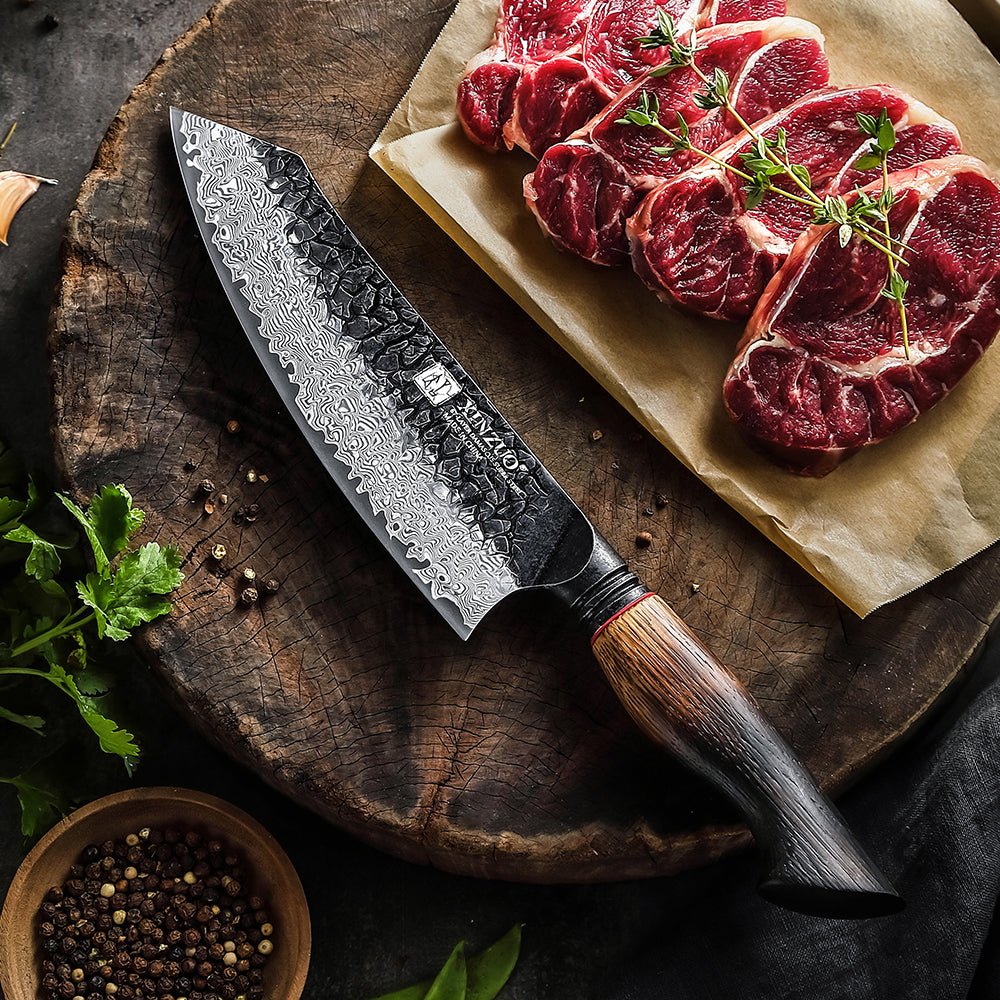
The santoku is the most popular knife in Japanese home kitchens. Its name means "three virtues," referring to its ability to handle meat, fish, and vegetables equally well. It emerged in the 1940s in the Kansai region as a post-war fusion design, combining the flat edge geometry of traditional Japanese vegetable knives with the pointed tip and versatility of Western chef knives.
Compared to a gyuto, the santoku is shorter, lighter, and has a flatter edge profile. This makes it a natural push-cutter. If your cooking leans heavily toward vegetables, stir-fries, and the kind of precise, repetitive prep that defines a lot of Australian home cooking (weeknight Asian-fusion, salads, meal prep), the santoku is arguably a better daily driver than the gyuto.
Where the santoku falls short is with larger items. Halving a cabbage, carving a roast, working with a big watermelon. The shorter blade length means less reach. We wrote a detailed santoku vs chef knife comparison if you're deciding between the two.
Nakiri (Vegetable Knife)
Length: 160-180mm | Profile: Flat blade, squared tip | Bevel: Double
The nakiri is the most underrated knife in the Japanese lineup. It does one thing extraordinarily well: cut vegetables. The completely flat blade edge makes full contact with the cutting board in a single downward stroke, which means your brunoise is actually uniform and your julienne doesn't leave that annoying connected bit at the bottom.
If you cook a lot of vegetables (and in Australia, where Saturday markets are a way of life and plant-forward eating is mainstream), a nakiri changes the experience completely. It handles everything from paper-thin shallot slices to breaking down butternut pumpkin. The wide, flat blade also works as a scoop for transferring chopped ingredients from board to pan.
The nakiri is NOT a replacement for a gyuto or santoku. It has no pointed tip, so detail work (deveining prawns, scoring meat, trimming silver skin) is out. Think of it as the specialist that partners with your main knife. For more detail, see our full nakiri guide.
Petty (Japanese Utility / Paring Knife)
Length: 120-150mm | Profile: Miniature gyuto shape | Bevel: Double
Every knife set needs a small knife, and the petty fills that role in a Japanese kitchen. It handles the tasks that are awkward with a full-size blade: peeling ginger, deveining prawns, segmenting citrus, trimming fat, slicing small fruits, mincing a single shallot when you don't want to pull out the big knife.
The 150mm petty is particularly versatile. It's large enough to work on a cutting board for light prep but small enough for in-hand work. If you're choosing between a 120mm and a 150mm, go with the 150mm. It covers more ground.
Tier 2: Worth Knowing About
These knives fill real gaps for specific cooking styles. You don't need them to start, but once you know your way around a Japanese-style knife, they're genuinely useful additions.
Bunka (K-Tip All-Purpose)
Length: 165-180mm | Profile: Angular reverse-tanto tip, flat belly | Bevel: Double
The bunka is having a moment right now, and for once the hype is mostly justified. Think of it as a santoku with a more angular, pointed tip (sometimes called a k-tip or reverse-tanto). This gives you the flat-blade vegetable cutting ability of a santoku combined with a sharp tip that's actually useful for precision work, scoring, and piercing.
For cooks who want one knife that handles both vegetables and more delicate protein work, the bunka might be a better pick than either a santoku or a nakiri. Read our bunka knife guide for more detail.
Kiritsuke (Multi-Purpose)
Length: 210-270mm | Profile: Angular tip, flatter profile | Bevel: Traditionally single, modern versions double
Traditionally, the kiritsuke was a single-bevel knife that only the head chef in a Japanese kitchen was allowed to use. It functioned as both a yanagiba (slicer) and usuba (vegetable knife), and carrying one signified rank and skill.
Modern double-bevel kiritsuke-style knives have dropped the status symbol baggage and kept the profile: a longer, flatter blade with an angular tip. They're essentially stretched-out bunka knives. If you like the gyuto's length but prefer a flatter cutting profile, a kiritsuke-style gyuto is worth considering.
Sujihiki (Japanese Slicer)
Length: 240-300mm | Profile: Long, narrow, slight curve | Bevel: Double
The sujihiki is the Japanese answer to the Western carving knife. Long, narrow, and designed for slicing cooked proteins in single, smooth strokes. If you regularly host Sunday roasts, carve brisket from your weekend BBQ smoke session, or slice cured meats, a sujihiki makes those tasks noticeably better.
That said, this is a single-purpose knife. If you carve a roast once a month, your gyuto can handle it.
Tier 3: Specialist Knives (Most Home Cooks Don't Need These)
Unless you have specific needs that match these tools, your money is better spent on a higher-quality version of a Tier 1 knife.
Deba (Fish Butchery Knife)
Length: 150-210mm | Bevel: Single
Built for breaking down whole fish. Thick enough to cut through fish bones and cartilage, with a single-bevel edge for precise filleting. If you aren't regularly buying whole fish and breaking them down yourself, you don't need one. Your gyuto handles the occasional whole fish just fine.
Yanagiba (Sashimi Knife)
Length: 240-360mm | Bevel: Single
The yanagiba exists for one purpose: slicing raw fish for sashimi and sushi. The long, single-bevel blade allows you to cut through fish in one continuous pull stroke, which matters because multiple back-and-forth cuts damage cell walls and affect both texture and appearance. If you're serious enough about sashimi to notice the difference, you probably already own one. For everyone else: your gyuto or sujihiki will produce perfectly good sashimi at home.
Honesuki (Poultry Boning Knife)
Length: ~150mm | Bevel: Typically single or asymmetric double
A stiff, triangular blade designed for breaking down poultry. If you spatchcock a lot of chickens or regularly debone thighs, a honesuki makes the job faster and cleaner. If you break down a chicken once a week or less, a petty knife works fine.
The honest assessment:
Deba, yanagiba, and honesuki are professional tools designed for cooks who perform specific tasks hundreds of times a week. In a home kitchen, they sit in the drawer 95% of the time. If you're tempted by one, ask yourself: "Would I use this every week?" If not, put that money toward a better gyuto or santoku instead.
Which Knife Should You Buy First?
What Steel and Handle Types Are Used in Japanese-Style Knives?
You don't need a materials science degree to buy a good knife, but understanding the basics helps you make sense of price differences.
For most home cooks, the VG-10 / 10Cr15CoMoV tier is the sweet spot. For a deeper look at how steel hardness affects performance, see our knife steel and hardness guide, or our VG-10 vs 10Cr15CoMoV comparison.
Wa vs Western Handles
Wa handles (traditional Japanese) are octagonal or D-shaped, made from wood, and attached with a partial tang. They're lighter, which shifts the balance forward toward the blade. Less hand fatigue, more blade-forward control.
Western handles use a full tang riveted into a contoured handle. They feel heavier and more substantial. If you're coming from a European knife tradition, Western-handled Japanese-style knives provide a familiar grip while still giving you the harder steel and thinner grind.
Neither is better. Many cooks end up preferring wa handles for lighter knives (petty, nakiri) and Western handles for heavier-duty work (gyuto).
How Do You Care for Japanese-Style Knives?
Sharpening: Use a ceramic honing rod for regular touch-ups (every few uses) and a whetstone every 3 to 6 months. Do not use a steel honing rod on Japanese steel at 58+ HRC. It will chip the edge rather than realign it. Our whetstone sharpening guide covers the full process.
Washing: Hand wash with dish soap and warm water. Dry immediately. Never put a Japanese-style knife in the dishwasher.
Cutting surface: Wood or plastic boards only. Glass, marble, and ceramic boards will dull or chip the edge rapidly.
Storage: Magnetic knife rack, knife guard, or a dedicated block. Never loose in a drawer.
What to avoid: Frozen food, bones (unless using a deba), and anything that requires twisting the blade laterally.
How Do You Build a Japanese Knife Collection?
The best approach to buying Japanese-style knives is sequential, not simultaneous. Start with one good knife, learn how it handles, develop your technique, and then add a second knife that fills a gap you've actually noticed in your cooking.
BROWSE ALL JAPANESE-style KNIVES SHOP CHEF KNIVES
Related Reading
- Santoku vs Chef Knife: Which One Should You Buy?
- How to Choose a Chef Knife: The Complete Buying Guide
- German vs Japanese-style Kitchen Knives
- Nakiri Knife Guide
- Gyuto Knife Guide
- Bunka Knife Guide
- Knife Steel and Hardness Guide
- Real Damascus Steel vs Fake
Frequently Asked Questions
What is the difference between single-bevel and double-bevel Japanese-style knives?
Single-bevel knives (deba, yanagiba, usuba) are ground on one side only, creating an asymmetric edge that steers during cuts and produces extremely clean slices on fish and vegetables. They require hand-specific models (right or left) and specialised sharpening technique. Double-bevel knives (gyuto, santoku, nakiri, bunka) are ground equally on both sides, work for any hand, and sharpen the same way as Western knives. Home cooks should start with double-bevel.
What Japanese-style knife should I buy first?
A 210mm gyuto or a 180mm santoku. The gyuto is longer and more versatile for proteins and large vegetables. The santoku is lighter and more compact for vegetable-heavy cooking. Either one handles 80 to 90% of daily kitchen tasks. Add specialist knives like a nakiri, petty, or sujihiki later once you have identified a gap in your setup.
How many Japanese-style knives does a home cook need?
Two to three. A gyuto or santoku for general prep, a petty knife (120 to 150mm) for peeling and detail work, and optionally a bread knife or nakiri if you eat a lot of bread or vegetables. Professional kitchens may use five or six specialised shapes, but most home cooks reach for the same two knives 90% of the time.
Why are Japanese-style knives thinner and lighter than Western knives?
Japanese bladesmiths use harder steel (58 to 67 HRC vs 54 to 58 HRC for German knives), which allows a thinner grind and a more acute edge angle (10 to 15 degrees per side vs 18 to 22 degrees). Thinner geometry means less resistance through food, so the blade does not need the extra weight. A 210mm gyuto weighs 140 to 180g compared to 200 to 260g for a Western chef knife of the same length.
Can you put Japanese-style knives in the dishwasher?
No. The combination of harsh detergent, high heat, and jostling against other items will dull or chip the edge and can corrode even stainless steel. Hand wash with warm soapy water, dry the blade immediately with a towel, and store on a magnetic rack or in a blade guard. This applies to all Japanese-style kitchen knives regardless of steel type.