

What Is a Gyuto and Why Is It Japan's Answer to the Chef Knife?
If you could only own one knife, most Japanese-style knife enthusiasts would tell you the same thing: get a gyuto.
The gyuto (牛刀, literally "beef sword") is Japan's interpretation of the Western chef knife. It emerged in the late 19th century when Japanese bladesmiths started forging knives for Western-style cooking, and what they produced was something genuinely different from the French and German chef knives that inspired it. Thinner. Lighter. Harder steel. A geometry that prioritises clean cuts over brute force.
Today, the gyuto is the most popular Japanese-style knife style worldwide, and for good reason. It handles about 90% of kitchen tasks with more precision than a traditional Western chef knife, while still being versatile enough for daily cooking. Whether you are breaking down vegetables, portioning proteins, or mincing herbs, the gyuto does it all with less effort and cleaner results.
This guide covers everything you need to know before buying one: how it compares to Western chef knives and santokus, what blade length and steel to look for, handle options, technique adjustments, and which gyuto fits your cooking style.
- Type: Japanese all-purpose chef knife
- Blade length: 180mm to 270mm (210mm and 240mm most common)
- Edge angle: Typically 12-15° per side (vs 20° for Western knives)
- Steel hardness: Usually 60-67 HRC
- Best for: Slicing, dicing, mincing, chopping vegetables, portioning meat and fish
- Not ideal for: Splitting bones, frozen food, heavy cleaver work
What Actually Changes Between a Gyuto and a Western Chef Knife?
On first glance, a gyuto and a French or German chef knife look similar. Same general profile. Same curved belly. Same pointed tip. But pick them both up and start cutting, and the differences become obvious fast.
The core distinction is blade geometry. A gyuto is ground thinner behind the edge, often significantly thinner. Where a typical German chef knife might be 2.5mm thick at the spine, a gyuto is often 1.8-2.2mm. That might not sound like much on paper, but it completely changes how the knife moves through food. Less material means less resistance. The blade parts food apart rather than pushing through it, which is why carrots and potatoes feel almost effortless with a good gyuto.
| Feature | Gyuto | Western Chef Knife |
|---|---|---|
| Blade thickness | 1.8-2.2mm spine | 2.5-3.0mm spine |
| Edge angle | 12-15° per side | 18-22° per side |
| Steel hardness | 60-67 HRC | 54-58 HRC |
| Weight (210mm) | 140-180g | 200-260g |
| Profile | Flatter belly, more tip curve | Pronounced continuous curve |
| Edge retention | Longer (harder steel) | Shorter (softer, easier to hone) |
| Cutting style | Push cuts and pull slices | Rock chopping |
| Durability | More chip-prone (harder steel) | More forgiving |
The harder steel matters more than people realise. Because gyuto blades are heat-treated to 60+ HRC (compared to 54-58 for most German knives), the edge holds its sharpness much longer. You will sharpen a gyuto far less often than a Wusthof or Zwilling. The tradeoff is that harder steel is more brittle, so you cannot twist the blade laterally or use it on bones without risking chips.
Weight is the other big difference. A gyuto feels almost nimble compared to a German chef knife of the same length. After an hour of prep, your wrist notices.
When Should You Choose a Gyuto Over a Santoku?
This is the comparison most people actually care about when they are choosing their first Japanese-style knife. Both the gyuto and the santoku are all-purpose knives, but they approach the job differently.
The santoku has a flatter edge profile and a wider blade. It excels at up-and-down chopping motions and works brilliantly for vegetables, which makes sense given that "santoku" translates to "three virtues" (slicing, dicing, and mincing). The wider blade also acts as a convenient scoop for transferring ingredients from board to pan.
The gyuto has more belly curve and a pointier tip. That gives you better reach for detail work, easier rocking motion when you need it, and more control when breaking down proteins. It is also typically longer than a santoku, which means you can process larger items without multiple strokes.
| Task | Better Knife | Why |
|---|---|---|
| Dicing onions | Either | Both handle this equally well |
| Slicing raw fish | Gyuto | Longer blade, more tip control |
| Mincing herbs | Gyuto (slight edge) | Belly curve allows gentle rocking |
| Rapid vegetable prep | Santoku | Flatter profile suits quick chopping |
| Breaking down a chicken | Gyuto | Pointed tip for precision work around joints |
| Scooping from board | Santoku | Wider blade works like a bench scraper |
| Large butternut squash | Gyuto | Longer blade and thinner geometry |
The short version: if your cooking is mostly vegetable-heavy Asian or home-style prep, a santoku is fantastic. If you want one knife that can handle every style of cooking, from delicate fish work to big roasts, the gyuto has broader range.
What Gyuto Blade Length Should You Choose?
Gyutos come in a range of lengths, but three sizes cover 95% of what people actually buy. Each has a sweet spot.
180mm (7 inches): The Compact Option
This is the shortest gyuto you will commonly find, and it suits people who work on smaller cutting boards, have compact kitchens, or simply feel more comfortable with a shorter blade. It handles most daily cooking tasks well, but you will notice the limitation when slicing through a large cabbage or watermelon. If you are coming from a santoku, the 180mm gyuto feels familiar in terms of reach.
210mm (8.2 inches): The Standard
This is the most popular gyuto length worldwide, and for most home cooks it is the right choice. It gives you enough blade to work through large onions and squash in single strokes while still being manageable in a home kitchen. If you are buying your first gyuto and you are not sure what length to get, 210mm is the safe bet.
240mm (9.4 inches): The Professional Length
Professional chefs overwhelmingly prefer 240mm because the extra length means fewer strokes and faster prep. More blade in contact with the board means more food processed per cut. It does require a larger cutting board and a bit more practice to control, but once you are comfortable with it, going back to a shorter knife feels limiting. If you do a lot of cooking or want to level up your knife skills, seriously consider 240mm.
Why Does Steel Hardness Matter for Gyuto Knives?
Steel choice affects three things you will notice every time you use the knife: how sharp it gets, how long it stays sharp, and how tough it is against chips and damage. For gyutos, this conversation revolves around hardness (measured on the Rockwell C scale, or HRC).
Most quality gyutos fall between 60 and 67 HRC. For context, your typical German chef knife sits around 56-58 HRC. That gap is significant.
What Higher Hardness Gets You
Harder steel can be ground to a more acute angle and hold that angle longer. A gyuto at 62 HRC can maintain a 12-degree edge that would roll or deform in minutes on a softer blade. This translates directly into sharper cuts, cleaner cell separation in food (which affects flavour and oxidation), and longer intervals between sharpening sessions.
Common Gyuto Steels
VG-10 (60-62 HRC): The workhorse of Japanese-style kitchen knives. VG-10 offers a great balance between hardness, corrosion resistance, and ease of sharpening. It takes an excellent edge and holds it well without being overly brittle. This is the steel you will find in most mid-range to high-end gyutos, and for good reason. It is a "set it and forget it" kind of steel that works beautifully for home cooks who want performance without fuss.
SG2/R2 Powder Steel (63-64 HRC): A step up in edge retention and refinement. Powder metallurgy steels have a very fine grain structure that allows for an incredibly keen edge. They cost more and are slightly harder to sharpen at home, but the performance difference is noticeable.
High-carbon steels like Aogami/White Steel (62-67 HRC): These reach the highest hardness levels and take the sharpest edges, but they are reactive (they rust and patina without care). Mostly found in traditional single-bevel Japanese-style knives, though some gyutos use them.
For most people buying their first or second gyuto, VG-10 steel at 60-62 HRC is the sweet spot. You get genuine Japanese-style knife performance with stainless convenience.
Should You Choose a Wa-Handle or Western Handle?
Gyutos come with two fundamentally different handle styles, and this is mostly about personal preference.
Wa-Handle (Japanese Style)
Traditional octagonal or D-shaped wooden handles. They are lighter, which shifts the balance point forward toward the blade. Many people find this gives better control for precision cuts. Wa-handles are typically made from magnolia or ho wood and can be replaced when worn. The feel is distinctly different from what most Western cooks are used to, and there is an adjustment period.
Western Handle (Yo-Handle)
Riveted handles similar to what you find on European knives. These feel immediately familiar if you have been cooking with German knives, and they tend to be more comfortable for people who use a full grip (palm wrapped around the handle). They also handle moisture well and require zero maintenance.
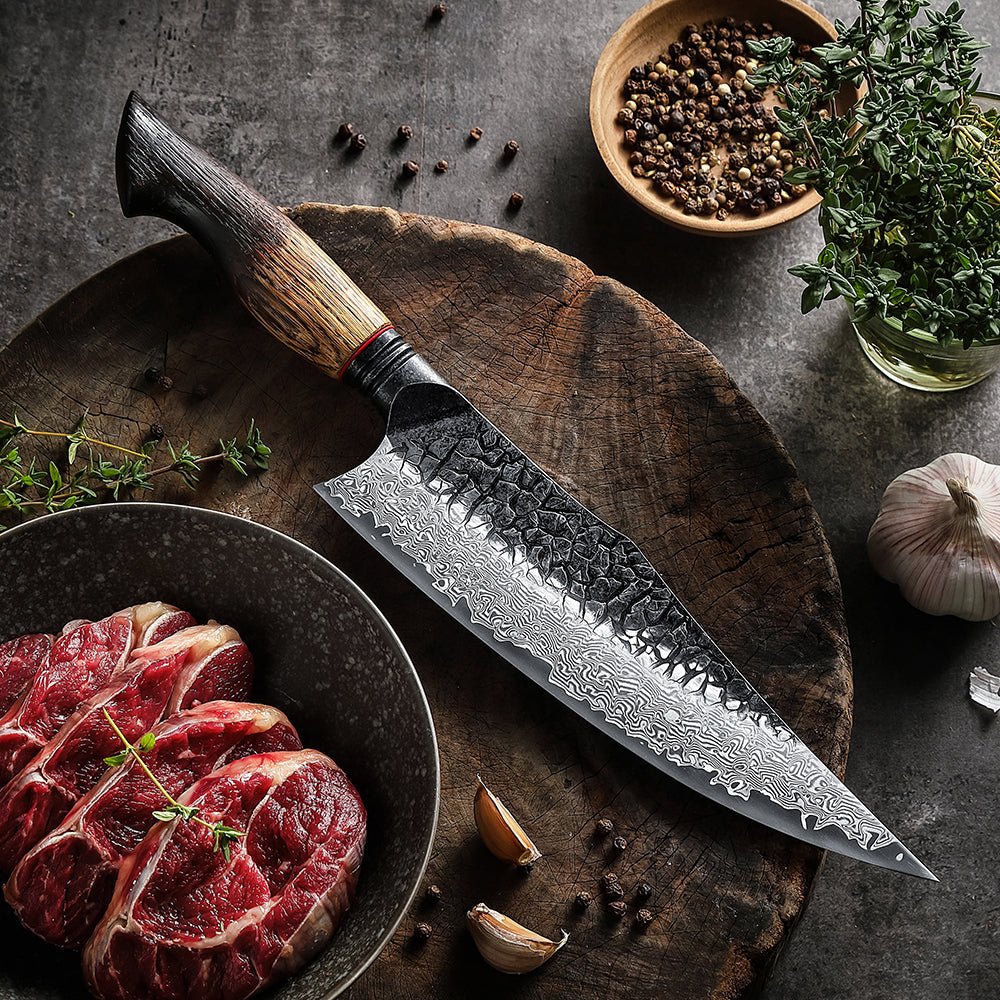
Neither style is objectively better. If you pinch-grip the blade (thumb and index finger on the spine of the blade, which is the technique most professionals use), a wa-handle is wonderful because the lightweight handle lets the blade do the work. If you grip the handle itself, a Western handle will feel more secure and natural.
How Does a Gyuto Change Your Cutting Technique?
If you have spent years rock-chopping with a German chef knife, a gyuto will gently nudge you toward different techniques. You do not have to change overnight, but the knife rewards certain motions more than others.
Push Cutting
This is the technique a gyuto was born for. You push the blade forward and down through the ingredient in a single diagonal motion, lifting the blade fully between cuts. It produces the cleanest cuts because the thin edge slices rather than crushes. Once you get the rhythm down, push cutting is fast, quiet, and incredibly satisfying. Your onion dice will look noticeably better.
Pull Slicing
For proteins especially, drawing the blade toward you through the ingredient (using the full length of the edge) produces smooth, clean slices. This is where the gyuto's length advantage over a santoku really shows. A long pull slice through a piece of salmon with a sharp gyuto is one of those moments that makes you understand what all the fuss is about.
Tap Chopping
A quick, vertical chopping motion using the front third of the blade. Great for herbs, green onions, and anything that needs a rough chop rather than precision cuts. The gyuto's pointed tip and slight belly curve make this efficient.
Rock Chopping
Yes, you can still rock-chop with a gyuto. The blade has enough belly curve to support it, especially at 210mm and longer. It just is not the knife's primary strength in the way it is for a heavily curved German blade. Think of it as a secondary technique rather than your default.
The key shift is this: Western chef knives are designed so the edge stays in contact with the board while the blade rocks. Japanese-style gyutos are designed for the edge to move through food in clean, distinct strokes. Both work. The Japanese approach is more precise.
Who Should Buy a Gyuto Knife?
A gyuto is the right knife for you if:
- You want a single knife that handles (almost) everything. From dicing shallots to slicing brisket to mincing garlic, the gyuto covers more ground than any other single knife style.
- You are upgrading from a basic knife set. The jump from a $30 chef knife to a quality gyuto is one of the biggest improvements you can make in your kitchen. Choosing the right chef knife is worth getting right.
- You cook frequently and value efficiency. The thinner blade and sharper edge mean less effort per cut. Over a week of daily cooking, the reduced fatigue adds up.
- You enjoy the process of cooking, not just the results. There is a tactile pleasure to using a well-made gyuto that turns routine prep into something you actually look forward to.
- You are willing to treat it with basic care. That means hand-washing, proper storage (magnetic strip, knife guard, or blade slot), and sharpening on a whetstone when it dulls. If you want to throw your knife in the dishwasher, a gyuto is not for you.
A gyuto is probably not the right knife if you regularly hack through bones, want something dishwasher-safe, or prefer a knife heavy enough to do the work through weight alone. For those situations, a thicker Western chef knife or a dedicated cleaver is a better choice.
Which Xinzuo Gyuto Knives Are Available?
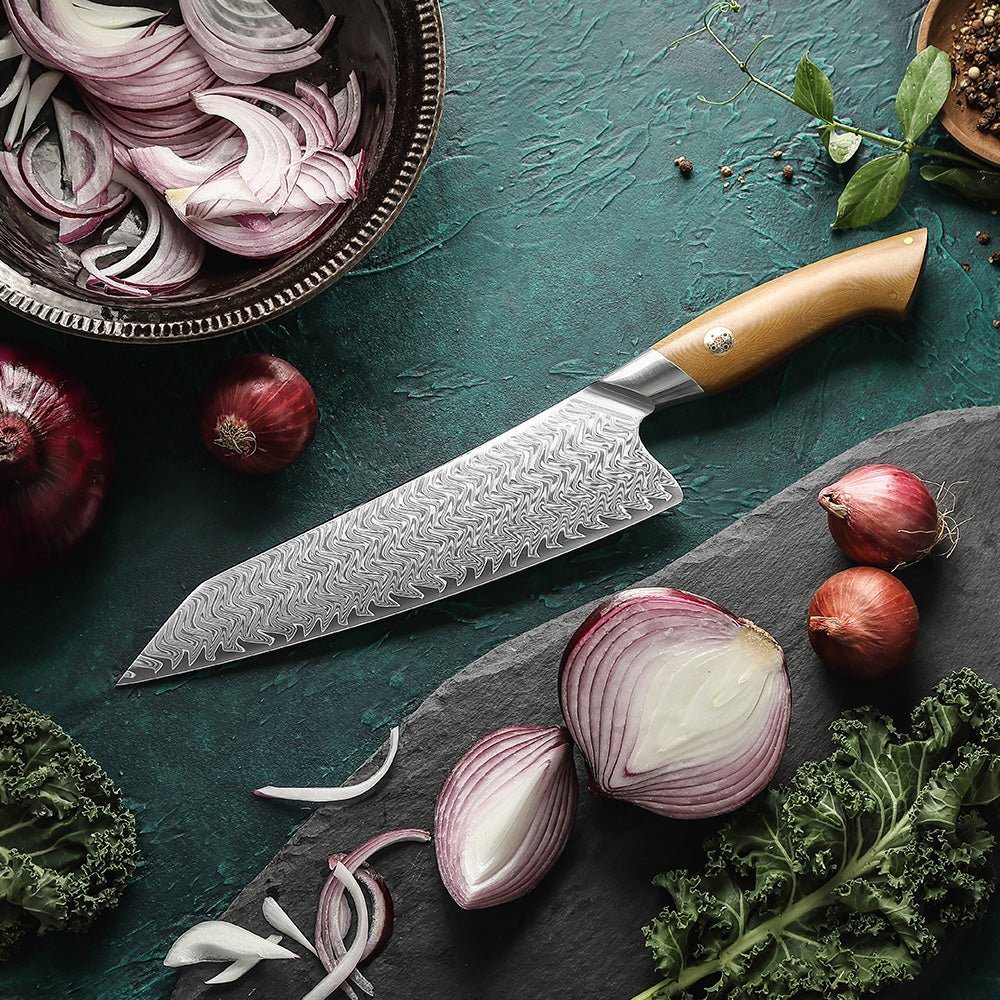
Xinzuo makes several gyuto-style chef knives at different price points, all using 67-layer Damascus-clad VG-10 steel at 60+ HRC. That puts them in a performance bracket that competes with knives costing two to three times as much.
A few things worth noting about the Xinzuo lineup:
- The steel is consistent across series. Whether you pick the Mo Series or the Elegant Series, the core VG-10 blade and 67-layer Damascus cladding are the same. The differences are in handle material, aesthetics, and balance.
- Handle variety is a real strength. The Mo Series uses a pakkawood Western handle for a classic feel. The Elegant Series features ebony wood with a mosaic pin for something more refined. If you want the full Japanese-style knife experience, the options give you room to match your preference.
- The 8.5-inch (215mm) blade length is a practical sweet spot. It is slightly longer than a standard 210mm, giving you a bit more cutting surface without the learning curve of a full 240mm.
For a deeper comparison of how different Xinzuo series stack up against each other, including handle materials, blade profiles, and which series suits which cooking style, check out the Xinzuo series comparison guide.
When evaluating any gyuto (Xinzuo or otherwise), check these five things: blade hardness (60+ HRC minimum), blade thickness at the spine (under 2.2mm is ideal), whether the blade is fully flat-ground or has a hollow grind, handle comfort in your preferred grip, and overall balance point. A well-made gyuto should feel like it almost cuts on its own.
How Should You Care for Your Gyuto Knife?
Japanese-style knives are not high-maintenance, but they do ask for a few basic habits that will keep them performing at their best for decades.
Hand wash only. The dishwasher is the number one killer of good knives. The combination of harsh detergent, heat, and jostling against other items will dull and damage any blade, but especially a thin Japanese edge.
Dry immediately after washing. Even stainless VG-10 can develop spots if left wet. A quick wipe with a towel after rinsing takes three seconds and prevents issues.
Use the right cutting surface. End-grain wood or quality plastic boards. Never glass, ceramic, marble, or steel. Those surfaces will wreck the edge faster than anything else.
Sharpen on a whetstone. Pull-through sharpeners and electric sharpeners remove too much material at inconsistent angles. A 1000/3000 grit combination whetstone is all you need, and sharpening a gyuto takes about ten minutes once you know what you are doing. Most home cooks only need to do this every two to three months.
Store it properly. A magnetic knife strip, individual blade guard, or knife roll. Tossing it in a drawer with other utensils is a guaranteed way to chip the edge and dull the blade.
What Is the Bottom Line on Gyuto Knives?
The gyuto is the most versatile single knife you can own. It brings Japanese precision and cutting performance to the familiar chef knife format, and once you have cooked with one, going back to a thick, heavy Western blade feels like trading a sports car for a truck. Both get the job done, but the experience is completely different.
If you are ready to make the switch, start with a 210mm in VG-10 steel with whichever handle style appeals to you. Learn the push cut. Keep it sharp. Within a week, you will wonder how you ever cooked without it.
Related Reading
- Santoku vs Chef Knife: Which One Should You Choose?
- How to Choose a Chef Knife: The Complete Buying Guide
- Japanese-style Knife Types Explained
- German vs Japanese-style Kitchen Knives
- Knife Steel Hardness Guide
- Knife Technique: Rock Chop, Push Cut, and Pull Slice
- Xinzuo Knives Series Comparison Guide
- Best Kitchen Knives Under $200
Ready to buy? Browse our gyuto-style chef knives.
Frequently Asked Questions
What is a gyuto knife used for?
A gyuto handles about 90% of kitchen tasks: slicing vegetables, portioning boneless proteins, mincing herbs, and dicing onions. It is the Japanese equivalent of a Western chef knife but ground thinner (1.8 to 2.2mm spine vs 2.5 to 3.0mm) with harder steel (60 to 67 HRC), so it cuts with less resistance and holds its edge longer. The curved belly also allows rock-chopping when needed.
Should I get a 210mm or 240mm gyuto?
210mm if you cook on a standard home cutting board and mostly prep onions, carrots, and boneless proteins. 240mm if you regularly work with large cabbages, watermelon, or whole fish fillets, or if you have a board 450mm or wider. Most home cooks are better served by 210mm. Professional cooks and anyone with larger hands or a spacious bench tend to prefer 240mm for the extra reach.
Can you rock chop with a gyuto knife?
Yes. The gyuto has a curved belly that supports a rocking motion, unlike flat-profiled Japanese-style knives such as the nakiri or kiritsuke. The curve is flatter than a German chef knife, so the rocking arc is shallower, but it works well for mincing herbs and garlic. Most gyuto users switch between push-cutting for vegetables and a gentle rock-chop for finer work.
What should you not cut with a gyuto?
Avoid bones, frozen food, hard-skinned produce like whole pumpkin or coconut, and anything that requires twisting or prying the blade sideways. The thinner blade and harder steel (60+ HRC) make a gyuto more chip-prone than a thick German knife. Use a cleaver, deba, or heavy Western chef knife for those jobs.
Is a gyuto better than a santoku for home cooking?
A gyuto is more versatile because it comes in longer lengths (210 to 270mm vs 165 to 180mm), has a pointed tip for detail work, and handles both push-cuts and rock-chops. A santoku is lighter and more compact, which suits cooks with smaller hands or limited board space. For a first Japanese-style knife, a 210mm gyuto covers the widest range of tasks.