


What Are the Essential Knife Techniques Every Cook Should Learn?
Every cutting technique pairs with a specific blade shape. Rock chopping works because a curved belly pivots on the board. Push cutting works because a flat edge meets food all at once. Pull slicing works because a long, thin blade glides through protein with minimal resistance. The technique you use should be dictated by the knife in your hand. When you match them correctly, cutting becomes noticeably easier and your results get cleaner.
What Is the Pinch Grip and Why Should You Start Here?
Before we talk about any cutting motion, we need to talk about how you hold the knife. Every professional cook and every credible knife skills instructor on the planet will tell you the same thing: use the pinch grip.
Here is what that looks like. Your thumb and the side of your index finger pinch the blade itself, right where it meets the handle (the heel or the bolster area). Your remaining three fingers curl around the handle. That is it.
This grip does two things that a handle-only grip cannot. First, it moves the balance point forward so you have actual control over the tip and edge. Second, it lets you steer the blade angle with micro-adjustments of your thumb and forefinger rather than rotating your entire wrist. If you have ever watched a chef move through an onion in eight seconds flat, they were using this grip.
Every technique below assumes you are using the pinch grip. If you are gripping the handle like a tennis racket, none of these motions will feel right, and you will compensate with excess force from your shoulder and forearm. That leads to fatigue and sloppy cuts.
What Is the Rock Chop Technique?
The rock chop is the technique most people learn first, whether they know the name or not. If you have ever seen someone rapidly mince garlic by keeping the tip of the knife on the cutting board and pivoting the blade up and down, that is a rock chop.
How It Works
The tip of the knife stays in contact with the board (or very close to it). Your guide hand holds the food. You lift the heel of the blade, then bring it down and slightly forward through the food. The curved belly of the knife rolls along the board surface, and the cutting happens as the edge makes contact along that arc.
The motion is rhythmic and continuous. You are not lifting the entire knife off the board and slamming it back down. Think of it more like a rocking chair: smooth, controlled, repetitive. Your wrist and forearm do most of the work. Your shoulder should barely move.
Which Knives
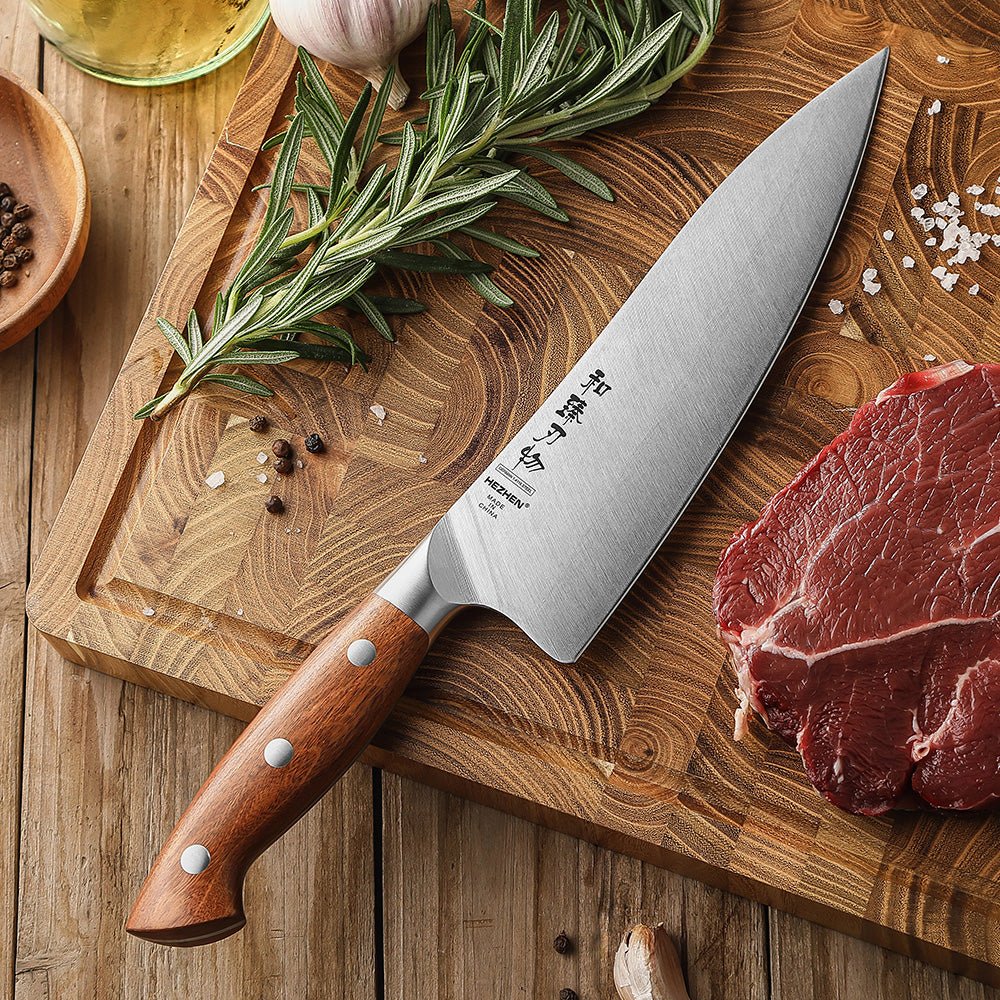
Rock chopping only works well with knives that have a pronounced curve along the belly of the blade. A chef knife with a Western (German) profile is the classic rock-chopping blade. The curve gives you that rolling contact with the board. A gyuto, which is the Japanese equivalent of a Western chef knife, also works for rock chopping, though it typically has a slightly flatter profile that blends rock chopping with push cutting.
Flat-profiled knives like nakiris and santokus are poor rock choppers. There is almost no curve to pivot on, so the motion feels forced and incomplete. If you have been trying to rock chop with a santoku and finding it awkward, you are not doing anything wrong. The geometry just does not support it.
Best Foods
Herbs (parsley, cilantro, basil), garlic, shallots, and anything you want finely minced. The rapid back-and-forth rocking motion lets you reduce food to a fine mince faster than almost any other technique. Rock chopping is also the default motion for general prep work with a curved chef knife: rough-chopping onions, dicing carrots, cutting through peppers.
Common Mistakes
The biggest mistake is lifting the entire knife off the board with each stroke. If the tip leaves the board, you are tap chopping (a different technique) and losing the mechanical advantage of the curved belly. The second mistake is applying too much downward force. If you are pressing hard, your knife is probably dull, or you are fighting the blade geometry with the wrong technique.
What Is the Push Cut Technique?
If the rock chop is the default Western technique, the push cut is its Japanese counterpart. And it is, by the physics, a more efficient way to cut.
How It Works
You lift the knife, then push it forward and down through the food in a single diagonal stroke. The blade moves in two directions simultaneously: forward (away from you) and downward (through the food). When the cut is complete, you lift the knife, reposition, and do it again.
There is no rocking, no pivoting on the tip. The entire edge passes through the food at roughly the same time because the blade is flat. Each cut is a discrete stroke rather than a continuous motion.
The Physics
This is where it gets interesting. In 2004, researchers Atkins, Xu, and Jeronimidis published work on the mechanics of cutting that quantified something experienced cooks already knew intuitively. They found that adding a forward slicing motion to a downward cut, at a slice-push ratio of roughly 3:1, reduced the required downward force to approximately one-tenth of what a straight press-down cut would need.
Read that again. One-tenth the force.
That is not a marginal improvement. That is the difference between pressing a sharp blade through a tomato versus the same blade falling through a tomato. The push cut takes advantage of this by building that forward motion into every stroke. You are not just pressing down. You are slicing forward, and the forward motion does most of the work.
Which Knives
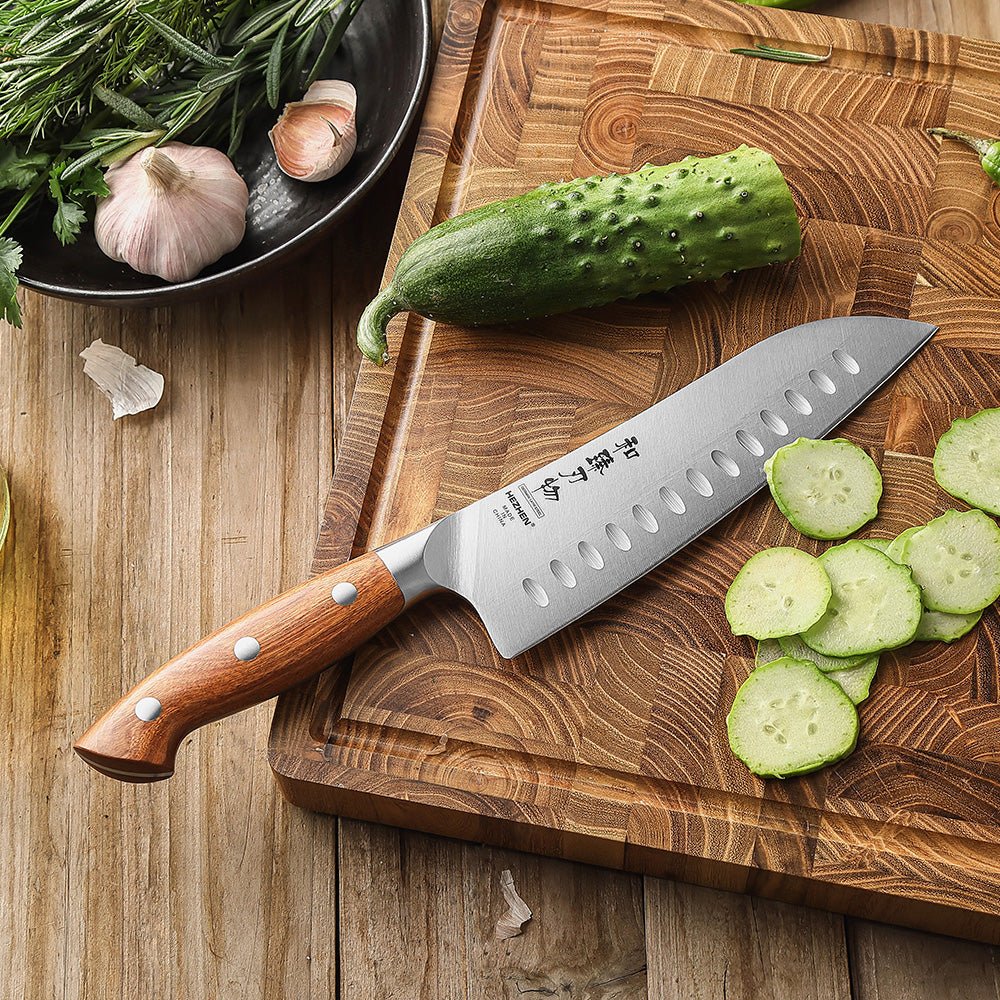
Flat-profiled knives are built for push cutting. A santoku is the most common example. A nakiri is even better for pure push-cutting because its edge is almost perfectly flat from heel to tip. The flat profile means the entire edge contacts the board at the same time, giving you clean, complete cuts without any rocking motion.
This is also why the santoku vs. chef knife debate is somewhat misguided. They are not competing designs. They are tools optimized for different cutting motions.
Best Foods
Vegetables, overwhelmingly. Carrots, daikon, zucchini, sweet potato, cabbage, peppers. Anything where you want uniform slices or precise dice. The push cut gives you more control over thickness than the rock chop because each cut is deliberate and separate. Professional Japanese cooks use this technique for katsuramuki (rotary peeling), which requires exact blade control that a rocking motion cannot provide.
What Is the Pull Slice Technique?
If you have ever watched a sushi chef portion a block of fish, you noticed they draw the blade backward through the fish in a long, smooth stroke. That is the pull slice, sometimes called a draw cut. It produces the cleanest cuts of any technique, and there is a very specific reason why.
How It Works
You place the heel of the knife against the food, then draw the blade backward toward you and slightly downward in one continuous motion. The entire length of the edge passes through the food. You are not pushing, sawing, or pressing. You are pulling, and the blade does essentially all of the work.
The key is that you use the full length of the blade in a single stroke. You start near the heel and finish near the tip. If you need multiple strokes or have to saw back and forth, either the knife is too short, it is dull, or the food needs a different technique.
Why It Creates the Cleanest Cuts
Like the push cut, the pull slice takes advantage of the relationship between slicing motion and cutting force. The long, continuous draw maximizes the slicing component while minimizing downward pressure. Less pressure means less compression of the food, which means less cell damage at the cut surface.
This matters enormously for proteins. When you crush through a piece of fish with a short, forceful chop, you rupture cells well beyond the cut line. Those broken cells leak their contents, which affects texture and promotes faster spoilage. A clean pull slice severs cells only at the cut surface, leaving everything else intact. With sashimi-grade fish, the visual difference is obvious: a clean cut surface looks glossy and translucent, while a crushed cut looks cloudy and matte.
Which Knives
Long, thin, single-bevel or low-angle blades. A yanagiba (the traditional sushi knife) is the gold standard. In a Western kitchen, a long slicing knife or carving knife serves the same purpose. What matters is length. You need enough blade to complete the cut in a single stroke. A short knife forces you to saw, which defeats the entire point.
You can use a chef knife or gyuto for pull slicing if it is long enough (210mm or more), but it will never match a dedicated slicing knife because the blade is thicker and the profile is designed for other tasks.
Best Foods
Raw fish (sashimi), cooked proteins (roast beef, brisket, turkey breast), smoked salmon, terrines. Anything where the integrity of the slice surface matters for texture or presentation.
What Is the Tap Chop Technique?
The tap chop is the simplest motion: lift the knife, bring it straight down. No rocking, no forward push, no backward draw. Pure vertical force. It is the dominant technique in Chinese cooking and it is faster than any other method for high-volume rough chopping.
How It Works
You lift the entire blade off the cutting board, then bring it straight down through the food. The blade hits the board, you lift it, reposition the food slightly with your guide hand, and chop again. Experienced cooks using this technique can move through a pile of vegetables at remarkable speed because the motion is simple and repetitive.
Unlike the rock chop, the tip does not stay on the board. Unlike the push cut, there is no forward component. It is a vertical drop with the weight of the knife doing much of the work.
Which Knives
Chinese cleavers were designed for this technique. They are heavy, flat, and broad. The weight generates the downward force so your arm does not have to. A nakiri also works well for tap chopping because of its flat profile and squared-off shape, though it is lighter than a Chinese cleaver and therefore better suited to softer vegetables.
Curved knives like Western chef knives are poor tap choppers. The curved belly means only a small portion of the edge contacts the food on a straight downward stroke. You will not get a clean, complete cut.
Best Foods
Scallions, ginger, garlic, leafy greens, Chinese vegetables like bok choy, bone-in poultry pieces (with a heavy cleaver). Anything that needs to be reduced to small pieces quickly where precision matters less than speed.
How Do You Match Cutting Technique to Knife Type?
This is the practical summary. If you own multiple knives, this table tells you which technique to default to with each one.
Notice that some knives appear in multiple rows. A nakiri works for both push cutting and tap chopping because it has the flat profile both techniques require. A gyuto can rock chop and pull slice because it has both curve and length. Versatile knives let you switch between techniques, but they will never be as good at any single technique as a knife designed specifically for it.
If you are building a collection, the most effective two-knife setup for home cooking is a gyuto (or chef knife) for rock chopping and general work, paired with a santoku or nakiri for push cutting vegetables. That combination covers 95% of what most people need. If you are unsure where to start, our complete buying guide breaks down the decision in detail.
Why Does Knife Technique Matter More Than You Think?
Most discussions about knife technique focus on speed and efficiency. Both matter. But the food science angle is more interesting and more directly affects what ends up on your plate.
Cell Damage and Oxidation
When you cut through a piece of fruit or vegetable, you rupture cells at the cut surface. Those ruptured cells release enzymes (polyphenol oxidase, primarily) that react with oxygen and cause browning. The more cells you damage, the more enzyme is released, and the faster browning occurs.
A dull knife combined with poor technique crushes its way through food, damaging cells well beyond the cut surface. A sharp knife with the correct technique severs cells cleanly at the cut line and leaves everything else intact. The practical result: apple slices cut with a sharp knife stay white noticeably longer. Basil cut with a sharp knife stays green instead of turning black at the edges. Lettuce cut with a sharp knife does not develop those brown, slimy edges for days longer.
The Onion Problem
Onions contain a sulfur compound called syn-propanethial-S-oxide that is released when cell walls are ruptured. That compound becomes a volatile aerosol that irritates your eyes. The more cells you damage during cutting, the more of this compound is released, and the more you cry.
A sharp knife with proper technique reduces the number of ruptured cells dramatically. Will it eliminate onion tears entirely? No. But the difference between dicing an onion with a dull knife using a sawing motion and dicing it with a sharp knife using clean push cuts is substantial. You will notice.
Grip Force and Fatigue
McGorry, Dowd, and Dempsey published research in 2005 examining the relationship between blade sharpness and the force required to cut. Their findings: sharper blades reduced grip force by more than 20% and cutting effort by nearly 30%. That is not just about comfort. Excessive grip force leads to fatigue, and fatigue leads to loss of control, which leads to inconsistent cuts and, eventually, to injuries.
The correct technique for your knife amplifies this effect. When you fight the blade geometry (rock chopping with a flat knife, or push cutting with a curved knife), you compensate with extra force. You grip harder, press down harder, and work your forearm harder. None of that extra effort produces better results. It just wears you out.
Putting It Together
The combination of a sharp knife, the correct grip, and the right technique for that knife's geometry is not about being fancy or showing off. It is about reducing the total force needed to cut, minimizing cell damage to the food, and keeping your hands and arms from getting tired. Every professional kitchen on the planet operates on this principle. It works just as well in a home kitchen. The only difference is that most home cooks were never shown why it matters.
The takeaway: You do not need to master all four techniques overnight. Start with the one that matches the knife you use most. If that is a chef knife, practice the rock chop. If it is a santoku, practice the push cut. Get the pinch grip right, let the blade do the work, and pay attention to how much less effort it takes when the technique matches the tool. Everything else follows from there.
Related Reading
- Santoku vs. Chef Knife: Which One Should You Buy?
- Japanese-style Knife Types Explained
- How to Choose a Chef Knife: The Complete Buying Guide
- German vs. Japanese-style Kitchen Knives
Frequently Asked Questions
Is push cutting better than rock chopping for vegetables?
For most vegetables, yes. Push cutting produces cleaner cuts with less cell damage because the forward-and-down motion slices through plant cells rather than crushing them. Research by Atkins, Xu, and Jeronimidis found that adding a forward slicing component reduces the required downward force to roughly one-tenth. Push cutting also puts less lateral stress on the blade, keeping the edge sharp longer.
What is the correct way to hold a kitchen knife?
Use the pinch grip. Your thumb and the side of your index finger pinch the blade just ahead of the handle, while your remaining three fingers curl around the handle. This moves the balance point forward for better control and lets you steer the blade angle with small thumb-and-forefinger adjustments. Gripping the handle alone forces you to compensate with wrist and shoulder movements, which causes fatigue and less precise cuts.
Why does my knife crush food instead of cutting cleanly?
Either the blade is dull, the technique lacks a slicing component, or both. A straight press-down chop compresses food before it cuts. Adding forward motion (push cut) or backward motion (pull slice) lets the edge separate cells cleanly with far less downward force. If your knife is sharp and you are still crushing, switch from chopping straight down to a push cut with a forward glide.
What knife technique is best for mincing herbs?
The rock chop. Anchor the tip of a chef knife or gyuto on the board and pivot the heel up and down in a rapid, continuous motion. The curved belly rolls along the board surface, mincing herbs finely with each pass. Flat-edged knives like nakiris and santokus lack the belly curve for this motion, so use a tap chop with those blades instead.
Can you rock chop with a santoku or nakiri knife?
Not effectively. Both knives have a flat or nearly flat edge profile with very little belly curve, so there is no arc for the blade to pivot on. Attempting a rocking motion with a flat blade feels forced and leaves uncut sections where the edge does not contact the board. Use a push cut or tap chop with these knives instead, and save rocking for a chef knife or gyuto.