

What Makes Carbon Steel Kitchen Knives Special?
Carbon steel in 30 seconds
Carbon steel takes a sharper edge than stainless and is easier to sharpen. The trade-off: it rusts if you leave it wet and needs more daily attention. Professional chefs accept this trade because edge quality matters more to them than convenience. Most home cooks are better served by modern stainless steels that get close to carbon performance without the babysitting.
Walk into a professional kitchen and count the knives on the magnetic rack. In Tokyo, Lyon, and increasingly in Melbourne, a significant number of those blades will be carbon steel. Not because those chefs don't know about stainless. Because they tried both and made a deliberate choice.
Understanding why they made that choice, and whether it's the right one for you, requires understanding what carbon steel actually is, how it behaves, and what it demands from the person holding it.
What Is Carbon Steel and How Does It Differ from Stainless?
All knife steel is an alloy of iron and carbon. The carbon is what lets the steel get hard enough to hold a cutting edge. Without enough carbon, you just have soft iron that bends and won't stay sharp.
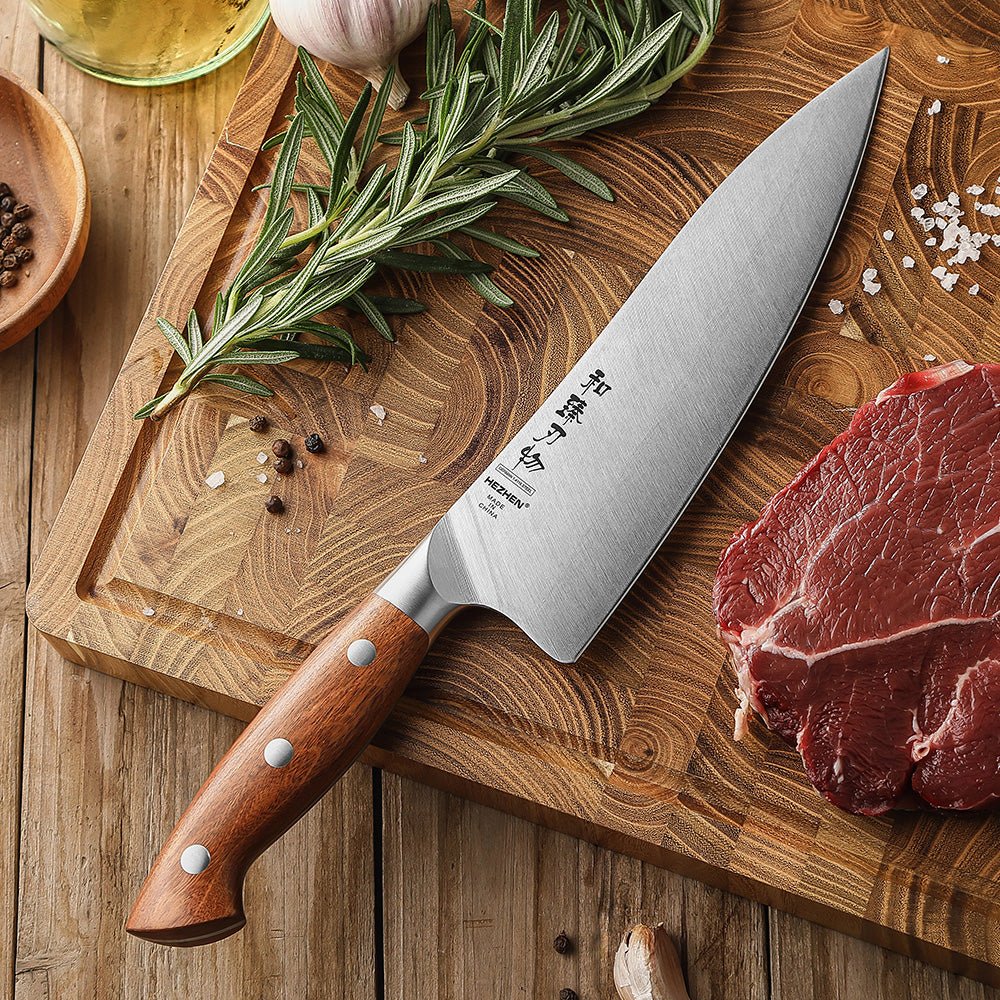
The difference between carbon steel and stainless steel comes down to one element: chromium. Stainless steels contain at least 12 to 13 percent chromium dissolved in the steel matrix, which forms a thin, invisible oxide layer on the surface that resists corrosion. Carbon steel either lacks chromium entirely or has far less than that 12 percent threshold.
That's the entire distinction. Carbon steel is not a mysterious ancient material. It's simply steel that prioritises hardness, edge-taking ability, and ease of sharpening over corrosion resistance. The absence of large chromium carbides in the microstructure means the steel can achieve a finer, more uniform grain, which translates to a keener cutting edge.
Common carbon steels you'll encounter in kitchen knives come from Japanese steel producers, particularly Hitachi Metals. They're categorised by colour-coded paper wrapping at the foundry, which is how we ended up with names like White Steel and Blue Steel.
Why Do Chefs Choose Carbon Steel Over Stainless?
The first time you use a properly sharpened carbon steel knife, the difference is obvious. The blade moves through food differently. Onion cells separate cleanly instead of crushing. Herbs get sliced rather than bruised. The edge bites into tomato skin under its own weight.
Three properties create that experience.
Finer achievable edge. Carbon steel's uniform grain structure allows sharpening to a more acute angle with a smoother, more refined edge. Where a stainless blade at 15 degrees per side might feel sharp, a carbon blade at the same angle feels surgical. The chromium carbides in stainless steel, which provide corrosion resistance, create microscopic irregularities in the edge that limit how refined it can get.
Easier sharpening. Carbon steel responds to a whetstone with noticeably less effort. You feel the stone grabbing the steel and raising a burr quickly and evenly. A carbon blade that's gone dull can be brought back to full sharpness in five minutes on a 1000-grit stone. The same task on stainless might take fifteen. For professional chefs who sharpen daily or every other day, this time savings compounds. For more on sharpening technique, see our whetstone sharpening guide.
Tactile feedback. This one is harder to quantify but chefs talk about it constantly. Carbon steel provides more feedback through the handle during cutting. You can feel the blade engaging with the food in a way that stainless sometimes doesn't communicate as clearly. Some of this is probably the thinner edge geometry that carbon steel permits. Some of it might be confirmation bias. But talk to enough professional cooks and the pattern is consistent.
The collective result is a cutting experience that, once you've had it, makes stainless feel slightly blunt by comparison. That's the hook. That's why chefs tolerate the maintenance burden.
How Do Different Carbon Steel Types Compare?
Not all carbon steels perform identically. The Japanese classification system organises them by composition and intended use.
White Steel is the purest form of carbon steel for kitchen knives. It's essentially just iron and carbon with minimal impurities. White #1 has slightly more carbon than #2 (about 1.3% vs 1.1%), which makes it marginally harder and capable of a slightly finer edge. But White #2 is tougher and more forgiving, which is why it's the more common choice among working blacksmiths. White Steel is what purists chase: the absolute sharpest possible edge with the fastest sharpening response. The cost is that it dulls faster and rusts faster than anything else on this list.
Blue Steel adds tungsten and a small amount of chromium to the mix. These additions form harder carbides that improve wear resistance without dramatically changing the steel's character. Blue #2 is the workhorse, balancing edge retention with reasonable sharpening ease. Blue #1 has more carbon and tungsten, pushing edge retention higher at the cost of making the steel a bit more demanding to sharpen. Both still rust freely and need the same care routine as White Steel.
Blue Super adds molybdenum and vanadium on top of the tungsten. It's the highest-performance carbon steel commonly used in kitchen knives, with edge retention that approaches some stainless steels. The trade-off: it's noticeably harder to sharpen than the other carbon options, which partly defeats the purpose for chefs who value quick touch-ups. Blue Super occupies an interesting middle ground between carbon and stainless philosophies.

What Is the Difference Between Patina and Rust on Carbon Steel?
Within hours of first use, a carbon steel knife starts changing colour. This alarms new owners. It shouldn't.
There are two completely different types of oxidation that happen on carbon steel, and understanding the difference matters.
Patina is a stable oxide layer that forms when the steel reacts with moisture, acids, and proteins in food. It appears as blue, grey, purple, or dark brown discolouration. It's smooth to the touch. It develops gradually and often creates striking, almost marbled patterns on the blade. Patina is not damage. It's the steel doing exactly what it's supposed to do. The oxide layer actually protects the steel beneath it, slowing further corrosion. A well-developed patina makes the knife progressively more resistant to rust over time.
Rust is something else entirely. Rust is orange or reddish-brown. It's rough and pitted. It forms when the steel stays wet without the controlled reaction that produces patina. Where patina protects, rust destroys. It eats into the steel, creating pits that weaken the blade and harbour bacteria.
How to tell them apart
Patina: Blue, grey, purple, or dark brown. Smooth surface. Develops over weeks and months of use. Desirable.
Rust: Orange or reddish-brown. Rough, pitted surface. Forms in hours when left wet. Destructive. If you see orange spots, scrub them off immediately with baking soda paste and a soft cloth, dry the blade, and apply a thin coat of food-safe mineral oil.
Many carbon steel enthusiasts actively cultivate their knife's patina, treating it as a personalised record of everything the blade has cut. A knife that spent its life breaking down onions develops a different patina than one used primarily for slicing fish. Over months and years, each blade becomes genuinely unique.
How Do You Care for Carbon Steel Knives Daily?
The maintenance burden of carbon steel is real but routinely overstated. It comes down to one non-negotiable rule and a few good habits.
The non-negotiable rule: Never leave the blade wet. Not for five minutes. Not while you finish plating. Not while you eat dinner. Wash it, dry it, put it away. This single habit prevents 90 percent of carbon steel problems.
The full daily routine looks like this:
While cooking: Wipe the blade with a damp cloth between ingredients, especially after cutting anything acidic (tomatoes, citrus, onions). This isn't about preventing damage so much as controlling how the patina develops. Unwiped acid contact creates blotchy, uneven discolouration. Regular wiping produces a more uniform patina.
After cooking: Hand wash with warm water and a drop of dish soap. Run a soft sponge along the blade from spine to edge. Rinse. Dry immediately and completely with a clean towel. Return to storage. Total time: under 30 seconds. For a more detailed breakdown, see our daily knife care guide.
For long-term storage: If you're not going to use the knife for more than a few days, apply a thin coat of food-safe mineral oil (or camellia oil, which is traditional in Japan) to the entire blade surface. This creates a barrier against moisture in the air. Store somewhere with good air circulation, not sealed in a sheath.
Absolute rules, regardless of steel type: Never put a carbon steel knife in the dishwasher. Never leave it soaking in the sink. Never store it wet in a drawer. These things will destroy any knife, but they'll destroy a carbon steel knife visibly within a single occurrence.
Is Carbon Steel Right for You?
This is an honest assessment, not a sales pitch.
Carbon steel is right for you if: You already have good knife habits. You wash and dry your knives immediately after use without thinking about it. You enjoy the process of maintaining tools. You sharpen on a whetstone regularly. You cook frequently enough that the knife won't sit unused for weeks. You want the absolute best cutting experience and you're willing to earn it.
Carbon steel is wrong for you if: You're the kind of person who leaves dishes in the sink overnight. Your knives currently go in the dishwasher. You want a knife you can forget about between cooking sessions. You cook sporadically and the knife might sit untouched for weeks. You share a kitchen with people who won't follow the care routine. There's nothing wrong with any of this. It just means carbon steel will frustrate you.
Professional chefs get away with carbon steel because their knives are in constant use. A knife that gets used, wiped, and dried forty times during a service shift naturally develops a heavy protective patina. A home cook's carbon blade that sits on a magnetic rack for three days between uses is far more vulnerable to neglect.
What Stainless Steel Alternatives Offer Similar Performance?
Here's something the carbon steel community doesn't love hearing: modern stainless steels have closed the gap significantly.
Steels like VG-10 and 10Cr15CoMoV at 60 HRC take a genuinely sharp edge. Not quite as refined as White #2, but close enough that most cooks can't tell the difference during normal kitchen tasks. They hold that edge longer than most carbon steels thanks to harder chromium carbides. And they do all of this while being effectively immune to rust under normal kitchen conditions.
The latest generation of stainless powder steels pushes the gap even smaller. At 62 to 64 HRC with finer carbide distribution, they approach carbon steel's edge refinement while maintaining full corrosion resistance. Our VG-10 vs 10Cr15CoMoV guide breaks down the specific performance characteristics, and our hardness guide explains what those HRC numbers actually mean in practice.
Most XINZUO knives use stainless steel, specifically 10Cr15CoMoV and proprietary powder steels. This is a deliberate choice. For the vast majority of home cooks and even many professionals, stainless delivers 90 percent of carbon's cutting performance with 10 percent of the maintenance burden. That's not a compromise. That's good engineering solving a real problem.
If you're drawn to carbon steel's reputation but realistic about your kitchen habits, a high-quality stainless knife in the 60+ HRC range is probably the better call. You'll get excellent edge quality, reasonable sharpening behaviour, and the freedom to cook dinner without worrying about whether you'll remember to dry the knife before sitting down to eat.
Related Reading
- Knife Steel Hardness Guide (HRC Explained)
- Daily Knife Care and Maintenance
- VG-10 vs 10Cr15CoMoV Steel Guide
- How to Sharpen Kitchen Knives with a Whetstone
- Japanese-style Knife Types Explained
Frequently Asked Questions
Is a carbon steel knife worth it for home cooking?
Only if you value sharpness above convenience. Carbon steel takes a finer edge than stainless and sharpens in about five minutes on a 1000-grit stone, compared to fifteen for stainless. The trade-off is real maintenance: you must hand wash, dry immediately after every use, and oil the blade for storage. If that sounds like a chore rather than a routine, modern stainless steels like VG-10 or 10Cr15CoMoV at 60 to 62 HRC get close to carbon performance without the babysitting.
What is the difference between White Steel and Blue Steel in kitchen knives?
White Steel (Shirogami) is pure iron and carbon with minimal additives, producing the finest possible edge and the easiest sharpening response. Blue Steel (Aogami) adds tungsten and a small amount of chromium, which form harder carbides that improve wear resistance. White Steel at 63 to 65 HRC dulls faster but resharpens in minutes. Blue Steel at 62 to 65 HRC holds its edge longer but takes more time on the stones.
Is patina on a carbon steel knife harmful?
No. Patina is a stable oxide layer (blue, grey, purple, or dark brown) that forms when the steel reacts with acids and moisture in food. It is smooth, protective, and actually slows further corrosion over time. Rust is the harmful one: orange or reddish-brown, rough, and pitted. If you see orange spots, scrub them off with baking soda paste immediately and dry the blade.
Can you use carbon steel knives on acidic foods like tomatoes and citrus?
Yes, but the acid will accelerate patina formation and can leave a faint metallic taste on the food if the blade sits in contact for a long time. Cut quickly, rinse and wipe the blade straight away, and there is no issue. Some chefs actually prefer cutting acidic ingredients with carbon steel because the resulting patina adds a layer of corrosion protection to the blade.
Do carbon steel knives stay sharper than stainless?
Not exactly. Carbon steel does not hold an edge longer than a comparable stainless steel at the same HRC. What carbon steel does better is take a finer, more refined edge because its grain structure lacks the large chromium carbides found in stainless. The edge feels sharper and cuts cleaner, even at the same measurable angle. White Steel #1 at 64 HRC achieves edges that most stainless steels physically cannot match.