

What Is the Difference Between Full Tang and Partial Tang Knives?
Tang type is a design choice, not a quality indicator
Full tang means the blade steel runs the entire length and width of the handle, with scales riveted on both sides. Heavier, handle-weighted balance, more familiar to Western cooks.
Partial tang (hidden tang) means the blade steel extends into the handle as a narrow rod, with the handle fitted over it. Lighter, blade-forward balance, traditional Japanese construction.
Neither is inherently better. A $500 Japanese-style gyuto with a hidden tang is not inferior to a $50 German knife with a full tang. What matters is steel quality, heat treatment, blade geometry, and handle fit. Tang type simply determines how the knife feels in your hand.
What Do "Full Tang" and "Partial Tang" Actually Mean?
If you've spent any time reading knife reviews or forum threads, you've encountered people who treat "full tang" like a golden seal of quality. It's one of those things that sounds authoritative and gets repeated so often that nobody questions it anymore. But tang construction is about engineering and ergonomics, not about quality. Let me explain what's actually going on.
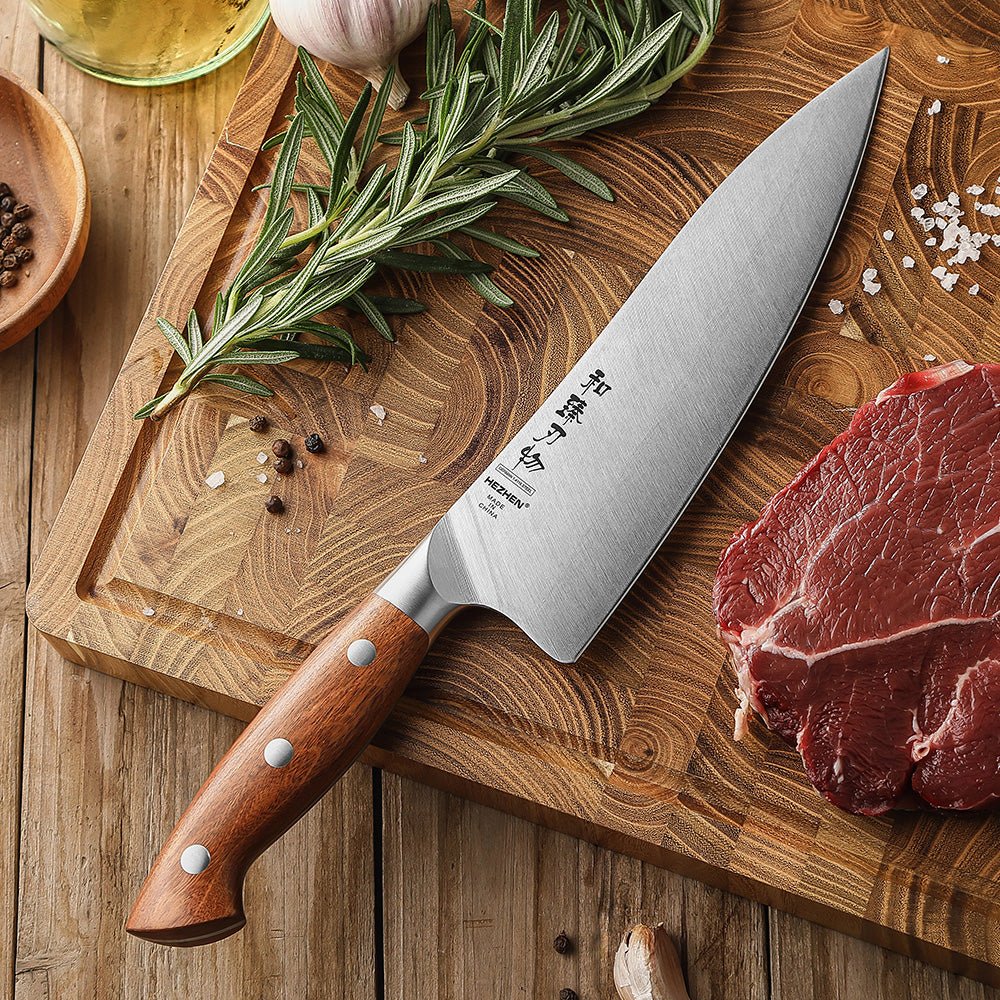
Full tang construction
In a full tang knife, the blade steel extends all the way through the handle. The metal is the same width and length as the handle itself. Two handle scales (sometimes called slabs) are attached to either side of the tang with rivets, screws, or bolts. If you look at the spine, top, and bottom of the handle, you can usually see the steel sandwiched between the two scales.
This is the standard construction for Western-style kitchen knives. Think of the classic German chef knife: three visible rivets through the handle, a bolster where the blade meets the handle, and solid steel running from tip to butt.
Partial tang construction (hidden tang, stick tang, rat-tail tang)
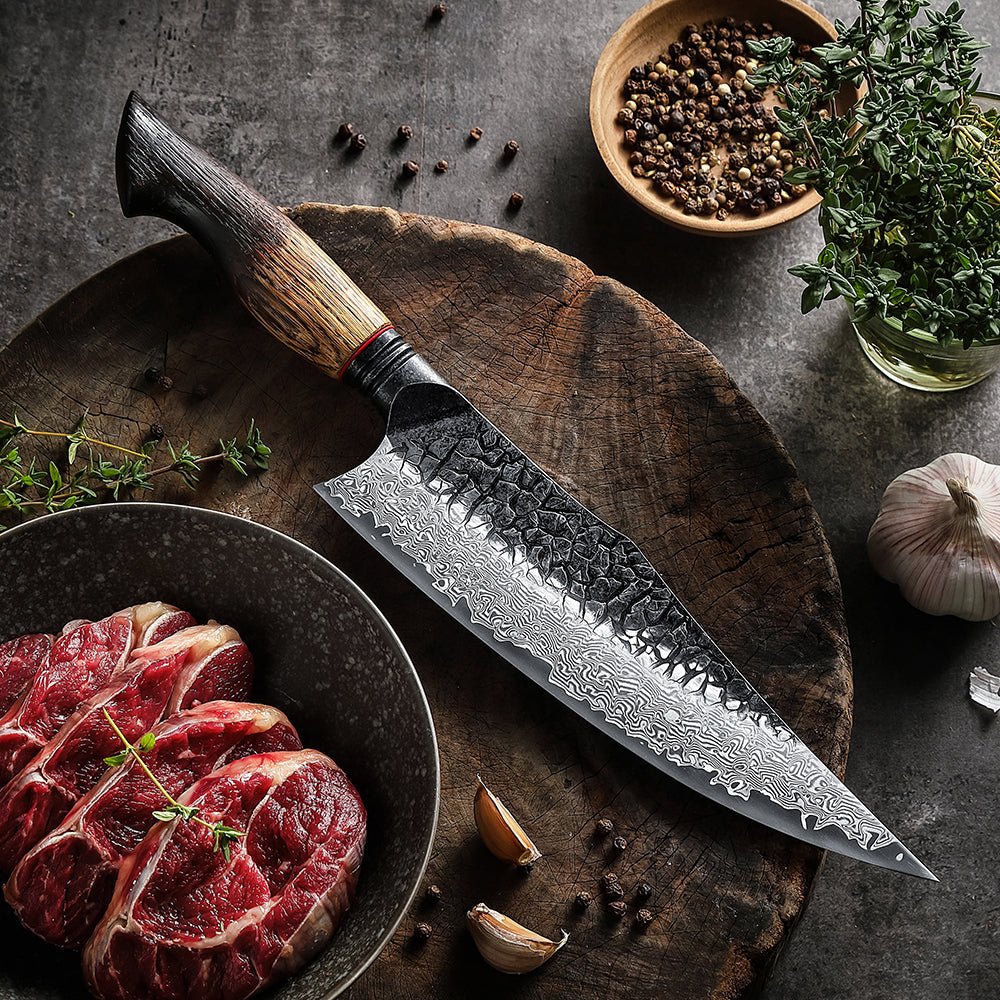
In a partial tang knife, the blade steel narrows after the heel and extends into the handle as a rod or stick. The handle is a single piece (or laminated construction) fitted over this narrow tang, secured with epoxy, a pin, a ferrule, or friction fit. You cannot see the steel when looking at the handle.
This is the traditional construction for Japanese wa-handle knives. The octagonal or D-shaped wooden handle slides onto the tang and is secured at the ferrule (the collar where handle meets blade). It's also common in Chinese cleavers, many European-style carving knives, and most traditional knives from cultures around the world.
Is It True That Full Tang Always Means Better Quality?
This one drives me a bit crazy, because it's so pervasive and so wrong.
The "full tang = quality" myth comes from the survival knife world, where it makes reasonable sense. If you're batoning wood or prying with a knife in a wilderness scenario, you genuinely need the structural strength of continuous steel through the handle. A cheap partial tang survival knife can snap at the handle junction under heavy lateral stress.
But kitchen knives are not survival knives. You are not prying open ammo cans with your santoku. The forces involved in slicing onions, breaking down a chicken, or push-cutting herbs are completely different from the forces involved in survival situations. In a kitchen context, a well-made hidden tang is every bit as durable as a full tang.
Consider this: the most expensive, most revered kitchen knives on earth are hidden tang. Single-bevel Japanese-style knives from masters in Sakai, Sanjo, and Takefu. Custom gyutos from blacksmiths with decade-long waiting lists. Honyaki knives that cost more than your rent. Every single one of them is a partial tang, hidden inside a simple wooden handle. Nobody who understands knives would call these inferior to a stamped full-tang chef knife from a department store.
Tang construction tells you how a knife is built. It tells you nothing about whether that knife is built well.
How Does Tang Construction Affect Knife Performance?
Weight
This is the most immediate, tangible difference. A full tang adds a significant slab of steel running through the entire handle. Depending on the knife, switching from full tang to hidden tang can reduce total weight by 40 to 60 percent.
A typical full-tang Western 210mm chef knife weighs 250 to 320 grams. A comparable hidden-tang Japanese-style gyuto in the same blade length comes in around 150 to 200 grams. That 100+ gram difference compounds over an hour of prep work. Ergonomics research by McGorry et al. (2005) shows that lighter tools with sharper edges reduce grip force requirements by over 20% and cutting effort by nearly 30%.
Balance
Full tang knives balance at or behind the bolster, near the pinch point or even in the handle. All that steel in the handle pulls the center of gravity backward. This gives a "planted" feeling that some cooks describe as secure or controlled.
Hidden tang knives balance forward of the handle, usually right at the heel or just ahead of it. The blade is the heaviest part and it does the falling for you. This forward balance is what makes a good Japanese-style knife feel like it drops through food on its own weight. Less muscular effort, more gravity doing the work.
Neither balance point is objectively correct. It depends on your cutting style. Rock-choppers tend to prefer handle-weighted balance. Push-cutters and pull-cutters tend to prefer blade-forward balance.
Durability
In a well-made knife, both constructions are effectively bomb-proof for kitchen use. You will not break either one during normal cooking.
The durability gap only appears at the bottom of the market. A cheap full-tang knife with press-fit plastic scales can have the scales crack or pop off. A cheap hidden-tang knife with a loose friction-fit handle can wobble or come free. Both failures are signs of poor manufacturing, not fundamental problems with the tang type.
A properly epoxied and ferrule-fitted hidden tang will last decades. A properly riveted full tang will last decades. The construction quality matters. The construction type does not.
Handle replaceability
This is one area where hidden tang construction has a genuine, practical advantage. Japanese wa-handles are designed to be replaced. The handle slides off, you slide a new one on, and you have essentially a new knife. Handle cracked? Replace it. Want a different wood species or shape? Swap it out. This is normal maintenance in Japanese knife culture, the same way you'd re-handle a hammer.
Full tang handles are permanent. The scales are riveted through the steel. Replacing them requires drilling out the rivets, fitting new scales, drilling new holes, and re-riveting. It's doable but it's a project, not routine maintenance.
How Do Full Tang and Hidden Tang Knives Compare Side by Side?
Which Should You Choose?
This is not a question about quality. It's a question about what kind of knife you want to use.
Choose a full tang (Western handle) if you:
Prefer a heavier knife that feels substantial in the hand. Use a rocking motion to chop. Want the familiar feel of a contoured handle with a finger guard. Are transitioning from budget knives and want something that feels immediately natural. Like the look of visible rivets and a solid bolster.
Choose a hidden tang (wa-handle) if you:
Prefer a lighter knife that lets the blade do the work. Use a push-cutting or pull-cutting motion. Do a lot of extended prep (mise en place for hours). Want the option to replace the handle down the track. Like the feel of natural wood and the aesthetics of traditional Japanese construction.
If you genuinely cannot decide
Buy a Western-handle knife first if you've never used a quality kitchen knife before. The ergonomics will feel immediately familiar. Then, once you understand what a good blade feels like, try a wa-handle knife. Most people who try both end up gravitating toward one or the other based on feel, not based on some spec sheet comparison.
What Actually Determines Kitchen Knife Quality?
If tang type doesn't tell you whether a knife is good, what does? Four things, roughly in order of importance.
1. Steel composition and heat treatment
The alloy the blade is made from and how it was hardened and tempered. This determines edge retention, toughness, and corrosion resistance. Two knives made from the same alloy but heat-treated differently can vary in performance by 10 to 20 percent. You cannot see heat treatment quality from the outside, which is why the manufacturer's process and reputation matter. For a deeper look at this, see our knife steel hardness guide.
2. Blade geometry
How thin the blade is behind the edge, the grind profile, and the edge angle. CATRA testing data shows that dropping edge angle from 25 degrees to 15 degrees per side improves cutting performance roughly five times on the same steel. Geometry is the biggest lever for cutting performance, and it has absolutely nothing to do with tang construction.
3. Fit and finish
How well the handle is attached. How smooth the spine and choil are. Whether the edge is properly set from the factory. A full tang knife with sloppy rivets and sharp handle edges is worse than a hidden tang knife with a perfectly fitted ferrule and polished spine. This is about craftsmanship.
4. Handle quality and ergonomics
The material, shape, and balance of the handle. Does it sit naturally in your hand? Does it cause hot spots during extended use? Is the material durable and moisture-resistant? A beautifully stabilised wood wa-handle and a well-contoured G10 Western handle are both excellent. A cheap, poorly shaped handle in either style will make the knife unpleasant to use.
The bottom line: Tang type determines feel and ergonomics. Steel, heat treatment, and geometry determine performance. When someone tells you a knife is good "because it's full tang," they are confusing construction style with construction quality. Ignore that advice. Focus on what the blade is made of, how it's ground, and how it feels in your hand.
Related Reading
- How to Choose a Chef Knife: The Complete Buying Guide
- Japanese-style Knife Types Explained
- German vs Japanese-style Kitchen Knives
- Knife Steel Hardness Guide
Frequently Asked Questions
Does a full tang knife last longer than a partial tang knife?
Not in a kitchen setting. Both constructions last decades when properly made. The durability gap only appears in survival and outdoor use, where heavy lateral stress can snap a weak partial tang. In normal cooking, a well-fitted hidden tang with epoxy and a ferrule is every bit as reliable as a riveted full tang. The most expensive kitchen knives in the world, including handmade Japanese honyaki, all use hidden tang construction.
Why are Japanese-style kitchen knives hidden tang instead of full tang?
Weight and balance. A hidden tang cuts 40 to 60% of the handle's steel mass, bringing total weight on a 210mm gyuto down to 150 to 200 grams compared with 250 to 320 grams for a full tang equivalent. The lighter build shifts the balance point forward of the handle, so the blade drops through food under its own weight with less muscular effort. The wa-handle also allows easy replacement if the wood cracks or wears out.
Can you tell knife quality by whether it is full tang?
No. Tang type tells you how the knife is built, not how well it is built. What determines quality is the steel composition, heat treatment, blade geometry, and handle fit. A cheap full tang knife with soft steel and sloppy grinding will underperform a quality hidden tang knife with hard steel ground to a 15 degree edge. Treat tang type as an ergonomic preference, not a quality indicator.
Is a full tang or hidden tang knife better for beginners?
A full tang Western-handle knife feels more immediately familiar if you have only used budget supermarket knives before. The contoured scales and finger guard sit naturally in a hammer grip. Once you are comfortable with basic knife skills, a hidden tang wa-handle is worth trying for its lighter weight and blade-forward balance. Most cooks who try both develop a clear personal preference within a few weeks.
Can you replace the handle on a Japanese wa-handle knife?
Yes, and it is designed to be replaced. The handle slides off the narrow tang and a new one slides on, secured with friction and a small amount of epoxy at the ferrule. The whole swap takes under ten minutes with no special tools. Full tang handles are permanent by comparison, requiring the rivets to be drilled out and new scales fitted and re-riveted.