

Two hundred dollars is a meaningful number in kitchen knives. It's the price point where you stop making compromises and start getting genuinely good steel, proper heat treatment, and handles that won't fall apart after a year of daily use.
Below about $40, you're buying soft stainless steel that won't hold an edge through a single week of cooking. Above $300, you're often paying for a brand name stamped on the box, or for aesthetics that don't actually make the knife cut better. The $100 to $200 range is where the engineering actually matters, and where Australian home cooks get the most value for their money.
I've spent a lot of time testing knives in this range, and the honest truth is that the steel chemistry in a well-made $150 knife is functionally identical to what you'll find in knives costing twice as much. The difference between a $150 Damascus chef knife and a $400 one usually comes down to handle materials, finish work, and how much the brand spends on marketing. The blade itself? Same alloys, same hardness, same edge geometry.
This guide covers the best options under $200 AUD, with real specifications and honest opinions about which knife makes sense for which cook.
Quick answer: If you want one great knife under $200, get the Mo Series 8.5" Chef Knife (~$145 AUD). It's 67-layer Damascus with a 10Cr15CoMoV core at 60-62 HRC, a burnt oak handle with a red G10 accent, and it outperforms knives at double the price. If you want the lowest-cost, no-fuss option, the Supreme Series 8" Chef Knife (~$65) in German 1.4116 stainless steel is excellent.
What Actually Matters in a Kitchen Knife Under $200?
Before getting into specific recommendations, it helps to understand what separates a good knife from a mediocre one. There are five things worth paying attention to, and everything else is mostly cosmetic.
Steel Type
The single most important factor. The steel determines how sharp the knife gets, how long it stays sharp, and how resistant it is to chipping and corrosion. In this price range, you want high-carbon stainless steel. Specifically, look for steels like 10Cr15CoMoV (the Chinese designation equivalent to Japanese VG-10) or AUS-10. These contain enough carbon for excellent edge retention, enough chromium for corrosion resistance, and additions like cobalt, molybdenum, and vanadium that improve toughness and wear resistance.
If a knife in this price range doesn't tell you what steel it uses, that's a red flag. Good manufacturers are proud of their steel. For more on how steel composition affects performance, the steel hardness guide goes deep on this topic.
Hardness (HRC)
Rockwell hardness tells you how well the blade holds an edge. German-style knives typically run 56-58 HRC. Japanese-style knives run 58-62 HRC. For a knife under $200, you want at least 58 HRC. Anything below that and you'll be sharpening every few days with regular use. The 58-60 HRC range is the sweet spot: hard enough for excellent edge retention, but not so hard that the blade becomes brittle and prone to chipping if you accidentally hit a bone or twist the blade.
Blade Construction
Damascus steel isn't just decorative. A proper Damascus blade has a hard cutting core (that high-carbon steel) wrapped in softer, more flexible outer layers. This gives you the best of both worlds: a razor-sharp edge that resists rolling, supported by a blade body that absorbs shock rather than transmitting it to the edge. The number of layers (67, 73, etc.) affects the visual pattern but doesn't meaningfully change performance. What matters is that the core steel is good and the heat treatment is done right.
Learn to spot the difference between real Damascus construction and printed patterns. The real vs fake Damascus guide explains what to look for.
Handle Material and Construction
Full tang construction (where the steel extends through the entire handle) gives better balance and durability than a partial tang where the blade is just glued into a handle. At this price point, you should absolutely be getting full tang.
Handle material is partly preference. G10 (a fiberglass laminate) is practically indestructible and doesn't absorb moisture. Ebony and rosewood are beautiful and comfortable but need occasional care. Resin handles split the difference with good durability and interesting aesthetics.
Blade Geometry
A thinner blade creates less resistance when cutting and produces cleaner cuts through dense vegetables. Japanese-style knives are typically ground thinner than German knives, which is why they feel so much sharper out of the box. For home cooking, a blade thickness of 1.8-2.2mm at the spine is ideal for a chef knife. Much thicker than that and you'll feel like you're wedging through food rather than slicing.
Worth knowing: The difference between a $150 knife and a $400 knife is rarely about the blade itself. It's usually about the handle material, the finishing details, and the brand's marketing budget. The actual cutting performance is often within a few percent of each other when the steel and heat treatment are equivalent.
What Are the Best Chef Knives Under $200?
A chef knife is the one knife you'll reach for 80% of the time. If you're only buying one knife, this is it. Here are the three best options under $200, each with a distinct personality.
Supreme Series 8" Chef Knife (~$65 AUD)
This is the cheapest knife in this roundup by a long way. At $65, it's almost unfairly good value.
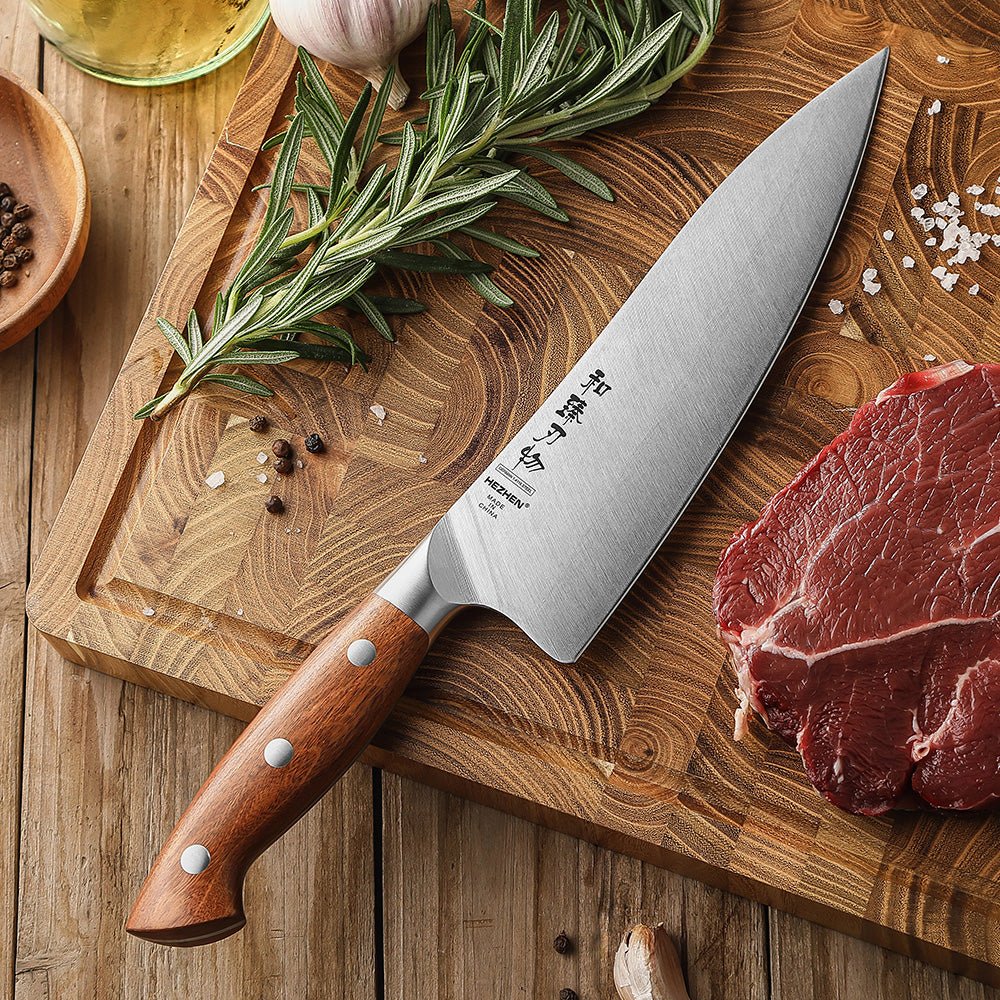
The specs: German 1.4116 (X50CrMoV15) stainless steel at 56-58 HRC, full tang construction, and a red wood handle secured with stainless steel rivets. The blade has a gentle curve that rocks well for mincing but also has enough flat belly for push-cutting if that's your style.
What I like most about this knife is its versatility. The steel is tough, easy to sharpen and easy to maintain, so you don't need to treat it delicately. It's a no-fuss workhorse. The chef knife buying guide covers what to look for in more detail. Just note that at 56-58 HRC it sits below the 58 HRC mark above, so expect to hone it more often.
If you cook dinner four or five nights a week and want something that performs exceptionally without demanding special attention, this is the one.
Mo Series 8.5" Chef Knife (~$145 AUD)
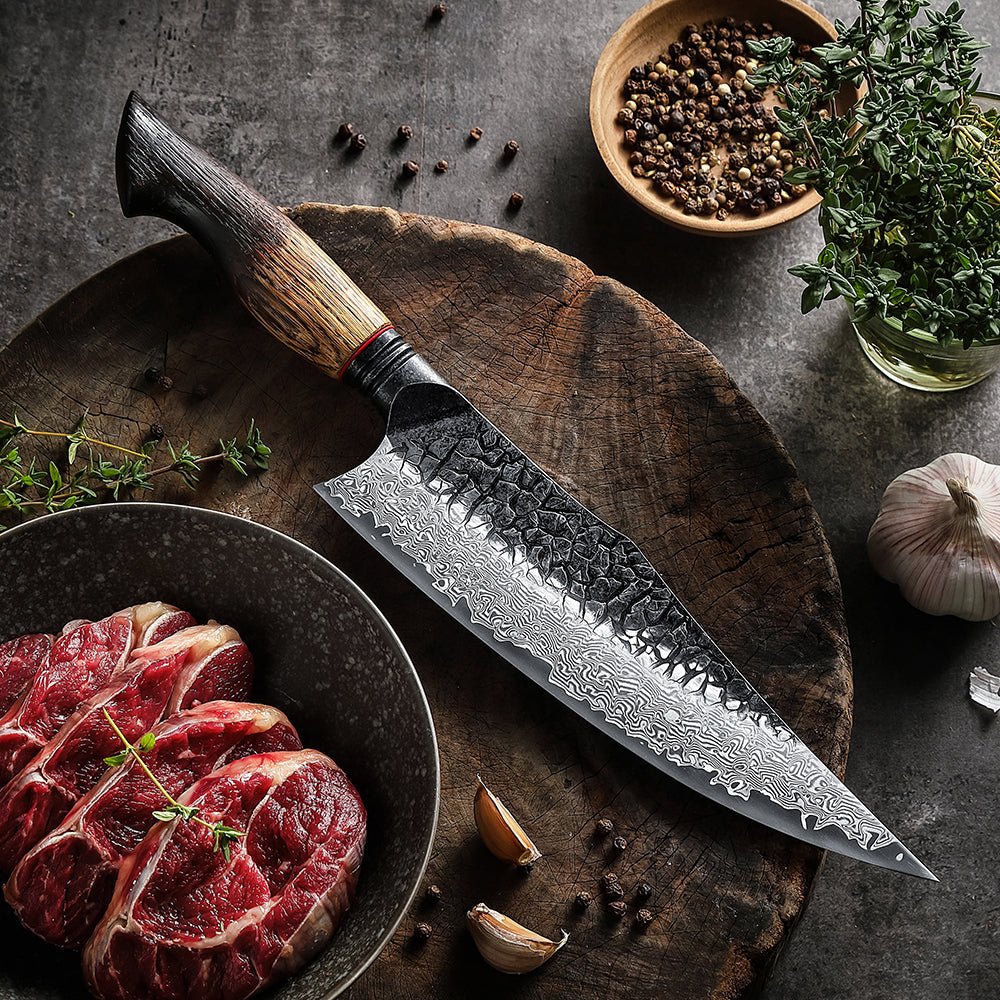
A 10Cr15CoMoV core wrapped in 67 layers of Damascus, hardened to 60-62 HRC. This is where the steel steps up from the Supreme, and that matters.
The Mo series uses a burnt oak handle with a red G10 accent, hand-shaped for a comfortable, secure grip. The 8.5" blade gives you an extra half inch of cutting length over the Supreme, which makes a noticeable difference when you're slicing through a large cabbage or watermelon.
The trade-off is price and care. It costs more than twice as much as the Supreme, and like any wooden handle, burnt oak needs occasional oiling (food-safe mineral oil, once every few months) and shouldn't be left soaking in water. If you're the kind of cook who washes and dries their knife immediately after use, the Mo is gorgeous and performs beautifully. If you tend to leave things in the sink, the Supreme's German stainless is the more forgiving blade.
Lan Series 8.5" Chef Knife (~$169 AUD)
The Lan series steps up to 73-layer Damascus, which creates a tighter, more dramatic visual pattern on the blade. The core is 14Cr14MoVNb powder steel at 62-64 HRC, and the handle is polished olive wood.
At $169, it's the most expensive individual chef knife in this roundup but still well under $200.
Honestly, the performance difference between the Lan and the Mo is modest. You're paying $24 more for the powder-steel core, the 73-layer pattern and the olive wood handle. If the visual appeal matters to you (and there's nothing wrong with wanting a beautiful knife), the Lan is worth the premium. If you're purely budget-focused, the Supreme at $65 is the better value. The series comparison guide breaks down all the differences if you want a side-by-side look.
| Specification | Supreme 8" | Mo 8.5" | Lan 8.5" |
|---|---|---|---|
| Price (approx.) | $65 | $145 | $169 |
| Core Steel | German 1.4116 | 10Cr15CoMoV | 14Cr14MoVNb (powder) |
| Damascus Layers | None | 67 | 73 |
| Hardness | 56-58 HRC | 60-62 HRC | 62-64 HRC |
| Handle | Red wood (Western) | Burnt oak | Olive wood |
| Best For | Low-maintenance daily use | Japanese-style knife enthusiasts | Visual impact + performance |
What Are the Best Santoku Knives Under $200?
The santoku is the Japanese answer to the chef knife. It's shorter, lighter, and has a flatter profile that excels at the three cuts it's named for: slicing, dicing, and mincing. If you do a lot of vegetable-heavy cooking, or if you find a 210mm chef knife feels too large and unwieldy, a santoku might actually be the better primary knife for you. The santoku vs chef knife comparison goes deeper on when each style shines.
Supreme Series 7" Santoku (~$59 AUD)
Same German stainless steel and red wood handle as the Supreme chef knife. The 7" blade is perfect for home cutting boards where you might not have 18 inches of counter depth to work with. At $59, this is probably the best value knife in the entire lineup. The flat belly makes it naturally good at the up-and-down chopping motion that works best for vegetables, herbs, and boneless proteins.
Mo Series 7.5" Santoku (~$139 AUD)
The extra half inch over the Supreme santoku is welcome, and it steps up to the Mo's 67-layer Damascus and 10Cr15CoMoV core. At $139, it's still comfortably under budget and gives you a knife that works beautifully for everything from paper-thin cucumber slices to rough-chopping onions.
Retro Series 7.5" Santoku (~$85 AUD)
The Retro series uses a three-layer 10Cr15CoMoV composite core rather than Damascus, which keeps the price down. At $85, this is a middle step for cooks who want a harder edge than the Supreme without paying for Damascus. Browse our best starter knives for more options at this level without committing $120+. The steel is hardened to 60-62 HRC, and the octagonal red wood and buffalo horn handle has a certain charm. It won't hold its edge quite as long as the Lan's powder steel, but for a cook who sharpens regularly, that's a minor inconvenience at a major price saving.
If you're not sure whether a santoku or chef knife is right for you, buy the Supreme Santoku at $59. It's cheap enough that you won't regret the experiment, and good enough that if you love it, you won't need to upgrade.
What Are the Best Specialty Knives Under $200?
Once you have a good chef knife or santoku, specialty knives fill in the gaps. None of these are essential for a beginning cook, but each one does its specific job better than a chef knife can.
Nakiri (Vegetable Knife)
If you eat a lot of vegetables (and living in Australia with access to great produce, you probably should), a nakiri is a revelation. The tall, flat blade chops straight down through vegetables without the rocking motion a chef knife requires. Shredding a whole cabbage, breaking down a butternut pumpkin, or cutting uniform julienne strips of carrot is genuinely faster and more precise with a nakiri than with any other knife shape.
Most nakiri options in the range fall between $99 and $149. The flat edge also means the entire blade contacts the cutting board simultaneously, so you get cleaner cuts with less effort.
Utility Knife (5")
A utility knife is the knife you grab when the chef knife feels too big. Trimming chicken thighs, slicing cheese, cutting a sandwich, peeling and segmenting citrus. It lives somewhere between a chef knife and a paring knife, and many experienced cooks find they use it more often than they expected. At around $79-$99 for most options in the range, it's a smart second knife.
Bread Knife
Serrated knives don't need to be expensive. They're not precision cutting tools. But a good one with proper tooth geometry will saw through crusty sourdough without crushing the crumb, and glide through ripe tomatoes without turning them into mush. Under $100 gets you a very capable bread knife.
Paring Knife (3.5")
Paring knives are for detail work: peeling, deveining prawns, removing eyes from potatoes, cutting small garnishes. You don't need Damascus steel in a paring knife (the blade is so small that edge retention differences are negligible), but it's nice to have a matching set. Paring knives in the range start around $45, making them an easy add-on.
What Are the Best Knife Sets Under $200?
Buying a knife set is almost always better value than buying individual knives, assuming the set contains knives you'll actually use. The key is to avoid those 15-piece knife blocks stuffed with specialty knives you'll never touch. A two or three-piece set of knives you use daily is infinitely more valuable than a dozen knives gathering dust.
The sets vs individual knives breakdown covers the full pros and cons, but here's the summary for this price range.
2-Piece Sets (~$74-$199 AUD)
A chef knife and a utility knife, or a chef knife and a santoku. This covers about 95% of home cooking tasks. Two-piece sets in the $74-$199 range give you matched knives from the same series, which means consistent steel quality, handle feel, and aesthetics. If you're starting from scratch and want to keep things simple, a two-piece set is the way to go.
3-Piece Sets (~$229-$289 AUD)
The sweet spot for most home kitchens. A typical three-piece set includes a chef knife, santoku, and utility knife. These sets all sit above $200, but the per-knife value is usually better than buying individually. A three-piece set gives you a large knife for heavy prep, a medium knife for everyday tasks, and a small knife for detail work. That's a complete kitchen right there.
Smart move: If your budget is exactly $200, consider buying a 2-piece set for ~$149 and adding a paring knife for ~$45. That gives you three knives that cover virtually every task, and the total stays close to budget.
How Do You Pick Between the Series?
The Mo and Lan are the two Damascus series here. The Mo uses a 10Cr15CoMoV core and the Lan a harder 14Cr14MoVNb powder-steel core, while the Supreme is German stainless with no Damascus. The choice comes down to four factors: steel, handle preference, aesthetic taste, and budget.
Choose the Supreme Series if...
You want the most practical, low-maintenance option. The German 1.4116 stainless is tough, easy to sharpen and highly corrosion resistant, and the full-tang red wood handle is secured with stainless steel rivets. If you're the kind of cook who doesn't want to think about knife care, Supreme is your series. It's also the most affordable of the three lines, which means you can either save money or put the savings toward a second knife.
Choose the Mo Series if...
You appreciate traditional Japanese-style knife aesthetics and want a Damascus blade at a lower price than the Lan. The burnt oak handles with their red G10 accent are genuinely beautiful, and the 10Cr15CoMoV core is hardened to 60-62 HRC. The trade-off is that burnt oak, like any wooden handle, needs occasional oiling and shouldn't sit in water.
Choose the Lan Series if...
You want the most visually striking knife. The 73-layer Damascus creates a tighter, more intricate pattern than the 67-layer used in the Mo series, and the 14Cr14MoVNb powder-steel core is the hardest of the three at 62-64 HRC. The polished olive wood handles make these knives look almost decorative (though they perform just as well as any working knife). If you're buying a gift or you simply want something that looks exceptional on a magnetic knife rack, the Lan series delivers.
What about the Retro Series?
The Retro series uses a three-layer 10Cr15CoMoV composite core rather than Damascus construction. Knives start around $65. If you're not sure whether you want to invest in quality kitchen knives, or if you need a beater knife for tasks where you wouldn't risk your Damascus blades (like cutting through cardboard, opening packages, or prying apart frozen foods), the Retro series is a solid choice. It won't match the Lan's powder steel for edge retention, but it's a real knife made with real craftsmanship, not a stamped-out piece of mystery metal from a department store.
| Series | Handle | Damascus Layers | Price Range | Best For |
|---|---|---|---|---|
| Supreme | Red wood (Western) | None | $45-$75 | Practical daily drivers |
| Mo | Burnt oak | 67 | $85-$215 | Japanese-style knife feel |
| Lan | Olive wood | 73 | $89-$215 | Visual impact, gifts |
| Retro | Red wood and buffalo horn (Octagonal) | N/A | $65-$99 | Harder steel on a budget |

What Are You Actually Getting Compared to Expensive Brands?
This is the part that might surprise you. When you buy a Damascus kitchen knife from a well-known Japanese brand, you're typically paying $250-$400+ AUD for a single chef knife in Australia. Let's break down what you're actually paying for at that price compared to what you get at $145-$169.
The steel is functionally the same. 10Cr15CoMoV has the same carbon content (roughly 1.0%), the same chromium (15%), and the same alloying elements as VG-10. The hardness range of 60-62 HRC is identical to what you'd find in premium Japanese-style knives. The edge geometry, the grind, the sharpness out of the box: equivalent.
The Damascus construction is real. 67 or 73 layers of alternating hard and soft steel, forge-welded and pattern-formed using the same process used by Japanese and European knifemakers. You can etch the blade in acid and see the layers. This isn't cosmetic printing.
So where does the extra $150-$250 go when you buy a premium brand? Some goes to higher-end handle materials (stabilised burl wood, for example). Some goes to hand-finishing steps that make the knife slightly prettier but don't affect performance. And a significant portion goes to brand marketing, distribution margins, and the simple fact that established brands can charge more because people expect to pay more.
There's a useful comparison to be made with the German vs Japanese-style knives debate. German knives in this price range use softer steel (typically X50CrMoV15 at 56-58 HRC), which means they're tougher but don't hold an edge as well. Japanese-style knives like these use harder steel that stays sharp longer but requires a bit more care. For home cooks, the harder steel is almost always the better choice because you'll sharpen less often.
A $145 Mo Series chef knife uses the same steel chemistry, the same hardness range, and the same Damascus construction as knives selling for $300-$400 from established Japanese brands. The performance difference is negligible. The price difference is not.
How Should You Care for Your Knife to Protect Your Investment?
A good knife treated well will last decades. A good knife treated poorly will chip, rust, and lose its edge in months. These are the basics.
Hand wash only. Never put a good knife in the dishwasher. The combination of harsh detergent, high heat, and rattling against other items will destroy the edge and can damage the handle. Wash with warm soapy water, dry immediately, done. Takes 15 seconds.
Use a proper cutting surface. Wood or plastic cutting boards. Never glass, marble, ceramic, or metal. These materials are harder than your knife's edge and will dull it instantly. If you hear a harsh scraping sound when you cut, your board is too hard.
Store properly. A magnetic knife rack, a knife guard, or a dedicated slot in a drawer organiser. Tossing knives loose in a drawer lets them bang against other utensils, which chips and dulls the edge. It's also a good way to cut yourself when reaching into the drawer.
Hone regularly, sharpen occasionally. A honing rod realigns the edge and should be used every few cooking sessions. Actual sharpening (with a whetstone or professional service) removes metal to create a new edge and only needs to happen every few months with normal home use. The daily knife care guide covers the complete routine, and the whetstone sharpening guide walks through the sharpening process step by step.
Quick care rule: If you do nothing else, just hand wash and dry your knife after every use. That single habit prevents 90% of the damage that ruins kitchen knives.
How Do You Pick Your First Quality Knife?
If you've read this far and still aren't sure which knife to buy, here's a simple decision tree.
Do you want one knife that does everything? Get the Mo Series 8.5" Chef Knife for $145. It's the most versatile option at this price point. If you want the lowest-maintenance option, the Supreme 8" Chef Knife is $65.
Do you cook mostly vegetables and prefer a shorter blade? Get the Supreme 7" Santoku for $59.
Do you want the most knife for your money? Get a 2-piece set for $74-$199, which gives you two high-quality knives for barely more than the price of one.
Do you want something beautiful that you'll enjoy pulling out every evening? Get the Mo Series with its burnt oak handle, or the Lan Series with its 73-layer pattern.
Are you on a tight budget but want real quality? The Supreme Series starts at $45 and delivers genuinely good performance.
Any of these choices will be dramatically better than whatever department store knife you're currently using. The difference between a $20 knife and a $139 knife isn't subtle. It's the difference between sawing through a tomato and watching the blade glide through it under its own weight. Once you've experienced that, you won't go back.
Related Reading
- How to Choose a Chef Knife: The Complete Buying Guide
- Santoku vs Chef Knife: Which One Should You Buy?
- Xinzuo Series Comparison Guide
- Knife Steel and Hardness: What the Numbers Mean
- Real Damascus Steel vs Fake: How to Tell the Difference
- Kitchen Knife Sets vs Individual Knives
- German vs Japanese-style Kitchen Knives
- Knife Care and Daily Maintenance Guide
- How to Sharpen Knives with a Whetstone
- Best Kitchen Knives for Every Budget
Frequently Asked Questions
Is $200 enough to get a good quality kitchen knife in Australia?
$200 AUD is more than enough. The best value sits between $100 and $170, where you get high-carbon stainless steel (58 to 60 HRC), full tang construction, and real Damascus cladding. Above $200, you are mostly paying for premium handle materials and brand positioning rather than better cutting performance.
Can you get a real Damascus kitchen knife for under $200?
Yes. Genuine 67-layer Damascus chef knives with a 10Cr15CoMoV core start around $109 AUD. The Damascus is forge-welded, not printed, and you can verify it by etching the blade in acid to reveal the layer pattern. The core steel is functionally identical to Japanese VG-10 used in knives costing $300 to $400.
What knife steel should I look for under $200?
Look for high-carbon stainless steel rated 58 HRC or above. 10Cr15CoMoV and AUS-10 are the best options at this price: both contain roughly 1% carbon and 15% chromium, giving you strong edge retention and corrosion resistance. Avoid knives that do not disclose their steel type, as that usually means soft stainless under 56 HRC.
How long will a kitchen knife under $200 last?
With basic care (hand washing, proper storage, occasional honing), a well-made knife in this range will last 20 years or more. The steel and heat treatment in a $139 to $169 Damascus knife are the same quality found in $400 knives. What shortens a knife's life is dishwashers, glass cutting boards, and leaving it wet in the sink.
Should I buy a knife set or a single knife with a $200 budget?
If you have no quality knives, start with a single 8 inch chef knife ($65 to $169 AUD) and add a paring knife ($45) later. If you want more coverage upfront, 2-piece sets run $74 to $199 and give better per-knife value. Avoid large block sets at this price because they pad the count with knives you will never use.