

Do You Really Need a Knife Set as a Beginner?
Let me save you a few hundred dollars and a whole lot of drawer space. If you are reading this, you are probably thinking about upgrading from whatever dull, wobbly thing came in a block set your parents gave you. Maybe you have been eyeing knife sets online, imagining a gleaming row of blades lined up on your counter like some kind of culinary armoury.
Stop right there.
The single best investment you can make in your kitchen is not a set of 12 knives. It is one really good chef knife. That is it. One knife that feels right in your hand, holds a screaming sharp edge, and makes you actually excited to cook dinner on a Tuesday night. Everything else comes later.
I have been cooking professionally and obsessively at home for years, and I still reach for my chef knife for about 80% of every task I do. Onions, garlic, herbs, meat, fish, even smashing ginger with the flat of the blade. A quality chef knife is not just a tool. It is the tool.
The One-Knife Philosophy
Professional chefs around the world will tell you the same thing: master one knife before you buy another. A high-quality chef knife can handle dicing, slicing, mincing, chopping, and even delicate work like chiffonading basil. Buy one good blade, learn to use it properly, and you will cook faster and with more confidence than someone with a drawer full of mediocre knives they barely understand.
Why Does a Chef Knife Handle Almost Everything?
Here is why the chef knife is the undisputed workhorse of any kitchen. Its curved blade profile lets you rock through herbs and garlic with a fluid motion. The length gives you enough leverage to power through dense vegetables like butternut pumpkin. The pointed tip handles detail work like breaking down a chicken or scoring meat.
Think about what you actually do when you cook. You dice onions. You mince garlic. You slice tomatoes. You break down a whole chicken maybe once a week. You chop herbs. You cut steak into strips for a stir-fry. Every single one of those tasks? Chef knife territory.
The only jobs where a chef knife genuinely struggles are peeling small round fruits (that is a paring knife job), cutting bread (serrated blade), and breaking through heavy bones (cleaver). Those are your second, third, and fourth knives. But right now, we are talking about knife number one.
What Size Chef Knife Is Best for Beginners?
If you have never used a proper chef knife before, an 8-inch (200mm) blade is where you want to start. It is long enough to handle big tasks like cutting through a whole cabbage or watermelon without feeling like you are sawing back and forth. But it is not so long that it feels unwieldy or intimidating.
Some people will tell you to go with a 6-inch knife if you have small hands. I would push back on that. A shorter blade means more strokes to get through the same amount of food, and you lose the rocking motion that makes a chef knife so versatile. Most people who think they want a smaller knife just have not spent enough time with an 8-inch blade to feel comfortable.
Give it a week. You will wonder how you ever managed with anything shorter.
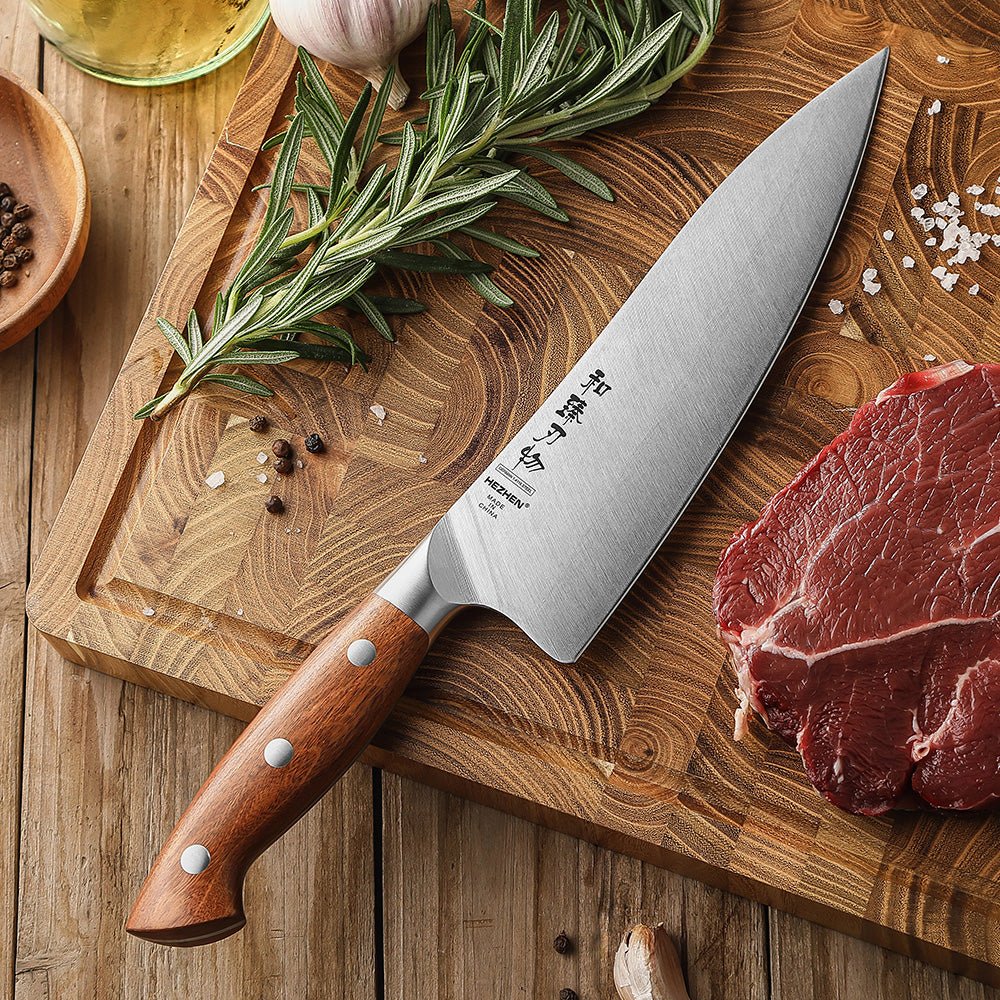
An 8-inch chef knife like the XINZUO Supreme Series is the ideal starting point for any home cook looking to upgrade.
What Should You Look for in Your First Quality Knife?
Alright, so you are sold on getting one good chef knife. But what actually separates a good knife from the flimsy thing you have been using? Here are the four things that matter most.
Steel Quality (58+ HRC)
Hardness is measured on the Rockwell scale (HRC). Cheap knives from department stores typically sit around 52-54 HRC. They dull fast, they flex, and they make you work harder than you should. A quality knife starts at 58 HRC and goes up from there. At 60+ HRC, you are getting into territory where the blade takes and holds a seriously fine edge.
Higher hardness steels like VG-10 and high-carbon stainless blends can be sharpened to a razor edge and will hold that edge through weeks of regular home cooking without needing a touch-up. The trade-off is that harder steels can chip if you abuse them (no twisting, no frozen food, no bones), but that is a care habit, not a flaw.
Full Tang Construction
A full tang means the steel of the blade extends all the way through the handle. This gives you better balance, more control, and dramatically more durability than a knife where the blade is just a thin stick of metal jammed into a handle. When you grip a full tang knife, you can feel the weight distributed evenly. It becomes an extension of your hand rather than something you are fighting to control.
Comfortable Handle
This one is personal, but it matters more than most people think. You are going to hold this thing for 20 to 30 minutes at a stretch. Maybe longer if you are doing serious meal prep. The handle should feel secure without you having to death-grip it. It should not cause hot spots on your palm or fingers. Materials like G10, Micarta, and quality resin-stabilised wood all work brilliantly. Avoid cheap plastic handles that get slippery when wet.
Blade Geometry
A thinner blade slices through food more easily. Cheap knives tend to be thick and wedge-shaped, which means they split food apart rather than slicing cleanly through it. A well-made knife will have a thin, precise grind that glides through an onion like it is not even there. This is one of those things you do not fully appreciate until you experience it firsthand.
| Feature | Budget Knife ($20-50) | Quality Knife ($100-250) |
|---|---|---|
| Steel Hardness | 52-54 HRC | 58-62 HRC |
| Edge Retention | Dulls within days | Holds edge for weeks |
| Tang | Partial or rat-tail | Full tang |
| Blade Thickness | Thick, wedge-like | Thin, precise grind |
| Handle | Cheap plastic | G10, Micarta, or wood |
| Balance | Handle-heavy or blade-heavy | Well-balanced at pinch grip |
| Lifespan | 1-3 years before replacement | Decades with proper care |
Will a Good Damascus Knife Really Transform Your Cooking?
Here is something I wish someone had told me when I bought my first proper knife: you really cannot go wrong at this stage. If you are coming from a $30 supermarket knife, literally any Damascus steel knife from a reputable maker is going to feel like a revelation. The difference is not subtle. It is the difference between pushing a dull blade through a tomato and watching it split the skin under its own weight.
Damascus steel is not just about looks, though the layered pattern is undeniably beautiful. Those layers of alternating hard and soft steel create a blade that is both tough and capable of holding a seriously keen edge. At the 60+ HRC range, a Damascus chef knife will slice through food with almost no resistance. It sounds like hyperbole until you experience it.
So do not fall down the rabbit hole of reading 47 reviews and comparing steel compositions down to the molecular level. Pick a reputable maker. Pick an 8-inch chef knife. Use it every day. That is the whole formula.
Tip
When you first unbox a quality knife, test it on a ripe tomato. Place the blade on the skin and pull gently. If it bites into the skin with almost zero pressure, you will immediately understand what you have been missing. That moment is what converts people from casual cooks into knife enthusiasts.
Japanese vs Western Style: Which Is Better for Beginners?
This is one of those debates that gets people heated in online forums, but for a beginner, the answer is simpler than you think.
Western-style chef knives (sometimes called gyuto when made by Japanese smiths) have a curved belly that makes rocking back and forth through food very natural. They tend to be slightly heavier, which means the weight of the knife does some of the work for you. The edge angle is typically around 15 to 18 degrees per side, which is more forgiving if your sharpening technique is not perfect yet.
Japanese-style knives like the santoku or nakiri tend to favour a push-cut or pull-cut technique rather than rocking. They are typically lighter, with a harder steel and a more acute edge angle (10 to 15 degrees). This means they are sharper out of the box, but they are also slightly less forgiving if you accidentally twist the blade or catch a bone.
For your first quality knife, I would lean toward a Western-profile chef knife or a Japanese-made gyuto. You get the best of both worlds: the familiar curved blade shape that works with the rocking technique most home cooks already use, combined with the superior steel and craftsmanship that Japanese bladesmiths are known for.
Once you have spent a few months with your chef knife and developed some confidence and technique, then explore Japanese-style blades like the santoku for your second knife. But for knife number one, go with what feels intuitive.
What Accessories Do You Need with Your First Knife?
You have bought the knife. Now you need exactly two things to go with it. Not five. Not ten. Two.
A Proper Cutting Board
This is non-negotiable. If you are cutting on glass, ceramic, marble, or a thin plastic sheet, you are destroying your edge every single time you cook. Those surfaces are harder than your blade's steel, and every contact dulls the edge a little bit more.
Get a thick wooden or quality plastic (HDPE) cutting board. Wood is ideal because it is gentle on edges, naturally antimicrobial, and will not slide around on your bench. End-grain boards are the gold standard, but any solid hardwood board will serve you well. Make sure it is big enough that you are not constantly chasing food off the edges. At minimum, go with something around 45cm x 30cm.
Browse our cutting board collection to find a board that matches your workspace.
A Honing Rod or Whetstone
A honing rod does not sharpen your knife. It realigns the microscopic edge that gets bent over during normal use. Running your blade along a ceramic or steel honing rod before each cooking session keeps the edge performing at its best between proper sharpenings. Think of it like tuning a guitar. The strings are still good, they just need a quick adjustment.
When the time comes for actual sharpening (every few months for a home cook), a whetstone is the way to go. A combination 1000/6000 grit stone handles both repair work and polishing in one package.
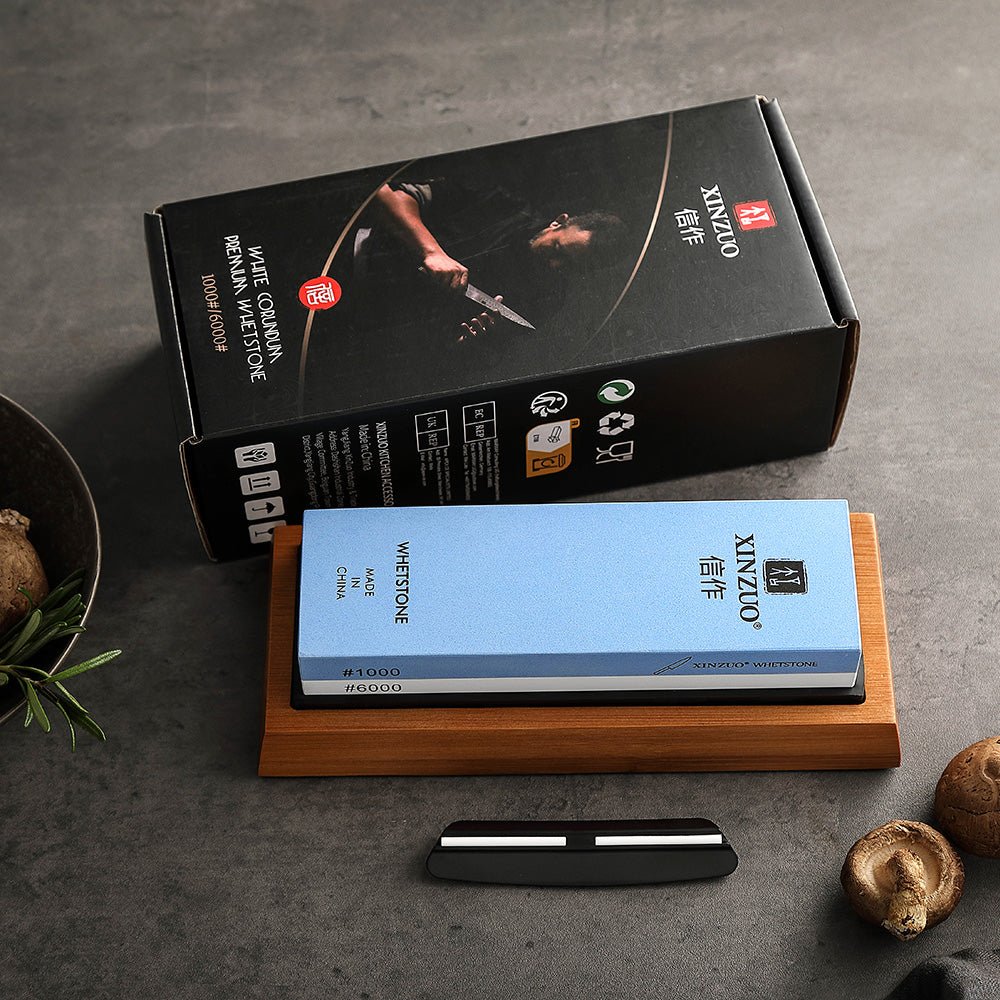
A dual-grit combination whetstone is the only sharpening tool you will ever need at home.
What Knife Care Habits Should a Beginner Build?
Here is the thing about owning a good knife: it will last you decades if you treat it right, or months if you do not. The good news is that proper knife care is dead simple. Build these habits from day one and they will become automatic.
Hand wash only. Never put your knife in the dishwasher. The detergent is abrasive, the water jets bang it against other items, and the high heat can damage the handle material. Wash it with warm soapy water, dry it immediately, and put it away. Takes 30 seconds.
Store it properly. A magnetic wall strip, a knife guard, or a dedicated slot in a drawer organiser. Never toss it loose in a drawer where it bangs against other utensils. That damages both the edge and every other tool in the drawer.
Use the right surface. Wood or plastic cutting boards only. No glass. No granite. No plates. This is the single easiest way to keep your knife sharp longer.
Hone before each use. Five to ten strokes on a honing rod takes about 15 seconds and keeps the edge aligned and performing. Make it part of your routine, the same way you preheat the oven before cooking.
Do not use it on frozen food or bones. Hard steel holds a better edge, but it is also more brittle. Frozen food and dense bones can chip the blade. Use a cheap beater knife for that kind of work, or better yet, let things thaw first.
Sharpen it regularly. Even the best knife in the world needs sharpening eventually. For a home cook using their knife a few times a week, once every two to three months on a whetstone is plenty. You will know it is time when the blade starts to slip on tomato skin instead of biting in cleanly.
Tip
The tomato test is the easiest way to check your edge at home. Place the blade on the skin of a ripe tomato and draw it toward you with minimal pressure. A sharp knife will bite immediately. A dull knife will slide across the surface. Test it before you cook, and you will always know where you stand.
When Should You Buy Your Second Knife?
Do not rush this. Seriously. Use your chef knife for at least three to six months before even thinking about adding to your collection. During that time, pay attention to the moments where you find yourself wishing for a different tool. Those moments will tell you exactly what to buy next.
For most people, the second knife is one of these three:
A paring knife if you find yourself peeling a lot of fruit, deveining prawns, or doing fiddly detail work where the chef knife feels oversized.
A bread knife if you bake or buy crusty sourdough regularly. A chef knife will crush bread rather than slice it cleanly.
A santoku or nakiri if you cook a lot of Asian-style food and want something optimised for rapid vegetable prep with a push-cut motion rather than rocking.
The point is to let your cooking tell you what you need rather than buying a pre-assembled knife set full of blades you will barely touch. Building a knife collection one piece at a time means every knife in your kitchen actually earns its spot.
When you are ready to explore your options, start with our chef knife collection for your first blade, and grow from there as your skills and cooking style develop.
Ready to Pick Your First Quality Kitchen Knife?
Browse our curated collection of chef knives, all crafted with 60+ HRC Damascus steel, full tang construction, and ergonomic handles designed for comfort during long prep sessions.
Shop Chef KnivesRelated Reading
Want to keep learning? These guides go deeper on the topics we covered above.
- How to Choose a Chef Knife: The Complete Buying Guide
- Santoku vs Chef Knife: Which One Should You Buy?
- Best Kitchen Knives Under $200
- Knife Care: Daily Maintenance Guide
- German vs Japanese-style Kitchen Knives
- Knife Steel Hardness Guide: Understanding HRC Ratings
- Kitchen Knife Sets vs Individual Knives: What Is Actually Worth It?
- How to Sharpen Knives with a Whetstone
Frequently Asked Questions
Is a 6 inch or 8 inch chef knife better for beginners?
An 8 inch (200mm) blade is the better starting point for most people. It is long enough to handle large vegetables like cabbage and pumpkin in fewer strokes, and the extra length gives you a proper rocking motion for mincing herbs. A 6 inch blade offers slightly more control but forces more strokes per cut and limits your technique. Most cooks who start with 8 inches never wish they had gone smaller.
What is the difference between a cheap knife and a quality knife?
Steel hardness is the biggest gap. Budget knives from department stores sit around 52 to 54 HRC and dull within days of regular use. A quality knife at 58 to 62 HRC holds its edge for weeks. Beyond hardness, quality knives have thinner blade geometry that slices through food rather than wedging it apart, full tang construction for better balance, and handle materials that stay grippy when wet.
Do I need a knife set or just one knife to start?
One good 8 inch chef knife covers about 80% of all kitchen tasks. A set with 12 to 15 pieces sounds impressive but most of those blades never leave the block. Buy a single quality chef knife first, learn to use it properly, then add a paring knife and a bread knife when you feel the need. You will cook faster with one sharp knife than with a drawer full of dull ones.
What should I look for in my first quality kitchen knife?
Four things matter most: steel hardness of 58 HRC or above, full tang construction where the steel runs through the entire handle, a thin blade grind that slices rather than wedges, and a handle material like G10 or hardwood that stays secure in wet hands. Weight and balance are personal, so pick the knife up before buying if you can. It should feel like an extension of your hand, not a burden.
Is Damascus steel worth it for a first kitchen knife?
Yes, if your budget allows $100 to $150 AUD. The layered construction of Damascus steel creates a blade that is both tough and capable of holding a fine edge at 60+ HRC. Coming from a $30 supermarket knife, the difference is not subtle. A well-made non-Damascus knife with good steel at 58+ HRC will also outperform any budget blade. Damascus adds visual appeal and slightly better performance, but good steel matters more than the pattern.