

Should You Buy a Knife Set or Individual Knives?
Buy individual knives, not sets. Three knives cover 95% of home cooking: a chef knife, a paring knife, and a bread knife. A single $200 chef knife will outperform every knife in a $200 twelve-piece set. Build your collection one good knife at a time, starting with the one you'll use every day.

What Is the Problem with Knife Sets?
Walk into any department store and you'll see them: 15-piece knife sets in a wooden block, priced at $200-$400, looking like the obvious way to equip a kitchen. The box art shows a gleaming block stuffed with handles. It feels comprehensive. It feels like a deal. And for most people, it's a trap.
Let's look at what's actually inside a typical 15-piece block set.
Count the knives you'll actually reach for: three. Maybe four if you do a lot of vegetable prep and want the santoku as a dedicated veg knife. That's it. The other eight to ten pieces exist to fill slots in the block and inflate the perceived value on the box.
Here's the deeper problem. When a manufacturer sells a 15-piece set for $300, they're spreading that budget across 15 items plus the block itself. The block alone eats $30-50 of that cost. The steak knives eat another $40-60. What's left for the three knives that actually matter? Not enough to use good steel. Not enough for proper heat treatment. Not enough for handles that feel right in your hand.
Then there's the block itself. A traditional fixed-slot knife block takes up premium counter real estate. The slots are sized for the specific knives that came with the set, which means you can't add a different knife later without it wobbling in an oversized slot or not fitting at all. You've locked yourself into a closed system on day one. If you want a block, universal blocks with flexible rod inserts are far more practical. They hold any blade shape, any size, and they grow with your collection.
What Is the Three-Knife Kitchen Approach?
Professional cooks who work with food every single day gravitate toward a core set of three knives. Not because they can't afford more. Because three is genuinely all you need for the vast majority of cooking tasks.
1. Chef knife (8" gyuto)
This is the knife. The one that does 80% of the work in any kitchen. Dicing onions, mincing garlic, breaking down chicken, slicing steak, chopping herbs, cutting through butternut squash. A good 8-inch chef knife or gyuto handles all of it. If you could only own one knife for the rest of your life, this is the answer without hesitation.
The gyuto (Japanese-style chef knife) has a slightly harder steel and thinner blade than a Western-style chef knife, which means it takes a sharper edge and holds it longer. For home cooks who aren't going to sharpen weekly, that edge retention makes a real difference. For the full breakdown on choosing one, read our chef knife buying guide.
2. Paring knife (3-4")
Everything the chef knife is too big for. Peeling ginger, deveining prawns, hulling strawberries, coring tomatoes, trimming fat from pork chops, segmenting citrus. These are all tasks that require a short blade and in-hand control. You'll pick up the paring knife dozens of times per cook session without even thinking about it. Read the paring knife buying guide for details on shapes and sizing.
3. Bread knife (9-10")
If you eat bread, you need a serrated blade. Nothing else cuts through a crusty sourdough boule without crushing the soft crumb inside. A bread knife also doubles as the best tool for slicing tomatoes, levelling cakes, cutting through large melons, and breaking down chocolate blocks. The serrated edge grips hard surfaces that would make a straight blade skid. See our bread knife guide for the full breakdown.
These three knives cover roughly 95% of home cooking tasks. Not an exaggeration, not a marketing figure. Actually think about what you did in the kitchen this week. Now think about which tasks couldn't be done with an 8" chef knife, a paring knife, or a bread knife. Almost nothing.
What Order Should You Build Your Knife Collection In?
If you're starting fresh or replacing a worn-out set, here's the order that gets you the most capability per dollar spent.
Step 1: Chef knife or gyuto
Start here. This is non-negotiable. A quality 8" chef knife is the single biggest upgrade you can make in any kitchen. It will handle the majority of your prep work from day one. If your budget allows only one good knife right now, make it this one and use a cheap paring knife from the drawer until you can afford to upgrade it.
Spend what you can. A $200 chef knife with 60+ HRC steel will hold its edge through weeks of daily use. A $40 chef knife will feel dull after a few sessions. The difference is not subtle.
Step 2: Paring or petty knife
Your second knife fills the gap for detail work. Anything that feels awkward or dangerous with an 8-inch blade becomes easy with a 3.5-inch paring knife. If you want something that handles both in-hand work and light board work, look at a 5-6" Japanese-style petty knife instead.
Step 3: Bread knife
If you eat bread regularly, buy a bread knife with quality steel. If bread rarely enters your kitchen, you can skip this or delay it. But if you're slicing sourdough or crusty baguettes even once a week, a proper bread knife prevents the mangled, crumb-everywhere experience of using a chef knife on hard crust.
Step 4: Nakiri or santoku
This is your first optional knife. A nakiri is a flat-edged Japanese vegetable knife that excels at push-cutting through greens, root vegetables, and herbs. A santoku is a lighter, shorter all-rounder that some people prefer to the chef knife for everyday prep. Either one is a nice addition, not a necessity. If you already love your chef knife for veg work, you can skip this entirely. For more on the different styles, see our Japanese-style knife types guide.
Step 5+: Everything else
Beyond this point, every knife you add is for a specific, optional task. A boning knife if you break down whole poultry. A slicing knife if you carve large roasts regularly. A cleaver if you prep a lot of Chinese cuisine. A fillet knife if you fish. None of these are essential for most home cooks, and all of them are wasted money if they sit in a drawer 350 days a year.
Why Does Buying Individual Knives Win Over Sets?
The case for individual knives isn't just about avoiding filler pieces. It changes the quality equation entirely.
You choose the best steel at each price point. When you buy a set, every knife in that set uses the same steel, the same handle material, the same construction. That steel is chosen to hit a set-wide price target. When you buy individually, you can put the most money where it matters most. A VG-10 or 10Cr15CoMoV chef knife for your daily workhorse. A simpler steel for the bread knife that doesn't need the same edge geometry.
You match handle style to your preference. Handle shape matters. Western, octagonal, D-shaped, rounded. Rosewood, pakkawood, olive wood. These aren't just aesthetic choices. They affect how the knife sits in your hand during 30 minutes of continuous chopping. Buying individually lets you hold each knife before committing to it. Sets force you into one handle for everything.
You upgrade one knife at a time. This is the biggest practical advantage. Your chef knife gets dull after two years? Replace just the chef knife with something better. You don't have to throw away an entire matching set because one piece wore out. Your collection improves gradually, and every upgrade is meaningful.
You never pay for knives you won't use. Every dollar goes toward a blade that will actually see the cutting board. No utility knife gathering dust. No boning knife you've never once touched. No steak knives inflating the price of your kitchen tools.
When Do Knife Sets Actually Make Sense?
Not all sets are created equal, and it's worth being honest about when a set is actually a smart buy.
The difference is curation. A well-designed set includes two or three knives where every piece earns its place. There's no filler. No shears masquerading as a knife. No steak knives bumping the count. Just the knives you'll use, built with the same quality steel throughout.
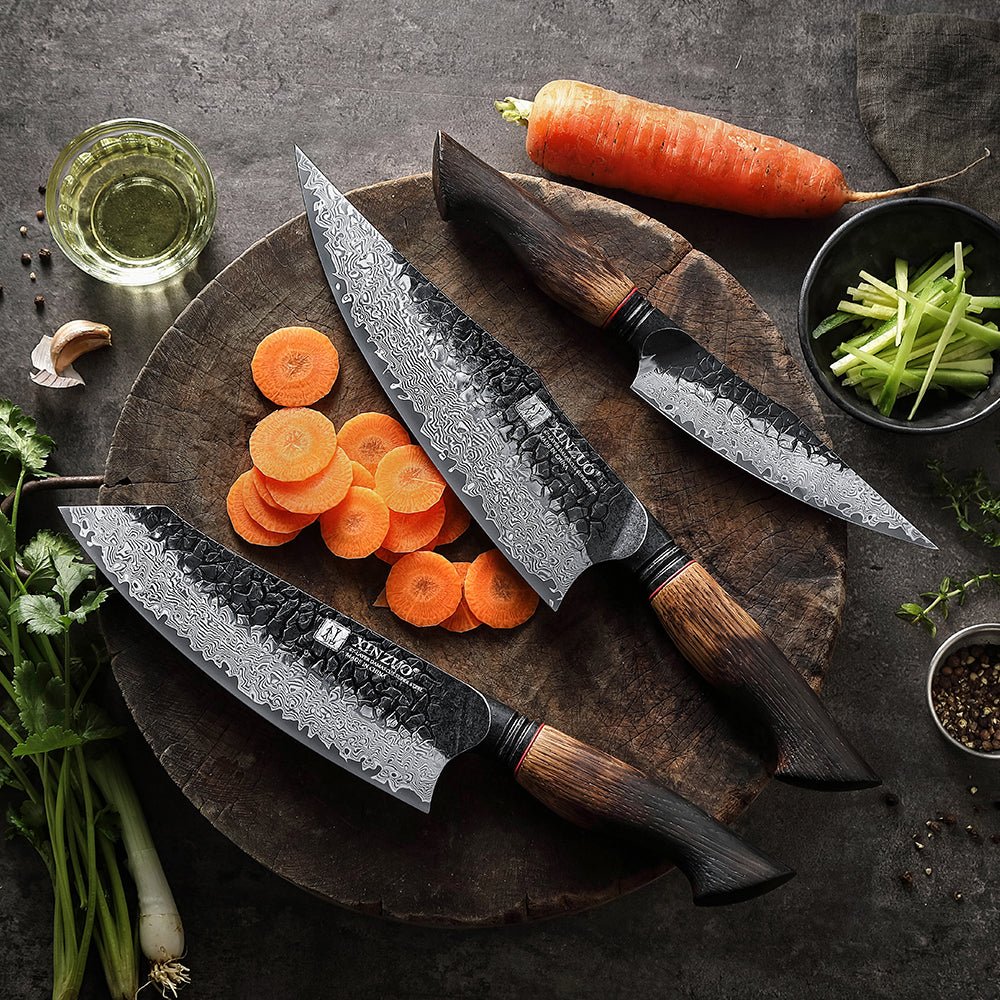
A three-piece set with a chef knife, santoku, and utility knife where all three use 60+ HRC Damascus steel and quality handles? That's not a set in the bad sense. That's a curated collection sold at a discount. The Xinzuo 3-piece sets follow this model: every knife in the set uses the same 67-layer Damascus construction and the same steel core as the individual versions.
Sets also make excellent gifts. When you're buying for someone else, you don't always know their preferences or what they already own. A tight, well-curated two or three piece set gives them a coherent starting point without the risk of duplicating what they have. A 15-piece block set, on the other hand, is a gamble that half of it ends up in the back of a cupboard.
Where Should You Start Building Your Knife Collection?
The right entry point depends on your budget and how much you cook. Here's a practical breakdown.
Under $150: One great knife. Put the entire budget into a single chef knife. A quality 8" gyuto at this price point will use better steel, have better edge geometry, and feel better in hand than any knife from any set at the same total spend. Add a $15 paring knife from wherever and you have a two-knife kitchen that outperforms most block sets.
$150-$300: The core three. This is the sweet spot. Budget roughly $120-150 for the chef knife, $40-60 for the paring knife, and $50-80 for the bread knife. At this price range, all three knives can use proper steel with decent hardness. This three-knife kit will handle everything most home cooks need for years.
$300-$500: Core three plus a specialist. Get your three essentials in quality Damascus or high-carbon stainless, then add a nakiri for vegetable work or a santoku as a lighter all-rounder. Or consider one of the curated two or three-piece sets at a saving and put the difference toward a separate bread knife or a good magnetic knife holder.
$500+: Build the full collection. At this budget, you're choosing between a premium set and premium individuals. Go individual. Get a top-tier gyuto with powder steel or premium Damascus, a petty knife, a bread knife, and then add one or two specialists that match your cooking style. A nakiri if you're vegetable-heavy. A sujihiki if you slice a lot of protein. A Chinese cleaver if you cook wok dishes regularly. Every knife in the collection should be something you chose deliberately for how you actually cook.
Related Reading
- How to Choose a Chef Knife: The Complete Buying Guide
- Paring Knife Buying Guide
- Bread Knife Guide
- Japanese-style Knife Types Explained
Frequently Asked Questions
Is it cheaper to buy a knife set or individual knives?
Individual knives cost more per piece, but you spend less overall because you only buy what you use. A typical 15-piece block set spreads its budget so thin that the three knives you actually reach for end up being mediocre. That same $250 to $350 spent on three individual knives (chef, paring, bread) gets you noticeably better steel, sharper edges, and longer-lasting performance.
How many knives does a home cook actually need?
Three. An 8-inch chef knife handles 80% of daily prep. A 3.5-inch paring knife covers peeling, deveining, and detail work. A serrated bread knife rounds out the set for crusty loaves and tomatoes. Everything else is a bonus for specific tasks: a nakiri for heavy vegetable prep, a utility knife for trimming, a carving knife for roasts.
Is a 3-piece knife set worth buying?
Yes, if every knife in the set is one you would buy on its own. A curated 3-piece set with a chef knife, santoku or utility, and paring knife using the same quality steel as the individual versions is a smart buy because you get a small discount without any filler. The red flag is sets that pad the count with shears, honing rods, or steak knives to look like better value.
Can I start with just one knife and add more later?
Yes, and most chefs recommend exactly that. Start with an 8-inch chef knife or gyuto, which handles about 80% of kitchen prep on its own. Add a paring knife when you get tired of using a big blade for small tasks, then a bread knife if you eat bread regularly. This way every dollar goes toward a knife you will actually use, and you can upgrade each piece independently as your budget allows.
Are expensive knives really better than cheap ones?
Up to a point, yes. The difference between a $40 knife and a $150 knife is dramatic: harder steel (58 to 62 HRC vs 54 to 56 HRC), thinner blade geometry for cleaner cuts, and an edge that stays sharp for weeks instead of days. Above $200 to $250 the improvements become more incremental, covering things like hand-finished Damascus cladding or premium handle materials. For most home cooks, the $100 to $200 range delivers the best return.