

What Is the Quick Answer on End Grain vs Edge Grain?
End grain boards are gentler on knife edges because the wood fibres point upward and part to accept the blade, then spring back together. They cost more, weigh more, and last 10 to 15 years with proper care.
Edge grain boards are lighter, cheaper, more warp-resistant, and still very kind to your knives. Expect 5 to 8 years of solid use before replacement.
Both are excellent choices. The single biggest improvement you can make for your knife edges is switching away from glass, ceramic, marble, or bamboo surfaces. Any quality wood board will outperform all of them.
How Do End Grain and Edge Grain Cutting Boards Actually Work?
Picture a piece of wood as a bundle of drinking straws glued together. The direction those straws face relative to your knife blade determines how the board interacts with the cutting edge.
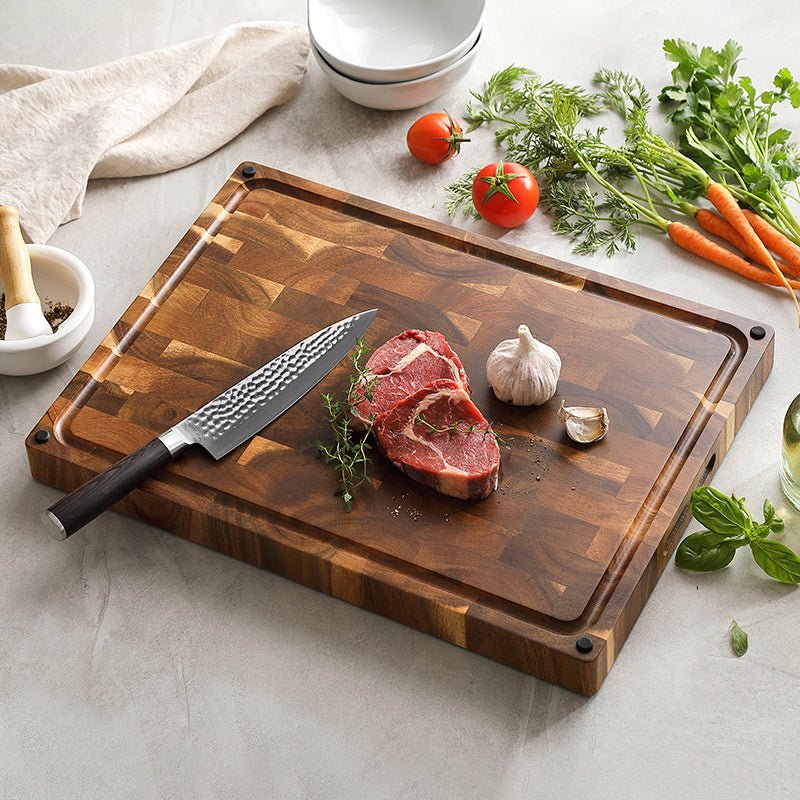
End Grain: Cutting Between the Fibres
An end grain board is built from blocks of wood stood on their ends, so the fibres point straight up toward the ceiling. When you bring a knife down, the blade slips between those upright fibres rather than cutting across them. The fibres separate, the edge passes through, and then the fibres push back together behind it.
This is where the "self-healing" label comes from, and it's not marketing hype. At the fibre level, what's happening is genuine elastic deformation rather than permanent damage. The cellulose fibres in wood have a natural springiness. When they're oriented vertically, the blade pushes them apart laterally. Once the blade moves on, the lignin matrix (the biological glue that holds wood cells together) pulls the fibres back into their original position. Knife marks on end grain boards are shallow, often invisible, and close up within hours.
Compare that to what happens when you cut into a piece of wood across the grain. You're severing fibres permanently. No amount of time or oil will make those fibres reconnect. The cuts stay.
Edge Grain: Cutting Across the Fibres
Edge grain boards lay the wood planks on their sides, so the long grain faces up. Your knife cuts across those fibres with every stroke. Instead of separating and rejoining, the fibres are severed completely. Over months and years, this shows up as visible cut marks scored into the surface.
That said, wood is still far softer than steel. Even with cross-grain cutting, a quality hardwood board puts up far less resistance than glass, stone, or bamboo. Your blade is still slicing through organic material that gives way to the edge rather than fighting it.
How Does Each Board Type Affect Your Knife Edge?
I tested this years ago with a freshly sharpened gyuto on three surfaces: end grain maple, edge grain maple, and a bamboo board. After 200 push-cuts through carrots on each surface, the edge on the end grain board was still popping arm hairs. The edge grain board had taken the knife from "scary sharp" to "still very good." The bamboo board had noticeably dulled the edge, and under magnification, you could see micro-chips forming along the bevel.
The science lines up with what you'd expect. End grain presents less cutting resistance because the blade is parting fibres elastically. Edge grain presents slightly more resistance because the blade is shearing through fibres. And bamboo is a different animal entirely (more on that below).
For Japanese-style knives ground to 15 degrees or less, end grain boards provide a real advantage. Thinner, harder edges are more vulnerable to lateral stress. The fibre-parting action of end grain creates almost no lateral force on the cutting edge. Edge grain is still perfectly fine for these knives, but you'll notice the difference at sharpening time. An end grain user might sharpen every 6 to 8 weeks. An edge grain user doing the same volume of cutting might sharpen every 4 to 6 weeks.
For German-style knives with 18 to 20 degree edges, the difference between end grain and edge grain is smaller. The thicker, more obtuse edge geometry handles lateral stress better, so the advantage of fibre-parting versus fibre-severing is less pronounced.
How Do End Grain and Edge Grain Compare Across Every Factor?
When Is the End Grain Price Premium Worth It?
End grain boards typically cost two to three times more than edge grain boards of the same size and species. That premium isn't arbitrary. End grain construction requires more raw material (the blocks are cut shorter, so there's more waste), more glue joints (sometimes 50 or more individual blocks), and more skilled labour to get the surface perfectly flat.
The premium makes financial sense if you meet two conditions. First, you own knives worth protecting. If you're cooking with a $200+ chef's knife, a $150 end grain board that extends the time between sharpenings by 30 to 50% is paying for itself within a year or two. Sharpening services run $15 to $30 per knife. If you're sharpening four knives every six weeks instead of every four weeks, the savings add up.
Second, you cook frequently. If you're doing serious knife work four or more times a week, the self-healing surface means the board itself lasts much longer. An end grain board used daily can look nearly new after five years. An edge grain board under the same use will be deeply scored and ready for replacement.
If you cook two or three times a week with a $60 knife, an edge grain board is the smarter buy. You'll get years of good service, and the cost difference lets you spend on other kitchen upgrades that will make a bigger impact.
How Long Do End Grain and Edge Grain Boards Actually Last?
A well-made end grain board from quality hardwood, maintained with monthly oiling, will last 10 to 15 years of regular home kitchen use. Professional kitchens might get 5 to 8 years out of the same board due to the sheer volume of cutting.
Edge grain boards last 5 to 8 years in a home kitchen. The surface accumulates knife marks that eventually become deep enough to harbour bacteria and make the board feel rough under the knife. You can sand an edge grain board once or twice to extend its life, but each sanding removes material and thins the board.
End grain boards can also be sanded and refinished, and because the self-healing action keeps cuts shallow, they typically need less material removed during refinishing. Some end grain boards go through three or four refinishing cycles over their lifetime.
Decision Tree: Which Board Should You Buy?
Start with your knives. If you own high-hardness Japanese-style knives (anything above 60 HRC), end grain is the better choice. Those thin, hard edges benefit most from the fibre-parting action.
If you cook daily or close to it, end grain is again the better pick. The self-healing surface will outlast edge grain by a significant margin under heavy use.
If you're on a budget, or if your kitchen is tight on space and you need a board that's lighter and easier to store vertically, edge grain gives you 90% of the knife protection at half the price.
If you're buying your first real cutting board to replace glass or bamboo, get whichever wood board fits your budget. Either option is a massive upgrade, and you can always add a second board later.
If you want one board for everything and you can afford it, a large end grain maple or acacia board is the closest thing to a buy-it-for-life kitchen purchase.
Which Wood Species Should You Choose for Your Cutting Board?
The Janka hardness scale measures how much force is needed to embed a steel ball halfway into a piece of wood. For cutting boards, you want the sweet spot: hard enough to resist deep gouging, soft enough that it doesn't fight back against your knife edge. That range is roughly 900 to 1,500 lbf.
Acacia sits in a particularly good spot. At 1,100 to 1,170 lbf, it's hard enough to resist deep gouging but soft enough to be gentle on knife edges. It produces natural oils that give it water resistance without the potential blade-dulling effect of teak's higher oil content. The grain pattern is visually striking, and it holds up well to the repeated oiling and washing that cutting boards endure.
What About Bamboo?
Bamboo boards get marketed heavily on sustainability. And bamboo is a fast-growing, renewable resource. No argument there. The problem is the silica.
Bamboo isn't actually wood. It's a grass. Its cell structure contains silica (silicon dioxide), which is essentially microscopic glass particles embedded throughout the material. On the Janka scale, bamboo scores 1,380 to 1,410 lbf, which would normally place it in acceptable territory. But that number only tells you about indentation resistance, not abrasiveness.
When your knife edge drags across bamboo, it's encountering those silica particles on every pass. Under magnification, a knife edge used on bamboo for a week shows micro-chipping and abrasion patterns similar to what you'd see from cutting on a ceramic plate. The damage is slower, but the mechanism is the same.
If you already own a bamboo board and it's in good shape, it won't destroy your knives overnight. But if you're buying new, a hardwood board at the same price point is a better investment for your edges.
When Do Plastic Cutting Boards Make Sense?
Plastic boards (HDPE or polypropylene) have a legitimate place in any kitchen. They're soft enough to be gentle on knife edges, they go in the dishwasher, and they're cheap enough to replace every couple of years.
For raw meat and poultry, the ability to sanitize at high temperature is genuinely useful. Research from UC Davis (1993) found that bacteria actually died faster on wooden surfaces than on plastic ones, thanks to the natural antimicrobial properties of wood. But deeply scored plastic traps bacteria in grooves that are nearly impossible to clean by hand. Once a plastic board has visible knife marks, replace it.
The best setup for most home kitchens: a quality wood board (end or edge grain) for your everyday vegetable prep, slicing, and general cooking. A separate plastic board for raw proteins. Replace the plastic board when it gets beat up.
Which Cutting Board Materials Should You Avoid Completely?
Glass cutting boards will destroy your knife edge in a handful of cuts. Glass is harder than the steel in your knife. Every time the blade contacts the surface, the edge deforms and chips at a microscopic level. A single session of mince work on glass can undo a professional sharpening.
Ceramic, marble, granite, and slate surfaces are equally damaging. Any stone or mineral-based surface will wreck a knife edge on contact. If someone in your household uses a glass cutting board, replacing it with a $40 edge grain hardwood board is the single biggest improvement you can make for your kitchen knives. The difference is immediate.
How Do Care Requirements Differ Between End Grain and Edge Grain?
Both types need regular oiling, but the frequency and technique differ slightly.
End grain boards are more porous because the open fibre ends face upward. They absorb oil faster and need it more often. Plan on oiling once a week for the first month (three or four coats to saturate the fibres), then monthly after that. Use food-safe mineral oil or a mineral oil and beeswax blend. Apply generously, let it soak in for a few hours or overnight, then wipe off excess.
Edge grain boards have their fibres running parallel to the surface, so they absorb oil more slowly. Once a month is typically sufficient after an initial seasoning. The same oil works for both types.
Both types share the same absolute rules:
- Never submerge in water or run through the dishwasher. Sustained water exposure warps and cracks wood.
- Wash with warm soapy water and a cloth, rinse, dry promptly.
- Dry standing on edge so air circulates on both sides.
- Never leave flat on a wet counter.
End grain boards have one additional vulnerability: because the open fibres point up, they can absorb moisture unevenly if only one side gets wet. This is the main cause of warping in end grain boards. Always wet both sides when washing, and always dry with both sides exposed to air.
What Makes Xinzuo Acacia Cutting Boards a Good Choice?

Our acacia boards are built specifically to pair with high-hardness kitchen knives. Acacia sits at 1,100 to 1,170 on the Janka scale, right in the sweet spot where the wood is hard enough to resist deep gouging but soft enough to protect a thin Japanese-style edge. The natural oils in acacia give it water resistance without the heavy silica content that makes bamboo problematic.
The end grain acacia board is built from individually selected blocks with matched grain patterns. It's heavy enough to stay planted during aggressive cutting and thick enough to absorb the impact of a cleaver without bouncing. For anyone doing regular cooking with quality knives, it's the board that earns its counter space.
Related Reading
- Chopping Board Guide: Protect Your Kitchen Knives
- Knife Care: Daily Maintenance Guide
- How to Sharpen Knives with a Whetstone
- Knife Steel Hardness Guide
- How to Care for Damascus Steel Knives
- Honing Steel Guide: Knife Edge Maintenance
- How to Choose a Chef Knife: The Complete Buying Guide
- Best Kitchen Knives Under $200
Frequently Asked Questions
How long does an end grain cutting board last compared to edge grain?
A well-maintained end grain board lasts 10 to 15 years in a home kitchen, while an edge grain board of the same wood species lasts 5 to 8 years. End grain's self-healing fibre structure keeps knife marks shallow, so the surface stays smooth far longer. Both types can be sanded and refinished to extend their life, but end grain needs less material removed each time.
Is an end grain cutting board worth the extra cost?
Yes, if you own knives worth protecting and cook frequently. A $150 AUD end grain board extends the time between sharpenings by 30 to 50% compared to edge grain, which saves $15 to $30 per professional sharpening session. Over 12 years, the cost works out to about $12.50 per year. An edge grain board at $60 lasting 6 years costs $10 per year, so the long-term gap is small once reduced sharpening costs are factored in.
What is the best wood species for a cutting board?
Walnut, hard maple, and cherry are the top choices. Walnut (Janka hardness 1010 lbf) offers the best balance of softness and durability. Hard maple (1450 lbf) is the professional kitchen standard and resists moisture well. Cherry (950 lbf) is gentle on edges but slightly soft for heavy daily use. The ideal range sits between 900 and 1500 on the Janka scale.
Is a bamboo cutting board bad for kitchen knives?
Bamboo is harder on knife edges than its Janka rating of 1380 suggests, because it contains silica, which is essentially microscopic glass particles. Under magnification, a sharp knife used on bamboo shows micro-chips along the bevel after moderate use. Bamboo boards are affordable and sustainable, but if you own knives with hard steel above 58 HRC, a hardwood board like walnut or maple will keep the edge noticeably longer.
Does the cutting board material matter more for Japanese-style knives than German knives?
Yes. Japanese-style knives ground to 12 to 15 degrees per side with steel above 60 HRC have thinner, harder edges that are more vulnerable to lateral stress and micro-chipping. End grain boards provide a real advantage for these blades because the fibres part rather than resist the edge. German knives at 17 to 20 degrees per side tolerate edge grain and even plastic boards with less noticeable wear.