

Is Your Cutting Board Dulling Your Knives?
You could spend weeks researching the perfect kitchen knife, drop serious money on a blade with exceptional steel and a heat treatment that pushes 60+ HRC, and then proceed to destroy that edge in a matter of days by using the wrong cutting board.
It happens constantly.
The cutting surface you work on has more impact on how long your knife stays sharp than almost anything else in your kitchen. More than what you cut. More than how you store the blade. A good knife on a glass cutting board will go dull faster than a mediocre knife on a proper end-grain board. That's not an exaggeration. Testing consistently shows that a high-hardness knife edge can lose its sharpness up to five times faster on glass or ceramic compared to end-grain wood.
So if you care at all about keeping your knives performing well (and you should, because sharp knives are safer and more enjoyable to use), the cutting board deserves real thought.
What Happens to Your Knife Edge on Different Cutting Surfaces?
At a microscopic level, a knife's cutting edge is incredibly thin and somewhat fragile. We're talking about a strip of steel that tapers down to fractions of a millimetre. When that edge meets a cutting board, one of a few things happens depending on the surface material.
On a hard surface like glass, ceramic, marble, or granite, the edge has nowhere to go. It impacts the surface and either rolls to one side (bending the thin edge over) or chips. Sometimes both. The harder the surface, the more violent the interaction. Every single cut is essentially the same as dragging your knife across a stone. Which is exactly what you're doing, when you think about it.
On a good wood board, something completely different occurs. The wood fibres have some give. The edge passes into the board slightly, the fibres separate around it, and the blade completes the cut without the same blunt-force trauma. The softer and more open the grain structure, the more forgiving this interaction becomes.
A knife edge on glass or ceramic can lose functional sharpness in a single cooking session. The same knife on an end-grain wood board can go weeks between sharpenings with normal home use.
This is why professional kitchens almost universally use either wood or commercial plastic boards. Nobody who actually understands knife maintenance uses glass. Those decorative glass boards you see at homewares stores? They're for serving cheese, not for cutting.
Which Wood Types Are Best for Protecting Your Knife Edge?
Not all wood is equal when it comes to protecting your edge. The species matters, the grain orientation matters, and even the growing conditions of the tree can affect the density. Here's how the common options stack up.
Best: End-Grain Hardwoods
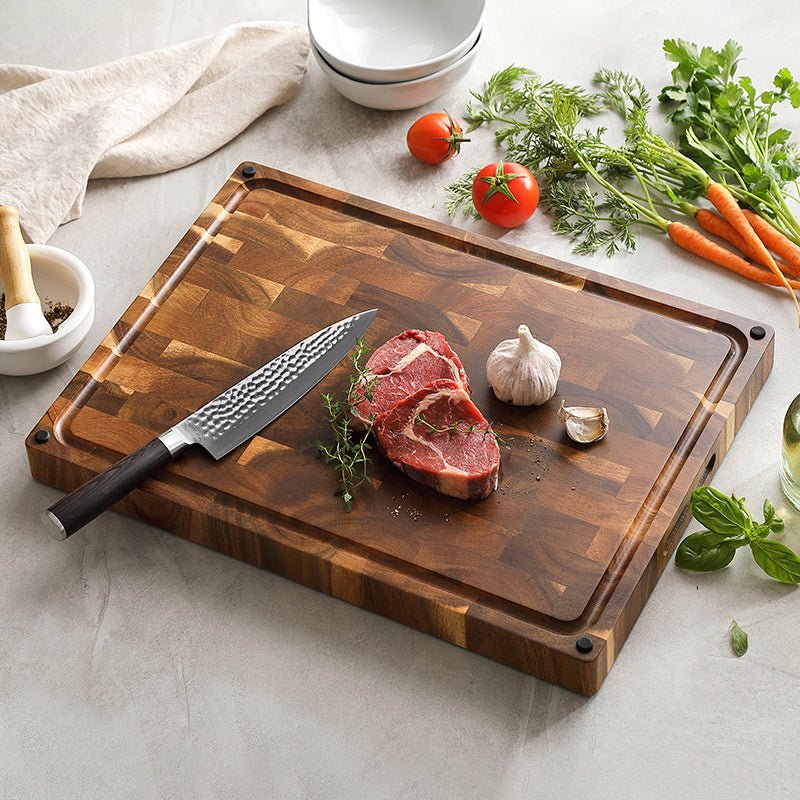
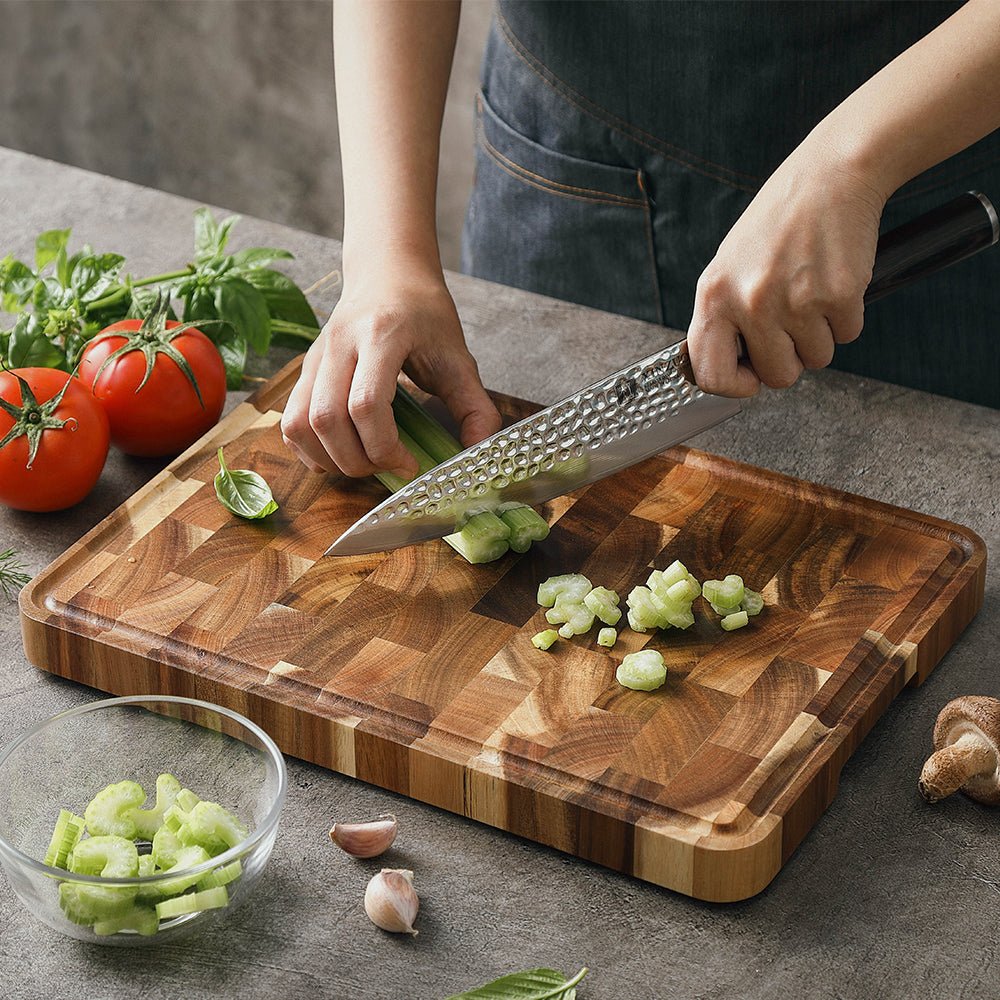
End-grain boards made from maple, walnut, cherry, or acacia are the gold standard. The exposed end grain creates a surface where wood fibres stand upright, and the knife edge passes between them rather than across them. The fibres separate and then close back together after the cut. This "self-healing" property means the board shows fewer cut marks over time and is far gentler on knife edges than any other orientation.
Walnut is my personal favourite for the balance of softness and durability. Cherry is beautiful and gentle on edges but a bit softer than ideal for heavy use. Hard maple is the classic choice in professional settings. Acacia is excellent, particularly here in Australia where it's native and widely available, with a Janka hardness that sits in a practical range for cutting boards.
Good: Edge-Grain Hardwoods
Edge-grain boards expose the long side of the wood fibres rather than the ends. They're more affordable to produce than end-grain because the construction is simpler, and they're lighter. They do show cut marks more readily since the knife is slicing across the fibres rather than between them, but they're still vastly better than any hard surface. For most home cooks on a budget, an edge-grain hardwood board is a perfectly solid choice.
Acceptable: Bamboo
Bamboo is technically a grass, not a wood, and this distinction matters. It rates around 1380 on the Janka hardness scale, which sounds reasonable on paper, but bamboo contains silica (essentially microscopic glass particles) that makes it harder on knife edges than that number suggests. It's also prone to splintering along the grain. Bamboo boards are affordable and sustainable, but they're noticeably rougher on a sharp edge than a comparable hardwood. If you own good knives, I'd spend the extra money on proper wood.
Bad: Glass, Ceramic, Marble, Granite, Steel
These materials are all dramatically harder than any knife steel. Cutting on them is like running your blade across a sharpening stone, except you're making the edge worse instead of better. Glass cutting boards are perhaps the worst offender because they're so commonly sold to people who don't know better. One aggressive rocking motion with your chef's knife on glass and you can chip the edge badly enough to require serious work on a whetstone to repair it.
Marble and granite are popular as pastry surfaces, and that's fine for rolling dough. Just never cut on them.
Mixed: Plastic (HDPE)
High-density polyethylene boards are gentle on knife edges and easy to sanitise, which is why they dominate commercial kitchens. The problem is longevity. Plastic boards develop deep grooves over time that harbour bacteria and are nearly impossible to clean properly. When you can feel distinct ridges and valleys under your fingernail, the board needs replacing. They're fine as a functional choice, but they're disposable in a way that a good wood board isn't.
What Is the Difference Between End Grain, Edge Grain, and Face Grain?
These terms describe how the wood is oriented in the finished board, and the differences are significant enough to understand before buying.
End grain is what you see when you look at the cut end of a log. The wood fibres stand vertically, pointing at you. When you cut on an end-grain board, your knife slides between those upright fibres. This is the gentlest orientation for your knife and the most durable configuration for the board itself. End-grain boards are thicker (typically 3cm or more for structural stability), heavier, and more expensive. They're worth it.
Edge grain shows the long sides of the wood strips, glued together side by side. Think of it like looking at a row of books on a shelf from the side. Your knife cuts across the fibres, which leaves visible marks over time but still provides a reasonably kind surface for your edge. Edge-grain boards can be thinner (2cm works fine) and are more affordable.
Face grain is the widest, flattest surface of a plank. It's what you'd see on a tabletop. Face-grain boards are essentially just planks of wood, and while they look attractive, they're the least durable option. They show deep cut marks quickly and are more prone to warping. Most cheap "wood" cutting boards at supermarkets are face-grain.
| Grain Type | Knife-Friendliness | Durability | Price Range |
|---|---|---|---|
| End grain | Excellent | Excellent (self-healing) | $80-$200+ |
| Edge grain | Good | Good | $40-$100 |
| Face grain | Moderate | Poor (shows deep cuts) | $20-$50 |
What Is the Janka Hardness Sweet Spot for Cutting Boards?
The Janka hardness test measures how much force it takes to embed a steel ball into wood. It's the standard way to compare wood density, and it's directly relevant to cutting boards because you need a surface that's hard enough to be durable but soft enough not to damage your knife.
The sweet spot for cutting boards sits between about 900 and 1500 on the Janka scale. Below 900 and the wood is too soft to hold up to daily use. It'll gouge deeply and fall apart. Above 1500 and you start getting into territory where the board is hard enough to be less forgiving on knife edges.
| Wood Species | Janka Hardness (lbf) | Board Suitability |
|---|---|---|
| Cherry | 950 | Gentle on edges, slightly soft for heavy use |
| Walnut | 1010 | Ideal balance of softness and durability |
| Teak | 1070 | Good, but natural oils can affect glue bonds |
| Bamboo | 1380 | Silica content makes it harsher than the number suggests |
| Hard Maple | 1450 | Professional standard, near the upper limit |
| Acacia | 1750 | Above the ideal range, but end grain offsets the hardness well |
You'll notice acacia sits above the traditional sweet spot at 1750. This is where grain orientation becomes important. An acacia end-grain board mitigates that higher hardness because the knife passes between fibres rather than impacting them directly. The self-healing end-grain structure compensates for the extra density, making acacia end-grain boards a practical and durable option. You wouldn't want an acacia face-grain board for daily knife work, but end-grain acacia performs well.
Worth knowing: Acacia is native to Australia and abundantly available here, which makes it a practical and sustainable choice for locally sourced boards. Most of the acacia used in quality cutting boards is plantation-grown.
What Size and Thickness Cutting Board Should You Buy?
People consistently buy cutting boards that are too small. A cramped board means you're constantly pushing food out of the way, which slows you down and makes prep less enjoyable. It also means your knife is more likely to slip off the edge.
Minimum useful size is about 30 x 45cm. That gives you enough room to break down an onion without ingredients falling off the sides. If you have the counter space, go bigger. A 40 x 55cm board handles everything from butternut squash to whole chickens without feeling crowded. The extra space genuinely makes you a more efficient cook.
For thickness, end-grain boards need at least 3cm to maintain structural integrity. The construction relies on the wood blocks supporting each other, and thinner end-grain boards can warp or crack. Edge-grain boards are fine at 2cm since the long grain provides inherent stability.
Weight is a consideration too. A large end-grain board can weigh 5kg or more, which is actually a feature. A heavy board doesn't slide around on your bench while you're working. If your board is light enough to shift under pressure, put a damp towel or a piece of shelf liner underneath it.
How Should You Care for and Maintain Your Cutting Board?
A good wood cutting board will last decades with proper care. A neglected one will crack, warp, and dry out within a year or two. The maintenance isn't difficult, but it does need to be consistent.
Oiling
Use food-grade mineral oil. Apply it generously to all surfaces (top, bottom, and sides) once a month, or whenever the wood looks dry or lighter in colour than usual. Let it soak in for a few hours or overnight, then wipe off any excess. The oil fills the wood pores, preventing water absorption and keeping the board from drying out and splitting.
Never use olive oil, vegetable oil, coconut oil, or any cooking oil. These will go rancid inside the wood and make your board smell terrible. Mineral oil is odourless, tasteless, and doesn't spoil.
Pro tip: A mixture of mineral oil and beeswax (about 4:1 ratio, melted together) provides longer-lasting protection than oil alone. The beeswax fills the grain and creates a semi-waterproof layer that doesn't need reapplying as frequently. Many board manufacturers sell this as "board butter" or "board cream."
Cleaning
Wash with warm water and mild dish soap after each use. Despite the old advice you might have heard, soap is fine on wood boards. The surfactants in dish soap don't penetrate deep enough to strip the oil you've applied. Just don't soak the board in water. Extended submersion causes uneven absorption that leads to warping.
Never put a wood board in the dishwasher. The combination of sustained heat, steam, and harsh detergent will crack it. I've seen beautiful end-grain boards destroyed in a single dishwasher cycle.
Drying and Storage
Dry your board standing upright on its edge so air circulates around both faces. Laying it flat on a damp counter while wet is a reliable way to encourage warping, because one side dries faster than the other and the uneven moisture causes the wood to cup.
Dealing with Odours and Stains
Coarse salt and half a lemon work well for surface odours. Scrub the salt across the board with the lemon cut-side down, let it sit for five minutes, then rinse. For persistent stains, a paste of bicarb and water left on for 15 minutes usually handles it. Avoid bleach, which is unnecessarily harsh on the wood.

How Do You Match Your Cutting Board to Your Knives?
If you've invested in high-hardness Japanese-style knives like our santoku knives (anything above 58 HRC, which includes all high-carbon and powdered steel options), your cutting board choice matters more than it does for softer European knives. Harder steel holds a finer edge but is more brittle and more susceptible to chipping on unforgiving surfaces.
A 60+ HRC knife on a glass board is practically a guarantee of edge damage. The same knife on an end-grain wood board will maintain its edge beautifully through weeks of normal home use.
This is also why proper daily knife care includes paying attention to what you're cutting on. You can maintain a perfect sharpening routine and still dull your knives prematurely if you're working on the wrong surface.
The single best thing you can do for your knife's edge retention, besides learning to use a honing steel correctly, is to use an end-grain wood cutting board for all your prep work.
What Makes Our Acacia End-Grain Boards a Good Choice?
We stock acacia end-grain cutting boards in two sizes specifically because acacia is an excellent match for high-hardness kitchen knives. The end-grain construction compensates for acacia's higher Janka rating, giving you a board that's extremely durable while still treating your edges well. Acacia also has natural antimicrobial properties and beautiful grain patterns that look good on the bench.
Both sizes are thick enough for genuine end-grain stability and heavy enough to stay planted while you work. If you're using any of our knives, whether it's a chef's knife for daily prep or a more specialised blade, pairing them with a proper end-grain board is the smart move. Investing in good knives and then cutting on a glass board is like buying a sports car and filling it with the cheapest fuel you can find.
What Is the Short Version of Choosing a Cutting Board?
Use wood. Preferably end-grain. Oil it monthly with mineral oil. Never cut on glass. That's genuinely 90% of what you need to know about choosing a cutting board that protects your knives.
If you want to go further, pick a wood species in the 900 to 1500 Janka range for edge grain, or up to 1750 for end grain where the construction offsets the hardness. Get the biggest board your counter can accommodate. Treat it well and it will outlast every other tool in your kitchen except the knives themselves.
Related Reading
- End Grain vs Edge Grain Cutting Boards
- Knife Care: Daily Maintenance Guide
- How to Sharpen Knives with a Whetstone
- Knife Steel Hardness Guide
- How to Care for Damascus Steel Knives
- Honing Steel Guide
- Kitchen Knife Sets vs Individual Knives
- How to Choose a Chef Knife: Complete Buying Guide
Frequently Asked Questions
Can a glass cutting board ruin a knife?
Yes, and quickly. Glass is dramatically harder than any knife steel, so every cut is like dragging the blade across a sharpening stone. A single aggressive rocking motion on glass can chip a hard knife edge (60+ HRC) badly enough to require serious repair on a whetstone. Glass boards are fine for serving cheese, but never use them for cutting.
How often should you oil a wood cutting board?
Oil once a week for the first month after purchase, then once a month after that. Use food-grade mineral oil, never olive oil or other cooking oils, which go rancid. End grain boards absorb oil faster because the exposed fibres act like open pores, so they need slightly more oil per application than edge grain boards of the same size.
What is the difference between end grain, edge grain, and face grain cutting boards?
End grain stands the wood blocks on their ends so fibres point upward, letting the knife slip between them. Edge grain lays planks on their sides, exposing the long grain. Face grain shows the widest flat surface of a plank. End grain is gentlest on knives and most durable. Edge grain is lighter and more affordable. Face grain is the cheapest but shows deep cut marks quickly and warps more easily.
What Janka hardness is best for a cutting board?
The sweet spot is 900 to 1500 lbf on the Janka scale. Below 900 (like pine at 690) the wood gouges too easily under daily use. Above 1500 (like purple heart at 1860) the surface becomes hard enough to dull knife edges faster. Walnut at 1010, teak at 1070, and hard maple at 1450 all fall within the ideal range.
Is a plastic cutting board better than wood for hygiene?
Not over time. New plastic boards are easy to sanitise, which is why commercial kitchens use them. But plastic develops deep grooves within months that trap bacteria and are nearly impossible to clean. Wood has natural antimicrobial properties. Research by UC Davis food scientist Dean Cliver found that bacteria on wood surfaces die off faster than on scored plastic. A well-maintained hardwood board is the safer long-term option.