

How Often Should You Sharpen Kitchen Knives?
I get this question a lot. And the honest answer is: it depends on how much you cook, what you're cutting, and what kind of steel your knife is made from. A home cook who makes dinner three times a week has completely different sharpening needs than a professional butcher breaking down whole animals eight hours a day.
But I can give you concrete schedules for each scenario. And before we get into those, we need to clear up a common confusion that trips up almost everyone.
How Is Honing Different from Sharpening?
This is the single biggest source of confusion in knife maintenance. People use "sharpening" and "honing" interchangeably, but they describe two very different processes that do very different things to your blade.
Honing is realignment. When you use a knife, the very thin edge bends and folds over microscopically. The blade isn't actually dull. The edge is still there, it's just no longer pointing straight down. A honing steel (that long rod that came with your knife block) pushes the edge back into alignment. No metal is removed. Think of it like straightening a bent wire.
Sharpening is material removal. When the edge has worn down to the point where honing can't bring it back, you need to actually grind away steel to create a new edge. This is done with a whetstone, a pull-through sharpener, or a belt system. Metal comes off the blade. The edge angle is re-established from scratch.
Quick version: Honing is maintenance you do frequently. Sharpening is repair you do occasionally. If you only do one, you'll either be honing a blade that's too far gone, or sharpening a blade that just needed a quick realign.
How Often Should You Hone Your Kitchen Knives?
Honing is quick, easy, and nearly impossible to do wrong. You should be doing it far more often than you probably are.
For most home cooks, honing before every cooking session is a good habit. It takes about 15 seconds. Five or six light strokes on each side of the blade, and you're done. Your knife will feel noticeably sharper every time.
If that feels like too much, aim for every 2 to 3 uses at minimum. The longer you wait between honing sessions, the more the edge folds over, and eventually honing won't be enough to bring it back. At that point you're looking at sharpening, which takes more time and removes steel from the blade.
How Often Should You Sharpen Your Knives?
Here's where people really want a number, so I'll give you one. But remember: these are guidelines based on typical use patterns, not laws of physics.
If you're honing regularly, you'll find that you can push these intervals out a bit longer. Honing is what keeps you from needing to sharpen as often. Skip the honing, and you'll be sharpening twice as much.
How Can You Tell Your Knife Needs Sharpening?
Schedules are useful, but your knife will also tell you when it's ready. Here are three reliable tests you can do at home.
The Tomato Test
Place a ripe tomato on the cutting board. Set the blade on the skin without applying downward pressure. Now draw the knife across the surface. A sharp knife will bite into the skin immediately and slice through without effort. A dull knife will slide across the top, and you'll need to push down to break through. If you're sawing, it's time to sharpen.
The Paper Test
Hold a single sheet of printer paper by one edge so it hangs vertically. Try to slice through it about an inch from the top. A sharp knife will cut cleanly with a smooth stroke. A dull knife will tear the paper, crumple it, or fail to catch at all. This is probably the most widely used sharpness test, and it works well.
The Fingernail Test
Lightly rest the edge of the blade on your thumbnail at about a 45-degree angle. Don't apply pressure, just let gravity hold it there. A sharp edge will catch and grip your nail immediately. A dull edge will slide off without biting. This one takes a bit of practice to feel the difference, but once you get it, it becomes second nature.
What Affects How Long Your Edge Lasts?
Some people sharpen once a year. Others sharpen every month. The difference comes down to four main factors.
Steel Hardness (HRC Rating)
This is the biggest one. The Rockwell hardness scale (HRC) measures how resistant a steel is to deformation. Higher numbers mean harder steel, which means the edge holds up longer between sharpenings.
Most European knives (your typical German-style chef's knife) sit around 56 to 58 HRC. They're softer, which means the edge rolls easily and needs frequent honing. The upside is they're easy to sharpen when the time comes.
Japanese-style knives, including most of the XINZUO range, are hardened to 60 HRC and above. That harder steel holds a finer edge for much longer. A knife at 62 HRC will stay sharp for roughly twice as long as one at 56 HRC under the same conditions. The tradeoff is that harder steel is more brittle and requires a bit more care when sharpening (you need a higher-grit stone for finishing).
Cutting Board Material
Your cutting board is either protecting your edge or destroying it. End-grain wood and rubber boards are soft enough that the knife edge sinks into the surface slightly, which reduces impact stress. Bamboo boards are harder than they look and will dull a knife faster than most people expect. Plastic boards are fine, though they score easily and can harbour bacteria in the grooves.
Glass, marble, ceramic, and granite cutting boards will wreck any knife. It doesn't matter how good your steel is. Running a thin edge across a surface that's harder than the blade itself is like dragging it across concrete. If you're using one of these, you'll be sharpening every few weeks.
Cutting Technique
How you use the knife matters more than most people realise. Rocking the blade with the tip anchored to the board (the classic French technique) is gentler on the edge than straight up-and-down chopping. Pushing the blade forward through the food while cutting down (a Japanese slicing motion) is even better, because the contact with the board is minimised.
What kills edges fast: twisting the blade while it's embedded in food, using the knife to scrape food off the board (flip it over and use the spine instead), and cutting on hard surfaces.
What You're Cutting
Vegetables and boneless proteins are easy on edges. Root vegetables like carrots and sweet potatoes are tougher but still fine. Bone, frozen food, hard squash, and crusty bread all accelerate wear. If you're breaking down whole chickens regularly, expect to sharpen more often than someone who mostly slices vegetables.
How Does Steel Hardness Affect Your Sharpening Schedule?
Understanding where your knife falls on the hardness spectrum changes your entire maintenance approach.
Soft steel (56-58 HRC) knives are the ones most people grew up with. The edge rolls and deforms easily, which is why regular honing is so effective: you're just pushing bent metal back into place. These knives need sharpening more often, but sharpening is fast because the softer steel grinds quickly on a medium-grit stone. A 1000-grit whetstone is all you really need.
Hard steel (60+ HRC) behaves differently. The edge doesn't roll, it chips. Micro-chips form along the cutting edge over time, and honing can't fix a chipped edge. When a hard steel knife gets dull, it needs to be sharpened, not honed. The good news is that you won't need to sharpen nearly as often, because that harder steel resists deformation far better. The bad news is that when you do sharpen, it takes longer because you're grinding through tougher material. Start with a 1000-grit stone and finish with a 3000 to 6000-grit stone to get the most out of a hard blade.
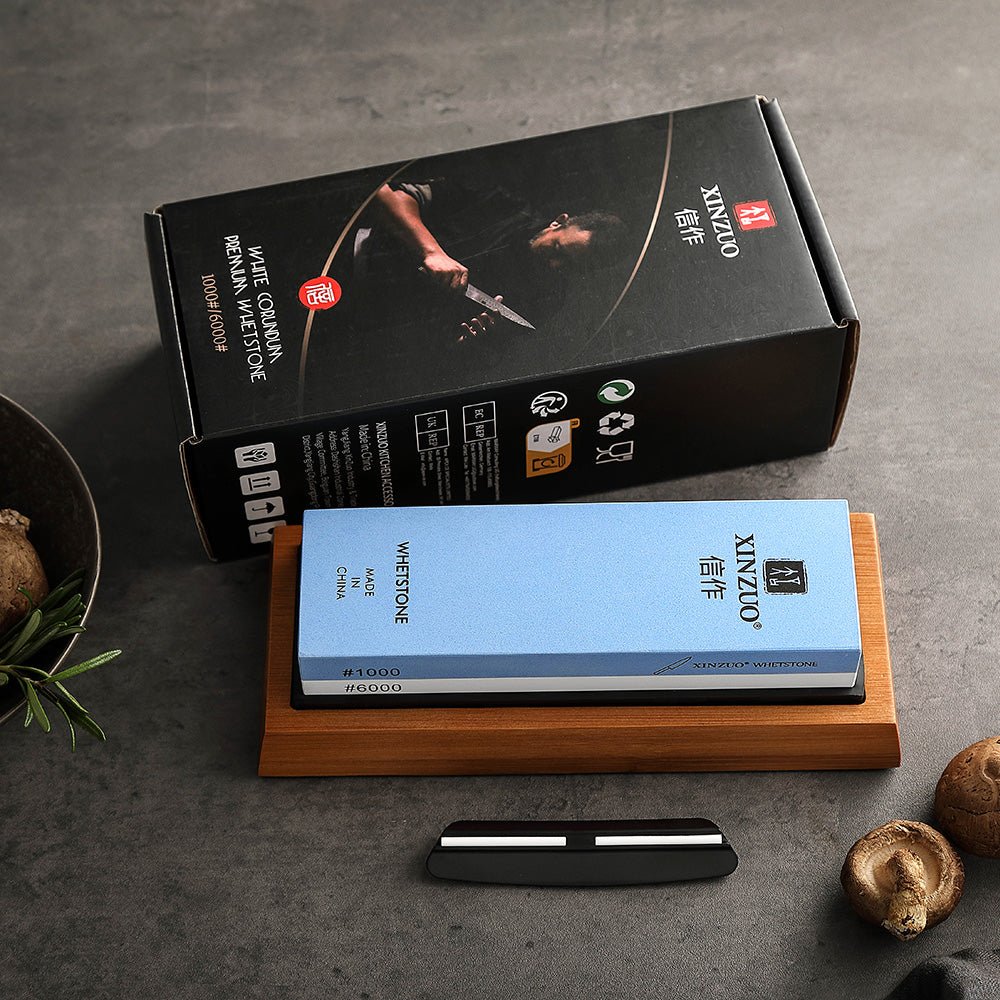
Combination stones like a 1000/6000 grit whetstone are ideal for home cooks. The 1000 side does the heavy lifting (resetting the edge), and the 6000 side polishes and refines it. One stone handles the full sharpening process.
Can Your Cutting Board Dull Your Knives?
I've talked to people who sharpen their knives religiously every month and still complain about dull edges. Nine times out of ten, the problem isn't the knife or the sharpening. It's the cutting board.
A glass cutting board will undo a professional-grade sharpening job in a single cooking session. I'm not exaggerating. Glass registers around 5.5 on the Mohs hardness scale. Most knife steels sit between 5 and 6.5. You're running your blade against a surface that's just as hard as the edge itself. Every cut is like running the blade on a grinding wheel.
Granite and marble countertops are even worse. If you're slicing anything directly on a stone counter, you're not cooking, you're actively sharpening the counter with your knife.
Switch to an end-grain wood board or a quality rubber board, and you'll be amazed at how much longer your edge lasts. I've seen people go from sharpening monthly to sharpening every three or four months, with no other changes, just by swapping their cutting surface.

How Do You Build a Knife Maintenance Routine?
If all of this feels like a lot, here's a simple framework. Three things, done consistently, will keep your knives performing well for years.
Before every cooking session: Give your knife five or six passes on a honing rod. Both sides. Light pressure. Takes 15 seconds.
Every 2 to 4 months (adjust based on use): Sharpen on a whetstone. Soak the stone for 10 minutes, do 20 to 30 passes per side on the 1000-grit, then 10 to 15 passes on the fine side. The whole process takes about 10 minutes once you have the motion down.
Once a year: Assess your knives. Are there any chips? Has the blade profile changed? If you're not confident in your sharpening skills, take them to a professional once a year for a full reset, then maintain at home between visits.
Related Reading
- How to Sharpen Knives with a Whetstone
- Honing Steel Guide: Knife Edge Maintenance
- Knife Sharpening Angle Guide
- Whetstone Grit Guide for Kitchen Knives
- Knife Care: Daily Maintenance Guide
- Knife Steel Hardness Guide
- Chopping Board Guide: Protect Your Kitchen Knives
- How to Choose a Chef Knife: The Complete Buying Guide
Frequently Asked Questions
How can you tell if your kitchen knife needs sharpening?
Try the tomato test. Rest the blade on a ripe tomato's skin and draw it across with almost no downward pressure. A sharp knife bites in immediately. A dull knife slides across the surface or compresses the flesh before cutting. Another reliable check: hold a sheet of paper by one corner and slice downward into the top edge. If it tears or catches instead of cutting cleanly, the knife is ready for a whetstone.
Does the cutting board affect how often you need to sharpen?
Yes, more than most people expect. Glass, marble, and ceramic boards register 5.5+ on the Mohs hardness scale and destroy edges within a single cooking session. End-grain wood and quality rubber boards are soft enough that the knife edge sinks in slightly, reducing impact stress. Switching from a glass board to an end-grain wood board alone can double the interval between sharpenings.
Do harder steel knives need sharpening less often?
Yes. A knife at 62 HRC (like SG2 or ZDP-189 steel) stays sharp roughly twice as long as one at 56 HRC (typical German stainless) under the same use. Xinzuo's 10Cr15CoMoV steel at 60 to 62 HRC holds a working edge for two to four months of regular home cooking. The trade-off is that harder steel takes longer to sharpen and requires a finer finishing stone (3000 to 6000 grit) for the best results.
Should I take my knives to a professional sharpener or do it myself?
A professional is worth it once a year for a full reset if you are not confident with a whetstone. Between those visits, basic honing at home keeps the edge usable. Learning to sharpen yourself on a 1000 grit whetstone takes about three practice sessions and saves $15 to $25 per knife per visit. Most home cooks find the DIY approach pays for the stone within two sharpenings.
Does what you cut affect how quickly a knife dulls?
Significantly. Boneless proteins and soft vegetables are easy on edges and add minimal wear. Root vegetables like carrots and sweet potatoes are tougher but manageable. Bone, frozen food, hard squash, and crusty bread accelerate dulling noticeably. If you regularly break down whole chickens or cut through butternut squash, expect to sharpen about twice as often as someone who mostly slices herbs and leafy greens.