


Is Your Damascus Knife Tougher Than You Think?
People buy a gorgeous Damascus knife and then treat it like a museum piece instead of what it is: a kitchen tool that happens to look spectacular. I've seen knife owners keep them in padded boxes on shelves, too afraid to use them. That defeats the purpose entirely.
Caring for a Damascus knife is not complicated. If you already know how to care for a good kitchen knife, you already know 90% of what you need. The other 10% is pattern maintenance, and even that is straightforward once you understand what's actually going on with the steel.

What Is the Quick Answer on Damascus Knife Care?
Damascus knives follow the same care rules as any quality kitchen knife: hand wash with mild soap, dry immediately, store properly, and hone on a ceramic rod.
The only extra consideration is the pattern. Damascus patterns fade naturally with use and cleaning. This is normal and proves the knife is real Damascus. Acidic foods (tomatoes, citrus, onions) can cause uneven spots if you don't clean promptly. And if the pattern ever fades too much, you can restore it at home with a simple re-etching process.
Why Does Damascus Steel Need More Attention Than Other Knives?
A mono-steel knife is one type of steel all the way through. A Damascus blade is made from alternating layers of two or more different steels, forge-welded together and folded. In Xinzuo's case, that's typically a hard 10Cr15CoMoV cutting core wrapped in softer stainless cladding layers.
Those different steels react to moisture, acid, and oxygen at slightly different rates. That's the whole reason the pattern is visible in the first place. An acid etch during manufacturing darkens the more reactive layers while leaving the less reactive layers brighter. Beautiful, but it also means the blade's surface is inherently more sensitive to environmental changes than a single-steel blade.
In practical terms, this means exactly one thing: be a bit quicker about washing and drying. That's it. No special rituals, no weekly polishing schedule, no complicated maintenance regimen. Just don't leave it sitting wet.
What Does a Daily Damascus Knife Care Routine Look Like?
This is identical to caring for any high-quality kitchen knife. Full breakdown in the complete maintenance guide.
1. Hand wash only. Warm water, mild dish soap, soft sponge. Wipe from spine to edge (not across the edge). 15 seconds total.
2. Dry immediately. Don't leave it on the drying rack. Don't prop it up next to the sink. Wash it, dry it with a clean towel, put it away. This single habit prevents 90% of Damascus care problems.
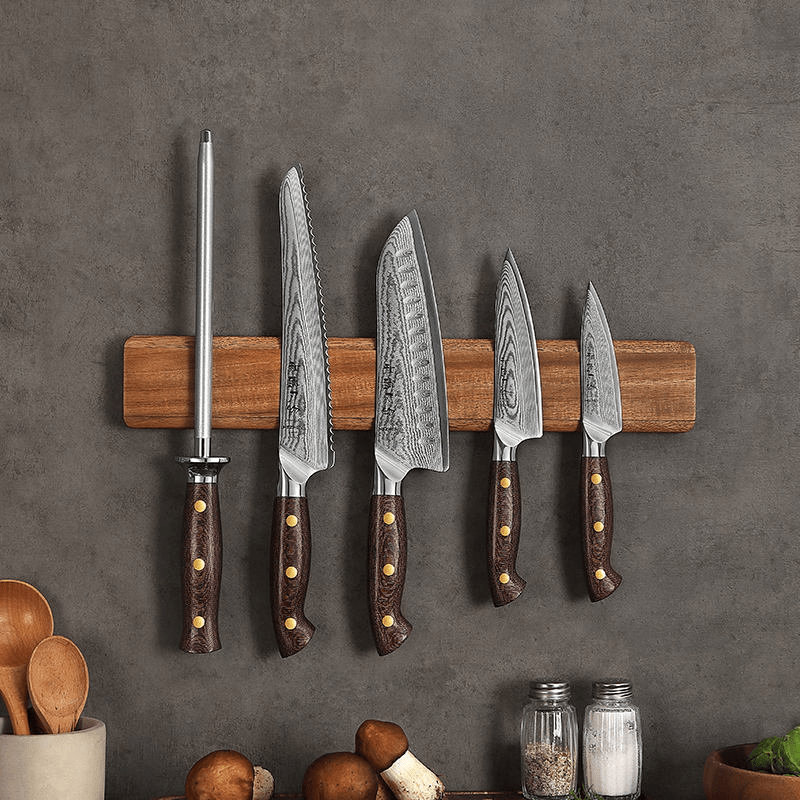
3. Store it properly. A magnetic wall rack is ideal for airflow and visibility. A knife block works too if you insert spine-first. Blade guards are the best option if you keep knives in drawers. Never leave blades loose in a drawer where they knock against other utensils.
What Causes Damascus Pattern Fading and How Do You Prevent It?
The Damascus layers are structural. They go all the way through the blade and they're permanent. But the visible contrast between layers is a surface effect created by acid etching during manufacturing. The acid reacts with each steel type at a different rate, darkening some layers more than others.
Every time you wash the blade, cut something acidic, or wipe it down, you're slowly wearing at that surface contrast. This is completely normal. A Damascus pattern that never changes would be suspicious, because that's what you see on fake Damascus knives with laser-etched cosmetic patterns.
The Main Causes of Uneven Pattern Changes
Acidic foods left on the blade. Tomatoes, citrus, onions, and vinegar-based sauces react with the steel if they sit for more than a few minutes. You'll get discolored patches where the acid ate into certain layers faster. The fix: wipe the blade with a damp cloth between tasks when cutting acidic ingredients.
Water spots from air drying. Mineral deposits in tap water leave spots as they evaporate. On Damascus, these create uneven oxidation that disrupts the pattern. The fix: dry immediately after washing.
Abrasive cleaners and scouring pads. Steel wool, abrasive powders, and rough scouring pads physically scratch the etched surface. This removes the dark oxide layer unevenly. Stick to soft sponges, always.
How Should You Store Damascus Knives in Australian Conditions?
Australia's coastal regions present a real challenge for knife storage. If you're in Sydney, Brisbane, the Gold Coast, or anywhere along the coast, you're dealing with ambient humidity that regularly exceeds 70%. Salt air compounds the problem. Steel corrodes faster in these conditions, and Damascus steel's multi-layer structure gives corrosion more surface area to work with.
High-humidity storage rules:
Keep knives out of enclosed, unventilated spaces. A sealed knife block sitting on a countertop in a humid coastal kitchen traps moisture against the blade. A magnetic wall holder is far better because it allows constant airflow around the blade.
If you must store knives in a drawer, wrap each blade in a dry cloth or use a blade guard. Consider dropping a silica gel packet into the drawer to absorb moisture. Replace it every couple of months.
For long-term storage (more than two weeks without use), apply a coat of mineral oil or camellia oil. This creates a barrier between the steel surface and humid air. In tropical or coastal Queensland, this step is worth doing for any knife you're not using weekly.
Which Oil Should You Use on Damascus Steel?
Apply a few drops on a soft cloth and wipe a thin, even coat across both blade flats. You want barely-there coverage, not a dripping wet blade. Before your next use, a quick wipe with a dry towel removes the oil film.
How Do You Re-Etch and Restore the Damascus Pattern at Home?
Re-etching is straightforward, reversible, and something you can do at your kitchen table. The Damascus layers are permanent. You're just refreshing the surface contrast that faded through normal use.
You'll need: 800 and 1500 grit sandpaper, isopropyl alcohol (90%+), ferric chloride solution (available from electronics suppliers like Jaycar in Australia), baking soda, water, food-safe mineral oil, chemical-resistant rubber gloves, and safety goggles.
Step by Step
Step 1: Sand the blade flats. Start with 800 grit, working in long strokes along the length of the blade (not across it). Switch to 1500 grit for a finer finish. When you're done, the blade should look uniformly silvery with no visible pattern. That's correct. You've removed the old etch.
Step 2: Degrease completely. Wipe down the entire blade with isopropyl alcohol to remove all oils, fingerprints, and residue. Any oil left on the surface will block the acid and create uneven results. Don't touch the blade flats with bare fingers after this step.
Step 3: Apply ferric chloride. You can either dip the blade into a shallow container of solution or apply it with cotton balls. Leave it in contact for 5 to 10 minutes. The pattern emerges as different layers darken at different rates. Shorter times (3 to 5 minutes) give a subtler, lighter pattern. Longer times (8 to 12 minutes) produce higher contrast.
Step 4: Rinse thoroughly. Hold the blade under running water for at least 30 seconds to stop the etching process.
Step 5: Neutralize the acid. Mix a tablespoon of baking soda into a cup of water. Apply the paste to the blade, let it sit for a full minute, then rinse again. This step is not optional. Ferric chloride residue left on the blade will continue to eat into the steel.
Step 6: Dry and oil. Dry the blade completely with a clean towel. Apply a thin coat of food-safe mineral oil immediately.
Chemical Safety for Ferric Chloride
Ferric chloride is a corrosive acid solution. It's not dangerously concentrated in the form sold for PCB etching (which is what you'll buy), but it still demands respect.
Skin contact: Causes irritation and stains skin yellow-brown. Wear chemical-resistant rubber gloves (not thin latex). If it contacts skin, wash immediately with plenty of water.
Eye contact: Can cause serious irritation or damage. Wear safety goggles, not just glasses. If it splashes in your eyes, flush with clean water for 15 minutes and get medical attention.
Ventilation: Work outdoors or in a well-ventilated area. The fumes are not severely toxic, but prolonged exposure in an enclosed space can irritate your throat and lungs.
Surfaces: Ferric chloride permanently stains stainless steel sinks, concrete, clothing, and most countertops. Work on a plastic tray or old plastic cutting board. Keep paper towels handy for drips.
Disposal: Don't pour spent solution down the drain. Neutralize with baking soda until it stops fizzing, then check your local council's guidelines for chemical waste disposal. In most Australian states, small amounts of neutralized ferric chloride can go in general waste, but check first.
How Do You Fix Common Re-Etching Problems?
What Is the Difference Between Patina and Rust?
Patina is stable, protective oxidation that develops naturally on carbon and semi-stainless steels. It shows up as blue-grey, sometimes purple or bronze discoloration that's smooth and flush with the steel surface. On Damascus, it adds character. Leave it alone.
Rust is destructive. It shows up as rough, raised, orange or reddish-brown spots. If you see it, make a paste from baking soda and water, apply it, and gently rub with a soft cloth or cork. Once removed, dry the blade and apply mineral oil immediately. If rust has caused pitting, you may need to lightly sand and re-etch that area.
What Should You Never Do with a Damascus Knife?
Never put a Damascus knife in the dishwasher. The combination of harsh detergent, high heat, prolonged moisture, and physical banging against other items will destroy the pattern and can cause pitting. There's a full explanation of why in the dishwasher article.
Never use bleach or bleach-based cleaners. Chlorine attacks the chromium in stainless steel, stripping the protective oxide layer. On Damascus, this creates irregular dark spots that won't come out without full re-etching.
Never soak the blade. Leaving a Damascus knife submerged in water (even soapy water) for more than a minute or two accelerates corrosion in the valleys between pattern layers. Wash, rinse, dry. Don't soak.
Never store a wet blade. Not in a block, not on a magnetic strip, not in a guard. Dry first, always.
Never use metal scouring pads. Steel wool and metal scrubbers scratch through the etched layer unevenly. You'll need to re-etch the whole blade to fix it.
How Should You Hone and Sharpen a Damascus Knife?
One common concern: "Will sharpening ruin my Damascus pattern?" No. Sharpening removes material from the edge bevel, where the core steel meets the cladding. The Damascus pattern lives on the blade flats. Normal sharpening on a whetstone doesn't touch those areas at all.
Honing: Use a ceramic honing rod. A few light passes before each cooking session keeps the edge aligned. Never use a grooved steel rod on hard Japanese core steels, as it can chip the edge.
Sharpening: A 1000/3000 grit whetstone is the best option. See the full whetstone sharpening guide for technique.
Related Reading
- Real Damascus Steel vs Fake: How to Tell the Difference
- Knife Care and Daily Maintenance Guide
- Can You Put Knives in the Dishwasher?
- Magnetic Knife Holder vs Knife Block
- Knife Block Buying Guide
- Knife Steel Hardness Guide
- How to Sharpen Knives with a Whetstone
- Chopping Board Guide: Protect Your Kitchen Knives
Frequently Asked Questions
Can you restore a faded Damascus pattern at home?
Yes. Sand the blade flats with 800 then 1500 grit sandpaper, degrease with isopropyl alcohol, and submerge in ferric chloride solution for 5 to 10 minutes. Rinse, neutralise with baking soda paste, dry, and oil. The whole process takes about 30 minutes at your kitchen table. For a gentler option, strong black instant coffee works as a mild etchant, though the contrast will be subtler.
Why does my Damascus knife pattern look different after a few months?
The visible contrast between layers is a surface effect created by acid etching at the factory. Normal use, washing, and contact with acidic foods gradually wear that surface contrast. This is expected on genuine Damascus steel and actually proves the pattern is real. Fake Damascus patterns stay perfectly uniform because they are printed onto a single steel.
What oil should I use on a Damascus steel knife?
Food-safe mineral oil is the best all-round choice: cheap, odourless, widely available, and it won't go rancid. Camellia oil (tsubaki) leaves a longer-lasting protective film and is the traditional Japanese option, though it costs more. Never use olive oil, canola, or vegetable oil on a knife blade. They oxidise and turn sticky within weeks.
How do you store Damascus knives in a humid climate?
Use a magnetic wall rack for constant airflow around the blade. Avoid sealed knife blocks in coastal or tropical kitchens, as they trap moisture against the steel. If you store knives in a drawer, wrap each blade in a dry cloth or use a blade guard and drop a silica gel packet in the drawer. For any knife left unused for more than two weeks, apply a thin coat of mineral oil before storing.
Is it normal for Damascus steel to develop a patina?
Yes. Patina is stable, blue-grey oxidation that forms naturally on the more reactive steel layers. It is smooth, flush with the surface, and actually protects the steel underneath from further corrosion. Rust is the opposite: raised, rough, orange-brown spots that eat into the metal. Patina can be left alone. Rust should be removed immediately with a baking soda paste and a soft cloth.