


What Is a Kiritsuke Knife and Who Should Use One?
A kiritsuke is a long, flat Japanese-style knife with an angular "k-tip" that combines the vegetable skills of a nakiri with a pointed tip for protein work. Traditional single-bevel versions were reserved for head chefs only. Modern double-bevel versions are accessible to any experienced home cook. If you already push-cut and want a longer blade with tip precision, a kiritsuke is your next knife. If you've never used a flat-profiled Japanese-style blade, start with a bunka instead.
Walk into a traditional Japanese kitchen and you'll notice something about the kiritsuke: only one person is using it. The head chef. Everyone else keeps their hands off. That's not restaurant politics. It's tradition. The kiritsuke was a mark of rank, a signal that the person wielding it had mastered both fish and vegetable disciplines. That history is part of what makes the modern version so interesting, and part of why choosing the right one requires some homework.
What Is the Difference Between Single-Bevel and Double-Bevel Kiritsuke?
The original kiritsuke is a single-bevel knife. One side is ground flat, the other is hollow-ground (ura). It merges two specialist knives into one: the yanagiba, a long single-bevel slicer for raw fish, and the usuba, a flat single-bevel vegetable knife. Using a single-bevel kiritsuke competently means you can do both jobs, and in a Japanese professional kitchen, that meant you were the most skilled person in the room.
Single-bevel knives cut differently from double-bevel ones. Because only one side has a ground edge, the blade naturally steers during cuts. Right-handed versions drift left. Left-handed versions drift right. You learn to compensate, but it takes months or years of practice. The edge is also more fragile, thinner, and sharper, but prone to chipping if you use poor technique or hit a bone.
Xinzuo's F3 series includes traditional single-bevel kiritsuke at 270mm and 300mm, hand-forged from SLD steel at 62-64 HRC. These are serious professional tools.
The modern double-bevel kiritsuke keeps the flat edge profile and the angular k-tip, but sharpens symmetrically on both sides. This removes the steering issue and the specialist sharpening requirement. You maintain it the same way you maintain a gyuto or santoku. The trade-off is that you lose some of the laser-thin cutting precision of a true single-bevel edge, but for 99% of home cooks and most professional Western-style cooks, the double-bevel version is the practical choice.
Why Does the K-Tip Shape Matter?
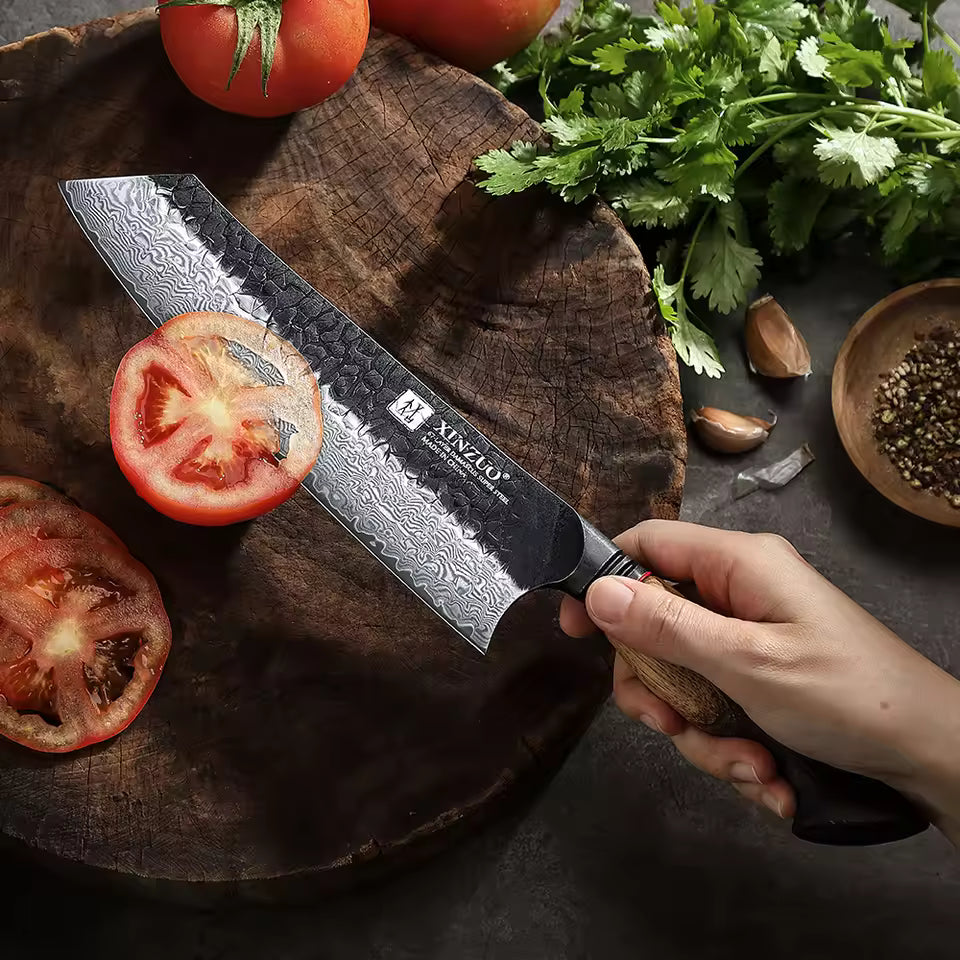
The kiritsuke's defining feature is the k-tip: the spine angles downward to meet the edge at a sharp point, creating a reverse-tanto profile. This isn't just for looks. The geometry serves real purposes.
The angled tip concentrates force at a small contact point. When you score duck breast skin, you're pressing through tough collagen-rich skin without crushing the fat beneath. A rounded chef knife tip smears and slides. The k-tip bites and cuts. Same principle applies when trimming silverskin off a tenderloin, separating membrane from a rack of ribs, or making shallow cuts in squid for tempura.
The flat edge behind the tip gives you a long, straight cutting surface. Unlike a gyuto's curved belly, which contacts the board at a single point during a rock-chop, the kiritsuke's flat edge meets the board along its entire length. Every push-cut goes through cleanly. No accordion-cut onions. No half-attached herb leaves.
The combination of the pointed tip and the flat edge is what makes the kiritsuke more capable than a nakiri (which has the flat edge but no tip) and more precise for push-cutting than a gyuto (which has the tip but a curved edge).
How Does a Kiritsuke Compare to a Gyuto and bunka?
These three knives get confused constantly, and for good reason. They overlap. But the differences matter when you're deciding which one belongs in your kitchen.
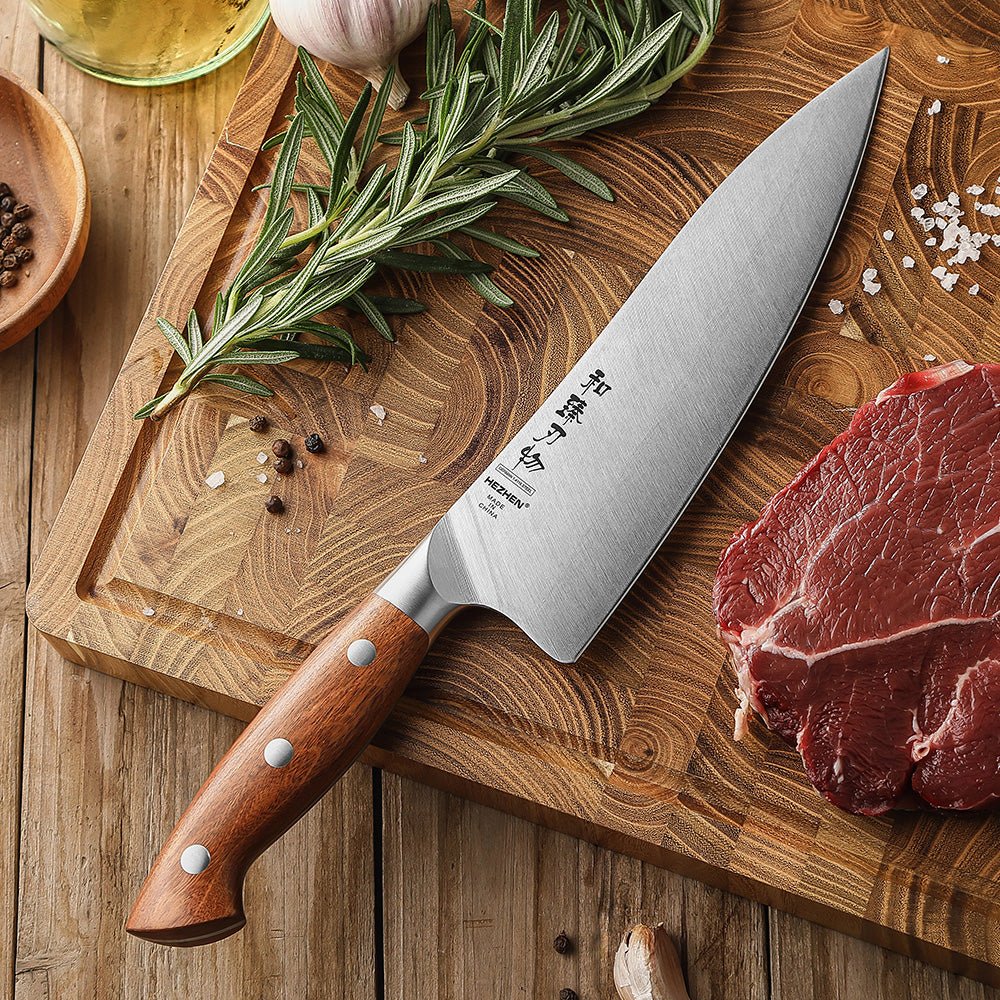
The gyuto is the most forgiving of the three. Its curved belly works with a rocking motion, a push-cut, a pull-slice, whatever you throw at it. If you're buying your first serious knife, the gyuto is the right call.
The bunka shares the kiritsuke's k-tip geometry in a compact package. At 165-215mm, it's quicker to manoeuvre, fits smaller cutting boards, and costs less. It's the best entry point into flat-profile k-tip knives.
The kiritsuke takes what the bunka does and stretches it out. More edge contact. More slicing length. More reach. But also more blade to control, more cutting board space required, and less forgiving of sloppy technique.
What Dishes and Techniques Is a Kiritsuke Best For?
Vegetable prep
The kiritsuke is at its absolute best doing high-volume vegetable prep. Making a large batch of mirepoix? The flat edge cuts through celery, carrots, and onions with full board contact on every stroke. Brunoise (those tiny 3mm dice) is where the flat profile really pays off, because every cut goes all the way through. No lifting the knife to check if pieces are still connected.
Shredding cabbage for okonomiyaki or coleslaw with a 270mm kiritsuke is genuinely fast. One pass per shred, and the length means you're cutting through a wider section of cabbage head with each stroke than you would with a 210mm gyuto.
Sashimi and raw fish
The long flat edge works well for pull-cutting raw fish. You draw the blade toward you in a single continuous stroke, and the flat profile keeps the edge in contact with the fish from heel to tip. This is close to how a yanagiba works, though a dedicated single-bevel sashimi knife will still outperform it for paper-thin slices.
Protein portioning
Trimming a whole chicken breast, breaking down a pork loin, or slicing cooked roast beef into even portions. The k-tip handles the detail work (trimming fat, separating membrane) while the long flat edge handles the slicing. Two operations, one knife, no swapping.
Herb work
Push-cutting through a pile of basil or parsley with a flat-edged knife produces cleaner cuts than rock-chopping. Less bruising, less oxidation, and the herbs stay green longer. If you've ever noticed your chopped basil turning black within minutes, the cutting technique (not the knife) is usually the problem. A flat-profiled knife naturally encourages the right technique.
How Do You Sharpen a Kiritsuke?
If your kiritsuke is double-bevel, sharpen it exactly like you'd sharpen a gyuto on a whetstone. Same angles (typically 15 degrees per side for Japanese steel), same progression from coarse to fine grit, same deburring technique.
The one area that needs extra care is the k-tip. The angular transition where the spine drops to meet the edge creates a section of blade that's thinner and more delicate than the rest. When sharpening near the tip, reduce your pressure. Let the weight of the blade do the work. If you press too hard, you risk rounding that angular point into a generic curve, and then it's just a long gyuto with an identity crisis.
For single-bevel kiritsuke, sharpening is a different discipline entirely. You work the bevel side on a stone at a lower angle (around 10-12 degrees), then flip and do light passes on the flat (ura) side to remove the burr. Single-bevel sharpening is a learned skill. If you're not confident, take the knife to a professional who works with Japanese-style blades.
Between sharpening sessions, a ceramic honing rod maintains the edge. Skip the grooved steel rod you might use on German knives. The harder steel in a Japanese-style kiritsuke (typically 60+ HRC) can chip against a coarse steel rod.
Should You Choose a Wa Handle or a Western Handle?
Kiritsuke handles come in two styles, and which one works for you depends on how you hold a knife.
Wa handles (traditional Japanese) are light, round or octagonal, made from wood like magnolia, ho, or ebony. They're designed for a pinch grip where your thumb and index finger sit on the blade itself, right at the heel. The handle just rests in your palm for balance. Because they're lightweight, wa handles keep the centre of gravity forward in the blade, which is ideal for push-cutting. You let the blade's weight do the cutting while your hand guides.
Western handles are heavier, fully riveted, with an ergonomic shape that fills the hand. They work better with a handle grip (all fingers wrapped around the handle). The extra weight in the handle shifts the balance point rearward, which makes the knife feel lighter and more manoeuvrable but reduces the natural "drop" of a blade-heavy knife.
For a kiritsuke, blade-forward balance is generally better. The knife's whole design philosophy is built around controlled downward push-cuts, and a heavier blade aids that motion. This is why most traditional kiritsuke come with wa handles. But if a wa handle feels foreign in your hand, a Western-handled kiritsuke will still work well. Comfort beats theory every time.
How Much Does a Kiritsuke Cost and Is It Worth It?
Kiritsuke pricing falls into three tiers:
$80-$150 (double-bevel, entry-level): Decent VG-10 or similar steel, 58-60 HRC. Factory-made, consistent quality. A good way to test whether the kiritsuke profile suits your cooking style before spending more. This is where most of Xinzuo's double-bevel options sit.
$150-$350 (double-bevel, mid-range): Better steel (SG2/R2, AUS-10, ZDP-189), higher hardness, thinner grinds. The performance difference between an $80 and a $250 kiritsuke is real: keener edge, longer edge retention, more responsive feel. Worth the upgrade if you've confirmed you like the profile.
$400+ (single-bevel, artisan): Hand-forged by individual smiths. White or blue carbon steel, or high-end tool steels like SLD. Xinzuo's F3 series single-bevel kiritsuke falls here. These are professional-grade tools that will last decades with proper care. The price reflects the smithing skill and the materials.
Value perspective: A kiritsuke is not a first knife. It's a second or third knife. If your $200 gyuto handles 80% of your cooking and you spend $150 on a kiritsuke for the other 20%, you now have a setup that covers everything. Don't buy a kiritsuke to replace your chef knife. Buy one to complement it.
Should You Buy a Kiritsuke or a Bunka?
Buy a bunka if: You want a compact, nimble k-tip knife. You work on a standard home cutting board. You like the idea of a flat-profile knife but haven't tried one yet. You do moderate amounts of prep. A 170-215mm bunka is the safest way to discover whether flat-edge push-cutting is your preferred technique.
Buy a kiritsuke if: You already own and love a bunka or nakiri. You've confirmed that push-cutting is how you prefer to work. You want the extra slicing length for proteins and large vegetables. You have a big cutting board (at least 450mm/18 inches long). You're comfortable with a 240mm+ blade.
Buy a gyuto instead if: You rock-chop a lot. You want one knife for everything. You cook a wide variety of cuisines. The gyuto is the most versatile single knife you can own.
A good progression looks like this: start with a gyuto, add a bunka when you want to experiment with flat profiles, then add a kiritsuke when you know that's the cutting style you prefer. Each step builds on the last.
Related Reading
- Bunka Knife Guide: The Japanese K-Tip
- Japanese-style Knife Types Explained
- Santoku vs Chef Knife
- Gyuto Knife Guide
- Knife Steel and Hardness Guide
- Knife Technique: Rock Chop, Push Cut, Pull Slice
- How to Sharpen Knives on a Whetstone
- How to Choose a Chef Knife: The Complete Buying Guide
Frequently Asked Questions
Is a kiritsuke knife good for beginners?
A traditional single-bevel kiritsuke is not. It requires months of practice to control the blade's natural steering, and the single-bevel edge is difficult to sharpen correctly. A modern double-bevel kiritsuke (often called a kiritsuke-gyuto) is far more accessible, since it cuts straight and sharpens the same way as a gyuto or santoku. Even so, the flat edge profile only suits push-cutting, so beginners who rely on rock-chopping should start with a gyuto instead.
What is the difference between a kiritsuke and a gyuto?
The kiritsuke has a flat edge profile and an angular k-tip, while the gyuto has a curved belly and a rounded point. The flat edge makes the kiritsuke better for push-cutting vegetables with full board contact on every stroke, and the k-tip excels at scoring, trimming, and detail tip work. The gyuto's curve allows rock-chopping and suits a wider range of cutting techniques. Kiritsuke blades are also longer, typically 240 to 270mm vs 210 to 240mm for a gyuto.
Can a kiritsuke replace a chef knife?
A double-bevel kiritsuke can handle most of the same tasks, but it is not a direct replacement. The flat profile does not rock-chop well, so mincing herbs and garlic takes a different technique. The longer blade (240mm+) also needs more board space. Cooks who push-cut everything and have a large prep surface may prefer a kiritsuke as their primary knife, but most people keep a gyuto alongside it for rocking tasks.
What is the k-tip on a kiritsuke used for?
The angular k-tip concentrates force at a small contact point, which is useful for scoring duck breast skin, trimming silverskin from tenderloin, separating membrane on ribs, and making shallow cuts in squid. A rounded chef knife tip smears and slides across tough surfaces, while the k-tip bites cleanly. It also gives more precise control when making decorative cuts on vegetables.
What size kiritsuke should I get?
240mm is the standard starting point for a double-bevel kiritsuke. It provides enough length for long push-cuts through large vegetables and proteins without being unwieldy on a home cutting board. 270mm suits cooks with large boards (450mm+) who want extra slicing reach. Anything under 210mm is sold as a kiritsuke but functionally behaves more like a bunka.