

Why Do Your Knives Deserve Better Than a Drawer?
You spent good money on your knives. You keep them sharp, you hand-wash them, you store them properly at home. And then you toss them in a duffel bag to drive across town for a catering gig, and they rattle around against each other for twenty minutes. All that careful maintenance, undone by one car ride.
That is the problem knife rolls solve. They are not a luxury item or a fashion statement (though some of them look fantastic). They are functional blade protection for anyone who needs to move knives from point A to point B without destroying the edges.
The short version: A knife roll keeps your blades separated, your edges protected, and your kit portable. It costs a fraction of what you spent on the knives themselves, and it prevents damage that would cost more than that to repair. If you move your knives with any regularity, you need one.
How Do Knife Edges Get Damaged in Transit?
A sharp knife edge is thin. Really thin. On a well-sharpened chef knife, the edge can be as narrow as 10 to 15 microns at the very tip. For reference, a human hair is about 70 microns wide. That kind of thinness is what makes cutting effortless, but it also means the edge is fragile when it contacts hard surfaces at the wrong angle.
When knives sit loose in a bag, they slide against each other, against zippers, against whatever else is in there. Every contact point is a chance for the edge to chip, roll, or dull. The same thing happens in kitchen drawers, by the way, which is why a knife block or magnetic holder is standard advice for home storage. But at home, you can control the environment. On the road, you need a portable solution.
A knife roll gives each blade its own pocket. No contact between edges. No metal-on-metal rattling. It is a simple concept, and it works extremely well.
Who Actually Needs a Knife Roll?
The obvious answer is professional chefs. Walk into any commercial kitchen and you will see knife rolls tucked into lockers or sitting on shelves. Professionals carry their own knives to work, and a knife roll is how they do it safely. But the audience for knife rolls is wider than that.
Professional Chefs and Line Cooks
If you cook for a living, your knives are your tools. You probably own between four and twelve knives that you use regularly, plus a honing steel, maybe a peeler, some tweezers. A knife roll holds all of it in one organized package. You grab it at the start of your shift, you roll it up at the end. It becomes part of your routine.
Culinary Students
Most culinary programs require students to bring their own knife kit. A knife roll is not optional here. It is how you transport your kit to class, how you keep everything organized during practicals, and how you signal that you take the work seriously. Showing up with knives loose in a backpack is a bad look.
Home Cooks Who Travel
You rent a holiday house and the kitchen has three blunt knives and a bread knife with a wobbly handle. Sound familiar? Plenty of serious home cooks pack their own knives when they travel. A knife roll makes that safe and practical. Same goes for cooking at a friend's house, potlucks, or any situation where you want your own gear.
BBQ and Competition Cooks
Competition BBQ teams need boning knives, slicing knives, cleavers, and trim knives at the cook site. That is a lot of sharp steel to transport, often across uneven ground in the back of a ute. A knife roll keeps everything organized and protected even when the ride is rough.
Outdoor and Camp Cooks
If you cook at camp with proper kitchen knives (not just a pocketknife), a compact knife roll is the best way to keep them safe in your gear. It takes up less space than a hard case and protects the blades from contact with pots, pans, and tent stakes.
Should You Choose Leather, Canvas, or Nylon?
Knife rolls are made from three main materials, and each has real trade-offs. This is not a case where one is objectively best. It depends on how you plan to use it.
Leather knife rolls are the gold standard for a reason. A thick leather pocket provides genuine cushioning and separation between blades. The material is stiff enough to hold its shape when rolled, which prevents knives from shifting during transport. Good leather also wears in rather than wearing out. A quality leather knife roll that gets regular use will look better at year five than it did at year one.
Canvas rolls are the workhorse option. They handle moisture better than untreated leather, they weigh less, and they are easier to clean if you get food on them. The trade-off is less natural padding, so the pocket construction has to do more of the protective work.
Nylon rolls are fine for culinary students on a budget or as a travel backup. But if you are carrying knives that cost several hundred dollars each, spending $30 on a thin nylon roll is a strange place to cut corners.
Capacity: How Many Knives Do You Actually Carry?
Knife rolls come in sizes ranging from 4 pockets to 20+. Bigger is not always better. A half-empty knife roll is bulky and the knives can shift inside oversized pockets. You want a roll that matches the number of knives you actually transport.
Here is a general guide:
A 7 to 10 pocket roll is the sweet spot for most people. It holds a solid working kit without being so large that it becomes awkward to carry. If you only transport two or three knives, a smaller roll or even individual knife guards might be more practical.
What Pocket Design Features Protect Your Blades Best?
Not all pockets are created equal. The pocket design is what actually separates a good knife roll from a mediocre one, because the pockets are doing the real work of keeping your blades safe.
Pocket Depth
Each pocket should be deep enough that the blade is fully enclosed when the roll is closed. If the tip of your knife sticks out past the pocket, it can poke through the roll material or contact other blades. Look for pockets that accommodate blades up to 25cm (10 inches) at minimum. If you carry a long slicer or a bread knife, check that there is at least one pocket deep enough for it.
Pocket Width
Pockets that are too loose let the knife slide around. Pockets that are too tight make it hard to insert and remove the knife without scraping the blade against the material. You want a snug fit, not a fight. The best knife rolls have pockets of varying widths to accommodate everything from a thin paring knife to a wider chef knife or cleaver.
Flap Protection
Some knife rolls have a fold-over flap that covers the handles after you insert the knives. This adds another layer of security, because even if a knife starts to work its way up out of its pocket during transport, the flap catches it. This feature is worth looking for, especially if you carry the roll on a motorcycle, bicycle, or in any situation with a lot of movement.
Separation Between Pockets
This is the detail that cheap knife rolls get wrong. If the pockets are stitched too close together, the blades can still press against each other through the material. Good knife rolls space the pockets far enough apart that even through the fabric, there is no blade-to-blade contact.
What Should You Look for When Buying a Knife Roll?
There are dozens of knife rolls on the market. Here is what separates the good ones from the ones that fall apart after six months.
Stitching Quality
This is the number one thing to check. Knife rolls take a lot of stress at the pocket seams because you are repeatedly inserting and removing heavy, sharp objects. Double or reinforced stitching at the pocket openings is essential. Single-stitch construction at stress points will start unraveling within months of daily use. Look at the thread too. Nylon thread holds up far better than cotton thread, especially in humid or wet conditions.
Closure System
Knife rolls close in one of three ways: leather straps with buckles, fabric ties, or snap buttons. Leather strap closures are the most secure and the most traditional. They wrap around the rolled bag and buckle or tie in place, creating tension that holds everything tight. Fabric ties work fine but can loosen during transport if they are not tied properly. Snap buttons are the weakest option and can pop open under pressure.
Handle or Carry Strap
You are going to carry this thing. A lot. A good handle or shoulder strap makes a real difference, especially when the roll is loaded with a full kit of knives. Some rolls have both a top handle and a shoulder strap, which is ideal. Rolls that only have ties to carry them by get uncomfortable quickly.
Extra Tool Pockets
Most chefs carry more than just knives. A honing steel, a Y-peeler, plating tweezers, a thermometer, maybe a Microplane. Knife rolls with a few smaller pockets or a zippered compartment for these accessories save you from having to carry a second bag.
Weight When Empty
Once you load a knife roll with six to ten knives and a few tools, it gets heavy. If the roll itself weighs a kilogram before you put anything in it, the loaded weight can become uncomfortable for daily carrying. Leather rolls are heavier than canvas. Canvas is heavier than nylon. Factor this in if you carry your kit a long distance on foot.
Can You Use a Knife Roll for Home Storage?
This is an unconventional use, but it works surprisingly well for certain situations.
If your kitchen does not have counter space for a knife block, or if you live in a small apartment where drawer space is limited, a knife roll can serve as your primary knife storage at home. Roll it up and tuck it in a cabinet. Each knife stays separated and protected. When you need a knife, unroll, grab it, and re-roll when you are done.
This is also a good solution if you have young children in the house. A knife roll stored on a high shelf or in a locked cabinet is more child-safe than a magnetic strip or countertop knife block. The knives are enclosed, not exposed, and the roll itself does not look like an interesting thing to grab.
Some people who live in share houses use a knife roll to keep their good knives separate from the communal kitchen knives. You keep your kit in your room, bring it out when you cook, and put it away when you are done. Nobody else uses your knives, and your edges stay sharp.
What Makes the Xinzuo Leather Knife Roll Different?
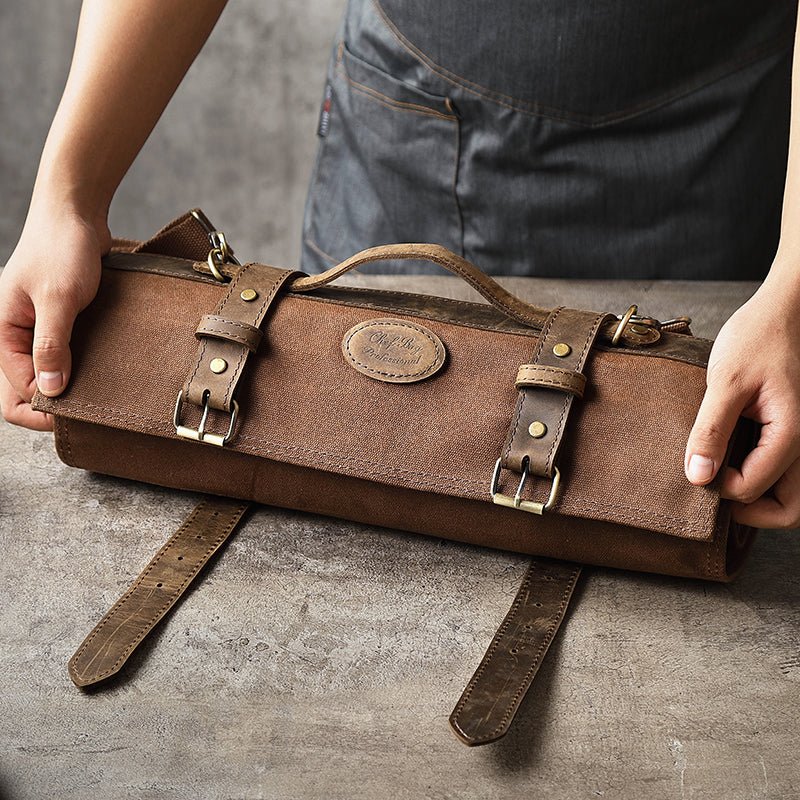
We make a leather knife roll that is designed to match the quality of the knives it carries. It is built from genuine leather with a vintage finish that develops a patina over time. The construction is thick enough to provide real protection, not the thin, floppy leather you find on budget rolls that are leather in name only.
The pockets are sized for a full chef's kit, with varying widths to accommodate everything from a small paring knife to a full-size chef knife or cleaver. The roll closes with leather straps that wrap tight and hold the knives securely during transport.
It is the kind of thing you buy once. Ten years from now, it will still be doing its job, and it will look better than it does today.
Related Reading
- Knife Block Buying Guide
- Knife Care and Daily Maintenance Guide
- Chef Gift Guide: Professional Kitchen Tools
- Kitchen Knife Sets vs Individual Knives
- How to Choose a Chef Knife: The Complete Buying Guide
- Magnetic Knife Holder vs Knife Block
- Best Kitchen Knives Under $200
- How to Care for Damascus Steel Knives
Frequently Asked Questions
What size knife roll should I get?
A 7 to 10 pocket roll fits most cooks. Home cooks who travel with three or four knives can get away with a 4 to 6 pocket roll, while professional chefs and culinary students carrying a full kit need 8 to 14 pockets. Make sure the deepest pocket accommodates your longest blade, usually a 25cm (10 inch) chef knife or bread knife, with room to spare.
Is a leather knife roll better than canvas?
Leather provides thicker padding, better blade cushioning, and lasts decades with occasional conditioning. Canvas (especially waxed canvas) is lighter, more water-resistant, easier to clean, and costs less. Professional chefs who carry knives daily tend to prefer leather for its durability and the way it develops a patina. Culinary students and outdoor cooks often start with waxed canvas for its lower weight and price.
Can you use a knife roll for home storage?
Yes, and it works well in small kitchens or share houses where counter space is limited. Roll it up and store it in a cabinet or on a high shelf. Each blade sits in its own pocket with no contact between edges. Make sure knives are completely dry before rolling, because moisture trapped inside leather or canvas pockets can cause rust spots on carbon steel and Damascus blades.
What is the difference between a knife roll and a knife bag?
A knife roll is a flat panel of pockets that wraps around the knives and ties shut, while a knife bag (or knife case) opens like a briefcase with structured compartments and a zip closure. Rolls are lighter, more compact, and easier to fit into other bags. Cases hold more tools, offer stiffer protection, and keep everything accessible without unrolling. Most working chefs prefer rolls for daily use and cases for long-distance travel.
How do you clean a knife roll?
Wipe the exterior with a damp cloth and mild soap, then air dry completely before rolling shut. For leather rolls, apply a leather conditioner every three to six months to prevent cracking. Canvas rolls can handle a gentle scrub with a soft brush for stubborn stains. Never machine wash a leather roll, and avoid storing it while damp, as trapped moisture promotes mould growth inside the pockets.