

What Does "Petty" Even Mean?
The name comes from the French word petit, meaning small. When Japanese bladesmiths adopted Western knife shapes during the Meiji era, they kept some of the French terminology that had already become standard in professional kitchens. The petty knife (ペティナイフ, peti naifu) is simply the Japanese interpretation of a small utility knife.
But "interpretation" is doing a lot of work in that sentence. Japanese bladesmiths didn't just copy the Western utility knife and call it a day. They applied their own metallurgy, their own grinding techniques, and their own design philosophy. The result is a knife that shares a silhouette with a Western utility knife but behaves differently in your hand.
Quick answer: A petty knife is a Japanese small knife, typically 120mm to 150mm long, with thinner blade stock and a more acute edge than a Western utility or paring knife. It fills the gap between paring and chef knife work, handling precision tasks that are awkward with a full-size blade.
Petty vs Utility vs Paring: What's Actually Different?
On paper, these three knives overlap. They all live in the 80mm to 150mm range. They all get used for small cutting tasks. So what separates them?
It comes down to blade geometry and design intent.
A paring knife (typically 75mm to 100mm) is designed for in-hand work. You hold the food in one hand, the knife in the other, and cut toward your thumb. Peeling, deveining shrimp, removing the eyes from potatoes. The blade is short enough to control without a cutting board.
A Western utility knife (typically 120mm to 150mm) is the "between" knife in a European knife block. It's essentially a scaled-down chef knife, but the blade is usually just as thick at the spine as its larger sibling. That makes it sturdy but not especially refined for precision work.
A petty knife occupies similar length territory to the utility knife but with thinner blade stock, a more acute edge angle, and (usually) harder steel. The combination means it cuts with noticeably less resistance. Where a Western utility knife muscles through food, a petty knife glides.
What Tasks Do Petty Knives Actually Excel At?
The petty knife is not trying to replace your chef knife. It's the specialist you reach for when your chef knife is too much blade for the job. And that happens more often than most home cooks realise.
Precision vegetable work. Mincing shallots, slicing garlic paper-thin, trimming the stems off mushrooms, segmenting citrus. A 150mm petty handles these tasks with a control you simply can't get from a 210mm gyuto. The shorter blade means your hand is closer to the cutting edge, and that proximity translates directly to accuracy.
Fruit work. Segmenting oranges, hulling strawberries, peeling mangoes, slicing kiwis. A petty knife's thin edge parts soft fruit flesh without crushing cells, which means cleaner cuts and less juice loss. Try segmenting a grapefruit with a chef knife and then do the same thing with a petty. The difference is immediately obvious.
Trimming and fabricating protein. Removing silverskin from a pork tenderloin. Trimming fat from chicken thighs. Portioning a side of salmon into individual fillets. These are tasks where a chef knife feels clumsy and a paring knife is too short to make confident cuts.
Garnish work. If you've ever tried to cut a perfect chiffonade of basil with a full-size knife, you know the leaves tend to bruise. The petty knife's lighter weight and sharper edge let you slice through delicate herbs cleanly.
General "grab it first" tasks. Cutting open packaging, splitting a sandwich, slicing a tomato for lunch. The petty becomes the knife you reach for twenty times a day for the small jobs that don't justify pulling out your main blade.
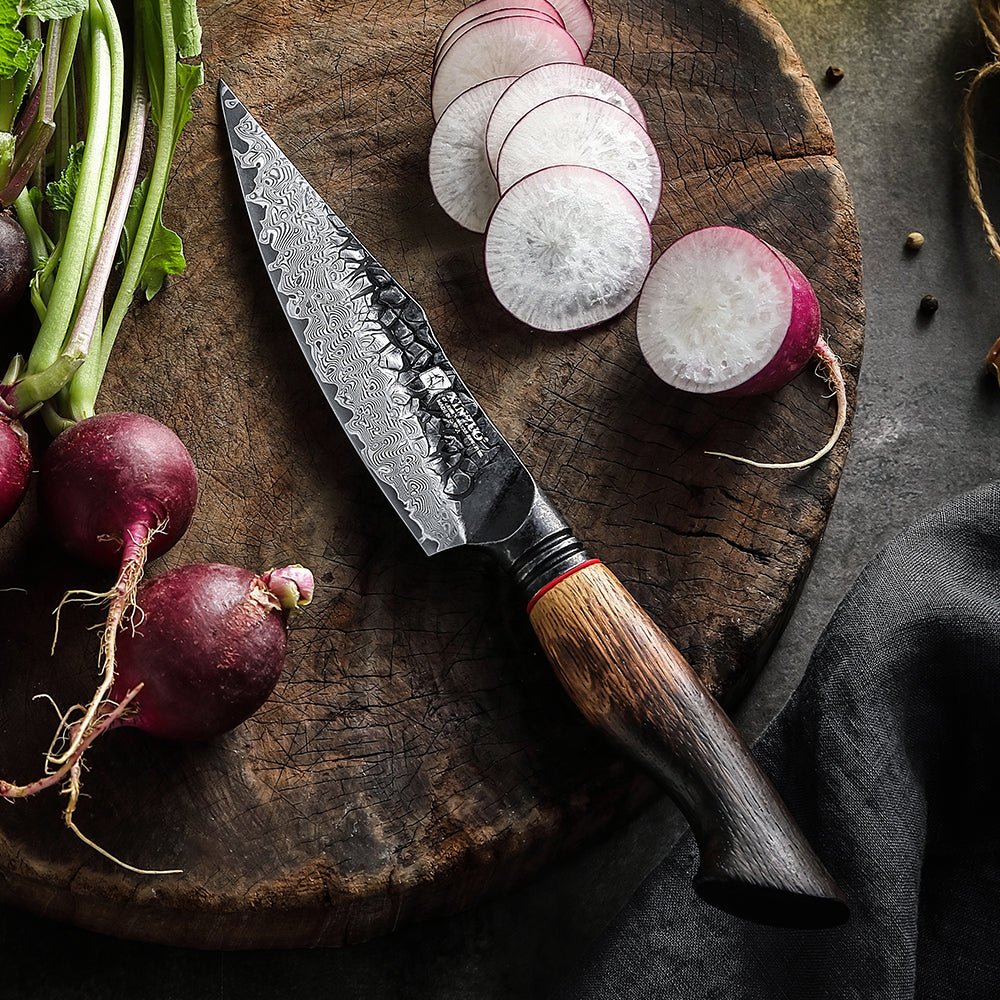
Blade Length: 120mm, 135mm, or 150mm?
Petty knives generally come in three size brackets, and each one suits a slightly different role.
120mm (4.7 inches) is the shortest option. At this length, the petty behaves almost like a large paring knife. It's small enough for in-hand work but long enough to use on a cutting board. If you already own a good paring knife, a 120mm petty might feel redundant. But if you don't have a paring knife, this size covers both roles well.
135mm (5.3 inches) is what many Japanese knife makers consider the sweet spot. Long enough for proper board work, short enough for fine control. This is the length you'll see most often in professional Japanese kitchens. If you're buying one petty knife, this is the size to start with.
150mm (5.9 inches) pushes into small chef knife territory. A 150mm petty can handle tasks that would typically require a short gyuto, like breaking down a whole chicken breast or dicing an onion. This is a popular choice for cooks who want a petty that doubles as a light-duty prep knife.
Why Does Steel and Edge Angle Make a Petty Knife Feel Different?
The most noticeable difference between a petty knife and a Western utility knife isn't the shape. It's how the edge behaves on food.
Japanese-style petty knives typically use steel hardened to 60 HRC or above. Some high-carbon models reach 63 or 64 HRC. For comparison, most Western utility knives sit around 55 to 58 HRC. That extra hardness means the steel can hold a more acute edge angle without the edge folding or rolling.
In practical terms: where a Western utility knife might be sharpened to 15 to 20 degrees per side (for a 30 to 40 degree inclusive angle), a petty knife sits at 12 to 15 degrees per side (24 to 30 degrees inclusive). That geometry produces noticeably less cutting resistance. Thin-skinned tomatoes don't crush. Garlic slices don't stick to the blade. Soft herbs cut cleanly instead of bruising.
The trade-off is that harder, thinner edges are more brittle. You shouldn't use a petty knife to rock through a butternut squash or split a lobster shell. It's a precision instrument, not a pry bar. Treat it that way and the edge will stay sharp for a remarkably long time between sharpening sessions.
Should You Choose a Wa Handle or Western Handle on a Petty Knife?
Petty knives come in two handle styles, and preference is genuinely personal. Neither is objectively better.
Wa-handle (Japanese): Lightweight octagonal or D-shaped wooden handle. The handle is typically magnolia or ho wood with a buffalo horn ferrule. These are noticeably lighter than Western handles, which shifts the balance point forward toward the blade. Some cooks find this gives them better control for precision work. The octagonal shape also provides a tactile reference point so you always know the blade's orientation without looking.
Western handle: Riveted or moulded handle made from wood, G10, Micarta, or similar materials. Heavier than wa-handles, which some cooks prefer because the extra weight provides a sense of stability. Western handles are generally more durable in commercial dishwasher environments (though you shouldn't be putting good knives in a dishwasher anyway).
For a petty knife specifically, the wa-handle's lighter weight is arguably a better fit. Since the petty is a precision tool, you want to feel the blade, not the handle. But plenty of excellent petty knives come with Western handles, and if that's what feels right in your hand, that's the correct choice.
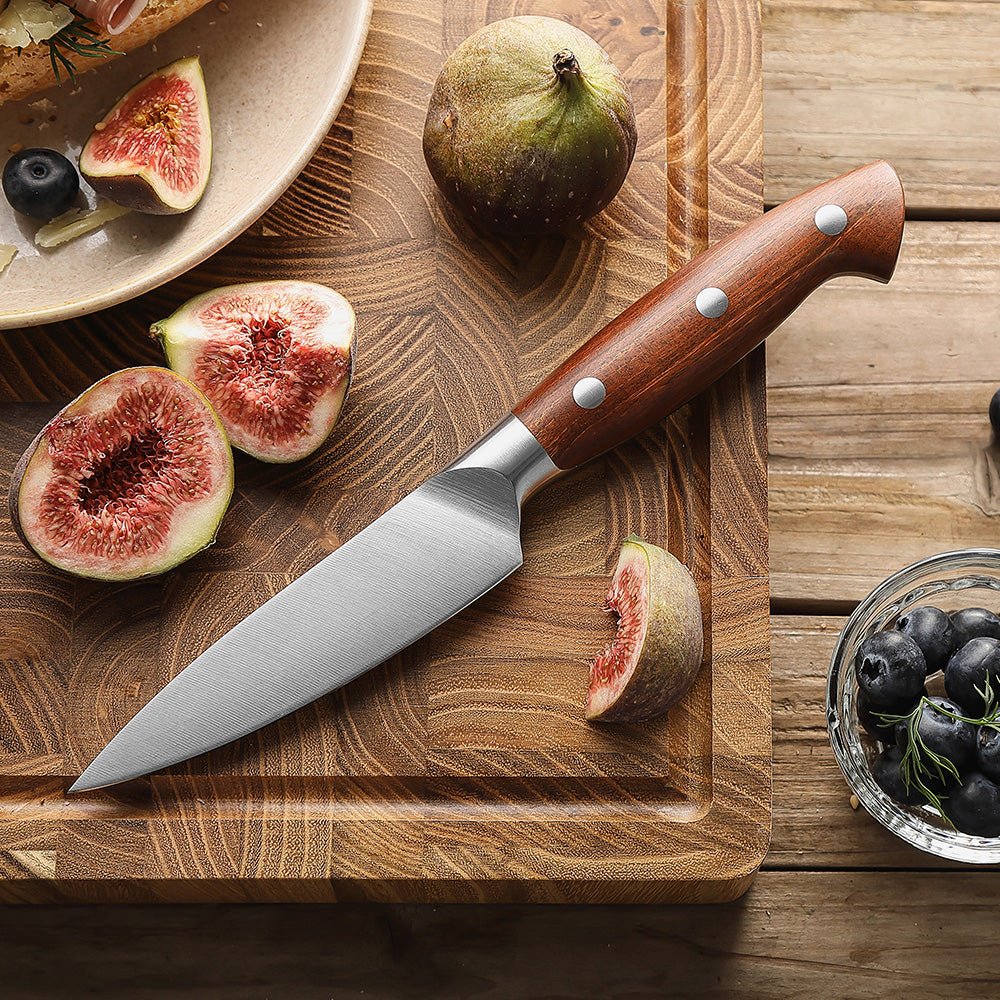
When Should You Use a Petty Knife Instead of a Chef Knife?
The line is surprisingly clear once you've used both knives for a while.
Reach for the chef knife when: you're cutting anything larger than an apple. Dicing onions. Chopping carrots. Breaking down a whole chicken. Mincing a large pile of herbs. Slicing meat. Any task where you need the blade's weight and length to work for you.
Reach for the petty when: the food is small, the cut needs to be precise, or the chef knife feels like you're using a sledgehammer to hang a picture frame. Slicing a single shallot. Trimming the fat from a steak. Develling a chilli. Cutting garnishes. Peeling a piece of ginger (yes, a petty knife peels ginger better than a spoon, and I will die on that hill).
In practice, most experienced cooks switch between the two constantly during prep. The petty lives on the cutting board next to the chef knife, and you grab whichever one the task demands. It's not about replacing one with the other. It's about having the right tool for the right moment.
What Is the Japanese Holy Trinity of Kitchen Knives?
In Western kitchens, the classic three-knife set is chef knife, paring knife, and bread knife. In Japanese knife culture, the equivalent is the gyuto (chef knife), petty (utility/paring), and nakiri (vegetable knife).
This trio covers essentially every cutting task in a home kitchen.
The gyuto handles the bulk of your cutting, from proteins to large vegetables. The petty takes over for precision work, small ingredients, and detail tasks. The nakiri is the specialist for high-volume vegetable prep, with its flat edge profile that makes push-cutting through vegetables incredibly efficient.
If you're building a Japanese-style knife collection from scratch, this is the order to buy them. Start with the gyuto because it's the most versatile. Add the petty second because it fills the biggest gap in your daily workflow. Then add the nakiri when you want to level up your vegetable prep.
Three knives. That's genuinely all you need for 95% of home cooking. Everything beyond this point is about specialisation and personal preference, not necessity.
The Japanese-style knife starter kit:
1. Gyuto (chef knife) , your workhorse for 70% of cutting tasks
2. Petty (utility knife) , precision work and small ingredients
3. Paring knife , in-hand peeling and the finest detail work
Add a nakiri later if you do a lot of vegetable prep.
What Should You Look for When Buying a Petty Knife?
A few things worth checking before you commit.
Steel quality matters more at this size. Because a petty knife's edge is doing fine work, you'll notice the difference between good and mediocre steel more than you would on a chef knife. Look for VG-10, SG2/R2, or high-carbon steels hardened to 60+ HRC. These steels take a keen edge and hold it.
Balance and weight. Pick the knife up (or at least check the specs). A good petty should feel almost weightless compared to your chef knife. If it feels heavy or handle-heavy, it's going to fight you on precision work.
Blade height. A taller blade gives you more knuckle clearance on the cutting board, which matters if you plan to use the petty for board work. A narrower blade is better for in-hand tasks. Most petty knives strike a middle ground.
Fit and finish. Check where the blade meets the handle. There shouldn't be a visible gap or rough transition. This joint is where food particles collect, so a clean fit is both a hygiene issue and a quality indicator.
Related Reading
- Utility Knife Buying Guide
- Paring Knife Buying Guide
- How to Choose a Chef Knife: The Complete Buying Guide
- Japanese-style Knife Types Explained
- Santoku vs Chef Knife
- Nakiri Knife Guide
- Knife Steel Hardness Guide
- Knife Care & Daily Maintenance Guide
Frequently Asked Questions
What is the difference between a petty knife and a paring knife?
A paring knife (75 to 100mm) is designed for in-hand work like peeling and deveining. A petty knife (120 to 150mm) is longer, thinner, and built for precision cutting board tasks: mincing shallots, slicing garlic, trimming small proteins. The petty also uses harder steel (58 to 62 HRC vs 54 to 58 for most paring knives) and a more acute edge angle (12 to 15 degrees per side), so it cuts with less resistance.
What size petty knife should I get?
A 150mm petty is the most popular size and the best starting point. It has enough blade length for light board work like slicing shallots and trimming chicken thighs, while still being short enough for in-hand detail tasks. A 120mm petty overlaps more with a paring knife and suits cooks who mostly need precision control for garnish work and small fruit.
Do professional chefs use petty knives?
Yes, and in many professional kitchens the petty sees more daily use than any knife except the gyuto. Line cooks reach for it during service because it takes up minimal space on the board and handles repetitive prep tasks like brunoise, citrus segments, and herb chiffonade quickly. The gyuto plus petty combination is the standard two-knife setup in Japanese-influenced professional kitchens.
Should I choose a wa handle or Western handle on a petty knife?
A wa (Japanese) handle is lighter and positions your hand closer to the blade, giving more control for precision tasks. A Western handle is heavier and fills the palm more, which some cooks prefer for extended use. For a petty knife, the wa handle has a slight advantage because the whole point of the knife is fine control, and the lighter weight reduces hand fatigue during detailed prep.
When should I use a petty knife instead of my chef knife?
Reach for the petty any time the ingredient is smaller than a tennis ball or the task needs more precision than force. Mincing a single shallot, slicing garlic paper-thin, segmenting an orange, trimming fat from a chicken thigh, cleaning mushroom stems. The shorter blade puts your hand closer to the cutting edge, which gives you finer control than a 210mm gyuto can.