

What Makes a Utility Knife Worth Buying?
A utility knife is a 120-150mm (5-6") blade that sits between your chef knife and your paring knife. It handles everything too small or too delicate for a 200mm chef knife and too large or too awkward for a 90mm paring knife.
If you own a chef knife and find yourself struggling with shallots, cherry tomatoes, citrus segments, or trimming chicken thighs, a utility knife will immediately feel like the missing piece. It is, genuinely, the most underrated knife in any kitchen.
Most knife buying advice focuses on the chef knife (the workhorse) and the paring knife (the detail tool). The utility knife gets mentioned as an afterthought, if it gets mentioned at all. That is a mistake. I reach for a utility knife more often than any other blade in the kitchen, because the majority of actual cooking tasks involve medium-sized ingredients that don't quite fit either category.
What Is a Utility Knife and What Does It Do?
A utility knife has a blade between 120mm and 150mm (roughly 5 to 6 inches). It's narrower than a chef knife, longer than a paring knife, and lighter than both. Think of it as a precision tool built for work that requires more reach than a paring knife but more control than a chef knife.
The blade profile is typically similar to a scaled-down chef knife: a gentle curve from heel to tip, with a pointed end for piercing and detail work. The narrower blade means less drag through dense ingredients and more manoeuvrability around bones and curves.
What Tasks Do Utility Knives Handle Best?
The utility knife's sweet spot is ingredients between the size of a golf ball and a tennis ball, plus any task that requires precision in tight spaces. That covers a surprising amount of actual cooking.
Trimming and portioning protein. Cleaning silver skin off chicken thighs, trimming fat from pork tenderloin, portioning small fillets of fish. A chef knife is too bulky for this kind of close work. A paring knife doesn't give you enough blade length to make clean, single-pass cuts. The utility knife fits perfectly.
Slicing small to medium vegetables. Shallots, radishes, mushrooms, celery, spring onions, jalapeños, garlic cloves. These are the ingredients you actually prep the most of, and they are all awkward with a 200mm chef knife.
Citrus work. Segmenting oranges and grapefruit, slicing lemons and limes for garnish, zesting when you need thick strips rather than fine zest. The narrow blade navigates the curve of the fruit without crushing it.
Cheese. Semi-hard cheeses like cheddar, gouda, and gruyère slice cleanly with a utility knife. The narrow blade creates less friction than a wide chef knife, which means less crumbling and sticking.
Sandwiches and soft breads. For anything without a hard crust, a sharp utility knife cuts cleaner than a serrated bread knife. Rolls, wraps, soft baguettes, croissants. The straight edge compresses less and gives you a neater result.
Herbs in small quantities. When you need a tablespoon of minced basil, not a full bunch of parsley, the utility knife is the right size for the job.
What Is the Difference Between a Utility Knife and a Petty Knife?
You will see these two terms used interchangeably online, but they come from different traditions and have real differences.
The utility knife is a Western concept. Slightly wider blade, often a bit heavier, with a handle designed for a full grip. It evolved from European kitchen knife traditions where durability and versatility were prioritised.
The petty knife is the Japanese equivalent. "Petty" comes from the French petit (small), adopted into Japanese kitchen terminology during the Meiji era when Western cooking techniques were being incorporated into Japanese culinary training. Petty knives tend to be thinner, lighter, and ground to a more acute edge angle. They excel at fine detail work and feel more nimble in the hand.
In practice, the line is blurring. Many modern utility knives incorporate Japanese steel and thinner grinds, giving you the best of both approaches. If you want a dedicated precision tool for garnish work and fine cuts, lean toward a petty knife. If you want a more versatile everyday blade, a utility knife is the safer choice.
What Key Features Should You Look for in a Utility Knife?
Blade Length
Utility knives come in three general sizes, and the differences matter more than you might expect.
125mm (5"): Closer to a large paring knife. Best for detail work, trimming, and smaller ingredients. If your main use will be precision tasks around protein and small vegetables, go with 5 inches.
140mm (5.5"): The sweet spot for most cooks. Long enough for slicing tasks, short enough for precise control. This is the size I recommend if you're buying your first utility knife.
150mm (6"): Overlaps more with a small chef knife. Good if you want a utility knife that can occasionally handle slightly larger tasks, but it sacrifices some of the nimbleness that makes the category special.
Straight Edge vs Serrated Edge
Skip the serrated utility knife. I know serrated versions are common, especially in cheap knife block sets, but they defeat the purpose. The entire point of a utility knife is precision, and serrations tear rather than slice. They are impossible to sharpen at home. A sharp straight-edge utility knife will outperform a serrated one on every task except sawing through crusty bread, and that is what your bread knife is for.
Handle Comfort
Because utility knives are used for extended detail work (think: trimming an entire tray of chicken thighs, or prepping a mirepoix for a large batch of stock), handle comfort matters more than on knives you only use for a few cuts at a time. Look for a handle that fits comfortably in a pinch grip, with no sharp edges or hot spots where the handle meets the bolster.
When Should You Use a Utility Knife Instead of a Chef Knife?
The general rule is simple: the size of the ingredient dictates the knife.
If the ingredient is wider than the blade of your utility knife, use your chef knife. A whole onion, a capsicum, a large carrot. The chef knife's wider blade and greater heft handle these better.
If the ingredient fits comfortably under the blade of your utility knife, use the utility knife. You will have more control, more precision, and less fatigue. A shallot, a lime, a mushroom, a chicken tenderloin.
There are grey areas, obviously. A medium-sized tomato works fine with either knife. But once you have a utility knife in your kit, you will notice yourself reaching for it instinctively. It just feels right for probably 40-50% of actual prep tasks.
What Utility Knife Options Does Xinzuo Offer?
Two standout options depending on your priorities.
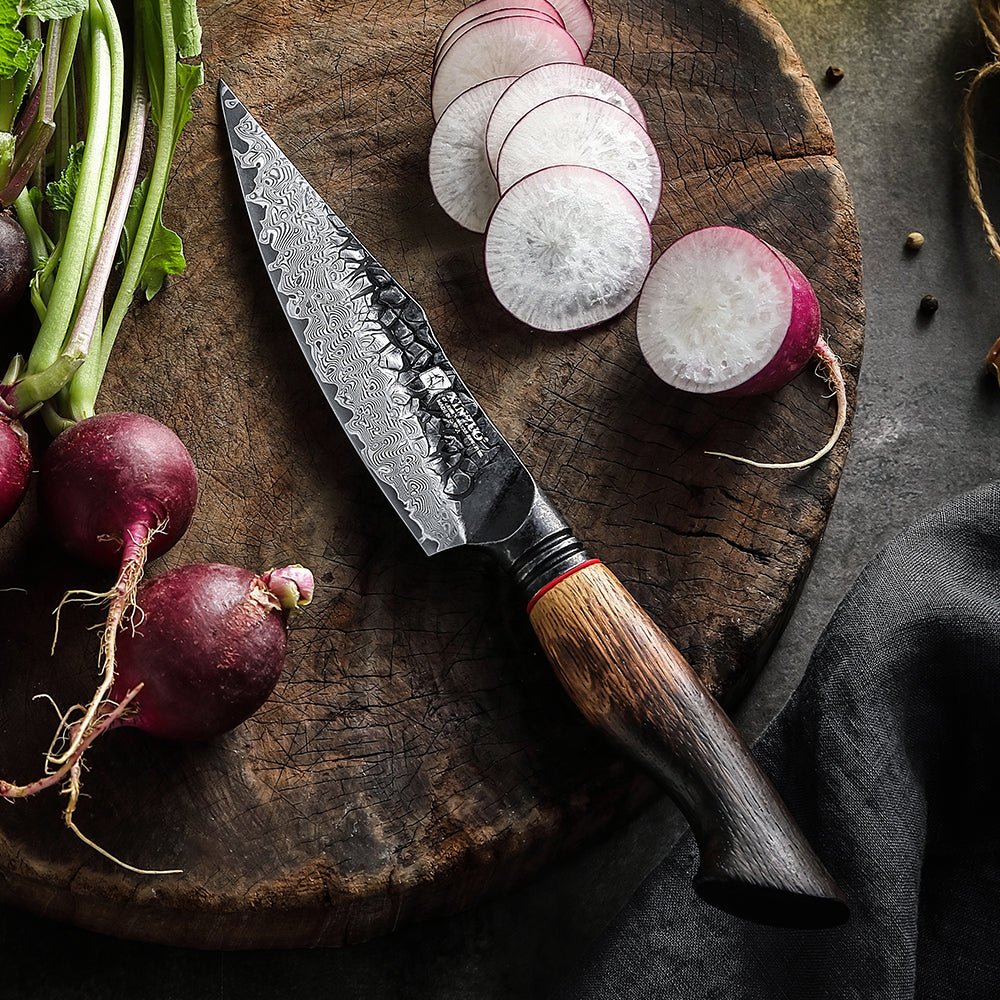
Mo Series 5.5" Utility Knife
The Mo Series utility uses a 67-layer Damascus blade with a VG-10 steel core. The 140mm blade length hits that ideal sweet spot between reach and control. The ebony wood handle gives it a premium feel and excellent grip even with wet hands. At 60±2 HRC hardness, it takes a keen edge and holds it through a full prep session.
This is the one I recommend for most home cooks. The 5.5" length handles everything from shallots to chicken trimming without feeling oversized or cramped.
Supreme Series 5" Utility Knife
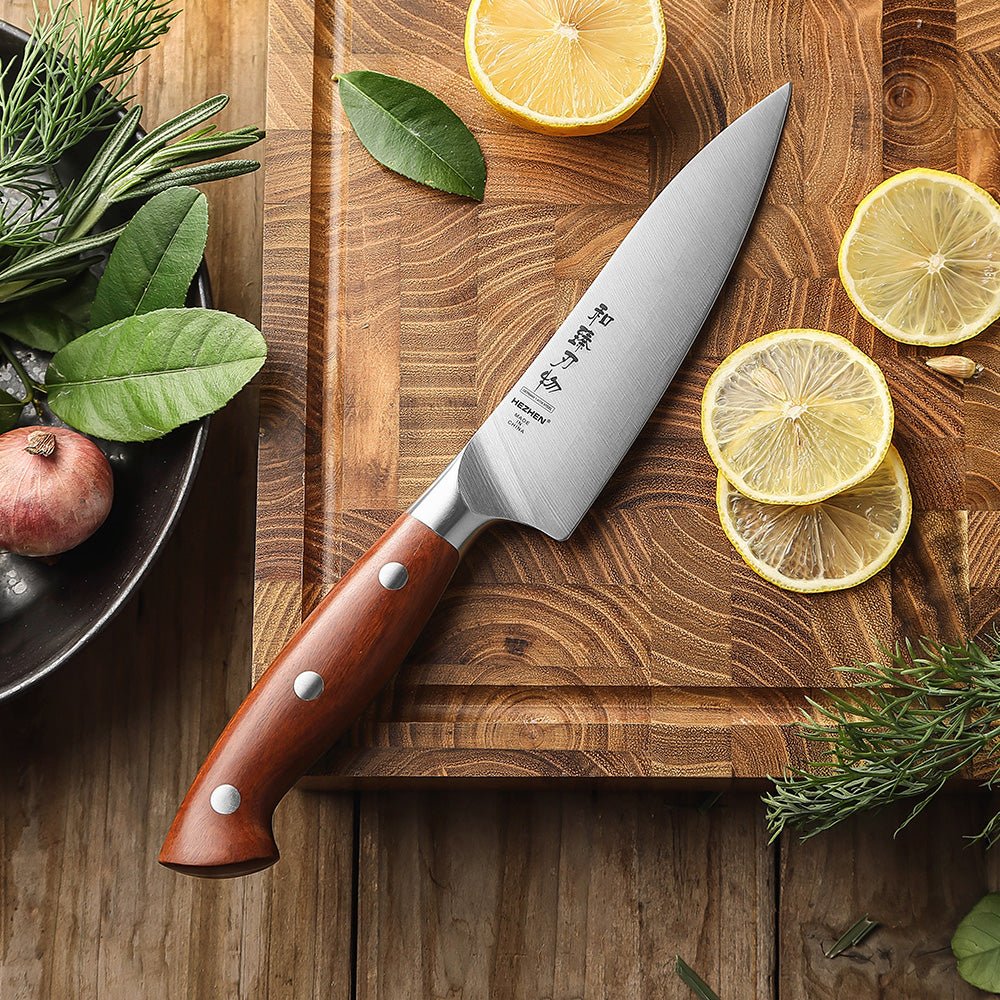
The Supreme Series opts for a 125mm blade, making it closer to a large petty knife in character. It is lighter and more nimble, with a thinner blade profile that glides through protein and delicate ingredients with minimal resistance. The G10 handle is practically indestructible and provides excellent grip in all conditions.
Choose the Supreme if your primary use will be precision trimming and detail work, or if you already own a 150mm+ knife that covers the upper end of the utility range.
How Does a Utility Knife Complete Your Knife Collection?
There is a reason professional knife kits always include a utility knife alongside the chef knife and paring knife. Those three blades, together, cover roughly 95% of everything you will ever need to do in a kitchen.
The chef knife (200-210mm) handles large vegetables, breaking down proteins, and any task where you need blade weight and a wide surface for scooping. The paring knife (80-100mm) handles anything you do in your hand: peeling, tourning, deveining shrimp. The utility knife fills the gap between them, and that gap is where you spend most of your actual cooking time.
If you are building a knife collection from scratch, buy a chef knife first, a utility knife second, and a paring knife third. That order might surprise you, but the utility knife will see more daily use than the paring knife in most home kitchens.
The three-knife collection: Chef knife (200mm+) for power and versatility. Utility knife (130-150mm) for medium tasks and precision. Paring knife (80-100mm) for hand work and fine detail. That is the foundation. Everything else, nakiri, bread knife, cleaver, is a specialist you add when you identify a specific need.
If you already own a knife set that came without a utility knife, adding one will immediately change how you work. Most people who buy a utility knife as an "extra" end up reaching for it more than half the time within a week.
Related Reading
- Petty Knife Guide: The Japanese Utility Knife
- Paring Knife Buying Guide
- How to Choose a Chef Knife: The Complete Buying Guide
- Santoku vs Chef Knife
- Kitchen Knife Sets vs Individual Knives
- Knife Steel Hardness Guide
- Knife Care and Daily Maintenance Guide
- Best Kitchen Knives Under $200
Frequently Asked Questions
What is a utility knife used for in the kitchen?
A utility knife handles everything between chef knife and paring knife territory: slicing shallots, trimming chicken thighs, portioning small fish fillets, cutting cheese, segmenting citrus, and slicing sandwiches. Its 120 to 150mm blade gives more reach than a paring knife but more control than a 200mm chef knife, making it the right tool for medium-sized ingredients that are awkward with either.
What is the difference between a utility knife and a petty knife?
They fill the same role but come from different traditions. A Western utility knife has thicker blade stock, softer steel (54 to 58 HRC), and often a slightly curved edge. A Japanese-style petty knife is ground thinner, uses harder steel (58 to 62 HRC), and has a straighter edge with a more acute angle (12 to 15 degrees vs 15 to 20). The petty cuts with less resistance, but the Western utility is more forgiving if you accidentally hit bone.
Should I get a serrated or straight edge utility knife?
Straight edge for most kitchen work. A straight blade gives cleaner cuts on vegetables, proteins, and cheese, and you can resharpen it at home on a whetstone. A serrated utility knife is better if you mostly cut bread rolls, tomatoes, and foods with tough skins, but it overlaps heavily with a bread knife and cannot be easily resharpened once dull.
What length utility knife is best?
A 130 to 140mm (5 to 5.5 inch) blade is the sweet spot for most home cooks. It is long enough to slice through a chicken breast in one stroke but short enough to manoeuvre around bones and curves. A 120mm blade feels closer to a paring knife, while a 150mm blade starts to overlap with a short chef knife.