


What Is the Difference Between a Santoku and a Chef Knife?
Both knives are designed for general-purpose cooking. The difference is in blade shape, weight, and how you move the knife through food.
Get a santoku if you cook mostly vegetables, fish, and lighter proteins. It's shorter, lighter, and built for precision.
Get a chef knife if you do a lot of heavy produce, bulk herb mincing, or bone-in meat. The extra length and weight help.
Genuinely unsure? A santoku handles a wider range of everyday home cooking and has a gentler learning curve.
If you want to understand why, and which specific features matter for your cooking, read on. We've included actual research data alongside the practical advice.

How Does Blade Shape Change the Way You Cut?
A santoku blade is nearly flat along the cutting edge, with a gentle curve near the tip. A chef knife has a pronounced curved belly that sweeps from heel to tip.
That curve (or lack of it) determines your cutting technique.
With a santoku, you push-cut: press the blade down and slightly forward through the food in a single stroke. The flat edge contacts the entire cutting board at once.
With a chef knife, you rock-chop: the tip stays on the board while you pivot the curved belly up and down. It's the motion most Western cooks learn first.
The physics favour the santoku for lighter tasks. Atkins, Xu and Jeronimidis (2004) measured cutting forces and found that adding even a small forward slicing motion to a downward press (a slice-push ratio of 3:1) reduced the required downward force to roughly one-tenth. The santoku's flat profile naturally encourages this kind of motion, which is part of why it feels so easy through vegetables and boneless proteins.
Many santoku blades also feature granton edges, the shallow scallops you see along the blade face. These create small air pockets between steel and food, so thin slices of potato or cucumber release cleanly instead of clinging to the blade.
Weight, Balance, and Hand Size
The santoku is lighter. For some people, that's the whole reason to buy one.
Claudon and Marsot (2006) studied upper-limb muscle activation during cutting tasks and found that sharper blades produced measurably lower EMG readings across five muscles in the hand, wrist, and forearm. Separate work by McGorry et al. (2005) showed that a well-finished, sharp blade reduced grip force by over 20% and cutting effort by nearly 30%. Over a 30-minute dinner prep, the difference is comfort. Over an 8-hour restaurant shift, it's injury prevention.
The chef knife's extra weight helps in specific situations. Pushing through a butternut pumpkin or a dense swede, the blade's mass carries it through where a lighter knife would need more arm force.
The santoku was originally designed for Japanese hands, which tend to be smaller. If you have small-to-medium hands and Western chef knives have always felt clumsy to you, it's the knife, not your technique. A 7-inch santoku with a 130g weight is a different experience from a 240g 8-inch chef knife.
What Foods and Tasks Does Each Knife Handle Best?
Santoku
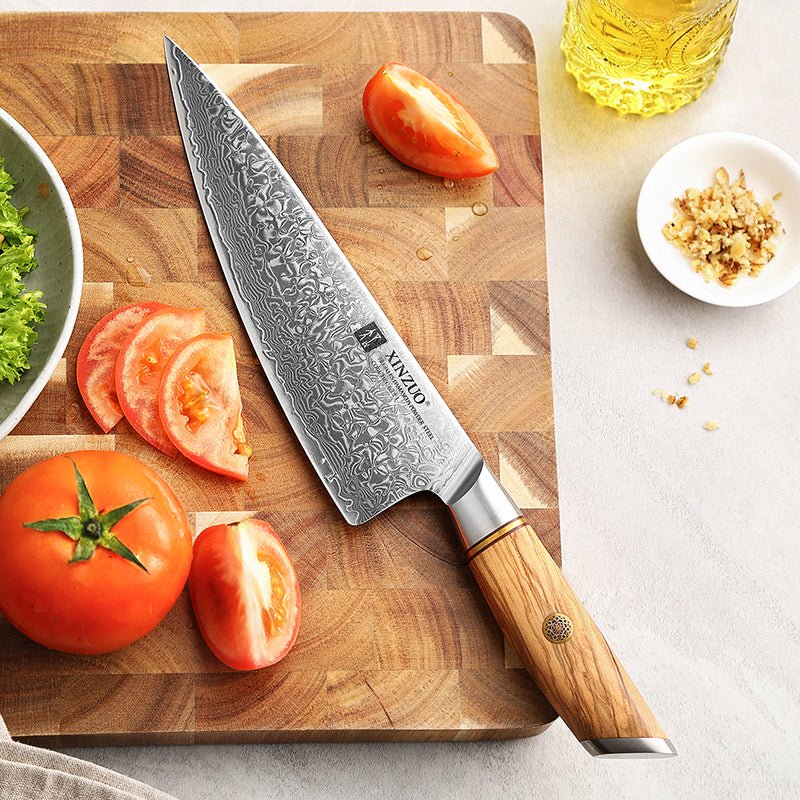
- Precision vegetable work: paper-thin cucumber, uniform onion rings, radish coins. The flat blade and acute edge angle give you more control than a curved chef knife can.
- Herbs. A clean push-cut slices through cell walls rather than crushing them. Less cellular damage means less browning and more flavour. You'll notice this especially with basil.
- Fish and boneless proteins. The thinner blade glides through salmon fillets and chicken breast with minimal resistance.
- Stir-fry prep, dumpling filling, julienned ginger. The santoku was designed for exactly this kind of work.
- Mincing garlic, then using the wide blade as a bench scraper to scoop everything into the pan.
Chef Knife
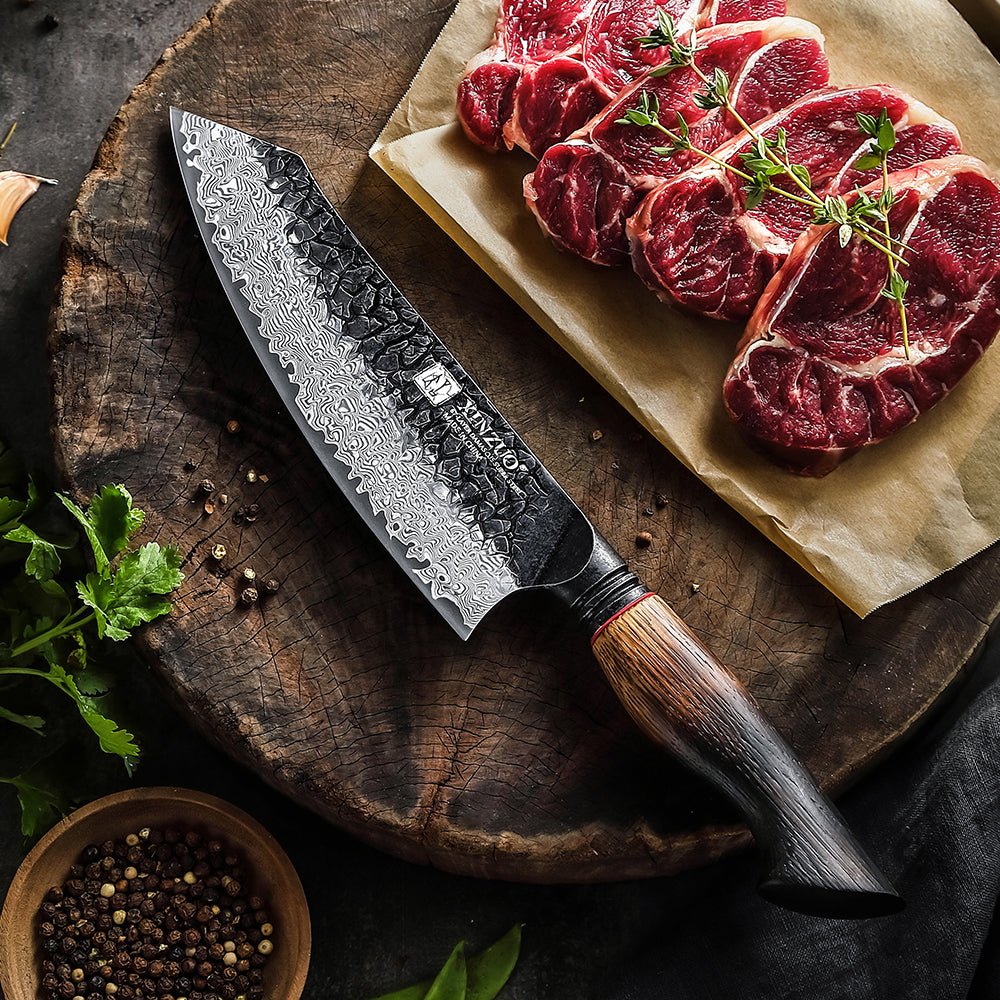
- Rock-mincing a large volume of herbs. The curved belly lets you pivot rapidly without lifting the blade off the board.
- Heavy root vegetables: butternut pumpkin, swede, celeriac. The extra weight and blade length make these less of a wrestling match.
- Bone-in cuts. The thicker spine and wider edge angle can handle light bone contact. A santoku can't. Its thin, hard edge will chip on bone.
- Large produce like watermelon halves and whole cabbages, where the 8 to 10 inch blade reaches across in a single stroke.
Where They Overlap
For about 70% of everyday cooking, either knife works well. Dicing onions, slicing tomatoes, breaking down a capsicum, general weeknight prep. Both handle these without issue.
The real differences show up at the edges: precision and delicacy favour the santoku, power and volume favour the chef knife. For everything in between, it's about which cutting motion feels better in your hand.
How Does Knife Steel Hardness Affect Performance?
You'll see HRC numbers on knife specs. HRC is the Rockwell Hardness C-scale, and it measures resistance to indentation, not overall quality. Harder steel holds a sharper edge for longer, but it's also more brittle and harder to sharpen at home. Softer steel dulls faster but flexes instead of chipping, and you can touch it up with a honing rod in seconds.
Every knife steel is a trade-off between those two properties.
The 10Cr15CoMoV deserves a closer look. It's a Chinese-made steel with a near-identical composition to Japanese VG-10, the industry standard found in knives at significantly higher price points. Same chromium and molybdenum content, with slightly more cobalt for heat resistance. Same performance tier. We wrote a full comparison of VG-10 vs 10Cr15CoMoV if you want the chemistry details.
San Mai Construction (and Why Hard Blades Don't Break)
If you're worried about a hard steel blade chipping or snapping, this is the section to read.
San mai (三枚, "three layers") is a laminated construction method. A hard cutting core, the steel that forms the actual edge, is sandwiched between two softer stainless steel cladding layers.
The hard core holds a sharp edge for a long time. The softer outer layers absorb shock and flex, preventing chips when you hit something unexpected. You get the edge retention of hard steel with the resilience of soft steel.
The "67-layer Damascus" and "73-layer Damascus" numbers refer to these cladding layers. They produce the wave pattern on the blade, and each fold adds a micro-layer of structural toughness around the hard core. The pattern is functional, not just decorative.
Will a santoku break? Not if it's san mai construction. The hard core stays sharp, the soft cladding absorbs the hits. Avoid bone and frozen food, and the blade will last decades.
Caring for Different Steels
Different hardness levels need different maintenance. This is where a lot of people unknowingly damage good knives.
On the topic of sharpness: Wu et al. (2025) published a study in PNAS measuring aerosol release during onion cutting. A dull blade (tip radius above 13 micrometres) produced roughly 40 times more tear-inducing droplets than a sharp one (tip radius below 1 micrometre). The dull blade crushes cells instead of slicing through them, launching irritant compounds into the air at up to 40 metres per second. Keeping a knife sharp is a food quality issue as much as a performance one.
What Is a Gyuto and Why Is It Worth Considering?
There's a third knife that fits between the santoku and chef knife: the gyuto (牛刀, literally "beef sword").
A gyuto is a Japanese-style chef knife. It has the curved belly of a Western chef knife, so you can rock-chop with it, but it uses thinner, harder Japanese steel, like a santoku. It's lighter than a German chef knife but longer than a santoku.
If you like the rocking motion of a Western chef knife but want Japanese steel and thinner geometry, a gyuto is exactly what you're after.
Which One Should You Buy?
Our recommendation: If this is your first good knife, get a santoku. It covers the widest range of home cooking, it's forgiving to learn on, and it's lighter on your wrist. The chef knife is the better pick only if you regularly cook for large groups or work with heavy, dense produce.
Match the Knife to Your Cooking
- Mostly vegetables and Asian dishes → Santoku
- Meal prep in large quantities → Chef knife (more blade length per stroke)
- Small kitchen or small hands → Santoku
- You rock-chop out of habit and don't want to change → Chef knife, or a gyuto if you want harder steel
- Clean, precise cuts are your priority → Santoku
- Low maintenance is more important than peak sharpness → German-steel chef knife
Choosing by Steel Level
These are not "good, better, best." They're different tools for different people. Someone who sharpens knives every week has different priorities than someone who wants to grab a knife and go.
Low maintenance, high durability: The Supreme Series 7" Santoku uses German 1.4116 steel at 57 HRC. Hone it with a regular steel rod. It's forgiving if you accidentally clip a bone, and it still takes a sharp edge.
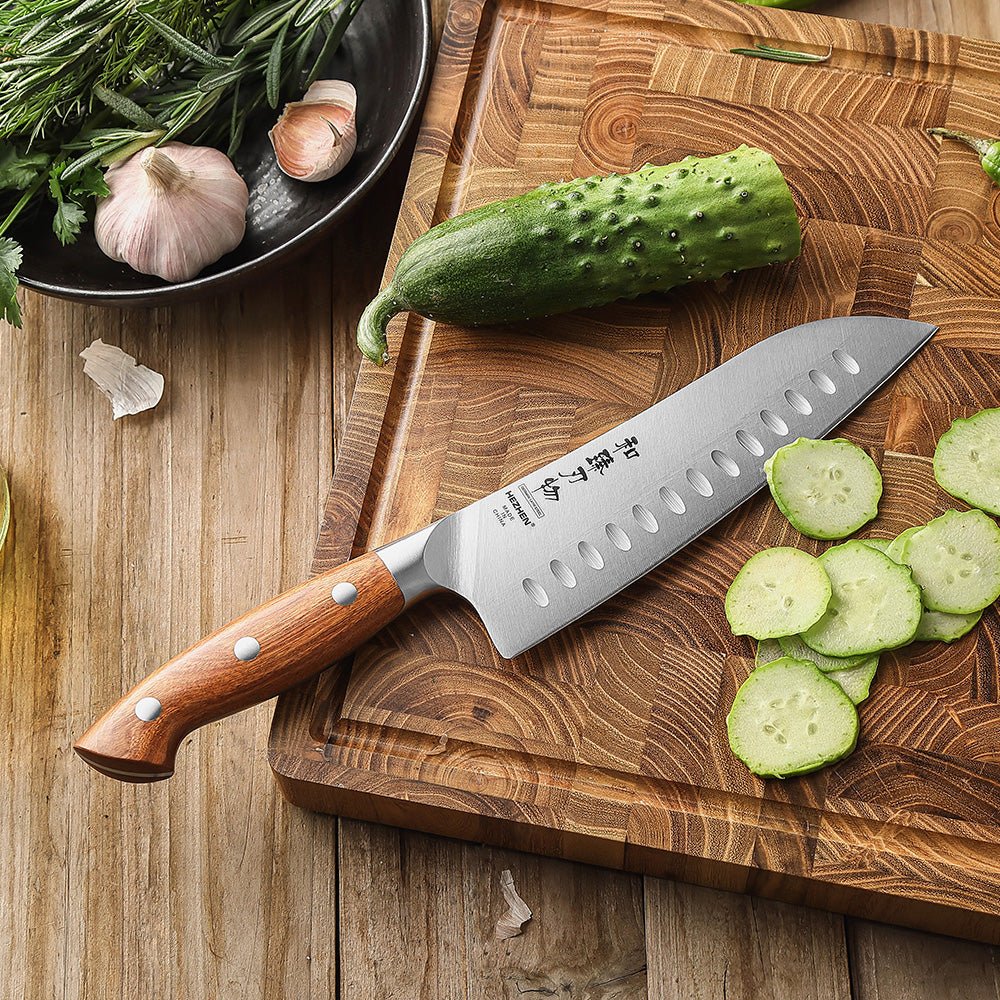
The performance sweet spot: The Mo Series 7.5" Santoku uses 10Cr15CoMoV steel (the VG-10 equivalent) at 60 HRC, clad in 67 layers of real Damascus. Sharper out of the box, holds its edge significantly longer than German steel, and the san mai construction keeps it tough despite the harder core.
For cooks who sharpen their own knives: The Lan Series 7" Santoku uses 14Cr14MoVNb powder steel at 62 to 64 HRC with 73-layer Damascus. The niobium carbides in this steel resist wear exceptionally well. If you prefer the chef knife shape, the Lan Series 8.5" Chef Knife uses the same steel. You'll want a whetstone to maintain this level of blade.
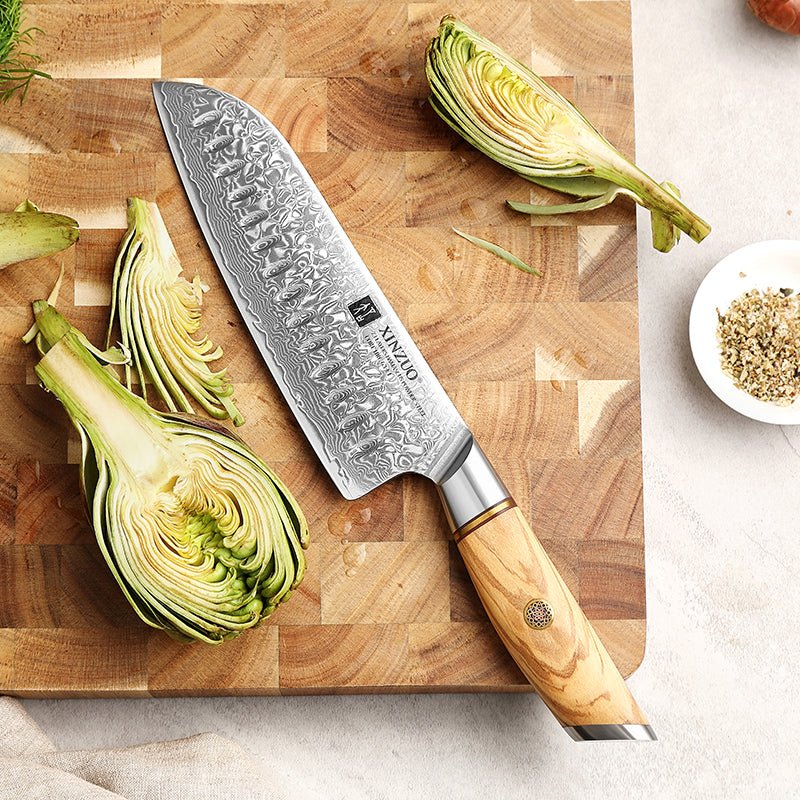
The Retro Series 7" Santoku uses the same 10Cr15CoMoV core steel as the Mo Series but with a hand-hammered finish instead of Damascus patterning. Same cutting performance, lower price.
What Are Five Things That Will Damage a Good Knife?
- Bone or frozen food with a santoku. The thin, hard edge is built for precision. Even small bones can chip it. Use a cleaver or a heavy chef knife for those jobs.
- A steel honing rod on Japanese-hardness steel (59+ HRC). The impact creates micro-chips along the edge. Use a ceramic honing rod instead.
- Twisting the blade sideways while cutting. Lateral force on a thin blade can flex it past its limit. Cut straight down and forward.
- The dishwasher. Abrasive detergent, high heat, and banging against other items. Hand wash and dry immediately. It takes ten seconds.
- Storing knives loose in a drawer. Edges hit other utensils and dull fast. Use a magnetic rack, knife block, or blade guard.
Where Are Santoku and Chef Knives Traditionally Made?
The santoku emerged in the 1940s in the Kansai region of Japan. After World War II, Western food, particularly meat, became common in Japanese households. Traditional Japanese kitchens used separate knives for each ingredient: the nakiri for vegetables, the deba for fish, the yanagiba for slicing. The santoku combined elements of all three into a single all-purpose blade. The name, santoku (三徳), means "three virtues," though whether that refers to the three ingredients or three cutting techniques is still debated.
The Western chef knife evolved from French and German butchery traditions. The gyuto appeared during Japan's Meiji period (from 1868), when swordsmiths who lost their livelihoods after the samurai class was dissolved turned their forging knowledge to kitchen cutlery. They took the Western chef knife shape and rebuilt it with Japanese steel and grinding techniques.
Sources
- Atkins, A.G., Xu, X. and Jeronimidis, G. (2004). "Cutting, by 'pressing and slicing,' of thin floppy slices of materials." Journal of Materials Science, 39, 2761 to 2766.
- Claudon, L. and Marsot, J. (2006). "Effect of knife sharpness on upper limb biomechanical stresses." International Journal of Industrial Ergonomics, 36(3), 239 to 246.
- McGorry, R.W., Dowd, P.C. and Dempsey, P.G. (2005). "The effect of blade finish and blade edge angle on forces used in meat cutting operations." Applied Ergonomics, 36(1), 71 to 77.
- Wu, Z., Hooshanginejad, A., Wang, W., Hui, C.-Y. and Jung, S. (2025). "Droplet outbursts from onion cutting." Proceedings of the National Academy of Sciences, 122(42).
- Singh, K.K. and Das, S. (2016). "Effects of knife edge angle and speed on peak force and specific energy when cutting vegetables." International Journal of Food Studies, 5(1), 22 to 33.
Related Articles
- Damascus Kitchen Knives: Real vs Fake Patterns and What Actually Matters
- How to Sharpen Kitchen Knives with a Whetstone
- German vs Japanese-style Kitchen Knives: Which Style Suits Australian Home Cooks?
- Japanese-style Knife Types Explained: Santoku, Nakiri, Gyuto and More
Frequently Asked Questions
Can a santoku knife replace a chef knife for everyday cooking?
For most kitchen tasks, yes. A santoku handles vegetables, fish, boneless meat, and herbs without any issues. Where it falls short is rocking through large piles of herbs, breaking down bone-in cuts, and slicing through big produce like whole pumpkin, where a longer, heavier chef knife has the advantage.
What should you not cut with a santoku knife?
Avoid bones, frozen food, and hard-skinned produce like whole pumpkin or coconut. The thinner blade and harder steel (typically 59 to 62 HRC) make it more prone to chipping under lateral force or impact. Use a cleaver or heavy Western chef knife for those jobs.
Do professional chefs use santoku knives?
Yes, particularly in Japanese kitchens and dedicated vegetable prep stations. Many Western-trained chefs keep a santoku alongside their chef knife for precision tasks like fine julienne, paper-thin slicing, and mincing shallots. The lighter weight makes it less fatiguing during long prep sessions.
What size santoku knife should I buy?
Most santoku knives are 165mm to 180mm (6.5 to 7 inches). This standard size suits most hand sizes and cutting tasks. If you have smaller hands or mostly do light prep, a 165mm blade gives better control. The 180mm version handles larger vegetables more comfortably.
What angle should I sharpen a santoku knife?
Sharpen at 12 to 15 degrees per side for Japanese-style santoku knives with harder steel (59+ HRC). German-style santoku knives with softer steel (54 to 57 HRC) work better at 15 to 20 degrees per side. Xinzuo santoku knives ship with a 12 to 15 degree factory edge on both sides.