

Why Do Different Meats Need Different Knives?
A chicken thigh and a beef brisket have almost nothing in common. One is small, relatively tender, and surrounded by a thin layer of skin. The other is a massive slab of muscle wrapped in connective tissue, fat cap, and silverskin. Using the same knife for both is like using a screwdriver to hammer nails. It'll sort of work, but you'll fight the material the entire time.
The anatomy of each animal dictates the knife work. Beef involves big primal cuts, long slicing motions, and precision trimming. Pork sits somewhere in between, with moderate-sized joints and some delicate trimming around tenderloins. Poultry requires finesse around joints and tight spaces where bones curve and cartilage connects.
Matching your blade to the protein you're working with means less effort, cleaner cuts, and less waste. That last point matters more than people realise. A bad trim on a beef tenderloin can cost you 15-20% of usable meat. The wrong knife on a whole chicken turns a five-minute breakdown into a ten-minute wrestling match.
Quick reference: A chef knife handles 70% of general meat prep. Add a boning knife for raw prep and a carving knife for cooked roasts, and you can tackle virtually any protein that comes through your kitchen.
What Knife Works Best for Beef?
Beef is the most demanding protein for knife work. The cuts are large, the connective tissue is tough, and the margin for error on expensive cuts is low. Different stages of beef preparation call for different blade profiles.
Breaking Down Primals: The Chef Knife
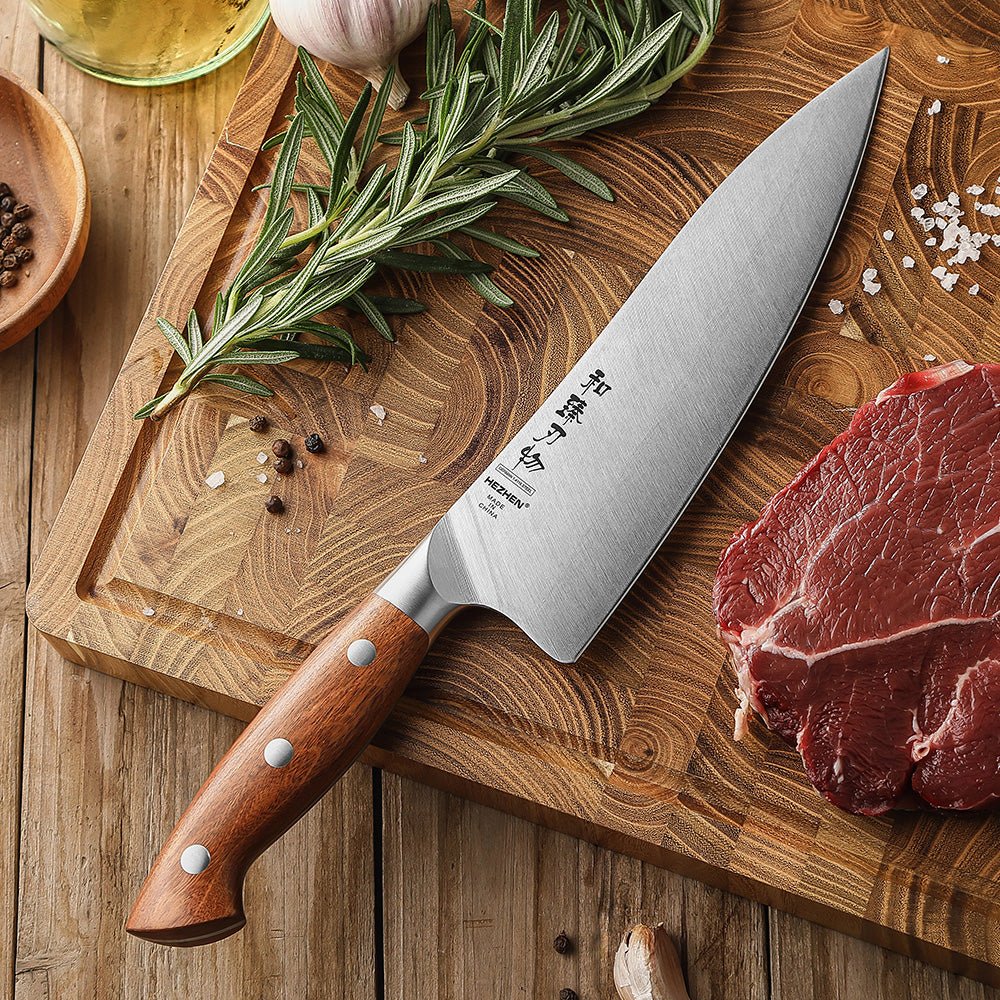
When you're portioning a boneless rib roast, slicing through a chuck roll, or cutting steaks from a striploin, an 8-inch chef knife is your primary tool. The broad blade and curved edge let you apply steady, even pressure through dense muscle tissue. The weight of the blade does a lot of the work for you.
For portioning raw steaks, you want a single clean stroke rather than sawing. A sharp chef knife with a slight rocking motion cuts through a New York strip in one pass. A dull or undersized knife compresses the muscle fibres and tears the surface, which affects how the steak sears later.
Slicing Cooked Beef: The Carving Knife
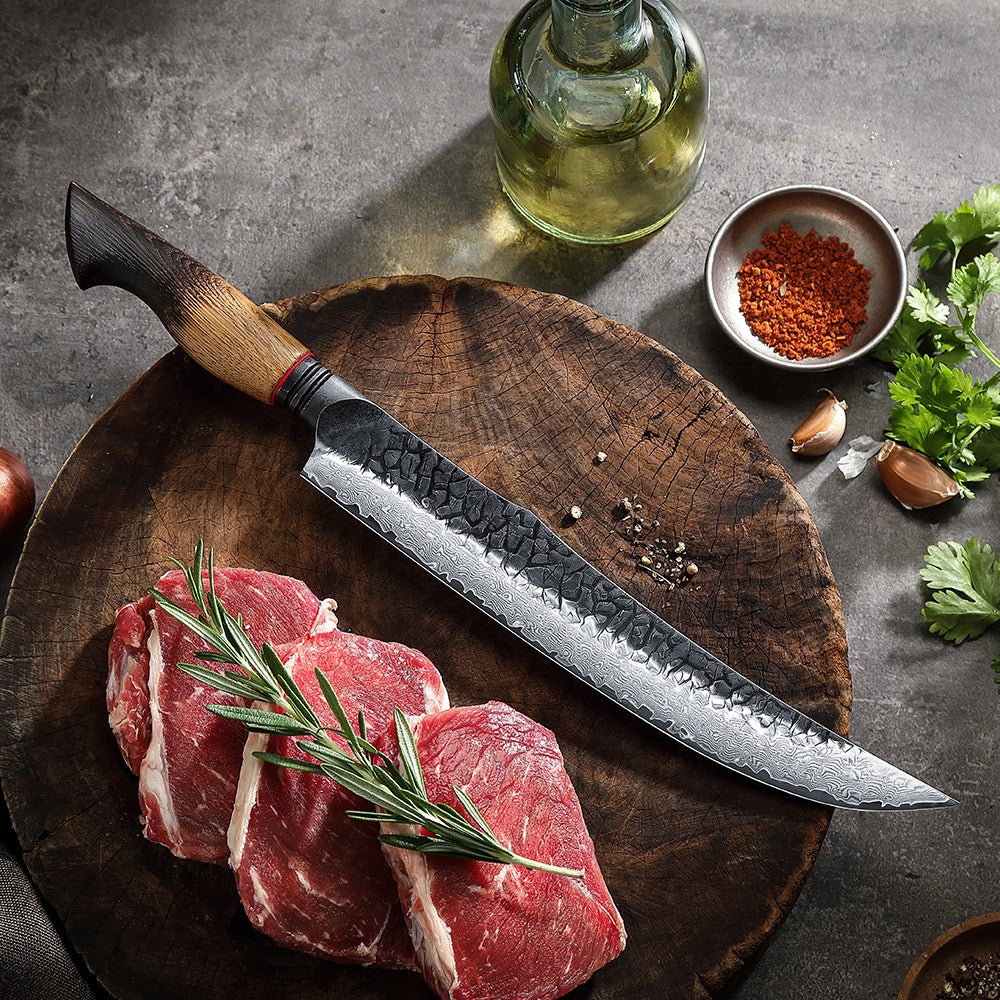
Roast beef, brisket, prime rib. These all need long, thin, even slices, and a chef knife is the wrong shape for the job. A 10-inch carving knife has a narrow blade that reduces drag through cooked meat. The length lets you complete each slice in one smooth pull rather than sawing back and forth.
This matters for texture. Every time you change direction mid-slice, you compress the meat and squeeze out juice. A single long draw keeps the muscle fibres intact and the juices inside the meat where they belong. With brisket especially, where you're slicing against the grain through a flat that might be 30cm wide, blade length is not optional.
Trimming Silverskin and Fat: The Boning Knife
Silverskin is the thin, silvery membrane that covers muscles like the tenderloin and eye fillet. It doesn't break down during cooking and turns into a chewy, unpleasant layer if left on. Removing it requires a thin, flexible blade that can slide just under the membrane without taking meat with it.
A 6-inch boning knife is purpose-built for this. You anchor one end of the silverskin with your free hand, then angle the blade slightly upward and pull it along the length of the muscle. The narrow blade follows the contour of the meat, and the slight flex lets you adjust as you go. Trying this with a chef knife means you either leave silverskin behind or waste good meat.
The same knife handles fat cap trimming on briskets and rib roasts. You want to leave about 5-6mm of fat for rendering during cooking, which means skimming just below the surface with precise, controlled strokes.

What Knife Works Best for Pork?
Pork prep falls somewhere between beef and poultry in terms of knife demands. The cuts are smaller than beef but larger than chicken, and the bone structure is denser than poultry but less massive than beef.
Portioning Chops and Loins: The Chef Knife
Cutting boneless pork chops from a loin is straightforward chef knife work. You're slicing through relatively uniform muscle with a thin fat cap. The key is consistent thickness, because a 2cm chop and a 3cm chop sitting next to each other on the same grill will cook at completely different rates.
For bone-in chops, you need to cut between the rib bones. A chef knife handles this as long as you position the blade between the bones rather than trying to cut through them. Feel for the gap with the tip of the knife, then commit to a single firm stroke.
Trimming Tenderloins: Boning or Utility Knife
Pork tenderloins have a similar silverskin situation to beef tenderloins, just on a smaller scale. A boning knife works well here, but a 5-6 inch utility knife can also do the job. The tenderloin is narrow enough that a smaller blade actually gives you better control.
There's also the "chain," a loose strip of meat and fat that runs along one side of the tenderloin. Removing it cleanly is easier with a thin, manoeuvrable blade than with a wide chef knife that obscures your view of what you're cutting.
What Knife Works Best for Poultry?
Poultry knife work is all about joints. Birds have a skeletal structure with ball-and-socket joints at the thighs, drumsticks, and wings. If you cut through the right spot, the joint separates with almost no resistance. Miss by a centimetre and you're grinding against bone.
Breaking Down Whole Birds: Chef Knife + Boning Knife
The most efficient way to break down a chicken uses two knives. Start with the chef knife to remove the legs: pull the thigh away from the body, slice through the skin, then pop the joint by bending the leg back and cut through the exposed ball-and-socket. The chef knife's weight helps here.
Switch to the boning knife for finer work. Separating the thigh from the drumstick, removing the backbone, and deboning the breast all require a narrow blade that can work around curves and between bones. The boning knife's pointed tip finds the joint lines that a wider blade would skip right over.
A whole turkey follows the same principles, just at a larger scale. The joints are bigger and the bones are harder, so your knives need to be properly sharp. A dull boning knife on a turkey is an exercise in frustration.
Carving Roast Chicken and Turkey: The Carving Knife
Once the bird is cooked, you want thin, even slices of breast meat and clean separation of the legs and wings. A carving knife handles the breast slicing beautifully. The long, thin blade cuts through the tender cooked meat without shredding it, and the narrow profile means minimal drag.
For presentation carving at the table, the technique matters as much as the knife. Slice the breast off the bone in one piece first, then crosscut into even slices on the cutting board. This gives you much cleaner results than trying to slice directly off the carcass.
Which Knife Types Are Best for Meat?
Each knife type has a specific role in meat preparation. Some overlap exists, but understanding where each blade excels helps you work faster and cleaner.
The Chef Knife: Your General-Purpose Meat Knife
About 70% of meat prep can be handled with a good 8-inch chef knife. Portioning steaks, cutting chops, dicing stew meat, slicing chicken breast. The curved belly of the blade works for both push cuts and rock-chopping motions, and the blade height gives you knuckle clearance on the cutting board.
For meat work specifically, a chef knife with a harder steel (58-60+ HRC) holds its edge better through long butchery sessions. Softer steel dulls faster when cutting through dense muscle and connective tissue.
The Carving Knife: Built for Cooked Meat
A carving knife is a specialist. The long, narrow blade is designed for one thing: producing thin, even slices from cooked roasts. The reduced blade height means less surface area creating friction against the meat, so each stroke glides rather than drags.
If you regularly cook roasts, brisket, or whole birds, a carving knife is not a luxury purchase. It is the difference between ragged, torn slices and the clean, uniform cuts you see at a good steakhouse.
The Boning Knife: Precision Raw Prep
Boning knives are narrow, pointed, and slightly curved. Some have a stiff blade for working around larger bones (beef ribs, pork shoulders), while others have a flexible blade for finer work (filleting, silverskin removal). For general meat prep, a semi-flexible blade covers the widest range of tasks.
The pointed tip is what makes this knife indispensable. It finds joint lines, gets under membranes, and works into tight spaces that a chef knife simply cannot reach.
The Cleaver: Through-Bone Power
When you need to cut through bone, not around it, a cleaver is the tool. Splitting spare ribs, portioning chicken through the backbone, or breaking down a rack of lamb all require the weight and thick spine of a cleaver. No other knife should be used for this job. Using a chef knife on bone risks chipping or cracking the thin, hard blade.
What Edge Angle Do You Need for Meat Work?
Edge geometry matters more for meat cutting than most people think. The angle at which the blade is sharpened affects how it moves through different types of tissue.
Japanese-style knives sharpened at 12-15° per side hit the sweet spot for most meat work. The acute angle means the blade enters the meat with less resistance, producing cleaner cuts and less cell damage. Less cell damage means less moisture loss, which is why professionally butchered steaks look smooth and glassy on the cut surface rather than rough and fibrous.
For boning knives that will scrape along bone, a slightly more obtuse angle (15° per side) provides better durability without sacrificing much cutting performance. The edge is more likely to encounter bone, cartilage, and sinew, so a little extra thickness behind the edge helps it survive those impacts.
What Steel Should You Look for in a Meat Knife?
The steel your knife is made from affects how it performs on meat in two main ways: edge retention and corrosion resistance.
Edge retention determines how many cuts you get before the blade dulls noticeably. High-carbon steels and powder metallurgy steels (like VG-10 and SG2) hold an edge significantly longer than softer stainless steels. For home cooks processing one chicken a week, this difference is small. For someone who breaks down a whole brisket, pork shoulder, and a couple of chickens every weekend, it adds up fast.
Corrosion resistance matters because meat prep is wet work. Blood, fat, and juices are all slightly acidic and can promote oxidation on reactive carbon steels if you don't wipe the blade down regularly. High-chromium stainless steels and Damascus steel with a stainless core handle this better, requiring less babysitting during long prep sessions.
VG-10 steel, which is used in many XINZUO knives, offers a strong balance here. It hardens to 60+ HRC for excellent edge retention, contains enough chromium for solid stain resistance, and takes a very fine edge at acute angles. For meat work where the knife encounters both soft muscle and tough connective tissue in quick succession, that combination performs well.
Which Knives Do We Recommend for Meat Preparation?
If you're building a meat-focused knife kit, these three cover the full range of tasks from raw prep to table service.
The Meat Prep Trio:
1. 8" Chef Knife (Supreme Series) , Your workhorse for portioning, dicing, and general meat prep. VG-10 Damascus core at 60+ HRC. Handles everything from slicing raw steaks to breaking down pork loins.
2. 10" Carving Knife (Mo Series) , Long, narrow blade designed for slicing cooked roasts. One smooth pull through a brisket flat or turkey breast instead of sawing. The extra length is not about show; it is functional.
3. 6" Boning Knife (Lan Series) , Pointed tip and narrow profile for trimming silverskin, deboning poultry, and working around joints. The semi-flexible blade follows contours that wider knives cannot.
How Do You Match the Right Knife to Each Meat Task?
Related Reading
- Steak Carving Knife Buying Guide
- Boning Knife vs Fillet Knife: What's the Difference?
- Brisket Knife Guide: Long Blades for BBQ
- The Complete Carving Knife Guide
- Knife Techniques: Rock Chop, Push Cut, and Pull Slice
- How to Choose a Chef Knife: The Complete Buying Guide
- Knife Steel Hardness Guide
- Cleaver Knife Guide: Chinese vs Western
Frequently Asked Questions
What is the single best knife for cutting meat?
An 8-inch chef knife handles roughly 70% of all meat prep: portioning raw steaks, dicing stew meat, cutting chops, and slicing chicken breast. For most home cooks who only want one knife for meat, a chef knife with steel rated 58 to 60 HRC or above gives the best combination of edge retention and versatility. Add a boning knife for raw prep and a carving knife for cooked roasts when your budget allows.
Do I need a cleaver for cutting meat at home?
Only if you cut through bone. A cleaver's heavy, thick blade is built for splitting spare ribs, chopping through chicken backbones, and portioning bone-in cuts. No other knife should be used for this job, as thinner blades risk chipping or cracking. If you buy your meat pre-portioned and never cut through bone yourself, a cleaver is unnecessary.
What edge angle is best for meat knives?
12 to 15 degrees per side is the best all-rounder for meat work. This angle is sharp enough for clean cuts through muscle with minimal cell damage, yet tough enough to handle connective tissue and fat without chipping. For boning knives that scrape along bone, 15 degrees per side adds durability. For slicing cooked meat where the blade never contacts bone, 12 degrees per side gives the smoothest cut surface.
What is the best knife for trimming silverskin off meat?
A 6-inch boning knife or a 150mm petty knife with a semi-flexible blade. Anchor one end of the silverskin, angle the blade slightly upward, and pull along the length of the muscle. The narrow, flexible blade stays close to the meat surface and follows its contour without gouging. A chef knife is too wide to see what you are cutting and removes too much good meat with the membrane.
Why does a sharp knife matter more for meat than vegetables?
Meat has muscle fibres that release moisture when torn. A sharp blade slices fibres cleanly, keeping juice inside the meat. A dull blade crushes and tears, which is why a poorly cut steak has a rough, wet surface and loses moisture during cooking. Connective tissue and fat also resist dull edges, making you push harder and lose control. For meat work, hone before each session and sharpen on a whetstone every 2 to 4 weeks.