

Why Does Your Carving Knife Matter More Than You Think?
There's a moment at every dinner party that separates good hosts from great ones. The roast comes out of the oven, rested and beautiful, juices pooled beneath a golden crust. Then someone picks up a chef knife and starts hacking at it like they're clearing brush. Thick slabs tear free, juices flood the cutting board, and that perfect medium-rare centre gets mangled into something that looks like it was attacked by a bear.
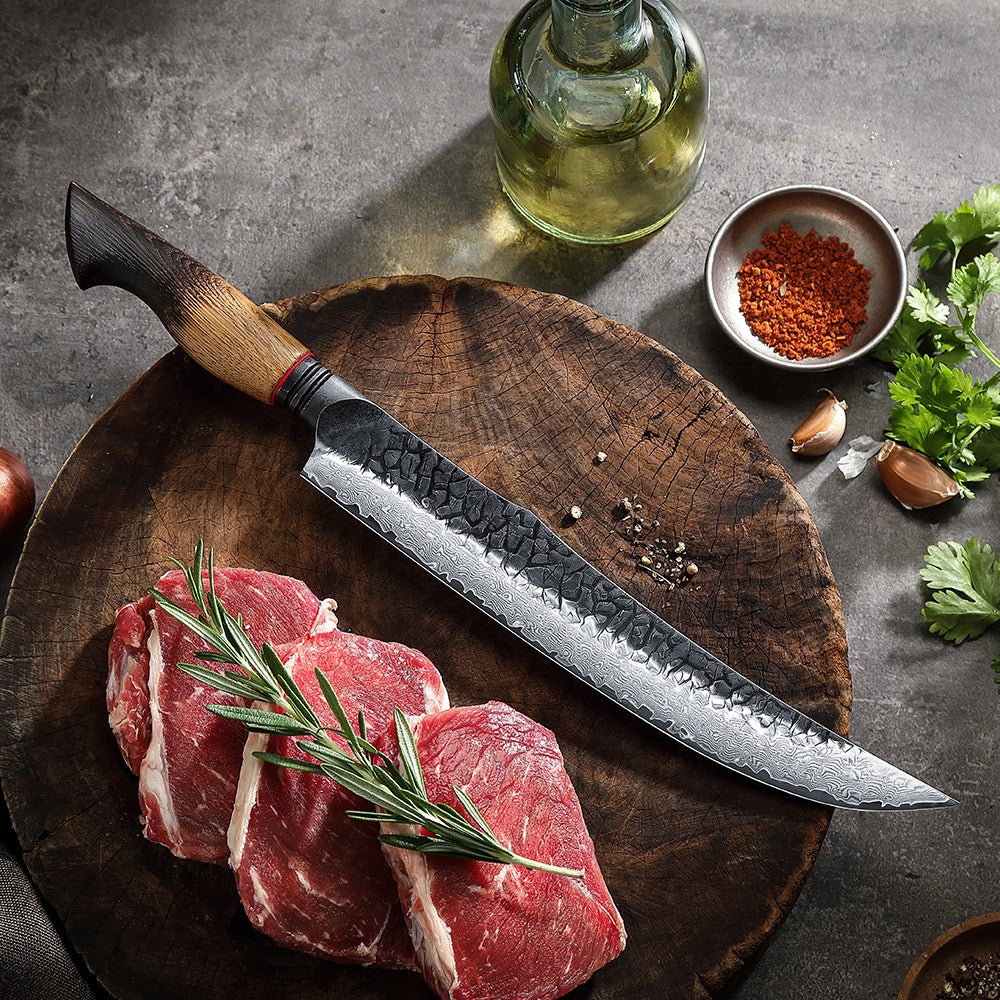
A proper carving knife fixes all of this. Not because it's fancy or expensive, but because the geometry is specifically designed for one job: making long, clean, even slices through cooked protein. The difference between carving with a chef knife and carving with an actual carving knife is like the difference between cutting bread with a paring knife and using a serrated blade. You can do it. You'll hate every second of it.
A carving knife's narrow blade, extended length, and keen edge allow you to slice through a roast in one smooth stroke rather than sawing back and forth. This preserves the meat's internal structure and keeps juices where they belong: in the slice, not on the board.
What Makes a Carving Knife Different from a Chef Knife?
Chef knives are generalists. They chop onions, mince garlic, break down chicken, and crush ginger. That versatility comes from a wide, curved blade that's typically 200mm to 250mm (8" to 10") long with a pronounced belly for rocking motions.
Carving knives are specialists. They do one thing, and they do it exceptionally well. The differences are specific and functional:
- The blade is narrower, usually 25mm to 35mm from spine to edge (compared to 45mm to 50mm on a chef knife). Less surface area means less friction and drag through the meat.
- The blade is longer, typically 200mm to 300mm (8" to 12"). Length matters because you want each slice to be a single, fluid pull rather than a sawing motion. Every time you push and pull, you tear muscle fibres.
- The edge geometry is thinner behind the edge. Most carving knives are ground to 12 to 15 degrees per side, compared to 15 to 18 degrees on a typical chef knife. Thinner geometry means less resistance.
- The tip is more pointed, which helps when you need to work around bones or start a precise cut at a specific point on the roast.
What Blade Length Should You Choose for a Carving Knife?
This one's simpler than people make it. Match the blade to what you're cutting most often.
An 8" (200mm) carving knife handles weeknight roast chicken, pork loin, and small beef roasts perfectly well. It's manoeuvrable, easy to control, and stores without taking up half your knife block. For most home cooks who roast a chicken on Sunday and carve the occasional holiday ham, 8 inches is the right call.
A 10" (250mm) carving knife is what you want for brisket, large bone-in legs of lamb, whole turkeys, and prime rib. The extra length means you can make full slices across a 200mm-wide brisket flat without having to saw. If you do any serious BBQ work, this is the size to own.
A 12" (300mm) blade is really only necessary for professional settings or if you regularly carve whole animals. For most people, it's unwieldy at home.
Practical rule: Your blade should be at least 50mm longer than the widest piece of meat you regularly carve. This ensures you can complete each slice in a single drawing motion.
Which Carving Knife Features Actually Matter?
Granton Edge (Kullenschliff)
Those scalloped divots along the side of the blade aren't decorative. They're called a granton edge (or kullenschliff in German), and they serve a real mechanical purpose. As the blade passes through meat, each divot creates a tiny air pocket between the steel and the sliced surface. This breaks the vacuum seal that would otherwise cause the slice to stick to the blade and drag along with it.
Is a granton edge essential? No. A well-made carving knife without one will still carve beautifully. But it helps noticeably with fatty, moist meats like brisket, ham, and turkey breast where sticking is a real problem.
Flexibility vs Rigidity
This is where personal preference and purpose actually diverge.
A flexible carving blade (one that bows when you press the tip against a cutting board) excels at following the contours of bone-in cuts. When you're carving a leg of lamb and need to trace around the femur, or separating turkey breast from the carcass, flex lets the blade hug curves. It's also preferred for ham, where you're working around a large bone and want thin, even slices that follow the meat's natural shape.
A rigid carving blade (minimal flex) gives you straighter, more uniform slices on boneless cuts. Prime rib, brisket, pork loin, beef tenderloin. When precision and consistency matter more than contour-following, rigid is better. You get exactly the thickness you intended, every time.
If you're buying one carving knife, go with moderate rigidity. It handles both situations adequately. Pure flexibility is more of a specialist tool.
Pointed Tip
A sharply pointed tip isn't just aesthetic. You'll use it to pierce the skin of a turkey before carving, to start cuts at precise points around joints, and to separate individual slices when they don't fall away cleanly. A rounded tip makes all of these tasks clumsier than they need to be.
What Is the Difference Between a Carving Knife and a Slicing Knife?
These terms get used interchangeably, and honestly, there's significant overlap. But there is a technical distinction worth knowing.
| Feature | Carving Knife | Slicing Knife |
|---|---|---|
| Typical length | 8" to 10" | 10" to 14" |
| Tip shape | Pointed | Rounded (bull-nose) |
| Best for | Bone-in roasts, poultry, general carving | Boneless roasts, brisket, smoked meats |
| Flexibility | Moderate to flexible | Rigid to moderate |
| Granton edge | Common | Very common |
A carving knife is optimised for table-side presentation and working around bones. A slicing knife is optimised for long, straight cuts through large boneless pieces. In practice, most home cooks will do great with either. If your collection already includes a good knife for meat, a carving knife complements it rather than replacing it.
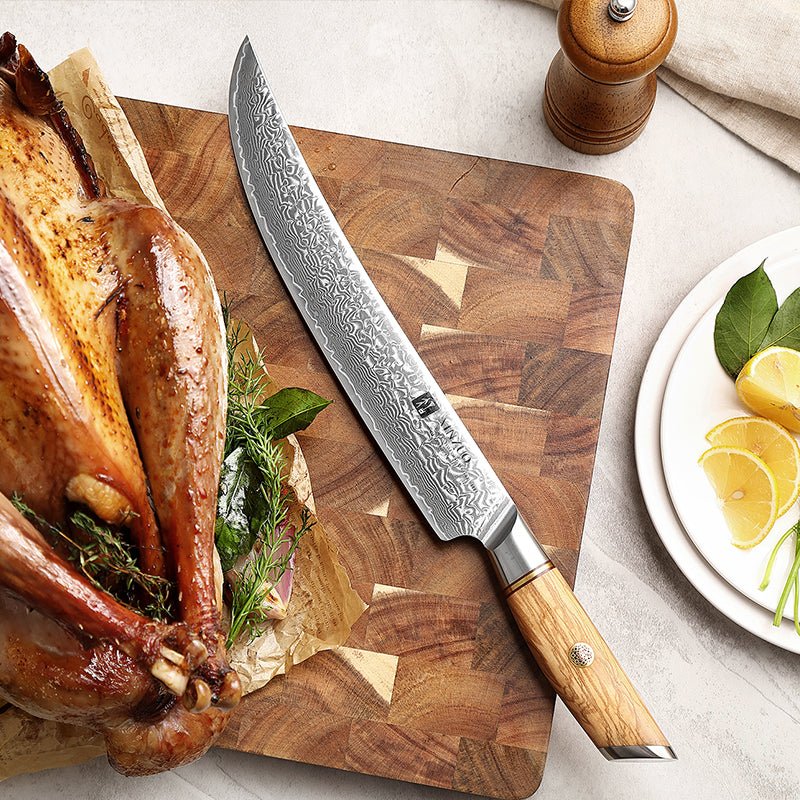
Why Does Steel Type and Edge Retention Matter for Carving Knives?
Of all the knives in your kitchen, a carving knife benefits the most from a razor-sharp edge. Here's why: when you slice cooked meat, you're cutting through soft protein fibres held together by rendered collagen. A sharp blade glides through this cleanly, leaving smooth surfaces that hold their juices. A dull blade tears and crushes those fibres, squeezing moisture out like wringing a sponge.
The effect is visible. Slice a rested brisket with a freshly sharpened carving knife and the board stays nearly dry. Do the same with a dull blade and you'll have a pool of liquid within seconds.
This is where steel quality earns its keep. High-carbon steels like VG-10 (hardened to 60-62 HRC) hold a keen edge significantly longer than softer German-style steels at 56-58 HRC. Damascus-clad blades with a VG-10 core give you the best of both worlds: a hard cutting edge wrapped in a tougher, more flexible outer layer that resists chipping.
For carving specifically, you want steel that can take and hold a fine edge at 12 to 15 degrees per side. Softer steels struggle to maintain that acute angle and will roll or deform after a few uses. If you're serious about carving, invest in the steel and learn to maintain it with a whetstone. Regular honing on a ceramic rod between sharpenings will keep a good carving knife performing for months.
How Do You Get the Most from Your Carving Knife?
Rest the Meat First
This isn't optional. A roast straight from the oven has its juices concentrated in the centre (heat pushes moisture inward). Let it rest 10 to 15 minutes for steaks and smaller roasts, 20 to 30 minutes for large cuts like prime rib or whole turkey. During resting, juices redistribute evenly throughout the meat. Cut too early and those juices have nowhere to go but out.
Slice Against the Grain
The "grain" is the direction of the muscle fibres. They look like parallel lines running through the meat. When you slice perpendicular to those lines, you're shortening each fibre to the thickness of your slice (3-6mm). Short fibres are easy to chew through. When you slice parallel to the grain, you get long, intact fibres that require serious jaw effort to break down. Same meat, same cook, wildly different eating experience.
Identifying grain direction is easy on raw meat but can be trickier once it's cooked and crusted. Look at the end of the roast before it goes in the oven and make a mental note. On brisket, the grain direction actually changes between the point and the flat, which is why experienced BBQ folks separate the two muscles before slicing.
Let the Knife Do the Work
A carving knife is designed for long, smooth drawing cuts. Place the heel of the blade at the top of the roast, apply light downward pressure, and draw the knife toward you in a single motion. The weight and sharpness of the blade provide the cutting force. If you're pressing hard, your knife is dull.
Never saw back and forth. Each pass tears fibres in both directions, leaving a ragged surface that weeps juice. One stroke, heel to tip. If the knife is sharp and long enough, one stroke is all you need.
Target thickness: For most roasted meats, aim for 3mm to 6mm slices. Thinner for delicate cuts like beef tenderloin, slightly thicker for brisket and ham. Consistency matters more than exact thickness. Uneven slices cook differently when reheated and look sloppy on the plate.
Uniform Slices
Angle your knife at a consistent angle (perpendicular to the cutting board for most cuts, slightly angled for presentation slices). Use the knuckles of your non-cutting hand as a guide if you're portioning from a block, or simply focus on keeping the blade's angle steady. With practice, you'll develop the feel for producing slices of identical thickness without thinking about it. This is one of those fundamental knife techniques that improves everything you do in the kitchen.
Should You Pair Your Carving Knife with a Carving Fork?
A carving fork isn't just traditional ceremony. It's a safety tool. Roasted meat is slippery. Fat-rendered surfaces have zero friction. Without a fork anchoring the roast, it will slide across your board mid-cut, and you'll instinctively reach out to grab it with your free hand while a sharp blade is in motion. That's how carving injuries happen.
A good carving fork has two long, curved tines spaced about 25mm apart. You plant it firmly into the top of the roast, angled slightly away from your cutting path, and it stays put. The curved tines grip better than straight ones and are easier to extract.
Position the fork at least 50mm from where you're cutting. This gives the blade clearance and ensures you're not slicing into the fork's tines (which will damage your edge instantly). Move the fork back as you work through the roast, always keeping it ahead of the blade.
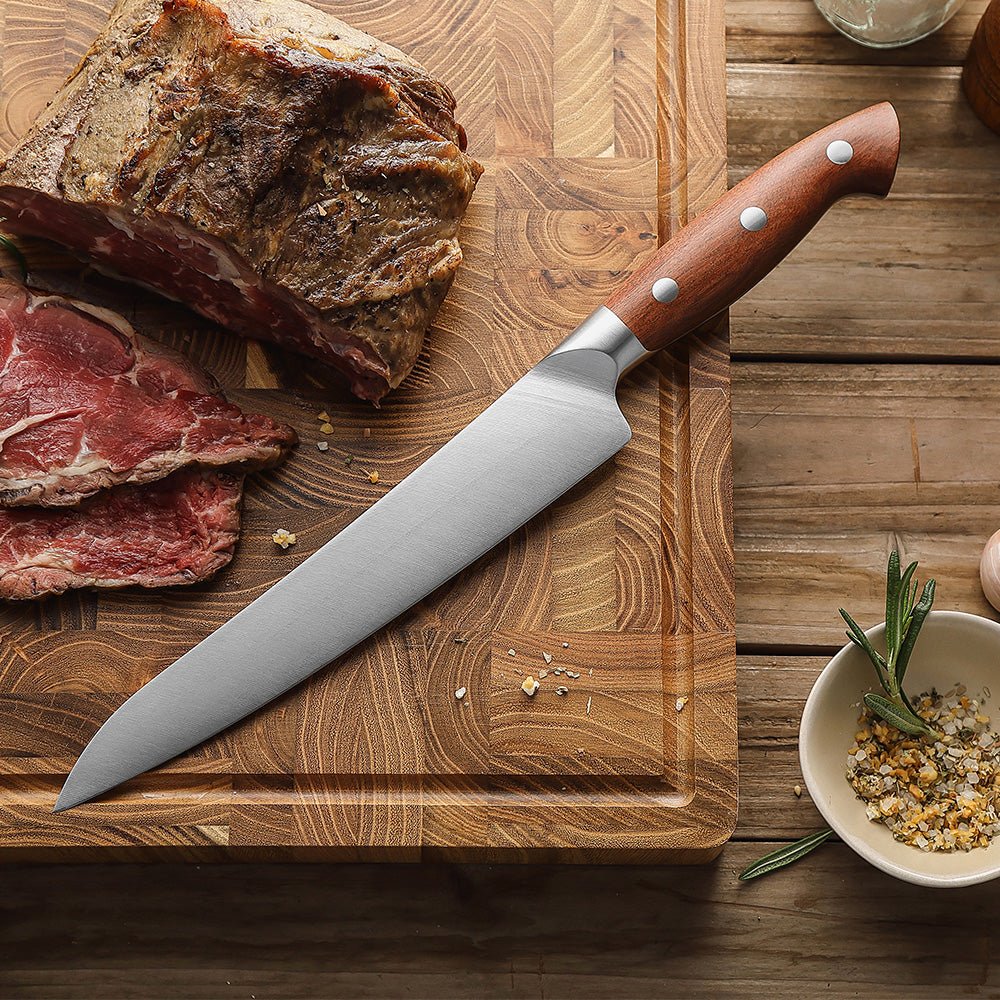
Which Xinzuo Carving Knives Do We Recommend?
We make three carving knives, each designed for a different use case and price point. All three use high-carbon steel cores for edge retention and feature the narrow, elongated blade profile that makes a carving knife actually useful.
The Supreme Series 8" Carving Knife is our entry point for home carvers. At 200mm, it handles roast chicken, pork loin, and small beef roasts with precision. The VG-10 cutting core holds a fine edge through dozens of carving sessions before needing attention, and the G10 handle provides a secure grip even with greasy hands. If you carve once or twice a week and mostly work with smaller roasts, this is the one.
The Mo Series 10" Carving Knife is the workhorse. The 250mm blade handles everything from holiday turkey to competition brisket. It features a 67-layer Damascus-clad blade with a VG-10 core, giving you both the hardness for edge retention and the visual depth of a hand-forged pattern. The extra length makes a real difference when you're working across a full packer brisket or a large leg of lamb.
The Lan Series 10" Carving Knife sits at the top of our range with a composite steel construction and pakkawood handle. It's built for serious use with a slightly thinner grind behind the edge, which reduces cutting resistance and produces even cleaner slices. If carving is something you do often and take pride in, this is the knife that rewards your technique.
How Should You Care for Your Carving Knife?
Because carving knives rely on an exceptionally fine edge, maintenance matters more here than with most kitchen knives. A few specifics:
Hand wash only. Dishwashers dull edges through mechanical vibration against other utensils, and the harsh detergent can damage handle materials. Wash with warm water and mild soap immediately after use, dry completely, and store properly.
Hone before every carving session. A few passes on a ceramic honing rod realigns the edge and restores cutting performance. This takes 15 seconds and extends the interval between full sharpenings dramatically.
When the honing rod stops bringing the edge back, it's time for a proper sharpening. A 1000/3000 grit combination whetstone is ideal for carving knives. Work at 12 to 15 degrees per side, use light pressure, and finish on the finer grit. If you're not comfortable with freehand sharpening yet, our whetstone sharpening guide walks through the full process.
Store your carving knife in a knife block, on a magnetic rack, or in a blade guard. Tossing it in a drawer with other utensils will dull the edge within weeks, no matter how good the steel is.
Further Reading
If you're building out your meat preparation setup or want to improve your knife skills across the board, these guides cover related ground:
- Brisket Knife Guide: Long Blades for BBQ
- Best Knife for Meat: A Buying Guide
- Boning Knife vs Fillet Knife
- Knife Techniques: Rock Chop, Push Cut, Pull Slice
- General Carving Knife Guide
- Knife Steel Hardness Guide
- How to Sharpen Knives with a Whetstone
- Knife Care and Daily Maintenance
- How to Choose a Chef Knife
Frequently Asked Questions
Do I need a separate knife for carving steak at the table?
Not for individual steaks, a sharp steak knife handles that. A carving knife is for slicing large shared cuts like a whole tomahawk, prime rib, or barbecue brisket at the table. If you regularly serve meat family-style from a large cut, a 10-inch carving knife with a narrow profile (25 to 35mm blade width) gives you clean, even slices that a chef knife or steak knife cannot match.
What blade length is best for carving steak and roasts?
For individual steaks and small roasts, an 8-inch (200mm) blade is enough. For whole briskets, prime rib, or leg of lamb, a 10 to 12-inch (250 to 300mm) blade lets you complete each slice in one smooth pull stroke without sawing. The blade should be at least 50mm longer than the widest part of the meat you are cutting.
What size carving knife should I buy?
An 8 inch (200mm) blade suits weeknight roast chicken and small beef roasts. A 10 inch (250mm) blade handles brisket, leg of lamb, whole turkey, and prime rib, where the extra length lets you complete each slice in a single drawing stroke. Your blade should be at least 50mm longer than the widest piece of meat you regularly carve.
What is a granton edge and does it help with carving?
A granton edge has small scalloped indentations ground into the side of the blade. These create tiny air pockets that reduce friction and stop thin slices from sticking to the flat of the knife. For carving fatty meats like brisket or prime rib, a granton edge makes a noticeable difference. For lean roasts like eye fillet, a plain edge works just as well.
How do you keep a carving knife sharp?
Hone with a ceramic rod before each carving session to realign the edge, and sharpen on a 1000 to 3000 grit whetstone every few months. A carving knife benefits more from a razor-sharp edge than most kitchen knives because dull blades tear cooked meat fibres and force juices out. Hand wash immediately after use, dry straight away, and store in a block or sheath to protect the fine edge.