

What Kind of Knife Do You Need for Slicing Brisket?
What you need for brisket
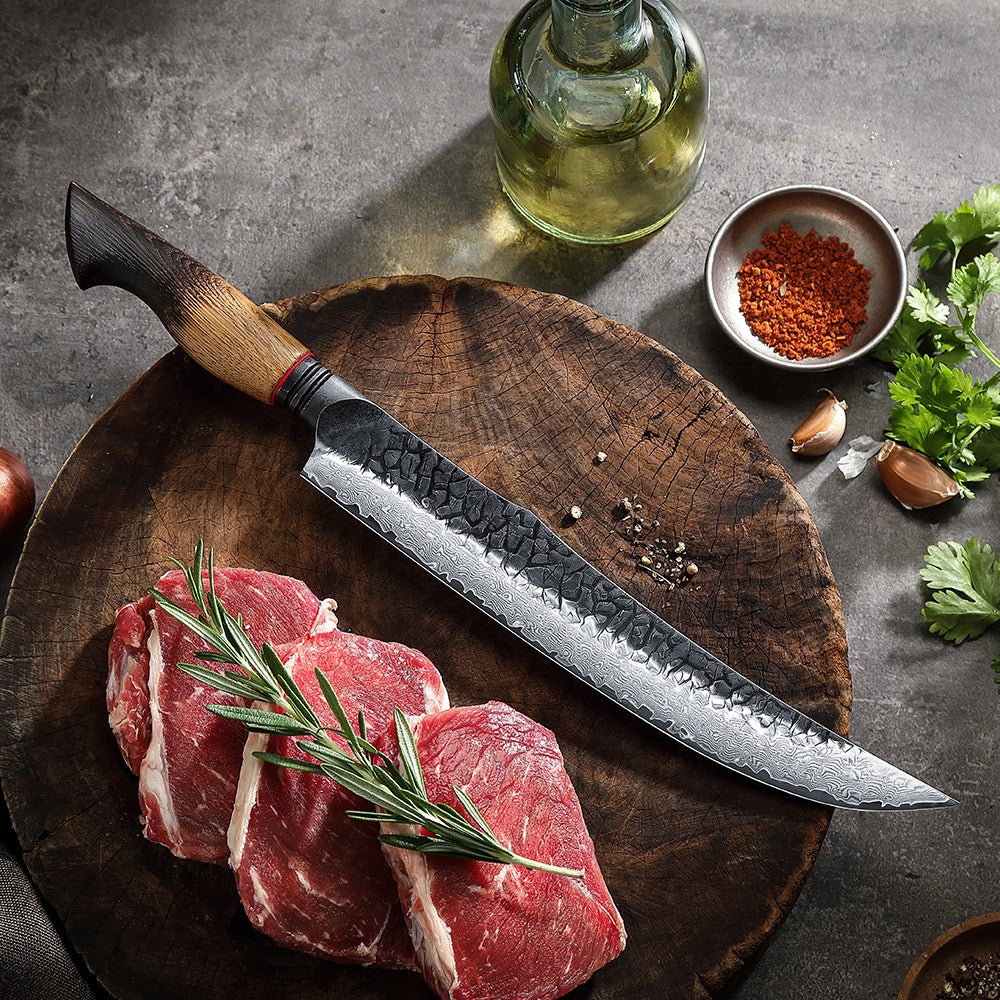
For brisket, you need a blade at least 10 inches (250mm) long. 12 inches (300mm) is better. A sujihiki or long carving knife lets you slice in a single smooth stroke, which preserves texture and juice. Your 8-inch chef knife is too short. After spending 12 to 16 hours smoking a brisket, slicing it properly is the least you can do.
There's a moment that separates the backyard smoker who knows what they're doing from the one who doesn't, and it has nothing to do with rub recipes or wood selection. It happens at the cutting board, right after the rest, when you pick up a knife and start slicing.
Get this right and each slice holds together, bends without breaking, and glistens with rendered fat and redistributed juice. Get it wrong and you end up with a pile of shredded meat that looks like you attacked it with a fork. Same brisket. Same 14-hour cook. Completely different result.
The knife is most of the equation.
Why Does Blade Length Matter When Slicing Brisket?
Here's the physics. A clean slice through any piece of meat requires the blade to travel across the full width in a single continuous stroke. One direction. Heel to tip, or tip to heel. One pass. The slice falls away clean.
A brisket flat, once rested and ready for slicing, can easily measure 30cm across. Some competition-size packers are wider. A standard 8-inch (200mm) chef knife gives you about 20cm of usable cutting edge. That means the blade runs out of length before it reaches the far side of the meat. So you reverse direction. You saw.
Every time you reverse the blade, two things happen. First, the edge creates a ridge in the cut surface where the direction changed. That ridge tears muscle fibres instead of slicing cleanly through them. Second, the back-and-forth motion compresses the meat, forcing juice out of the cut surface. You can literally watch it pool on the board.
One smooth pull-stroke doesn't do either of those things. The edge enters at one side and exits the other. The fibres are severed cleanly. The surface of the cut is smooth, almost glossy. The juice stays inside the meat instead of running onto your chopping board.
The sweet spot for most home pitmasters is 10 to 12 inches. If you only cook brisket flats (the leaner half), 10 inches works. If you regularly cook full packers, go with 12.
How Do You Choose the Right Brisket Slicing Knife?
Two styles of knife dominate the brisket world: the Japanese sujihiki and the Western carving knife. Both are long and narrow. Both are built for slicing. The differences are in the steel, the geometry, and how those translate to the cut surface.
Sujihiki (Japanese slicer)
A sujihiki is a double-bevel Japanese slicing knife. Harder steel (typically 58 to 62+ HRC) ground to a thinner edge at a more acute angle (12 to 15 degrees per side, compared to 18 to 20 for Western). The blade is narrow, stiff, and flat-profiled.
What this means in practice: the thinner edge separates meat fibres with less cellular damage. The harder steel holds that thin edge longer without rolling or microchipping. The flat profile keeps the entire cutting edge in contact with the board, giving you consistent slice thickness from one end to the other.
If you've ever seen competition brisket slices that look like they were cut by a machine, with that smooth, almost wet surface that catches the light, that's a sharp sujihiki at work. The difference between a sujihiki slice and a chef knife slice is visible to the naked eye. It's not subtle.
The trade-off: a stiff, hard blade doesn't forgive contact with bone. If you're working around ribs or through bone-in cuts, a sujihiki is the wrong tool. And the thinner steel requires more careful handling. You can't throw it in a drawer or let it clank against other knives.
Western carving knife
The traditional option. Softer steel (54 to 58 HRC), slightly wider blade, and often a small amount of flex. The edge angle is wider, which means a little more resistance through the meat but also more durability. You can be rougher with it.
A Western carving knife shines on bone-in cuts where you need to navigate around the joint. That slight flex lets the blade follow contours. It's also more forgiving if you accidentally hit a bone, a hidden rib tip, or the bark is particularly thick and crusty. The softer steel rolls rather than chips.
For a backyard smoker who cooks brisket alongside bone-in lamb legs, beer can chickens, and Christmas ham, a Western carving knife is the more versatile option. It won't produce the same mirror-finish slices as a sujihiki, but the difference only really matters if you're competing or if you're the type of person who notices.
Granton edges
Some slicing knives have scalloped dimples along the blade face. These are Granton edges, and they create tiny air pockets between the steel and the meat. On long slicing strokes through fatty brisket, this reduces suction and helps prevent slices from sticking to the blade.
Is it essential? No. Useful? Yes, particularly on the fattier point section where rendered fat can make the blade grab. It's a nice-to-have, not a dealbreaker.
What Is the Best Technique for Slicing Brisket?
A good knife is only half the job. The other half is knowing what to do with it. Brisket has quirks that trip up even experienced home cooks.
Rest it properly
This is not optional. When a brisket comes off the smoker, the proteins are tight and the juices are mobilised. If you slice immediately, those juices run straight out. The board floods. The meat dries out within minutes.
Minimum rest: 30 to 60 minutes, wrapped in butcher paper or foil, placed in an insulated cooler (no ice, just the insulation). Many competition cooks rest for 2 to 4 hours. The brisket stays hot, the juices redistribute back into the muscle fibres, and when you finally slice, the meat is noticeably juicier and more tender.
Find the grain. Then find where it changes.
This is where most people make their first serious mistake. Brisket has two muscles: the flat (the large, lean section) and the point (the thicker, fattier section that sits on top of the flat). The muscle fibres in these two sections run in different directions.
On the flat, the grain typically runs lengthwise along the brisket. On the point, the grain runs roughly perpendicular to the flat, at approximately 90 degrees. If you slice the entire brisket in one direction, one section will be cut against the grain (tender, correct) and the other will be cut with the grain (tough, chewy, wrong).
Before you start slicing, look at the top surface of the brisket. The grain is visible as parallel lines running through the meat. On the flat, identify the direction, then slice perpendicular to it. When you reach the junction where the point overlaps the flat, stop. Rotate the brisket about 90 degrees. Now slice the point section against its own grain direction.
Some people separate the flat and point entirely before slicing. This makes the grain direction easier to manage and lets you cube the point for burnt ends if that's your thing.
Use long, single pull-strokes
Place the heel of the blade on the far side of the brisket. Draw the knife toward you in one smooth, continuous motion, letting the weight of the blade and the sharpness of the edge do the work. Don't press down. Don't saw. If you need downward pressure, your knife isn't sharp enough.
The stroke should use as much of the blade length as possible. Start with the heel making contact and finish with the tip exiting the near side of the meat. One pass. One slice. It falls away clean.
Slice thickness
The target is about the width of a pencil: 6 to 7mm. This is the sweet spot where the slice is thick enough to hold together when picked up but thin enough to bite through easily without chewing. Too thin and the bark crumbles and the slice disintegrates. Too thick and you lose that melt-in-your-mouth quality.
Consistency matters more than hitting an exact number. Uneven slices cook differently in the first place, and they look amateurish on a plate. A long, sharp knife with a stiff blade gives you the control to keep each slice uniform.
The bend test
Pick up a slice by one end and hold it horizontally. A properly cooked and properly sliced piece of brisket will bend and droop under its own weight without breaking apart. It should look like it's about to fall, then hold. If it snaps in half, the brisket is overcooked or sliced too thin. If it sticks out rigidly, it's undercooked or sliced too thick. This is the standard competition test and it works just as well in your backyard.
Do You Need a Dedicated Brisket Knife?
Honest answer: it depends on how often you smoke brisket.
If you fire up the smoker monthly or more through the Australian summer, yes. A dedicated 10 to 12 inch slicing knife will transform your results. The difference in slice quality between a purpose-built slicer and a chef knife is large enough that guests will notice, even if they can't articulate why. The meat just looks and tastes better when it's sliced properly. And at that frequency of use, you'll develop the muscle memory that makes every cut automatic.
If you smoke brisket a few times a year, your chef knife is fine. The slices won't be competition-grade, but the meat will taste the same. You can still apply the technique: rest properly, find the grain, slice against it, use the longest single strokes your blade allows. A sharp 210mm gyuto with good technique beats a dull 300mm slicer every time.
The middle ground that makes sense for a lot of Australian cooks: a 10-inch (250mm) slicing knife that doubles as a carving knife for Sunday roasts, Christmas ham, and anything else that needs long, clean slices. You'll use it for brisket in summer and roast lamb in winter. At that point, it stops being a single-purpose tool and starts pulling its weight year-round.
One thing worth mentioning: a long slicing knife is useless if it's dull. Brisket bark, that thick crust of rendered fat, smoke particles, and caramelised rub, is abrasive. It dulls edges faster than typical kitchen cutting. If you're using your slicer regularly, hone it before each session and sharpen it on a whetstone every few months. A few minutes of maintenance protects the investment and keeps your slices clean.
Related Reading
- Carving Knife Buying Guide
- Steak Carving Knife Buying Guide
- Japanese-style Knife Types Explained
- How to Choose a Chef Knife
Frequently Asked Questions
What is the best knife for slicing brisket?
A 10 to 12 inch slicing knife with a rigid or semi-rigid blade. Aaron Franklin uses a 12-inch Dexter-Russell scalloped slicer. A Japanese sujihiki with harder steel (58 to 62 HRC) and a thinner edge angle (12 to 15 degrees per side) produces the cleanest slices, but a Western carving knife is more forgiving if you hit bark or bone. Blade length matters most: anything under 10 inches will force you to saw.
Is a scalloped edge or straight edge better for brisket?
Both work well. A straight edge produces the cleanest cut surface with the least fibre tearing, but the blade must be very sharp, otherwise it drags. A scalloped (Granton) edge creates small air pockets that reduce suction on fatty brisket, making it more forgiving when the edge is not freshly honed. For most home cooks, a scalloped edge is easier to maintain.
How thick should brisket slices be?
About 6 to 7mm, roughly the width of a standard pencil. At this thickness, each slice is sturdy enough to hold together when picked up but thin enough to bite through without chewing. Too thin and the bark crumbles; too thick and the meat loses its melt-in-your-mouth quality. Consistent thickness across every slice matters more than hitting an exact measurement.
Why does the grain direction change on a brisket?
A whole packer brisket contains two separate muscles: the flat and the point. The muscle fibres in each run in different directions, roughly 90 degrees apart. If you slice the entire brisket in one direction, one section is cut against the grain (tender) and the other with the grain (chewy). Rotate your cutting angle when you reach the transition between the flat and point.
Can I use a chef knife to slice brisket?
You can, but the results will be noticeably worse. A standard 8-inch chef knife covers about 200mm of cutting edge, while a brisket flat can be 300mm wide. The blade runs out of length before it reaches the far side, forcing you to saw. Each direction change tears fibres and squeezes out juice. If you smoke brisket only a few times a year, a sharp chef knife with careful technique is acceptable. For regular use, a 10 to 12 inch slicer is worth the investment.