


What Is the Best Knife for Vegetable Prep?
The best knife for vegetable prep depends entirely on what you're cutting and how you're cutting it. A nakiri is the dedicated specialist. A santoku is the best all-rounder for home vegetable prep. A chef knife or gyuto handles herbs and rocking cuts better than either. And a Chinese cleaver (cai dao) gives you the most blade surface area for crushing, smashing, and transferring.
No single knife does everything perfectly. But understanding which blade shape suits which task will make you measurably faster, produce cleaner cuts, and reduce waste.
I spend a lot of time thinking about vegetables. Not in some abstract culinary philosophy sense, but in the practical, repetitive reality of prepping six onions, three capsicums, a bunch of bok choy, and a kilogram of carrots before the wok gets hot. That kind of volume is where knife choice actually matters. And most people are using the wrong blade for at least half of their vegetable prep.
The reason is simple: different vegetables have different structures, and different cuts demand different blade geometries. A butternut pumpkin requires a completely different approach than a shallot. Chiffonading basil is nothing like dicing a potato. The physics of the interaction between steel and plant cell wall changes depending on the task.
So rather than argue about which knife is "best," let's match specific blades to specific jobs.
Why Is the Nakiri the Ultimate Vegetable Knife?
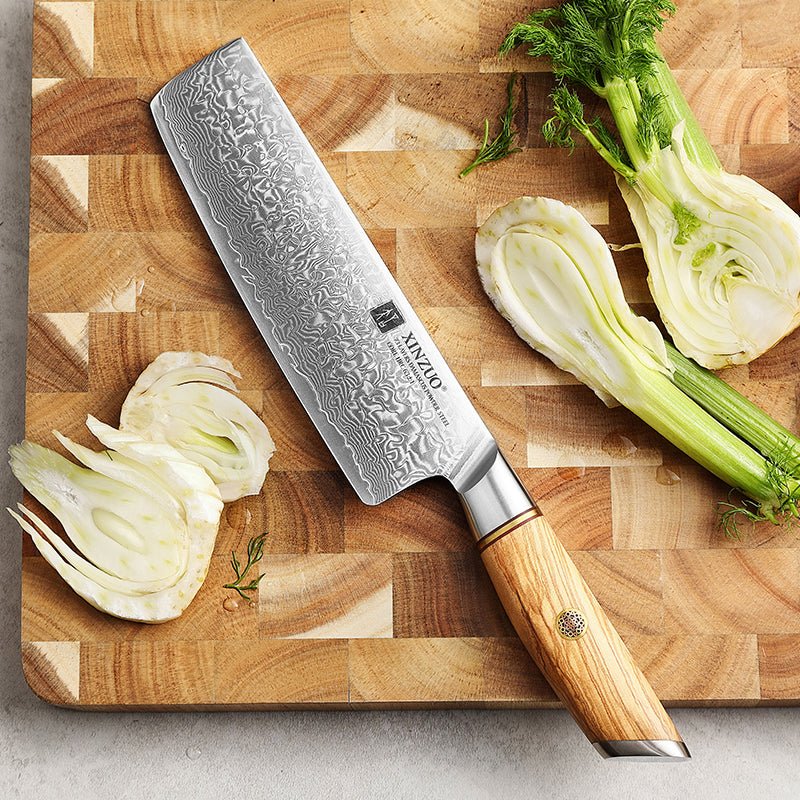
The nakiri exists for one reason: vegetables. The name literally translates to "leaf cutter," and every design decision in this blade serves that purpose.
Three features define it. The cutting edge is completely flat from heel to tip. The blade is tall, usually 45-55mm from spine to edge. And there's no pointed tip, just a squared-off or gently rounded end.
That flat edge is the key feature. When you push the blade straight down, the entire edge contacts the cutting board simultaneously. There's no rocking motion, no forward-and-back draw, no partial contact. The cut happens all at once, cleanly, across the full width of whatever you're slicing.
For high-volume prep, this translates into speed. You can tap-chop through a pile of spring onions or shred half a cabbage with a rapid up-and-down motion that feels almost mechanical. Each stroke is a complete cut. No need to finish the cut with a forward push like you would with a curved blade.
The honest trade-off: a nakiri can't do detail work that requires a pointed tip. No scoring, no piercing, no trimming around the eye of a potato. And the flat edge means rocking cuts are physically impossible. If you're mincing garlic by rocking a blade back and forth, the nakiri is not the tool for that technique.
Where the nakiri genuinely outperforms everything else: slicing cucumbers, julienning carrots and daikon, dicing onions with push cuts, breaking down bok choy and Asian greens, chiffonading herbs, and any task where uniform thickness across the full cut width matters.
Can You Use a Chef Knife or Gyuto for Vegetables?
A 200-210mm chef knife or gyuto is probably what you're already using for vegetables, and it's not a bad choice. The curved belly allows rocking cuts, which are efficient for mincing herbs, garlic, and anything that needs to be reduced to a fine consistency.
The gyuto (the Japanese equivalent of a Western chef knife, but typically thinner and lighter) has enough curve to rock effectively while being thin enough to make clean push cuts when needed. It's a compromise blade, intentionally designed to do many things well rather than one thing perfectly.
For vegetables specifically, the chef knife and gyuto shine when you need to switch between tasks quickly. Breaking down a butternut pumpkin with the heel, slicing onions with the belly, mincing parsley with a rapid rock, and using the tip to remove pepper seeds. All with the same blade, no switching required.
The limitation is precision. The curved edge means that during a push cut, only part of the blade contacts the board at any given moment. The cut sweeps rather than drops. For thin, uniform slicing (think translucent-thin cucumber rounds or perfectly consistent julienne), you're working against the blade's geometry rather than with it.
Is a Santoku Good for Cutting Vegetables?
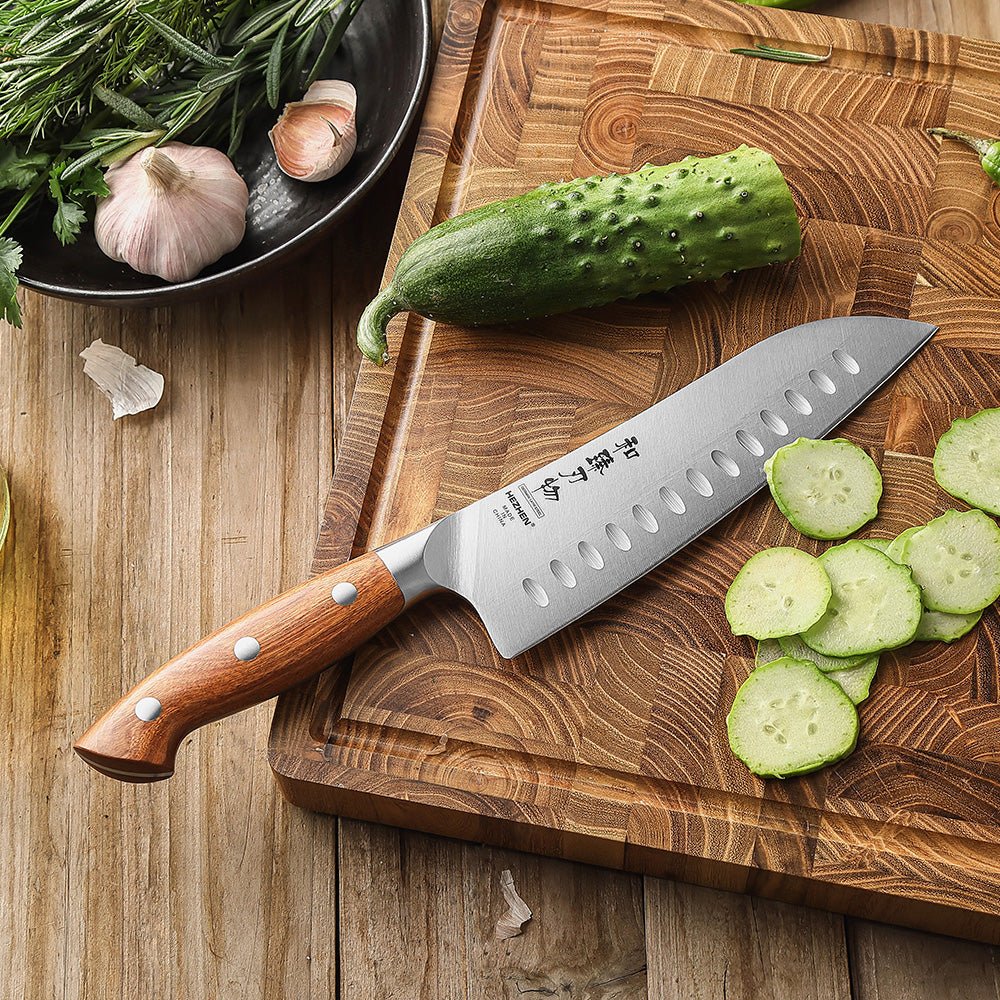
The santoku occupies the middle ground between a nakiri and a gyuto, and for many home cooks, it's the single best vegetable knife precisely because of that positioning.
The name means "three virtues," traditionally referring to slicing, dicing, and mincing. At 165-180mm, it's shorter than a chef knife. The blade profile is flatter than a gyuto but not completely flat like a nakiri. There's a slight curve near the tip that allows some rocking motion, but the flat section near the heel supports clean push cuts.
This matters for home cooks because most home kitchens don't have the board space or the workflow to justify switching between multiple specialty knives. If you're making a stir-fry, you need to slice the protein, dice the vegetables, mince the garlic, and julienne the ginger. The santoku handles all of those tasks without feeling like a compromise on any of them.
The shorter length also helps with control. On a smaller cutting board, a 210mm gyuto can feel unwieldy. The santoku's compact profile gives you more agility in tight spaces, which is exactly where most home vegetable prep happens.
If you can only own one knife for vegetable prep: The santoku is probably your best bet. It won't match the nakiri's speed on high-volume push cuts or the gyuto's efficiency at rocking through herbs, but it handles both techniques competently, and the shorter blade makes it more manoeuvrable for the varied, task-switching nature of home cooking.
Is a Chinese Cleaver Good for Vegetable Prep?
Most Australians see a Chinese cleaver and think "meat chopper." That's a misunderstanding. The cai dao (literally "vegetable knife") is thin, light, and built for exactly the kind of work this article covers. It's not the same thing as a bone cleaver, which is thick, heavy, and designed for a completely different purpose.
The cai dao's defining feature is surface area. That massive rectangular face is a workstation in itself. Smash garlic cloves flat with the side of the blade. Scoop an entire cutting board's worth of diced vegetables in one pass. Use it as a dough scraper. Transfer a pile of chopped aromatics straight from board to wok.
The cutting profile is very similar to a nakiri: flat edge, tall blade, no pointed tip. Push cuts work beautifully. But the cai dao is longer (typically 200-220mm) and heavier than a nakiri, which gives it more momentum for cutting through dense vegetables like taro, sweet potato, and pumpkin.
The weight takes some adjustment. If you're used to a light Japanese-style knife, the cai dao will feel like a different instrument entirely. But many experienced Chinese home cooks can prep vegetables with a cai dao faster than someone using a nakiri, precisely because the heavier blade does more of the work on each downstroke.
How Do You Match the Right Knife to Each Cutting Technique?
The real question isn't "which knife is best for vegetables." It's "which knife is best for the specific cut I'm making right now." Here's how the main blade shapes match up against common prep tasks.
Notice the pattern: precision cuts favour the nakiri's flat edge, versatile multi-technique work suits the santoku, mincing herbs calls for a curved gyuto, and brute-force tasks belong to the cai dao.
What Edge Angle Is Best for Vegetable Prep?
This is the part that most knife guides skip, but it matters more for vegetable prep than almost any other kitchen task.
The angle at which a blade is sharpened determines how easily it separates plant cells. Most Western knives are sharpened to 20-22 degrees per side. Japanese-style knives typically sit around 12-15 degrees per side. Some high-end Japanese-style blades go as low as 10 degrees.
On meat and fish, the difference between 15 and 20 degrees is noticeable but not dramatic. On vegetables, it's transformative.
Here's why. A vegetable's resistance to cutting comes primarily from the rigid cell walls (made of cellulose) and the turgor pressure inside each cell. A more acute edge angle means less material has to be displaced during the cut. The blade wedges apart the cells with less force, less compression, and less lateral splitting.
The practical difference: Slice a tomato with a knife sharpened at 20 degrees per side and one sharpened at 12 degrees per side. The acute blade will pass through the skin without any downward pressure. The wider angle requires you to push, which compresses the tomato before the cut begins, squishing out juice and seeds.
The same principle applies to every vegetable. Onion layers separate more cleanly. Capsicum skin doesn't resist the initial bite. Carrot sticks have smooth faces instead of splintered fibres.
The trade-off is durability. A 12-degree edge is more fragile than a 20-degree edge. It will chip if you hit a bone, a frozen ingredient, or a hard cutting board. But for pure vegetable work, the more acute angle is better in every measurable way: less effort, cleaner cuts, less cellular damage, and longer-lasting freshness on the cut surfaces.
This is one reason Japanese-style knives like the nakiri and santoku are so well-suited to vegetable prep. They're designed from the ground up with these acute edge angles in mind, using harder steel (typically 58-62 HRC) that can hold a thin edge without rolling over.
What Cutting Board Should You Pair with Your Vegetable Knife?
Your cutting board affects your knife's performance on vegetables more than most people realise. A knife is only as good as the surface it lands on.
There are three viable options for vegetable prep, and one you should avoid entirely.
End-grain wood is the ideal surface. The exposed wood fibres flex apart when the blade lands, then close back together. This does two things: it cushions the blade's edge (extending the time between sharpening sessions) and it creates a cleaner cut at the board surface because the fibres absorb the impact rather than resisting it. Acacia, maple, and walnut are all excellent choices.
Edge-grain wood is the next best option. It's more affordable and still kind to your blade, though slightly harder on the edge than end-grain because the fibres run parallel to the cut rather than absorbing it.
Rubber (Hasegawa-style) boards are what most professional Japanese kitchens use. They're self-healing, gentle on edges, and easy to sanitise. Not as beautiful as wood, but functionally superb.
Glass, ceramic, marble, and steel surfaces will destroy any knife's edge within a few cuts. If you're prepping vegetables on a glass board, you're essentially re-dulling your blade every time you use it. No amount of sharpening will compensate for a surface that's harder than your steel.
How Do You Build Your Vegetable Prep Setup?
If you're building a collection specifically for vegetable work, here's how I'd approach it based on cooking style.
For stir-fry and Asian cooking: Start with a nakiri. The push-cut technique matches the prep style perfectly, the tall blade doubles as a scoop, and the flat edge handles everything from slicing spring onions to julienning ginger. Add a cai dao later if you want more weight and surface area.
For general home cooking (Australian/European style): Start with a santoku. The versatility covers 90% of what you'll encounter, from dicing onions for a bolognese to slicing zucchini for a roast tray. The compact size suits standard home kitchens and cutting boards.
For cooks who prep in volume: A nakiri and a gyuto together cover virtually every technique. Use the nakiri for precision slicing and push cuts, switch to the gyuto for rocking through herbs and handling non-vegetable tasks. This is the combination you'll find in most serious home kitchens.
Related Reading
- Nakiri Knife Guide: The Dedicated Vegetable Blade
- Santoku vs Chef Knife: Which One Should You Buy?
- Cleaver Knife Guide: Chinese vs Western
- Knife Techniques: Rock Chop, Push Cut, Pull Slice
- How to Choose a Chef Knife: The Complete Buying Guide
- Japanese-style Knife Types Explained
- Chopping Board Guide: Protect Your Kitchen Knives
- Knife Sharpening Angle Guide
Frequently Asked Questions
What type of knife is best for chopping vegetables?
A nakiri is the best dedicated vegetable knife. Its fully flat edge contacts the board in one stroke, producing clean, uniform cuts with minimal cell damage. A santoku is the best all-rounder if you also need to handle boneless proteins and herbs. For herb mincing specifically, a chef knife or gyuto with a curved belly is faster because the rocking motion works as a fulcrum.
Does knife sharpness really matter for cutting vegetables?
More than for any other food group. A blade sharpened at 12 to 15 degrees per side passes through tomato skin without any downward pressure, while a 20 degree edge requires you to push and compress the tomato before it cuts. Sharper edges also cause less cell damage, which means less browning on cut surfaces and longer shelf life for prepped vegetables.
What is the difference between a santoku and a nakiri for vegetables?
The santoku (165 to 180mm) has a slight curve near the tip that allows some rocking, making it better for mixed tasks like mincing garlic and slicing proteins alongside vegetables. The nakiri has a completely flat edge and taller blade, purpose-built for straight push cuts on produce. If vegetables make up more than half your prep, the nakiri is faster. If you want one knife for everything, pick the santoku.
What cutting board is best for vegetable knives?
Soft end-grain wood (hinoki, maple, or walnut) or rubber. These materials absorb the blade's impact instead of resisting it, which keeps a thin, hard edge sharp for longer. Avoid glass, ceramic, marble, and even bamboo, all of which are hard enough to dull or chip a Japanese-style blade rated above 58 HRC after just a few uses.
Can you use a chef knife for all vegetable prep?
Yes, and most home cooks do. An 8 inch chef knife handles rough chopping, dicing, and rocking through herbs competently. Where it loses to a nakiri or santoku is on precision push cuts, because the curved belly means only part of the edge contacts the board at any point. For translucent-thin cucumber rounds or consistent julienne, a flat-edged knife produces noticeably better results.