

Does It Matter Where Your Knife Steel Was Made?
Walk into any kitchen store and the sales pitch writes itself: Japanese steel is harder, sharper, and better. And if you stopped the conversation there, you'd have a reasonable argument. Japanese-style knives can take a screaming-sharp edge at acute angles that would make a German blade weep. The metallurgy is genuinely impressive.
But "harder" and "better" are two different words for a reason.
I've spent years testing knives across every price point, steel type, and origin story the industry has to offer. What I've found is that the country on the box matters far less than the heat treatment inside the blade, the geometry of the grind, and (most critically) how you actually cook. A poorly heat-treated Japanese-style knife will underperform a well-made Chinese or German one every single time.
So before you spend $300 on a knife because it says "Japan" on the tang, read this first.
The short version: Japanese steel excels at hardness and edge retention. German steel excels at toughness and forgiveness. Neither is objectively better. Your cooking style, cutting technique, and willingness to maintain the knife should drive the decision, not the country of origin.
And some of the best knives on the market today are neither Japanese nor German.
What Does Japanese Knife Steel Actually Do Well?
Credit where it's due. The Japanese knife tradition has produced some genuinely outstanding metallurgy, and understanding why helps you figure out if it's right for you.
Hardness and edge retention. Most Japanese-style knives run between 60-67 HRC on the Rockwell scale. That extra hardness means the steel can hold a thinner, more acute edge for longer. Where a German knife might need touching up every week with regular use, a good Japanese-style blade can go two to three weeks before you notice any real degradation.
Acute edge angles. Because the steel is harder, it can support edge angles down to 10-15 degrees per side without folding over. That translates to less resistance when cutting, cleaner slices through proteins, and paper-thin vegetable cuts that would be physically impossible with a softer blade ground at 20 degrees.
Lighter weight. Japanese-style knives tend to use thinner stock, which means less material pushing through your ingredients. For precision tasks like julienning vegetables or slicing sashimi, that thin profile is a real functional advantage, not just a preference.
Where Does Japanese Steel Fall Short?
Every advantage in metallurgy comes with a trade-off. Hardness and toughness exist on a spectrum, and when you push one up, the other comes down. Physics doesn't negotiate.
Brittleness and chipping. A blade at 63 HRC is hard, yes, but it's also more brittle than one at 57 HRC. Hit a bone, twist the blade while it's wedged in a butternut squash, or let it fall tip-first onto a tile floor, and you're looking at a chipped edge. I've seen $400 Japanese-style gyutos with chips the size of a grain of rice after one encounter with a frozen chicken thigh. Repairing that chip means grinding away significant steel on a whetstone, which takes time and skill.
Maintenance demands. That thin, hard edge needs regular attention on whetstones, not a honing steel. A standard grooved honing rod will micro-chip a hard Japanese-style blade rather than realign it. You need ceramic or leather strops for maintenance, and proper sharpening on Japanese waterstones every few weeks. If the idea of spending 15-20 minutes on sharpening feels like a chore rather than a meditative ritual, that's worth knowing before you buy.
Corrosion risk. Many high-end Japanese-style knives use high-carbon steel or carbon-core laminates that will rust if you look at them wrong. Leave a carbon steel blade wet on the counter for an hour and you'll come back to orange spots. Even stainless Japanese steels like VG-10 or SG2 are less corrosion-resistant than the softer chromium-heavy German alloys.
What Is the Case for German Knife Steel?
German-style knives get dismissed as "beginner knives" by online knife enthusiasts, which is honestly a bit ridiculous. Professional kitchens around the world are full of German-made and German-style blades, and not because the chefs don't know any better.
Toughness. At 56-58 HRC, German steels like X50CrMoV15 are significantly tougher than their Japanese counterparts. You can rock-chop through herbs, break down a chicken, accidentally hit the spine of another knife in the drawer, and the edge bends rather than chips. A few passes on a honing steel and you're back to sharp.
Forgiveness. This is the big one. German knives tolerate bad habits. Not-ideal cutting boards, imperfect technique, aggressive rocking motions, lateral pressure when scooping food off the board with the blade. All the things that would damage a Japanese-style knife are shrugged off by a German one.
Low maintenance. A honing steel before each use and a professional sharpening once or twice a year. That's genuinely all most German knives need. No whetstone collection required. No worrying about which grit to finish on. Straightforward and practical.
Corrosion resistance. The high chromium content in German stainless steels makes them far more forgiving of moisture, acidic foods, and the general chaos of a busy kitchen.
How Do Japanese and German Steels Compare Head to Head?
Why Does Heat Treatment Matter More Than Steel Origin?
Here's where the conversation gets interesting and where most knife forums get it wrong.
Two knives can use the exact same steel composition and perform completely differently based on how they were heat-treated. Heat treatment is the process of heating the steel to a specific temperature, holding it there, then cooling it at a controlled rate (quenching). The temperatures, hold times, and quenching medium determine the final grain structure, which in turn determines hardness, toughness, and edge stability.
A VG-10 blade heat-treated to 61 HRC with a fine, uniform grain structure will outperform a VG-10 blade rushed through heat treatment to hit the same number on the Rockwell tester. The hardness number is just one data point. Grain structure, carbide distribution, and tempering all matter just as much, but you can't print those on a spec sheet.
This is exactly why country of origin is a poor proxy for quality. A Chinese factory with excellent heat treatment protocols, modern vacuum furnaces, and strict quality control will produce a better blade than a Japanese workshop cutting corners on tempering. The steel doesn't know what country it's in.
What Is 10Cr15CoMoV and Why Does It Challenge the Japan vs Germany Debate?
If you've been researching knife steels, you've probably seen 10Cr15CoMoV mentioned alongside VG-10, usually with some skepticism because it's a Chinese-developed alloy. So let me be direct about this.
10Cr15CoMoV and VG-10 are functionally equivalent steels. The chemical compositions are nearly identical: similar carbon content (around 1%), similar chromium (around 15%), both include cobalt, molybdenum, and vanadium. In blind cutting tests, experienced users cannot reliably tell them apart. The edge retention is comparable. The sharpening characteristics are comparable. The corrosion resistance is comparable.
The difference? VG-10 carries the prestige of being Japanese-made by Takefu Special Steel. 10Cr15CoMoV doesn't have that marketing advantage. But if you're choosing a knife based on how it performs rather than how it sounds in a forum post, the steel is the same class of material doing the same job.
Our full comparison of VG-10 vs. 10Cr15CoMoV breaks down the chemistry and real-world testing in detail.
Why Is the Hybrid Steel Approach Winning?
The most interesting trend in the knife world right now isn't happening in Japan or Germany. It's happening in the space between them.
Hybrid knives take Japanese-style blade geometry (thin spines, acute edge angles, hard steel) and pair them with Western-style handles and slightly more forgiving heat treatments. You get 80% of the cutting performance of a traditional Japanese-style knife with significantly more durability and a handle shape that feels natural if you grew up using Western knives.
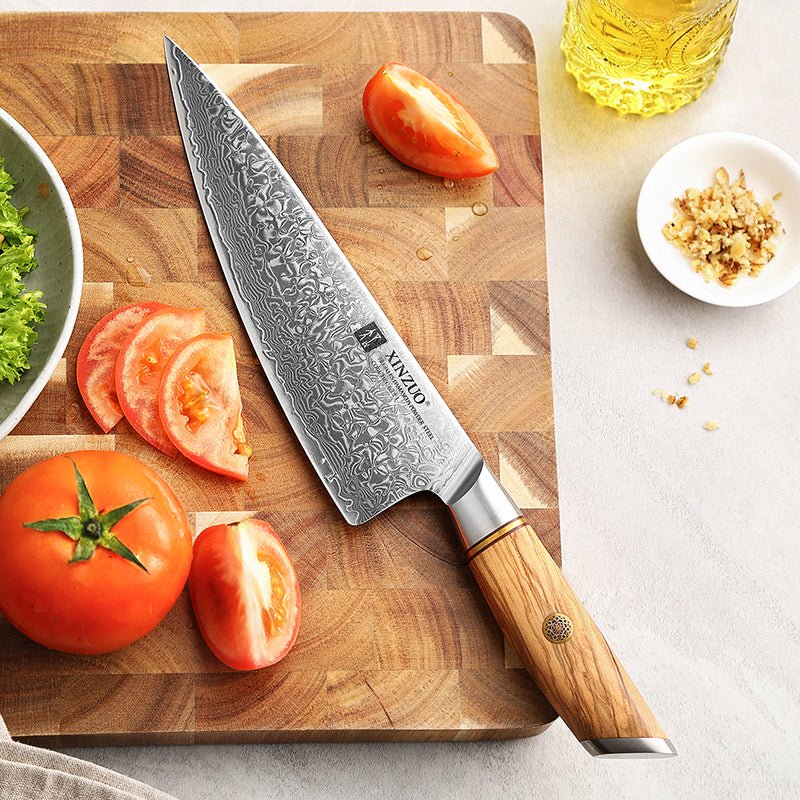
This is the approach Xinzuo takes. Our blades use 10Cr15CoMoV or high-carbon composite steel, heat-treated to 60-62 HRC, with Japanese-influenced thin grinds and edge angles around 12-15 degrees per side. But the handles are ergonomic Western designs in G10 or stabilised wood, and the blades are ground with enough convexity behind the edge to resist chipping during normal kitchen work.
The result is a knife that slices like a Japanese-style blade, survives like a German one, and doesn't require you to rebuild your entire sharpening setup or change how you hold a knife.
Which Knife Steel Should You Choose for Your Cooking Style?
Forget the forum debates. Match the knife to how you actually use it.
You cook mostly vegetables and do a lot of precise knife work. A harder steel with a thin grind will serve you well. You'll notice the difference in how cleanly it moves through an onion versus a thicker, softer blade. Japanese-style geometry is your friend here.
You break down whole chickens, cut through cartilage, or prep a lot of hard root vegetables. You need toughness. A 67 HRC blade hitting a chicken joint is a recipe for chips. Go with something in the 58-62 HRC range with a slightly thicker grind behind the edge.
You're a home cook who wants one great all-purpose knife. A hybrid-style chef's knife in the 60-62 HRC range with a Western handle is the sweet spot. Hard enough to hold a good edge, tough enough to handle the occasional bone or frozen herb cube, and comfortable for long prep sessions.
You hate sharpening and just want something that works. German-style steel or a hybrid with good corrosion resistance. Pair it with a honing rod and get it professionally sharpened twice a year. Done.
You work in a professional kitchen with high volume. You need corrosion resistance (because the knife will get wet and stay wet), chip resistance (because you're moving fast), and easy maintenance (because you're sharpening at the end of a 12-hour shift, not as a weekend hobby). Softer steels or well-tempered hybrids make the most sense.
You want the absolute sharpest edge possible and enjoy the maintenance process. Go full Japanese. Get a single-bevel yanagiba or a carbon steel gyuto, invest in a stone set, and enjoy the ritual. Just know what you're signing up for.
What Do Steel Specs Not Tell You About Real-World Maintenance?
Steel specs on paper and steel performance in your kitchen are two different conversations. Here's what the daily reality looks like for each category.
Japanese carbon steel (White #2, Blue #2): Wipe the blade dry after every single cut if you're working with acidic ingredients like tomatoes or citrus. Develop a patina intentionally or fight rust constantly. Sharpen on waterstones every 1-2 weeks with regular use. Store in a saya (wooden sheath) or on a magnetic strip, never in a drawer loose.
Japanese stainless (VG-10, SG2/R2): More forgiving on moisture, but still not dishwasher-safe. Hone on a ceramic rod between sharpening sessions. Full whetstone sharpening every 2-4 weeks depending on use. These steels can be slightly tricky to sharpen because the hard carbides resist abrasion.
German stainless (X50CrMoV15): Hone on a steel rod before each use session. Professional sharpening or a pull-through sharpener every few months. Rinse and dry after use, but a few minutes of moisture won't cause problems. These are the lowest-maintenance knives you can own.
Hybrid stainless (10Cr15CoMoV at 60-62 HRC): Similar to Japanese stainless in terms of sharpening interval, but more tolerant of minor abuse. A ceramic honing rod extends the time between full sharpenings. Hand-wash and dry, store properly, and you'll get excellent longevity without the anxiety that comes with managing carbon steel.
Should You Shop by Country or by Steel Specs?
The knife industry has trained consumers to think in terms of Japanese vs. German, as if those are the only two options and one must be better. That framing made sense 30 years ago when Japanese and German manufacturers dominated the market and used distinctly different approaches.
Today, excellent knives come from China, Japan, Germany, France, and a dozen other countries. The meaningful differences are in the steel composition, heat treatment quality, blade geometry, and handle ergonomics. Those are the specs that determine how a knife performs in your hand, on your cutting board, with your ingredients.
A $150 knife with 10Cr15CoMoV steel, proper heat treatment to 62 HRC, a thin convex grind, and a comfortable handle will outcut a $300 knife with a famous name and mediocre heat treatment. Every time.
Buy the knife. Not the flag.
Related Reading
- German vs. Japanese-style Kitchen Knives: Full Comparison
- Knife Steel Hardness Guide: HRC Explained
- VG-10 vs. 10Cr15CoMoV: Steel Comparison
- The Truth About Chinese Kitchen Knives
- Carbon Steel Knife Guide
- How to Choose a Chef Knife: The Complete Buying Guide
- Xinzuo Knives Review and Brand Guide
- Knife Care and Daily Maintenance Guide
Frequently Asked Questions
Is Japanese-style knife steel better than Chinese knife steel?
Not automatically. The steel itself does not know what country it was made in. A Chinese factory with modern vacuum furnaces and strict quality control can produce blades equal to or better than a Japanese workshop cutting corners on heat treatment. Steels like 10Cr15CoMoV (Chinese) and VG-10 (Japanese) share near-identical compositions and perform the same at 60 to 62 HRC. What matters is heat treatment quality, blade geometry, and carbide distribution, not country of origin.
Why do Japanese-style knives chip more easily than German knives?
Hardness and brittleness are linked. Japanese-style knives run 60 to 67 HRC, while German knives sit at 54 to 58 HRC. That extra hardness lets Japanese-style blades hold a thinner edge for longer, but it also means the steel flexes less before it fractures. Hit a bone, twist the blade in a pumpkin, or drop it on a tile floor, and a 63 HRC blade will chip where a 57 HRC blade would just bend.
Does heat treatment matter more than the steel type in a knife?
Heat treatment has an enormous effect on performance. Two knives using the same VG-10 steel can perform completely differently depending on furnace temperatures, hold times, quenching medium, and tempering cycles. Controlled vacuum furnace heat treatment produces toughness values three to four times higher than poorly managed processes at the same Rockwell number. A well-treated budget steel will outcut a poorly treated premium one.
Are Chinese-made knives with Japanese-style steel any good?
The best ones are. Brands manufacturing in Yangjiang with in-house heat treatment, vacuum furnaces, and quality control produce knives using 10Cr15CoMoV or VG-10 equivalent steel that match Japanese-made blades in blind cutting tests. The risk is with uncertified factories that skip proper tempering or use non-water-cooled grinding stones that overheat the edge. Look for a stated HRC rating, a named steel grade, and food-safety certifications like LFGB or FDA.
Should I buy a Japanese-style knife or a German knife for everyday cooking?
Match the knife to your cooking style. If you do a lot of precision vegetable prep and are willing to use a whetstone every few weeks, a Japanese-style blade at 60 to 62 HRC will reward you with cleaner cuts and longer edge life. If you regularly break down bone-in poultry, rock-chop through herbs aggressively, or want a knife that tolerates occasional abuse, a German-style blade at 56 to 58 HRC is more forgiving and needs only a honing steel to maintain.