

Why Aren't Price and Quality Linear in Kitchen Knives?
I've tested a lot of kitchen knives over the years, from $15 supermarket specials to $500 Japanese single-bevels, and one thing I can tell you with absolute confidence: spending twice as much does not get you a knife that's twice as good. The relationship between price and performance in kitchen knives is deeply nonlinear, and understanding where the real breakpoints are will save you money and get you a better knife.
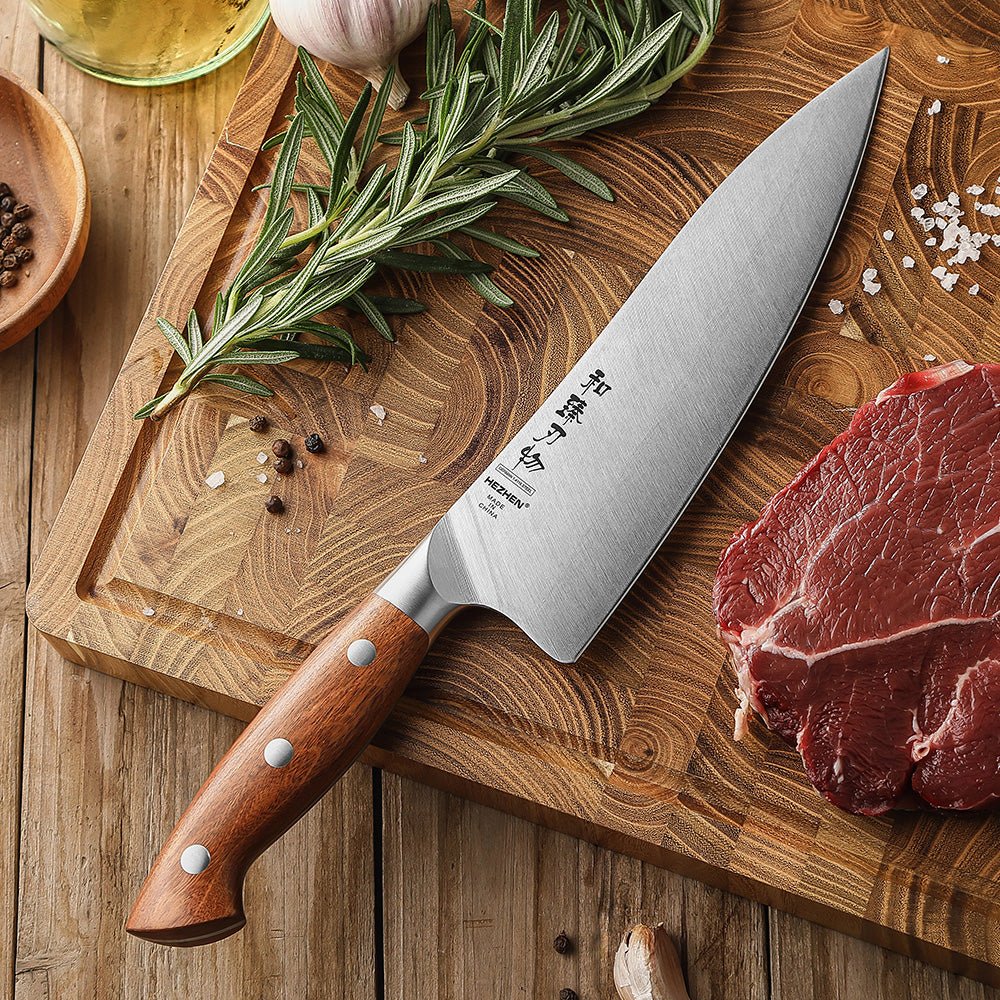
A $50 knife isn't four times worse than a $200 knife. In fact, a well-made $50 knife will handle 90% of home cooking tasks perfectly well. But there ARE specific price points where meaningful things change: steel composition, heat treatment precision, edge geometry, handle ergonomics, and the number of Damascus layers (which affects both aesthetics and blade flexibility). Those jumps matter. The stuff in between? Often just marketing.
The quick version: Under $80 gets you a solid everyday knife. $100-$150 is where Damascus chef knives and premium handles enter the picture. $150-$200 buys genuinely premium single knives. Above $200, you're looking at sets that equip an entire kitchen. Some of the best value per knife sits in the $229-$289 range for 3-piece sets.
I'm going to walk through every price tier using XINZUO's current range as the reference point, because they hit every one of these breakpoints with specific series. No filler models, no confusing sub-brands. Just clear jumps in materials and construction at each level.
Which Kitchen Knives Are Best Under $50?
At this price, you need to be realistic about what you're getting. No knife under $50 is going to have powdered steel, 67-layer Damascus cladding, or a hand-finished ebony handle. And that's fine. What you should expect is a blade made from decent composite or stainless steel that takes a reasonable edge, holds it for a few weeks of regular use, and feels comfortable enough that you actually want to pick it up.
XINZUO's Supreme Series paring knives and utility knives sit in this range, at $45.95. The steel is German 1.4116 stainless that won't chip if you accidentally twist it against a bone or hit the cutting board at an angle. The handles are red wood with stainless steel rivets, comfortable and secure in the hand. These are honest knives. They do what they're supposed to do without pretending to be something they're not.
Who should buy here: If you cook a few times a week and you need a paring knife or utility knife that works reliably, this is the right tier. Don't feel bad about spending $45 on a knife. A good paring knife at this price will outperform a $30 "chef knife" from a department store every single time, because the geometry is right for the tasks you'll use it for.
The realistic limitation at this price is edge retention. You'll need to hone more frequently (every 2-3 uses) and sharpen on a whetstone every couple of months with regular use. The steel is softer, around 56-58 HRC, which means it's also more forgiving. It won't chip. It won't snap. It will just gradually dull, which is honestly the failure mode you want in a kitchen knife.
What Can You Get for $50 to $100?
This is the range where I think most people should start if they're buying their first real kitchen knife. Our best starter knives collection is curated for exactly this situation. You get noticeably better steel, better edge retention, and in XINZUO's case, you get access to both the larger Supreme Series knives (chef knives and santoku knives at $59.95 to $65.95) and the Retro Series (from $65.95).
The Retro Series chef knife at $89.95 is a genuinely capable daily driver. The blade is 8.5 inches, the profile is a gentle curve that works for both rock-chopping and push-cutting, and the balance point sits right at the bolster. For someone who wants one good knife to do everything, this is a strong starting point.
The Retro Series knives represent a different class of knife entirely. The steel jumps to a three-layer 10Cr15CoMoV core (a high-chromium, cobalt, molybdenum, and vanadium alloy), hardened to 60-62 HRC. That's a meaningful jump. At 60 HRC, the steel takes a finer edge and holds it roughly 2-3 times longer than the German stainless in the Supreme Series.
Why Is $100 to $150 Where the Real Quality Jump Happens?
If there's one breakpoint in this entire guide that matters most, it's this one. At the $100-$150 range, you cross into Damascus steel territory, and the difference is not just cosmetic.
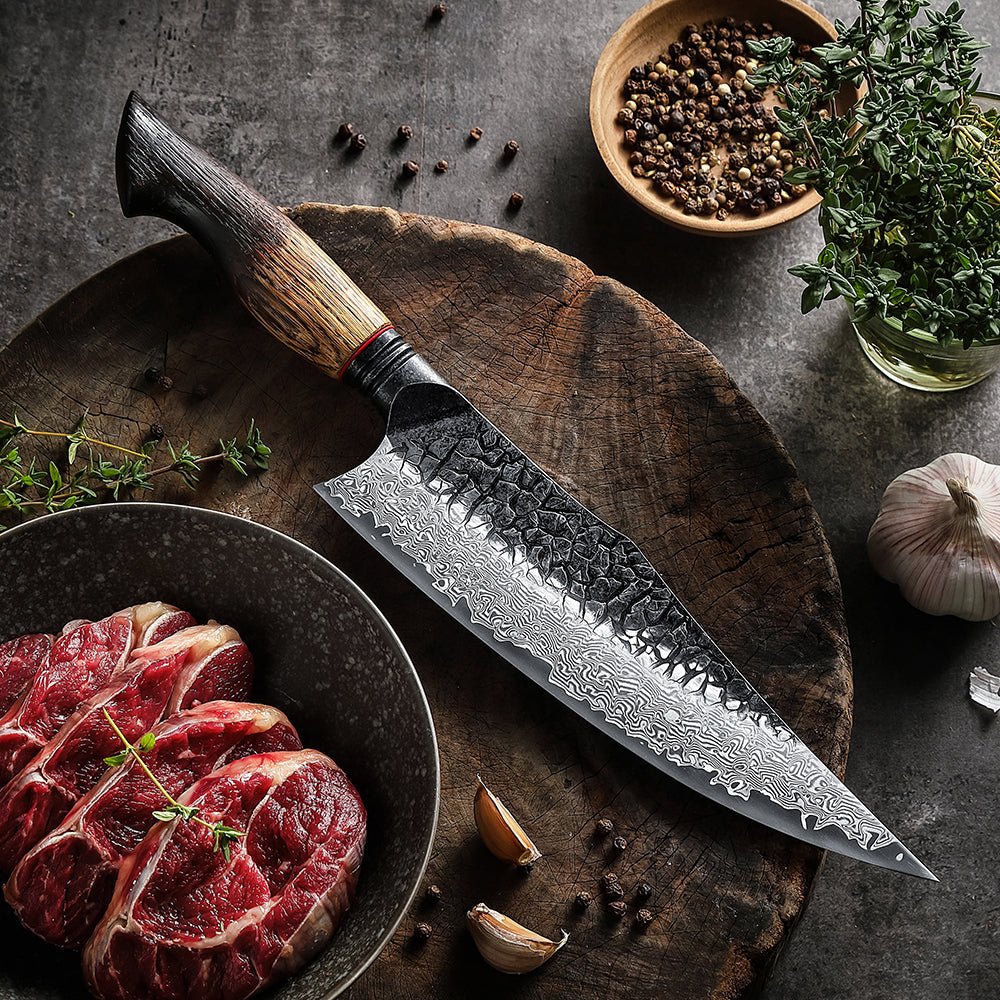
The Mo Series 8.5" chef knife lives in this range ($145.95), and it's built around a 10Cr15CoMoV core clad in 67 layers of Damascus steel. That layered construction does two things. First, it creates the distinctive wave pattern that makes Damascus knives so visually striking. Second, and more importantly for performance, the alternating layers of hard and soft steel give the blade a combination of edge hardness and lateral flexibility that a mono-steel blade can't achieve. The hard core holds the edge. The softer outer layers absorb shock and resist chipping.
The handle is burnt oak with a red G10 accent, hand-shaped for a comfortable, secure grip.
What $145 gets you that $65 doesn't: Damascus steel construction (67 layers), a harder core steel (60+ HRC vs 56-58 HRC), thinner blade geometry for less cutting resistance, and roughly 3x the edge retention between sharpenings.
The Mo Series paring and utility knives sit just below this range at $85.95, with the same 10Cr15CoMoV core and 67-layer Damascus cladding as the chef knife.
Which Premium Knives Are Best Between $150 and $200?
At this level, you're buying knives that a professional cook would be happy to use on the line. The Mo Series 10" chef knife and the Lan Series 8.5" chef knife (both $169.95) sit here, and they represent two distinct philosophies of what a premium kitchen knife should be.
The Mo Series is the classic choice. Burnt oak handles, 67-layer Damascus, and blade profiles that lean slightly toward Western geometry. The 8.5" chef knife has a belly curve that's comfortable for rock-chopping, with enough flat section near the heel for push-cutting herbs and scallions. It's a knife that doesn't force you to change your technique.
The Lan Series goes a different direction. It uses 73-layer Damascus steel (six more layers than the Mo) over a 14Cr14MoVNb powder-steel core at 62-64 HRC, and pairs it with polished olive wood handles. The extra layers create a finer, more intricate Damascus pattern, and the slightly different layer composition gives the blade a touch more flexibility. The Lan also tends toward more traditionally Japanese-style blade profiles, with flatter edges and more acute cutting angles.
Mo vs Lan, honestly: The performance difference is minimal. Both use premium core steels, both have Damascus cladding, and both are hardened to similar Rockwell values. Choose the Mo if you want a warmer, more traditional look with burnt oak. Choose the Lan if you prefer more Japanese aesthetics and a slightly lighter blade. Neither choice is wrong.
This is also the range where most 2-piece sets sit, typically in the $149-$199 range. A 2-piece set at this price usually pairs a chef knife with a utility or paring knife from the same series, which gives you the two most essential knives in any kitchen at a per-knife cost that's lower than buying them individually.
Why Is $200 to $300 Such Good Value?
I'll say something that might sound counterintuitive: some of the best value in XINZUO's lineup isn't at the cheapest price point. You can see the numbers for yourself in our best sellers. It's here, in the $229-$289 range, where 3-piece sets start.
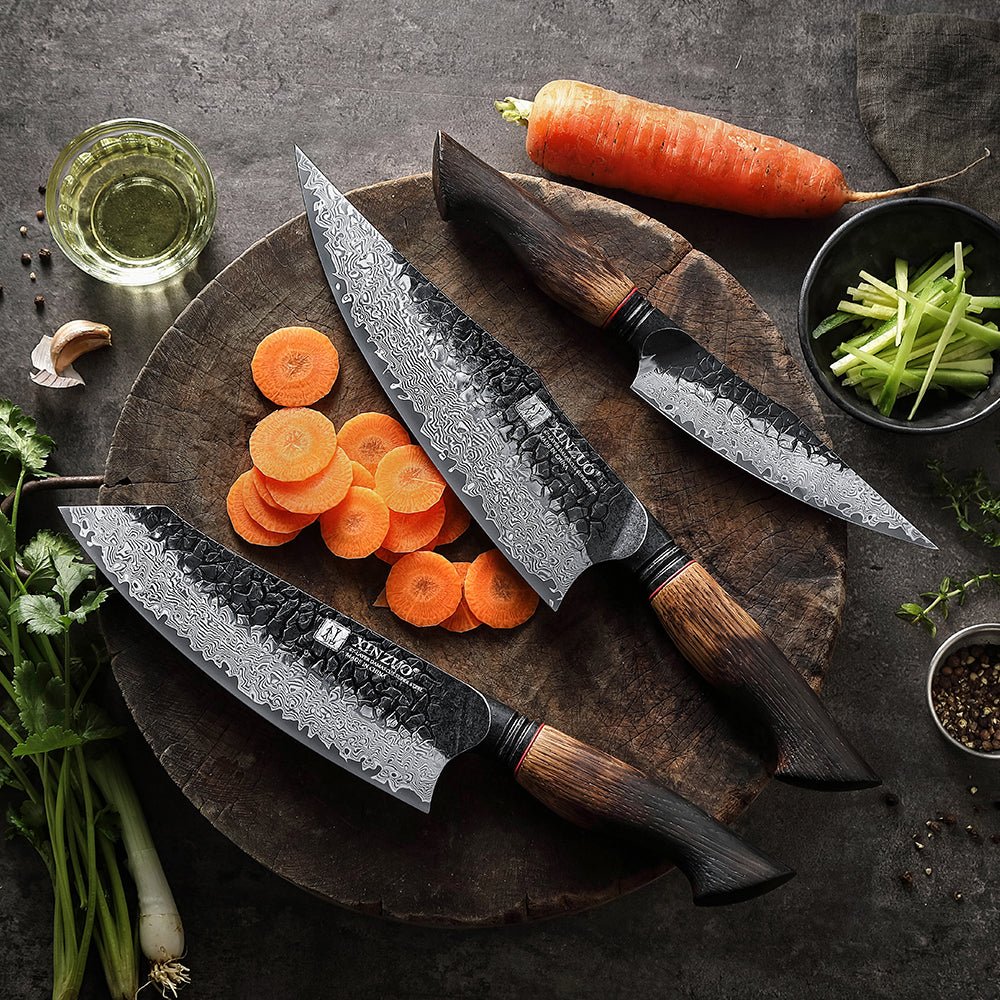
A 3-piece set at this price typically includes a chef knife (8" or 8.5"), a utility knife (5"), and a paring knife (3.5"). That combination covers essentially every cutting task in a home kitchen. The chef knife handles 80% of your work. The utility knife takes care of medium tasks like trimming meat, slicing tomatoes, and cutting sandwiches. The paring knife does detail work: peeling, deveining shrimp, hulling strawberries, and turning garnishes.
When you break down the math, the Elegant Series 3-piece set at $289.95 works out to about $97 per knife. Each of those knives, bought individually from the same series, would cost $85.95-$139.95. You're saving about 18% compared to individual pricing, and you're getting matched knives that share the same steel, handle material, balance philosophy, and aesthetic.
The 3-knife kitchen: Professional chefs will tell you that you can cook virtually anything with three knives: a chef knife, a utility knife, and a paring knife. Everything else (bread knives, cleavers, boning knives) is nice to have but not necessary for 95% of home cooking. A 3-piece set at this price can give you all three in Damascus steel.
What Do You Get for $300 and Above?
Above $300, you're looking at larger sets (5-piece, 7-piece), premium accessory bundles that include magnetic holders or knife rolls, and specialty knives that round out a collection. This is territory for someone who already knows they love cooking and wants a complete, matched set of professional-grade tools.
At this tier, you might be adding a nakiri for vegetable work, a santoku as a secondary all-rounder, a bread knife for weekend baking, or a Chinese cleaver for the sheer versatility of having a large, flat blade. These are knives that make specific tasks easier and more enjoyable, even if they're not strictly essential.
The per-knife value continues to improve in larger sets. The Mo Series 5-piece set at $475.95 works out to about $95 per knife for Damascus steel knives that individually retail for $85.95 to $145.95 each. If you know you want four or more knives, buying a set is almost always the smarter financial move.
A word on building vs buying sets: There's nothing wrong with buying knives one at a time over several months. Start with a chef knife, add a paring knife next, then a utility knife. But if you already know you want the full trio, the set pricing is significantly better. Buy the set now. Buy specialty knives individually later.
What Actually Changes in a Knife As You Spend More?
Not everything that changes between price tiers matters equally for cooking performance. Here's what actually makes a measurable difference when you're cutting food, ranked by how much impact it has.
| Feature | Budget ($45-$75) | Mid ($65-$145) | Premium ($145-$200+) |
|---|---|---|---|
| Core Steel | German stainless | 10Cr15CoMoV | 10Cr15CoMoV or 14Cr14MoVNb powder |
| Hardness (HRC) | 56-58 | 60+ | 60+ |
| Damascus Layers | None | None (Retro) or 67 layers (Mo) | 67-73 layers |
| Edge Retention | Sharpen every 4-6 weeks | Sharpen every 2-3 months | Sharpen every 2-3 months |
| Handle Material | Red wood | Red wood and buffalo horn / Burnt oak | Burnt oak / Olive wood |
| Blade Geometry | Standard grind | Thinner, refined | Thinner, refined |
Steel type and hardness are the single biggest factors in cutting performance. The jump from 56 HRC to 60+ HRC means the blade can be ground to a more acute angle (typically 12-15 degrees per side instead of 18-20 degrees) and hold that angle under regular use. A more acute edge means less force required to cut, cleaner cuts through proteins, and thinner slices of vegetables. This is the change you'll feel most immediately in your hand.
Damascus cladding matters more than people give it credit for. Yes, the pattern is beautiful. But the functional benefit is real: the alternating hard/soft layers create micro-serrations at the blade surface that reduce food adhesion. If you've ever had potato slices stick to the flat of your knife, you know the frustration. Damascus blades experience this less.
Handle material affects durability and feel but has zero impact on cutting. G10 is the most practical choice. Ebony is the most beautiful. Resin allows the most design variety. All three are comfortable. All three will last for years with normal care. Pick whichever one makes you want to cook.
Where Should You Avoid Wasting Money on Knives?
There are several things the knife industry charges premium prices for that have little or no impact on how well a knife actually cuts food. Being aware of these will help you spend your money on things that matter.
Exotic handle materials beyond a certain point. Stabilised burl wood, mammoth tooth, and carbon fiber handles look incredible. They also don't make the knife cut any better than a well-shaped G10 or ebony handle. If you're buying a knife as a display piece or a gift, absolutely go for the fancy handle. If you're buying a knife to dice onions at 6pm on a Tuesday, save your money and put it toward better steel.
Ultra-high layer counts in Damascus. Some manufacturers offer 200-layer or even 400-layer Damascus. The visual difference between 67-layer and 200-layer Damascus is subtle. The performance difference is essentially zero. The sweet spot for both aesthetics and function sits in the 67-73 layer range, which is exactly where XINZUO's Mo and Lan series land.
Brand names from Western heritage brands. Several well-known German and French knife brands charge $200-$300 for single knives made from basic X50CrMoV15 steel at 56 HRC. That's the same steel as XINZUO's entry-level Supreme Series at $45.95 to $75.95. You're paying for the name engraved on the blade, not for the metallurgy behind it. Look at the specs, not the logo.
Full tang construction as a selling point. Nearly every quality kitchen knife made today is full tang. It's not a premium feature. It's a baseline. If a brand is advertising "full tang" as if it's something special, they're probably trying to distract you from asking about their steel composition and heat treatment.
The smartest way to spend a knife budget: Put 70% of your budget into your chef knife. It's the knife you'll use for 80% of all cutting tasks. A $149 chef knife paired with a $49 paring knife will outperform two $99 knives every day of the week, because the chef knife is where steel quality and blade geometry matter most.
What Is the Quick Knife Recommendation for Each Budget?
| Your Budget | Best Option | What You Get |
|---|---|---|
| $45-$75 | Supreme Series single knife | Reliable daily cutter, German stainless steel |
| $65-$99 | Retro Series single knife | 3-layer 10Cr15CoMoV core, 60+ HRC |
| $145-$169 | Mo or Lan Series chef knife | Premium single knife, burnt oak or olive wood handle |
| $149-$199 | 2-piece set (any series) | Chef + utility or paring, better value than singles |
| $229-$375 | 3-piece set (any series) | Complete kitchen setup, good per-knife value |
| $300+ | 5-piece set or chef knife + accessories | Full collection with specialty knives |
Related Reading
- Best Kitchen Knives Under $200
- How to Choose a Chef Knife: The Complete Buying Guide
- Knife Steel Hardness Guide: What HRC Means for Your Kitchen
- XINZUO Series Comparison Guide
- Kitchen Knife Sets vs Individual Knives: Which Is Better Value?
- German vs Japanese-style Kitchen Knives: What's the Real Difference?
- Real Damascus Steel vs Fake: How to Tell the Difference
- Santoku vs Chef Knife: Which One Should You Buy?
- Knife Care and Daily Maintenance Guide
Frequently Asked Questions
How much should you spend on a good kitchen knife?
Between $80 and $150 AUD for a single chef knife gets you the biggest jump in performance: harder steel (60+ HRC vs 56 to 58 HRC in budget knives), thinner blade geometry, and 2 to 3 times longer edge retention between sharpenings. Below $80 you still get a reliable daily cutter, but the steel is softer and dulls faster. Above $150 per knife the improvements become cosmetic or incremental rather than functional.
Are cheap kitchen knives worth buying?
A well-made knife under $80 AUD handles 90% of home cooking tasks without issue. The trade-off is softer steel (56 to 58 HRC) that needs honing every 2 to 3 uses and sharpening every 4 to 6 weeks. Where cheap knives fail is when manufacturers cut corners on heat treatment and blade geometry rather than just using simpler steel. A $49 paring knife with correct edge angles will outperform a $30 department store chef knife with sloppy grinding.
Is it better to buy a knife set or individual knives?
If you know you want three or more knives, a set usually costs less per knife than buying individually. A 3-piece Damascus set at around $290 AUD works out to roughly $97 per knife for knives that retail at $85.95 to $139.95 each. If you only need one knife right now, buy the best single chef knife your budget allows and add a paring knife later.
Is Damascus steel actually better for kitchen knives?
The layered construction provides a real performance benefit beyond the pattern. A 67-layer Damascus blade pairs a hard cutting core (60+ HRC) with softer outer layers that absorb shock and resist chipping, giving you edge hardness and lateral toughness in one blade. The alternating layers also create micro-serrations at the surface that reduce food sticking to the flat of the blade. Damascus kitchen knives start around $80 AUD, which is where the price-to-performance ratio is strongest.
What three kitchen knives does every home cook need?
An 8-inch chef knife for 80% of all cutting tasks, a 5-inch utility knife for trimming meat and slicing tomatoes, and a 3.5-inch paring knife for peeling, deveining, and detail work. That combination covers virtually everything in a home kitchen. Put most of your budget into the chef knife, since steel quality and blade geometry matter most on the blade you use daily.