


Why Does Your Outdoor BBQ Deserve Better Knives?
I've cooked a lot of barbecue. Hundreds of briskets, countless racks of ribs, more lamb shoulders than I can remember. And for years, I made the same mistake most backyard cooks make: I'd spend hours perfecting the smoke, dialling in temperatures, obsessing over resting times, and then I'd hack into the finished product with whatever knife happened to be sitting in the kitchen drawer.
It's a bit like spending all day making fresh pasta and then serving it on a bin lid. The cooking matters, but so does everything that comes after.
Australian barbecue culture is built around gathering, sharing, and showing off what you've made. Whether it's a weekend brisket low-and-slow session, a Christmas Day lamb leg, or a simple steak night with mates, the knife you pick up at the end determines whether your guests see beautiful, clean slices or a pile of shredded meat. And the knives you use before the cook, during trimming and prep, directly affect how evenly the meat cooks in the first place.
So let's talk about what actually belongs in a barbecue knife kit, why each blade earns its spot, and how to keep them in good shape when you're cooking outdoors.
| Knife | Blade Length | Primary BBQ Use |
|---|---|---|
| Brisket/Carving Slicer | 10-12" | Slicing brisket, roasts, large cuts |
| Chef Knife | 8-10" | General prep, chopping, dicing |
| Boning Knife | 5.5-6" | Trimming fat, removing silverskin |
| Carving Knife + Fork | 8-10" | Tableside presentation, serving |
| Utility Knife | 5-6" | Small tasks, trimming, portioning |
Why Is a Brisket Slicer Your Most Important BBQ Knife?
If you only buy one knife specifically for barbecue, make it a long slicing knife. A 10 to 12 inch blade, narrow profile, with either a straight or slightly scalloped edge. This is the knife that turns a whole brisket into those picture-perfect slices that hold together when you pick them up.
The physics here are simple. A longer blade lets you slice through a wide piece of meat in a single, smooth pull rather than sawing back and forth. Every time you saw, you're tearing muscle fibres and squeezing out moisture. A single clean stroke preserves the texture and keeps the juices where they belong: in the meat, not on the cutting board.
I've tested this side by side more times than is probably reasonable. Take the same brisket flat, slice half with a 10-inch slicer and half with a standard 8-inch chef knife, and the difference is visible. The slicer produces even, uniform slices that look like they came from a competition tent. The chef knife produces slices that are thicker on one end, thinner on the other, with torn edges where you had to change direction mid-cut.
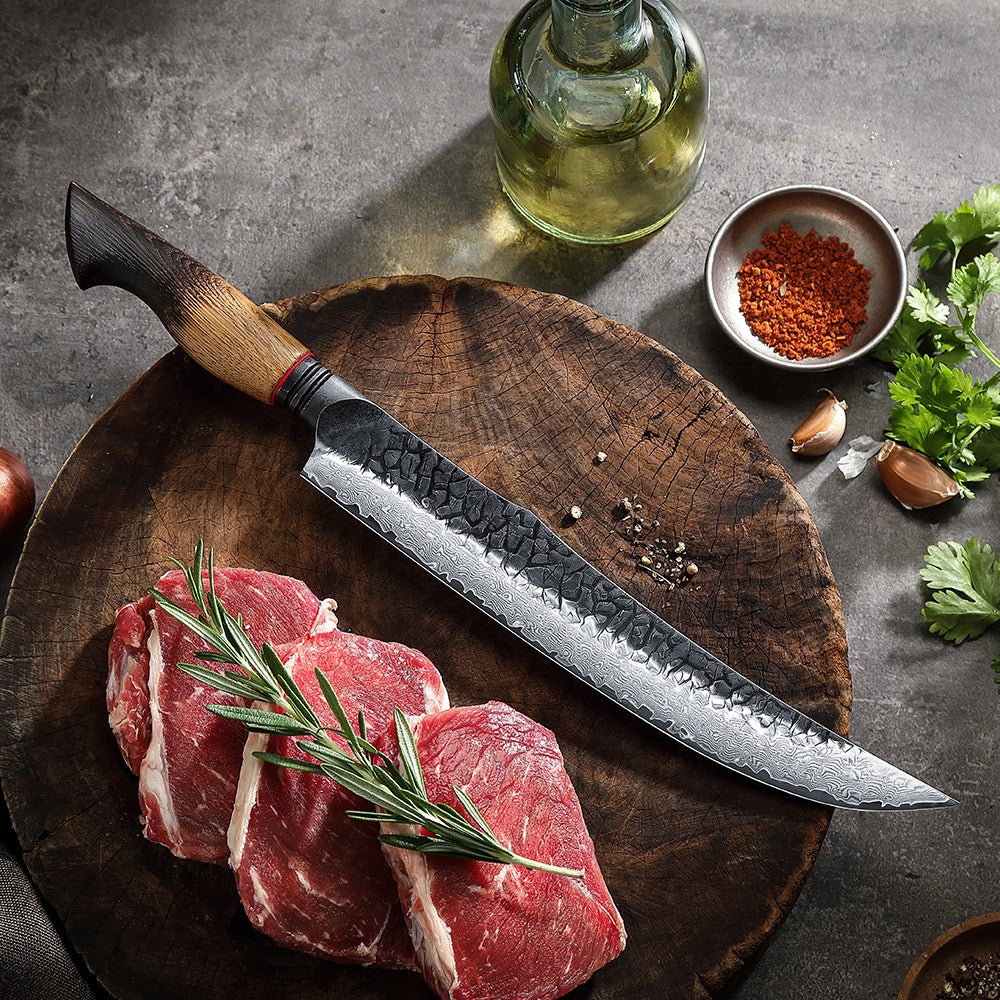
For brisket specifically, you want a blade with minimal flex. Some slicers are designed for salmon and have quite a bit of bend to them, which is the opposite of what you need when cutting through a bark-crusted piece of beef. Look for a carving or slicing knife with a relatively rigid blade and a pointed tip that lets you control exactly where each slice starts.
Why Is a Chef Knife Essential for BBQ Prep?
Before anything hits the grill or smoker, there's prep work. Dicing onions for a barbecue sauce. Mincing garlic for a marinade. Chopping herbs for chimichurri. Cutting vegetables for the inevitable side salad someone requested. Breaking down a whole chicken into pieces for the kettle.
This is where your chef knife earns its keep. An 8 to 10 inch chef knife handles all of this and more. It's the one blade that does a passable job at almost everything, which is exactly what you want when you're cooking outdoors and don't want to haul your entire knife collection to the backyard.
For barbecue prep specifically, I lean towards a slightly heavier chef knife rather than a lighter Japanese-style gyuto. When you're breaking down chicken, trimming pork shoulders, or cutting through ribs (between the bones, not through them), a bit of extra weight behind the blade helps. You're not doing delicate brunoise here. You're doing the kind of rough prep where a blade with some heft feels right.
That said, sharpness matters more than weight. A razor-sharp 180mm gyuto will outperform a dull 250mm Western chef knife every time. Keep whatever you choose properly sharpened, and it'll handle barbecue prep without complaint.
Why Does Great BBQ Start with a Good Boning Knife?
Most people skip this one, and it shows in their results.
The trimming stage, the part where you clean up a brisket before it goes on the smoker, directly affects how the finished product turns out. Uneven fat caps cook unevenly. Silverskin that hasn't been removed creates chewy, unpleasant patches. Hard pieces of fat that won't render properly leave greasy, waxy pockets in the meat.
A boning knife, with its narrow, curved blade and sharp tip, is designed specifically for this kind of work. The thin blade follows the contours of the meat, letting you remove fat and membrane precisely without taking too much of the good stuff with it. Try trimming a brisket with a chef knife and you'll end up removing chunks of perfectly good meat along with the fat, simply because the wide blade can't navigate tight spaces.
Beyond brisket, a boning knife is what you reach for when you're breaking down a lamb leg, removing the bone from a pork shoulder for faster cooking, or cleaning up ribs by removing the membrane from the back of the rack. If you do any kind of whole-animal or primal-cut barbecue, a boning knife isn't optional. It's the tool that makes everything else go smoothly.
Why Do You Need a Carving Knife and Fork for BBQ?
There's a moment at every barbecue that separates the people who take it seriously from those who don't. It's the moment when the meat comes off the smoker or grill, hits the cutting board, and gets sliced in front of everyone.
A proper carving knife and fork set turns that moment into something worth watching. The fork holds the meat steady while you make clean, even slices with the carving knife. It looks professional because it is professional. This is how meat has been carved tableside in restaurants for centuries, and the technique works just as well on a back deck in Brisbane as it does in a French dining room.
The carving knife differs from a brisket slicer in a few ways. It's typically a bit shorter (8 to 10 inches rather than 10 to 12), with a wider blade that provides more surface area for guiding slices. Some have a granton edge (those little scalloped divots along the side) that help prevent sliced meat from sticking to the blade.
For a Christmas ham, Sunday roast lamb, or a beautifully smoked turkey, a carving set is worth having. And honestly, there's something deeply satisfying about carving meat properly with good tools. It connects you to a tradition that goes back a long way.
Why Is the Utility Knife an Underrated BBQ Multitasker?
A utility knife sits between a chef knife and a paring knife, usually around 5 to 6 inches. It's the knife you reach for when the chef knife feels too big and the paring knife feels too small. At a barbecue, that happens more often than you'd think.
Slicing sausages to check if they're done. Cutting limes for drinks. Portioning a piece of cooked meat that doesn't warrant bringing out the big slicer. Trimming the ends off corn cobs. Slicing bread rolls. Opening packaging (we've all done it). A utility knife handles all these small jobs quickly and without fuss.
It's also the knife I'd hand to a guest who offers to help with prep. It's small enough to be non-intimidating, sharp enough to be useful, and versatile enough to handle whatever task you point them toward. Every barbecue knife kit should have one.
How Do You Protect Your Knives When Cooking Outdoors?
Here's where outdoor cooking creates problems that kitchen cooking doesn't. Inside, your knives live in a block or on a magnetic strip. They go from the block to the cutting board and back. Outdoors, knives end up on folding tables, balanced on the edge of the smoker, tossed into bins with tongs and spatulas, or left sitting in the sun.
All of these things are bad for your knives. Every nick, scratch, and ding from metal-on-metal contact dulls the edge faster than actual cutting does. Direct sunlight heats up handles and can dry out wood. Humidity and meat juices left on the blade accelerate corrosion, even on stainless steel.
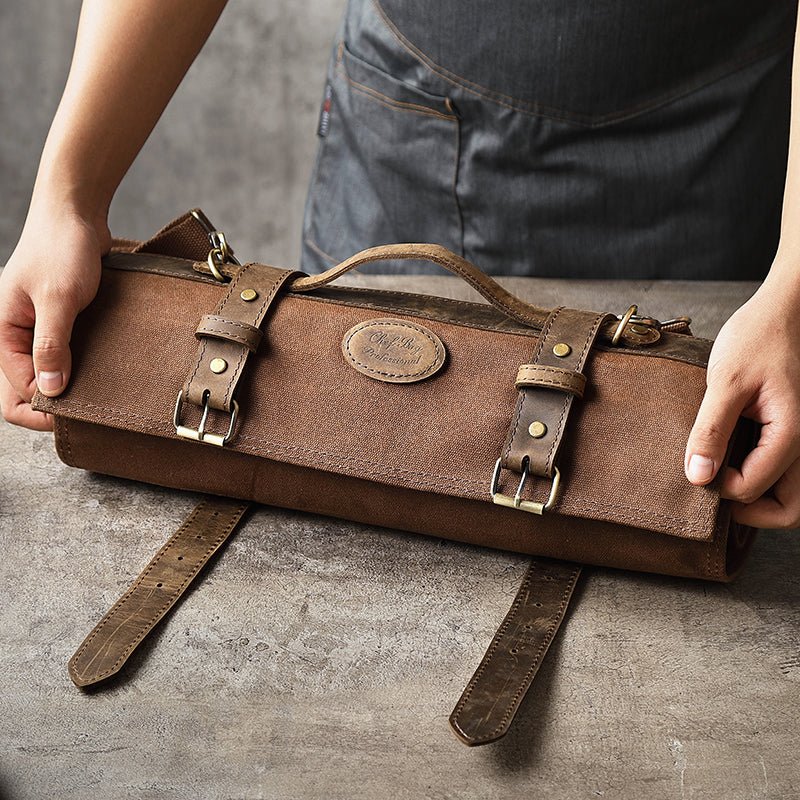
A quality knife roll solves most of these problems. It gives each blade its own pocket, keeps everything organized and protected during transport, and unrolls into a tidy setup at your cooking station. Leather rolls last for years and develop a nice patina over time. Canvas rolls are lighter and easier to wash.
Individual blade guards are the other option. They're cheaper, take up less space, and work well if you only bring two or three knives outside. Look for guards with felt or fabric lining rather than hard plastic, which can scratch the blade face over time.
What Steel Considerations Matter for Outdoor Cooking?
Not all knife steels behave the same way in outdoor conditions, and this is worth thinking about before you invest in a barbecue knife set.
High-carbon steel takes an incredible edge and is easy to sharpen, but it's reactive. It will rust if left wet, stain from acidic foods (like the vinegar in your barbecue sauce), and develop a patina over time. Beautiful steel for a controlled kitchen environment. Less ideal when you're juggling twelve things at once outdoors and might not wipe the blade down immediately.
Stainless steel resists corrosion much better, but cheaper stainless steels don't hold an edge well and can feel dull after a single brisket trim. You end up sharpening constantly, which is annoying when you should be tending the fire.
High-carbon stainless steel splits the difference nicely. Steels like VG-10, SG2, and similar alloys combine good edge retention with meaningful corrosion resistance. They'll still stain if you abuse them, but they'll survive the kind of occasional neglect that happens at a barbecue without pitting or rusting.
Damascus steel refers to the layered construction rather than the core steel itself. A Damascus knife with a VG-10 core, for example, gets the edge performance of VG-10 with the added benefit of the layered structure distributing stress across the blade. The visual pattern is a bonus. For outdoor cooking, what matters is the core steel's properties, so check what's at the centre of the Damascus layers.
| Steel Type | Edge Retention | Corrosion Resistance | BBQ Suitability |
|---|---|---|---|
| High-Carbon | Excellent | Low | Risky outdoors |
| Budget Stainless | Low | High | Frequent sharpening needed |
| VG-10 / SG2 | Very Good | Good | Ideal balance |
| Damascus (VG-10 core) | Very Good | Good | Best all-round choice |
How Do You Build a Complete BBQ Knife Kit with Xinzuo?
The XINZUO range includes several knives that are specifically well-suited to outdoor cooking, all built with high-carbon stainless Damascus steel and ergonomic handles designed for extended use.
For slicing, the XINZUO carving knife range includes 10-inch blades with the length and rigidity you need for clean brisket slices. The 67-layer Damascus construction with a VG-10 core provides the edge retention to get through an entire brisket without touching a honing rod, while the stainless composition handles outdoor conditions well.
For prep work and trimming, the BBQ knife collection brings together the blades most commonly needed at the grill or smoker. Rather than buying individual knives and hoping they work well together, the collection is curated for the specific tasks barbecue demands.
For transport and protection, the XINZUO leather knife rolls are built from genuine leather with individual pockets for each blade. They look good, they protect your investment, and they make it easy to grab your kit and head outside without hunting through kitchen drawers.
Ready to upgrade your outdoor cooking setup?
Browse the full range of barbecue-ready knives, carving sets, and accessories.
Shop BBQ Knives Browse Knife RollsWhat Else Should You Know About BBQ Knives?
Cutting boards matter outdoors too. A thick end-grain board won't slide around on an uneven table the way a thin plastic board will. It also absorbs impact better, which saves your edge. If you're buying one specifically for barbecue, go big. A 50x35cm board gives you enough room to slice a whole brisket without pieces falling off the edge.
Bring a honing rod. Even the best steel will start to feel slightly less keen after extended use, and a few passes on a ceramic or diamond honing rod between tasks keeps the edge aligned without requiring a full sharpening session. It takes ten seconds and makes a noticeable difference.
Don't leave knives near the heat. This sounds obvious, but I've seen people rest their knife on the shelf of a smoker running at 120°C. Heat can affect the temper of the steel, especially thinner blades. Keep your knives on the prep table, not the cooking surface.
Clean before you store. Meat fats solidify as they cool and become much harder to remove once they've set on the blade. A quick wash with warm water and dish soap immediately after use saves you from scrubbing later and keeps the blade in better condition.
Related Reading
If you want to go deeper on any of the topics covered here, these guides have you covered:
- Brisket Knife Guide: Why Blade Length Matters for BBQ
- Steak Carving Knife Buying Guide
- Best Knife for Meat: A Complete Buying Guide
- Carving Knife Guide: How to Choose the Right Blade
- Boning Knife vs Fillet Knife: Which Do You Need?
- Knife Care: Your Daily Maintenance Guide
- How to Choose a Chef Knife: The Complete Buying Guide
- Knife Block Buying Guide: Storage That Protects Your Blades
Frequently Asked Questions
How many knives do you need for BBQ?
Three covers everything, even at competition level: a chef knife (8 to 10 inches) for prep, a boning knife (5.5 to 6 inches) for trimming, and a long slicing knife (10 to 12 inches) for carving. A utility knife is a useful fourth for small jobs like checking sausages or slicing limes, but it is not required.
What type of steel is best for BBQ knives used outdoors?
High-carbon stainless steel rated 58 to 62 HRC, such as VG-10 or 10Cr15CoMoV. These alloys hold a sharp edge through a full brisket trim and resist corrosion from meat juices and humidity. Pure high-carbon steel takes a sharper edge but rusts fast if left wet outdoors. Budget stainless steel resists rust but dulls too quickly for extended butchery sessions.
How do you transport and store knives for outdoor cooking?
A knife roll with individual pockets is the safest option. It protects edges during transport and unrolls into an organised station at your cooking setup. Leather rolls last years and handle outdoor abuse well. If you only bring two or three knives, individual blade guards with felt lining work and take up less space. Never store knives loose alongside tongs and spatulas.
Do you need a brisket slicer if you already own a chef knife?
If you smoke brisket or cook large roasts regularly, yes. A standard 8-inch chef knife is too short to slice a brisket flat in one pass. You end up sawing back and forth, which tears muscle fibres and pushes juice out of the meat. A 10 to 12 inch slicer completes each cut in a single pull stroke, producing cleaner slices with better moisture retention.
Should I use my expensive kitchen knives at a barbecue?
You can, but outdoor conditions are harder on knives than a kitchen. Direct sun heats handles and can dry out wood. Meat juices left on the blade speed up corrosion. Knives get knocked against metal tools on folding tables. If you bring good knives outside, wash and dry them promptly after use, store them in a roll or guards between tasks, and avoid leaving them sitting on metal surfaces.