

How Many Knives Do You Actually Need?
Walk into any kitchen store and you'll see knife blocks stuffed with 12, 15, even 20 pieces. There's a "tomato knife" and a "sandwich knife" and some weird curved thing nobody can identify. It looks impressive on the counter. It also represents a spectacular waste of money.
Here's what I've learned after years of cooking professionally and at home: most of those knives never leave the block. The ones that do get used are the same three or four, over and over, day after day. The rest just collect dust and take up counter space.
So if you're building your first real knife collection, or replacing a cheap set that's falling apart, forget about getting everything at once. Focus on getting a few knives that are actually good. The difference between cooking with a sharp, well-balanced knife and struggling with a dull department store blade is night and day. It changes how you feel about prep work. It makes you faster, safer, and honestly, it makes cooking more fun.
Let's talk about exactly which knives you need, what order to buy them in, and where to put your money.

What Are the Three Essential Kitchen Knives?
If you had to cook every meal for the rest of your life with only three knives, these are the ones you'd pick. Professional chefs might carry a full roll, but when the pressure's on and tickets are flying, they reach for these same three blades 90% of the time.
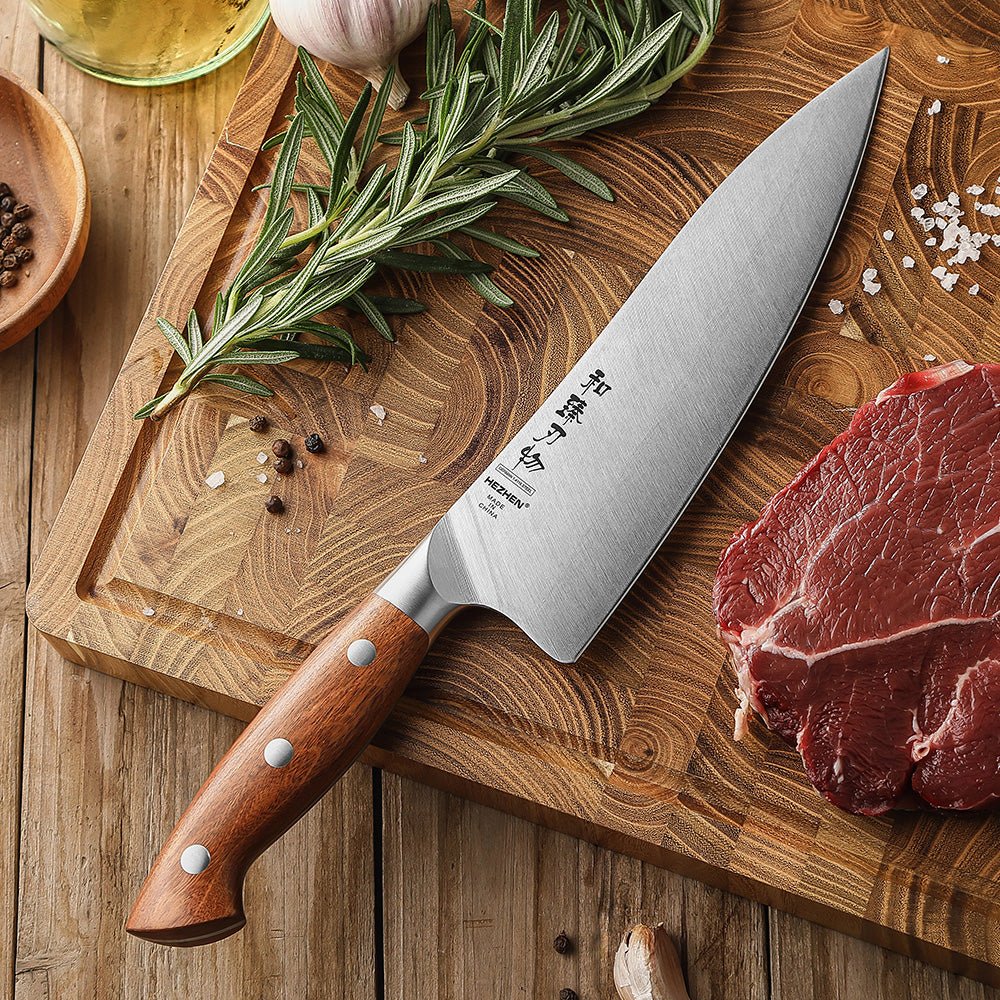
1. The Chef's Knife (20cm / 8 inches)
This is the one. The workhorse. The knife that does 80% of everything in your kitchen. Dicing onions, breaking down a butternut pumpkin, mincing garlic, slicing steak, chopping herbs. If you could only own one knife for the rest of your life, this is it.
An 8-inch (20cm) chef's knife hits the sweet spot for home cooks. It's long enough to handle large vegetables and make clean slicing cuts, but not so long that it feels unwieldy on a regular-sized cutting board. Some people go with 21cm (8.5") or even 24cm (10"), but for most home kitchens, 20cm is the right call.
- Blade length: 20cm (8") for most people. If you have smaller hands, a 18cm (7") works too.
- Steel quality: High-carbon stainless or Damascus steel holds an edge far longer than soft stainless.
- Weight and balance: Pick it up. It should feel like an extension of your hand, not a burden.
- Profile: A gentle curve (Western-style) suits rock-chopping. A flatter profile (Japanese-style) suits push-cutting. Both work. It comes down to your technique.
A good chef's knife should feel natural in your hand within minutes. If you're fighting it, if it feels nose-heavy or handle-heavy or just awkward, it's the wrong knife for you regardless of what any review says. Our complete chef's knife buying guide breaks down all the details if you want to go deeper.
2. The Utility / Petty Knife (12-14cm / 5-5.5 inches)
This is your detail knife. Where the chef's knife handles the big jobs, the utility knife (called a "petty knife" in Japanese knife terminology) handles everything that's too small or too fiddly for a large blade.
Trimming fat from a chicken thigh. Cutting citrus segments. Slicing a shallot when your 8-inch chef knife feels like overkill. Deveining prawns. Hulling strawberries. These are all petty knife tasks.
Think of it as the middle child between your chef's knife and your paring knife. It's small enough for precision work but has enough blade length to actually slice things on a cutting board, which a tiny paring knife can't really do comfortably.
A 13cm (5-inch) blade is the most versatile size. It bridges the gap between your chef's knife and paring knife perfectly. Our petty knife guide covers the differences between Western utility knives and Japanese-style petty knives in detail.
3. The Paring Knife (8-9cm / 3-3.5 inches)
Small, nimble, and designed for in-hand work. A paring knife is what you use when the cutting board isn't involved. Peeling an apple. Deseeding a chilli. Testing whether a potato is cooked through. Trimming the eyes out of a pineapple.
You don't need to spend a fortune on a paring knife. Because the blade is short, steel quality matters less than it does for a chef's knife. The edge doesn't need to hold up through mountains of prep work. That said, a sharp paring knife versus a dull one is still a completely different experience. Even a well-made budget option will outperform the flimsy paring knives that come bundled in cheap block sets.
Get one with a blade around 8-9cm (3-3.5 inches). Any longer and it stops being a paring knife and starts being a bad utility knife. Our paring knife buying guide has more on choosing the right one.
What Is the Best Optional Fourth Knife?
Three knives will handle 95% of your cooking. But if you want to round things out, your fourth knife depends entirely on what you cook most often.
If You Cook a Lot of Vegetables: Nakiri
A nakiri is a Japanese vegetable knife with a flat blade profile and a squared-off tip. It's designed for one thing: chopping vegetables. And it does that one thing absurdly well.
The flat edge makes full contact with the cutting board across the entire length of the blade, which means clean, complete cuts every time. No more half-attached bits of carrot or accordion-cut celery. If your diet leans heavily toward plant-based cooking, stir-fries, salads, and meal prep with lots of vegetables, a nakiri will genuinely change your prep speed.
If You Bake Bread or Buy Crusty Loaves: Bread Knife
A serrated bread knife is the only way to slice through a crusty sourdough or baguette without crushing it flat. The serrations grip the crust and saw through cleanly while the soft interior stays intact. No straight-edged knife can do this, no matter how sharp it is.
Bread knives are also useful for slicing tomatoes (though a sharp chef's knife does this just fine), levelling cakes, and cutting through anything with a hard exterior and soft interior.
What Order Should You Buy Your Knives In?
Don't try to buy everything at once. Build your collection over a few months, starting with the knife that makes the biggest difference.
| Order | Knife | Budget Share | Why This Order |
|---|---|---|---|
| 1st | Chef's Knife (8") | 50-60% | Handles 80% of all kitchen tasks. Biggest single upgrade. |
| 2nd | Utility/Petty (5") | 20-25% | Fills the gap for medium and detail work on the board. |
| 3rd | Paring Knife (3.5") | 10-15% | In-hand work. Less daily use, so you can spend less. |
| 4th (optional) | Nakiri or Bread Knife | Bonus | Specialty pick based on your cooking style. |
The logic here is simple: put the most money into the knife you'll use the most. Your chef's knife will be in your hand for the vast majority of your prep time. A $200 chef's knife paired with a $70 utility knife and a $50 paring knife will outperform a $300 set of mediocre knives every single time.
- Chef's knife: $200-240 (this is where quality matters most)
- Utility/petty knife: $80-100
- Paring knife: $50-70
- Remaining: Put toward a cutting board or whetstone
Check out our best kitchen knives under $200 guide for specific recommendations at every price point.
Should You Buy a Knife Set or Build Your Collection?
This is one of the most common questions people ask, and the answer depends on how much you value choice versus convenience.
The Case for Buying a Set
A curated set (emphasis on "curated," not a 15-piece block stuffed with filler) can actually be a smart buy. When a knife maker puts together a 3 or 4-piece set, the knives are designed to work together. They'll share the same steel, the same handle material, the same design language. They look cohesive in your kitchen, and you often save 10-20% compared to buying each knife individually.
The key word is "curated." A good set contains 3-5 knives you'll actually use. A bad set contains 15 pieces including a "cheese knife" and kitchen shears that fall apart in six months. Our knife sets are built around the core knives home cooks actually need.
The Case for Building Individually
Buying one knife at a time lets you choose exactly the right blade for your hand, your cooking style, and your budget. Maybe you want a German-profile chef's knife but a Japanese-style petty. Maybe you want to spend big on the chef's knife now and add a budget paring knife later.
Building individually also lets you spread the cost over time. Buy the chef's knife this month, the utility knife in two months, and the paring knife when you can. No pressure to drop $400+ all at once.
Our detailed comparison of sets vs. individual knives breaks down the full pros and cons if you want the complete picture.
What Accessories Should You Get with Your Knives?
Good knives without proper accessories is like buying a sports car and filling it with the cheapest petrol you can find. Two things should be on your list alongside your knives.
A Proper Cutting Board
This matters more than most people think. A good cutting board protects your knife edges. A bad one destroys them.
| Material | Edge Friendly? | Verdict |
|---|---|---|
| End-grain wood | Excellent | Best option. Wood fibres absorb the blade rather than resisting it. |
| Edge-grain wood | Good | Solid daily choice. More affordable than end-grain. |
| Rubber (Hasegawa-style) | Excellent | What many Japanese restaurants use. Easy to sanitise. Gentle on edges. |
| Plastic (HDPE) | OK | Fine for budget use. Gets scored up and harder to clean over time. |
| Bamboo | Poor | Harder than it looks. Dulls knives faster than wood. |
| Glass / Marble / Ceramic | Terrible | Will destroy any knife edge on contact. Never use these. |
Get the biggest board that fits comfortably on your counter. A cramped cutting board makes prep work miserable and slows you down. For most home kitchens, something around 45 x 30cm (18 x 12 inches) is a good starting point.
A Whetstone
Every knife gets dull. Even the best Damascus steel in the world will eventually lose its edge with regular use. The question is whether you know how to bring it back.
A combination whetstone (1000/6000 grit) is all most home cooks need. The 1000-grit side does the actual sharpening, and the 6000-grit side polishes and refines the edge. With 15 minutes of practice once every few weeks, you'll keep your knives sharper than the day you bought them.
Honing rods (those steel rods that come with most knife sets) don't actually sharpen. They realign the edge, which helps maintain sharpness between proper sharpening sessions. They're useful, but they're not a substitute for a whetstone.
Our knife care and maintenance guide walks you through the full routine for keeping your knives in top condition.
What Knives Can You Skip for Now?
Part of building a smart knife collection is knowing what NOT to buy. Here are the knives you can safely ignore until you have a very specific reason to own one.
Steak Knives
If your steak needs a special knife to cut through it, the problem is the steak, not the knife. A properly cooked steak should yield easily to a regular dinner knife. Serrated steak knives are more about tradition and table presentation than actual necessity. They're nice to have eventually, but they should be nowhere near the top of your priority list.
Boning / Fillet Knife
Unless you're regularly breaking down whole chickens, deboning legs of lamb, or filleting whole fish, you don't need one. A chef's knife and a petty knife will handle the occasional bit of trimming just fine. If you start buying whole animals from the butcher, then it's time to invest.
Santoku (If You Already Have a Chef's Knife)
A santoku is a fantastic knife. But it fills roughly the same role as a Western chef's knife. Owning both is a bit like owning two cars that both seat five. One of them will end up neglected. Pick one profile and master it. If you're torn, our santoku vs. chef's knife comparison can help you decide.
Cleavers (Unless You Cook a Lot of Chinese Food)
A Chinese cleaver (cai dao) is an incredibly versatile knife in the right hands. But it requires a different technique than Western knives, and the learning curve is real. If you grew up using one, you probably don't need this article. If you didn't, your chef's knife does the same jobs with a more familiar feel.
Specialty Knives (Deba, Yanagiba, Usuba)
These are traditional Japanese single-bevel knives designed for very specific tasks: butchering fish, slicing sashimi, and precision vegetable work respectively. They're beautiful, and in skilled hands, they produce results nothing else can match. But they require dedicated maintenance, different sharpening techniques, and years of practice to use properly. They're expert-level tools, not starter knives.
Every dollar you don't spend on a knife you won't use is a dollar you can put toward a better version of a knife you will. A $300 chef's knife will transform your cooking. A $300 collection of specialty knives you use twice a year will collect dust.
How Do You Put Your Knife Collection Together?
Here's your action plan, whether you're starting from scratch or upgrading from a cheap block set:
| Stage | What to Buy | Estimated Cost |
|---|---|---|
| Month 1 | 8" Chef's Knife + Cutting Board | $200-300 |
| Month 2-3 | 5" Utility / Petty Knife + Whetstone | $100-150 |
| Month 3-4 | 3.5" Paring Knife | $50-70 |
| When ready | Optional 4th knife (Nakiri or Bread Knife) | $80-150 |
Total investment for a complete, high-quality home knife kit: $350-500. That's less than many 15-piece block sets, and every single knife in your collection will be one you actually use.
The best part? Because you've invested in quality over quantity, these knives will last decades with proper care. A well-maintained Damascus or high-carbon stainless knife doesn't wear out. It just keeps getting better as you learn to sharpen and maintain it.
Start with the chef's knife. Cook with it for a week. Notice how different it feels compared to whatever you were using before. Then, when you're ready, add the next piece. Build slowly, buy well, and you'll end up with a collection that actually works as hard as you do in the kitchen.
Ready to Build Your Collection?
Start with our chef's knives, or explore our curated knife sets designed around the knives home cooks actually need.
Related Reading
- How to Choose a Chef Knife: The Complete Buying Guide
- Kitchen Knife Sets vs. Individual Knives: Which Is Right for You?
- Santoku vs. Chef Knife: Which Should You Choose?
- Petty Knife Guide: The Japanese Utility Knife Explained
- Paring Knife Buying Guide
- Best Kitchen Knives Under $200
- Nakiri Knife Guide: The Japanese Vegetable Knife
- Knife Care and Daily Maintenance Guide
Frequently Asked Questions
What is the most important knife to invest in first?
An 8-inch (200mm) chef knife or gyuto. It handles roughly 80% of all kitchen cutting tasks: chopping vegetables, slicing proteins, mincing herbs, and breaking down produce. Put 50 to 60% of your total knife budget into this one blade, because steel quality, blade geometry, and edge retention matter most on the knife you reach for every day.
Do I really need a bread knife if I have a good chef knife?
Yes, if you regularly eat crusty bread, sourdough, or baguettes. No straight-edged knife, no matter how sharp, can grip a hard crust and saw through it without crushing the soft interior. The serrated teeth are specifically designed for that job. If you only buy pre-sliced bread, you can skip it. A bread knife also handles tomatoes, layer cakes, and anything with a tough exterior and soft inside.
In what order should I buy kitchen knives?
Start with an 8 inch (200mm) chef knife, which handles 80% of all kitchen tasks and deserves 50 to 60% of your total budget. Second, add a utility or petty knife (120 to 140mm) for medium detail work on the board. Third, get a paring knife (80 to 90mm) for in-hand peeling and trimming. A fourth knife, either a nakiri for vegetables or a bread knife, rounds things out based on what you cook most.
Should I buy a knife set or build my collection individually?
Building individually gives you better value and more control. You pick each blade to match your hand, your cooking style, and your budget. A well-chosen three to four piece set can save 10 to 20% over individual pricing if it contains knives you will actually use. Avoid large block sets with 12 to 15 pieces, because you will pay for knives that collect dust. If a set matches what you need, take it. If it includes filler knives, build your own.
What cutting board material is best for protecting kitchen knives?
End-grain wood is the best option because the wood fibres absorb the blade rather than resisting it, which keeps edges sharp longer. Edge-grain wood and rubber boards (Hasegawa-style, common in Japanese restaurants) are also gentle on edges and easier to sanitise. Avoid glass, ceramic, marble, and granite, as all of those materials are harder than your blade's steel and will dull the edge every time you cut.