


What Is a Sujihiki and Why Do Chefs Use One?
A sujihiki is a Japanese double-bevel slicing knife, typically 240mm to 300mm long, designed for one job: pulling through protein in long, uninterrupted strokes. It is thinner, lighter, and ground at a more acute angle than a Western carving knife. The result is less cell damage, cleaner surfaces, and noticeably better texture on sliced meats and fish. If you regularly carve roasts, slice brisket, or portion raw fish, this is the knife that will make the biggest difference in your results.
What Is a Sujihiki?
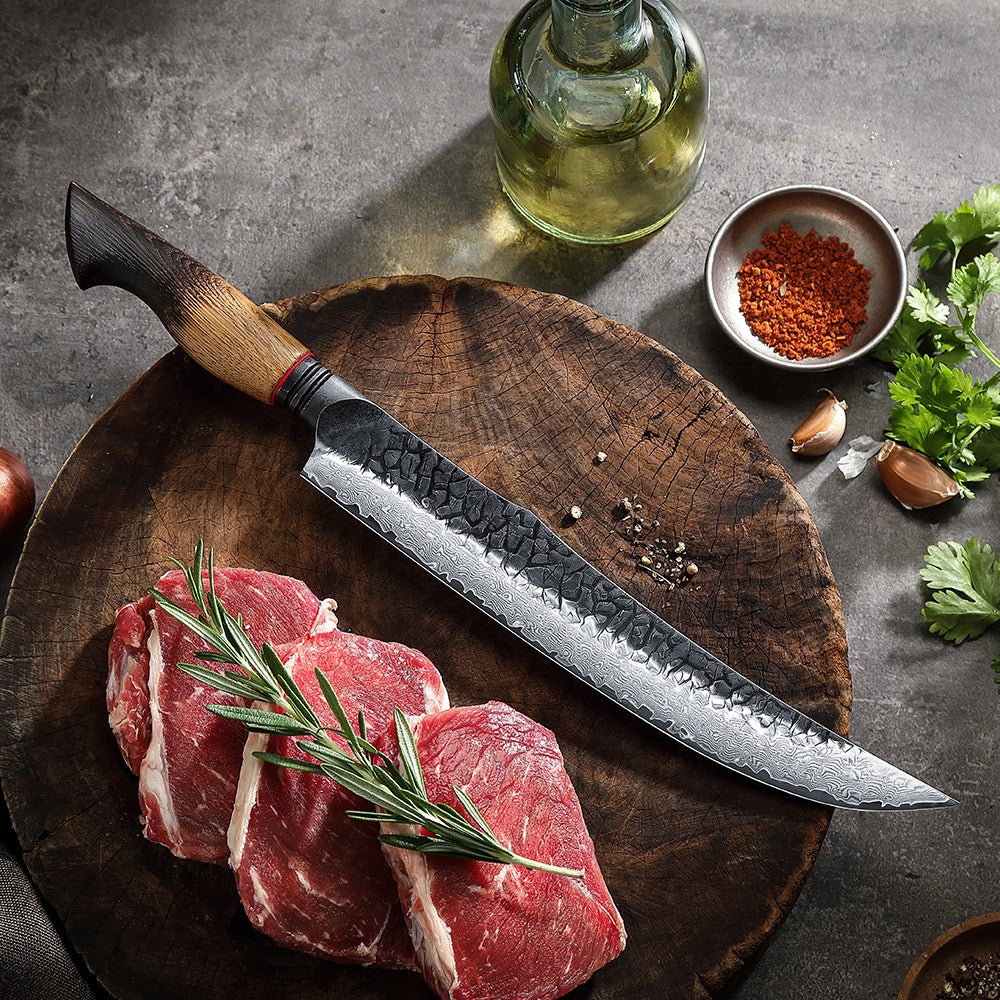
The name translates roughly to "flesh slicer," which is about as direct as Japanese knife naming gets. A sujihiki is a long, narrow, double-bevel slicing knife that borrows its profile from Western knife design but applies Japanese metallurgy and grinding techniques. The blade is typically between 240mm and 300mm (about 9.5 to 12 inches), with a gentle curve toward the tip and very little height from spine to edge.
Think of it as what happens when Japanese bladesmiths look at a European carving knife and say, "We can do better." They kept the symmetrical grind and the general shape, but they made the blade thinner behind the edge, used harder steel that holds a more acute angle, and reduced the overall weight. The geometry is purpose-built for slicing, not chopping, not rocking, not mincing. Slicing.
That narrow profile is the whole point. When you pull a sujihiki through a piece of cooked beef or a side of salmon, the thin blade displaces very little tissue on either side. Less displacement means less compression. Less compression means the muscle fibres stay intact rather than getting crushed and squeezed, which is how you end up with ragged surfaces and excessive moisture loss on carved meat.
What Is the Difference Between a Sujihiki and a Yanagiba?
This is where most people get confused, and it matters because these are genuinely different tools despite looking similar at a glance.
A yanagiba (also called yanagi) is a traditional single-bevel Japanese-style knife designed for slicing sashimi. One side of the blade is ground completely flat (the ura), and the other carries all of the bevel angle (the shinogi). This asymmetric grind does something specific: it causes the blade to steer itself away from the flat side as it cuts. For a right-handed yanagiba, the blade naturally pushes the cut piece to the left, away from the block of fish you are portioning. That self-steering is genuinely useful for sashimi work, where you need each slice to separate cleanly without sticking.
A sujihiki is ground symmetrically on both sides, just like a Western knife. No self-steering. No flat side. The edge geometry is equal on left and right.
The practical upshot: if you are not a sushi chef working behind a bar, a sujihiki will do everything you need. It slices raw fish beautifully. It carves roasts. It portions terrines. And you sharpen it the same way you sharpen your chef knife, on both sides, without needing to learn flat-side grinding technique. The yanagiba is a specialist tool for specialists. The sujihiki is a specialist tool for everyone.
How Does a Sujihiki Compare to a Western Carving Knife?
Most kitchens in Australia already have some version of a carving knife. It came in a block set, it is about 8 to 10 inches long, and it does an acceptable job on the Christmas ham. So why would you want a sujihiki instead?
Three reasons, all related to geometry.
Thinner blade stock. A typical Western carving knife is ground from steel that is 2.0 to 2.5mm thick at the spine. A sujihiki starts around 1.8mm and often tapers to 1.5mm or less toward the tip. That might not sound like much on paper, but you feel it immediately when cutting. Less steel means less wedging force needed to push through a piece of meat. The knife slides rather than forces its way through.
More acute edge angle. Western carving knives are typically ground at 18 to 22 degrees per side. A sujihiki, because it uses harder steel (more on that below), holds an edge at 12 to 15 degrees per side. A lower angle means a sharper edge that cuts cleaner. The total included angle on a sujihiki is around 24 to 30 degrees versus 36 to 44 degrees on a Western carver. You are cutting with something closer to a scalpel than a wedge.
Less weight. A lighter knife gives you more feedback through your hand. When you are slicing a roast, you want to feel the blade moving through the grain. You want to sense when you are cutting at the right angle versus fighting across the fibres. A heavy, thick knife bulldozes through regardless, and you lose that tactile information.
What Tasks Does a Sujihiki Excel At?
This is not a general-purpose knife. You would not use it to dice an onion or break down a butternut pumpkin. It does a very specific set of tasks better than any other knife shape.
Carving Roasts
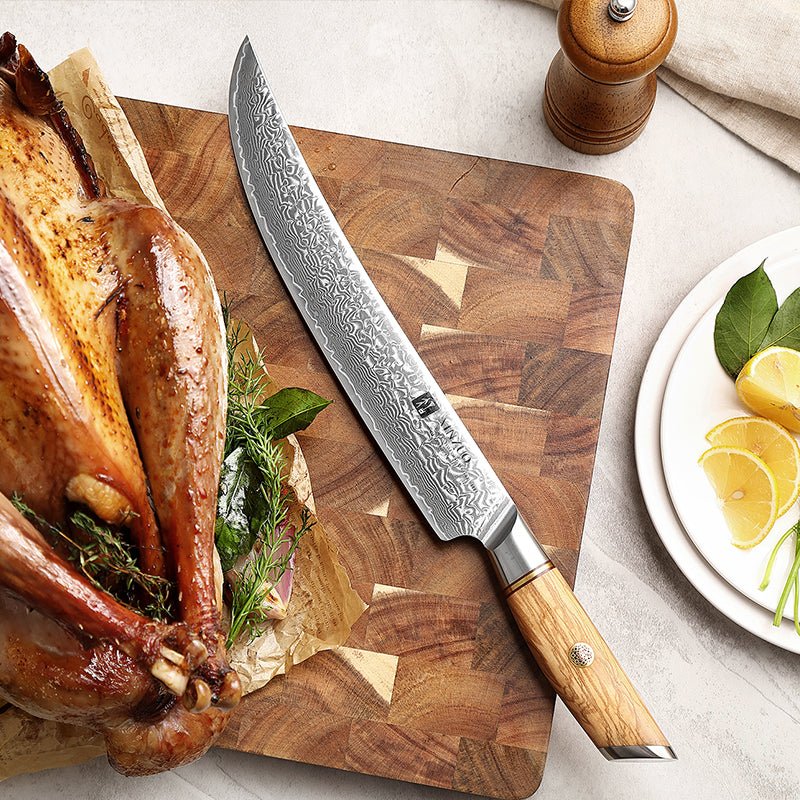
Beef roasts, lamb legs, pork loin, turkey breast. Anything where you need long, even slices from a large piece of cooked protein. The blade length lets you complete each slice in a single pull stroke rather than sawing back and forth. Sawing tears the surface. A single pull stroke leaves it smooth. If you have ever carved a brisket at a barbecue joint and noticed the slices look almost polished on the cut surface, the cook was using something long and thin. Likely a sujihiki or a dedicated slicing knife with similar geometry.
Sashimi-Style Slicing
Raw fish portioning. Not just sashimi, but any application where you are slicing raw seafood thinly. Crudo, ceviche prep, tartare. The double bevel makes it more forgiving than a yanagiba. You can slice from either side without the blade pulling in one direction, which matters when you are working around the shape of a fillet rather than cutting from one consistent angle.
Cold Proteins
Charcuterie, cured meats, cold-smoked salmon, pates, terrines. Cold proteins firm up in the refrigerator, which makes them easier to slice thinly, but they also highlight every flaw in your blade. A thick, dull knife will leave drag marks and tear delicate textures. A sujihiki cuts through these clean and quiet.
Gravlax and Smoked Salmon
This deserves its own mention because it is one of the tasks where the sujihiki truly shines. Slicing gravlax or cold-smoked salmon into thin, wide slices requires a long blade, a sharp edge, and a gentle hand. You want each slice to peel off the skin in one smooth pull without bunching or tearing. The narrow profile of the sujihiki means there is almost no friction between the blade and the salmon, so slices come off effortlessly.
Trimming Silverskin and Fat Caps
The pointed, flexible tip on many sujihiki makes them surprisingly good at sliding under silverskin on tenderloins and removing fat caps from roasts. This is not their primary job, but the narrow profile and sharp tip give you precision that a bulkier carving knife cannot match.
What Blade Length Should You Choose for a Sujihiki?
Sujihiki come in three common lengths, and the right one depends on what you are cutting most often.
A good rule: the blade should be at least 1.5 times the width of whatever you are slicing. If you regularly carve a brisket flat that is 6 inches across, you want at least 9 inches of blade. For a full packer brisket, 10 to 12 inches makes sense. The entire point of this knife is completing each slice in one pull. If you have to saw back and forth because the blade is too short, you have lost the advantage.
What Steel Properties Does a Good Sujihiki Need?
The steel in a sujihiki matters more than it does in a chef knife, and the reason is geometry. When you grind an edge to 12 or 15 degrees per side, you are creating a very thin, very acute cutting surface. Soft steel (below about 57 HRC on the Rockwell scale) cannot sustain that kind of angle. It rolls and folds within minutes of use. You end up with an edge that feels dull even though it was sharp when you started.
Good sujihiki steel sits between 58 and 62 HRC. At that hardness, the crystalline structure of the steel is rigid enough to hold an acute angle through extended use. You can sharpen it thin and it stays thin.
VG-10 is the most common steel in quality sujihiki at accessible price points. It hits about 60-61 HRC, takes a keen edge, and has enough chromium content (about 15%) to resist corrosion without constant babysitting. It is not the hardest steel available, but it strikes the best balance between edge retention, ease of sharpening, and resistance to chipping for this blade shape.
Higher-end options include SG2/R2 powder steel (63-64 HRC) and ZDP-189 (64-67 HRC). These hold their edge longer but are more prone to chipping if you twist the blade during a cut or hit bone. For a sujihiki, which should never contact bone anyway, the chipping risk is manageable. But VG-10 is the practical choice for most users.
One thing to watch for: softer stainless steel (German X50CrMoV15 at 55-56 HRC) is common in budget Western carving knives. It works at 20-degree angles but falls apart at sujihiki angles. If a sujihiki is priced suspiciously low and does not list the steel type, it is probably using soft steel that will not hold the edge geometry the blade shape demands.
How Do You Use a Sujihiki Properly?
This is a pull-slicing knife. Not a push cutter, not a rocker. You draw the blade toward you in a long, smooth stroke.
Here is the basic motion. Place the heel of the blade (the part closest to the handle) at the far edge of the protein. Apply light downward pressure and pull the knife toward you in a single stroke, letting the length of the blade do the cutting. The tip should exit the protein at the near edge. One stroke, one clean slice.
Two things to avoid.
Do not saw. If you find yourself pushing forward and pulling back repeatedly, either the blade is too short for the protein or it needs sharpening. The whole point of the sujihiki length is to complete each cut in one direction.
Do not press down hard. Excessive downward force compresses the protein before the edge reaches it, which causes tearing rather than slicing. Let the weight of the blade and a light guiding hand provide the downward pressure. The acute edge angle does the rest. If you feel like you are muscling through the cut, stop and sharpen the knife.
For raw fish, the technique is slightly different. You angle the blade at about 30 to 45 degrees relative to the fillet and pull slice in a single motion from heel to tip. The angle gives you wider slices from a narrow fillet. Speed should be moderate, not fast. Rushing creates uneven pressure along the edge, and you get slices that are thicker at one end than the other.
Who Actually Needs a Sujihiki?
Not everyone. This is a specialist knife, and if you only cook for yourself a few nights a week, your chef knife can handle the occasional slicing job just fine. But there are situations where a sujihiki goes from nice-to-have to genuinely useful.
You cook large roasts regularly. Sunday roasts, Christmas dinner, holiday gatherings. If you are carving at the table or portioning a full beef tenderloin, the sujihiki makes a noticeable difference in slice quality and effort.
You do barbecue. Brisket and pulled pork butts need long, confident slices. Brisket especially rewards a long, thin blade because the flat is wide and the grain structure shows every sawing mark.
You work with raw fish at home. Making sushi, poke bowls, or crudo at home is becoming increasingly common. If you buy sashimi-grade fish and want to portion it properly rather than hack through it with a chef knife, a sujihiki is the most approachable way to get professional-looking results without learning single-bevel technique.
You are building out a proper knife collection. If you already have a good chef knife and a petty knife, the sujihiki fills the biggest remaining gap. It handles tasks that no other knife shape does as well.
If you only own three knives, they should be a gyuto (chef knife), a petty (utility knife), and a sujihiki (slicer). Those three shapes cover about 95% of everything you will ever do in a kitchen. The chef knife handles prep. The petty handles detail work. The sujihiki handles protein.
Related Reading
- Steak and Carving Knife Buying Guide
- Brisket Knife Guide: Long Blades for BBQ
- Carving Knife Guide
- Japanese-style Knife Types Explained
- Knife Steel Hardness Guide
- Best Knife for Meat: Buying Guide
- How to Sharpen Knives with a Whetstone
- Knife Technique: Rock Chop, Push Cut, and Pull Slice
Frequently Asked Questions
What is the difference between a sujihiki and a Western carving knife?
A sujihiki is thinner (1.5 to 2.0mm at the spine vs 2.0 to 2.5mm for a Western carving knife), lighter, and ground at a sharper edge angle (12 to 15 degrees per side vs 18 to 22 degrees). The thinner blade displaces less tissue during each pull stroke, producing cleaner slices with less moisture loss. A Western carving knife is heavier and more durable for rough work, but it tears through delicate proteins where a sujihiki glides.
Can you use a sujihiki to cut sashimi?
Yes. A sujihiki at 240mm or longer can complete a full pull stroke through most fish fillets in a single motion, which is the key requirement for clean sashimi. The double-bevel grind means slices will not release quite as effortlessly as they do from a single-bevel yanagiba, but the difference is small for home use. A sujihiki also doubles as a carving knife for roasts and brisket, which a yanagiba cannot do.
What size sujihiki should I buy?
240mm is the minimum practical length, and it covers most home carving and fish slicing. 270mm gives comfortable margin for wider cuts like salmon fillets, brisket flats, and beef tenderloin. 300mm is professional territory for butchery and large whole-muscle portioning. If you only buy one sujihiki, 270mm (about 10.5 inches) is the most versatile size.
What is the difference between a sujihiki and a yanagiba?
A sujihiki has a double-bevel (symmetrical) grind and works in either hand. A yanagiba has a single-bevel (asymmetrical) grind, is hand-specific (right or left), and steers itself during cuts so slices release without sticking. The yanagiba produces marginally cleaner sashimi cuts, but it requires specialised sharpening technique. For any cook who is not a dedicated sushi chef, the sujihiki is the more practical choice.
Do you need a sujihiki if you already have a chef knife?
Only if you regularly carve roasts, slice brisket, or prepare raw fish at home. A chef knife is too short (usually 200 to 210mm) and too thick to pull through a wide piece of protein in one clean stroke. The sujihiki's 240 to 300mm blade and thin profile make a visible difference in slice quality and presentation. If you rarely carve or slice, your chef knife is fine.