

What Is the Quick Answer on Choosing a Meat Carving Knife?
A dedicated carving knife does one thing a chef knife cannot: it produces long, clean, uniform slices through large pieces of cooked protein without sawing, tearing, or crushing the meat. The right carving knife depends on what you are carving. An 8-inch blade handles most home roasts. A 10-inch blade is the workhorse for brisket, full pork loin, and bone-in lamb legs. Blade flexibility matters too: a semi-flexible blade follows curves around bone, while a rigid blade keeps slices perfectly straight through boneless roasts. This guide covers blade length, flexibility, technique, and which knife to use for every major roast you will encounter.
Why Does a Dedicated Carving Knife Matter?
You just spent four hours roasting a prime rib. The internal temperature is perfect, the crust is deeply browned, and you have rested it for a solid twenty minutes. Then you grab your chef knife and start cutting. The slices are uneven. Some are thick on one end and thin on the other. The juice that should be in the meat is pooling on the cutting board instead. The surface of each slice looks ragged rather than smooth.
This is not a skill problem. It is a geometry problem.
A chef knife is built for versatility. It rocks, it chops, it minces. The blade is relatively wide and often curved, designed for a dozen different cutting motions. That width means more surface area contacting the meat as you slice, which creates friction and drag. And because the blade is shorter than most roasts are long, you end up sawing back and forth rather than slicing in one continuous motion. Each saw stroke tears muscle fibres instead of separating them cleanly.
A carving knife solves this with a simple design principle: a long, narrow blade that completes each slice in a single pulling stroke. Less contact surface means less drag. Longer reach means no sawing. The result is smoother cut surfaces, less moisture loss, and slices that actually look like they came from a professional kitchen.
The difference is visible. Pick up a slice carved with a chef knife and one carved with a proper carving knife. The chef-knife slice will have a rough, fibrous surface. The carving-knife slice will look almost polished. That smoothness is not cosmetic. Smooth-cut muscle fibres retain their juices. Torn fibres release them. The carving knife slice will taste juicier.
How Do You Match Blade Length to the Roast?
Blade length is the single most important factor when choosing a carving knife, and the rule is straightforward: the blade should be longer than the widest dimension of whatever you are slicing. If the blade is shorter, you will saw. If you saw, you tear.
8-Inch Blades
The practical minimum for carving work. An 8-inch carving knife handles chicken breasts, pork tenderloins, small beef roasts, and rack of lamb cleanly. It is the right size for most weeknight cooking where you are carving one small to medium roast for a family dinner. The shorter length also makes it easier to control for people who are not used to longer knives.
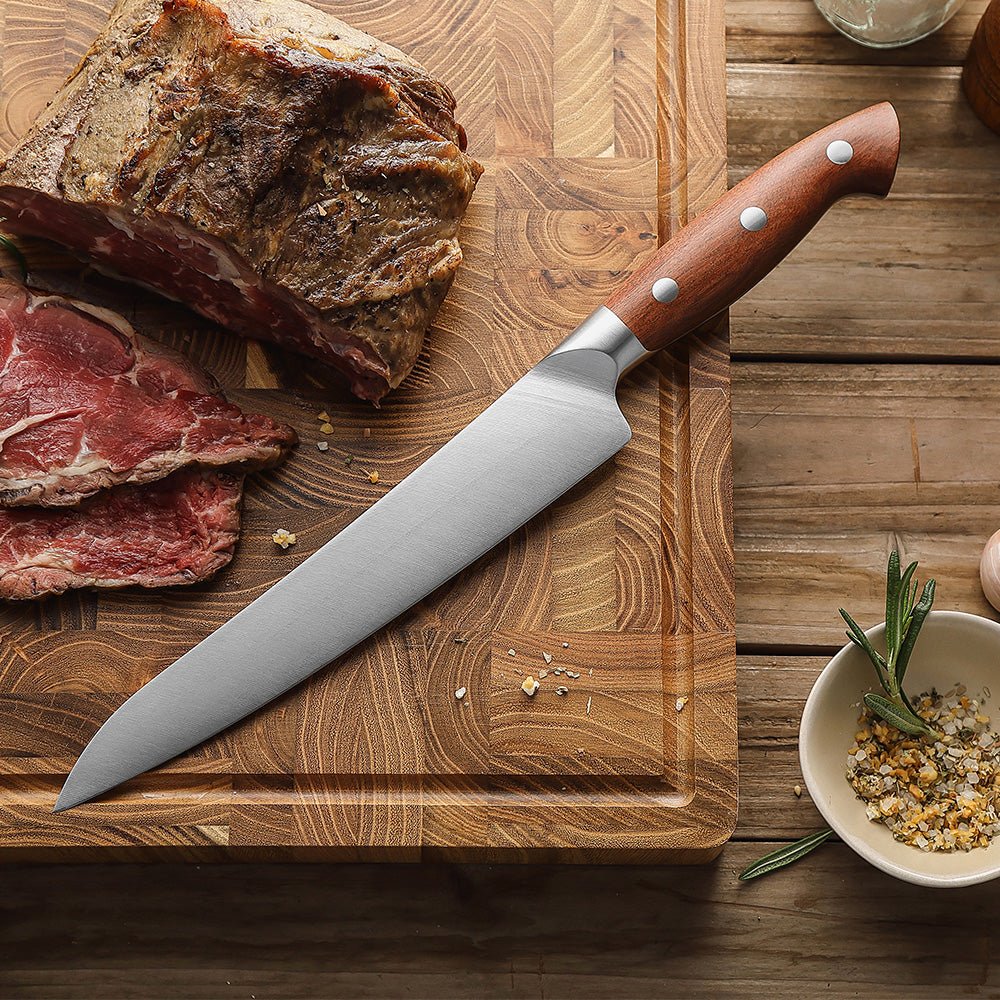
Where an 8-inch falls short: anything bigger than about a 2 kg roast. Try to carve a full brisket flat with an 8-inch blade and you will be sawing through the middle of every slice.
10-Inch Blades
This is the sweet spot for most serious home cooks and the length professionals use daily. A 10-inch carving knife handles full brisket flats, bone-in lamb legs, whole pork loins, large beef rib roasts, and turkey breasts without any difficulty. You can complete each slice in a single pull stroke on roasts up to about 25 cm wide, which covers nearly everything you will encounter at a home dinner or barbecue.
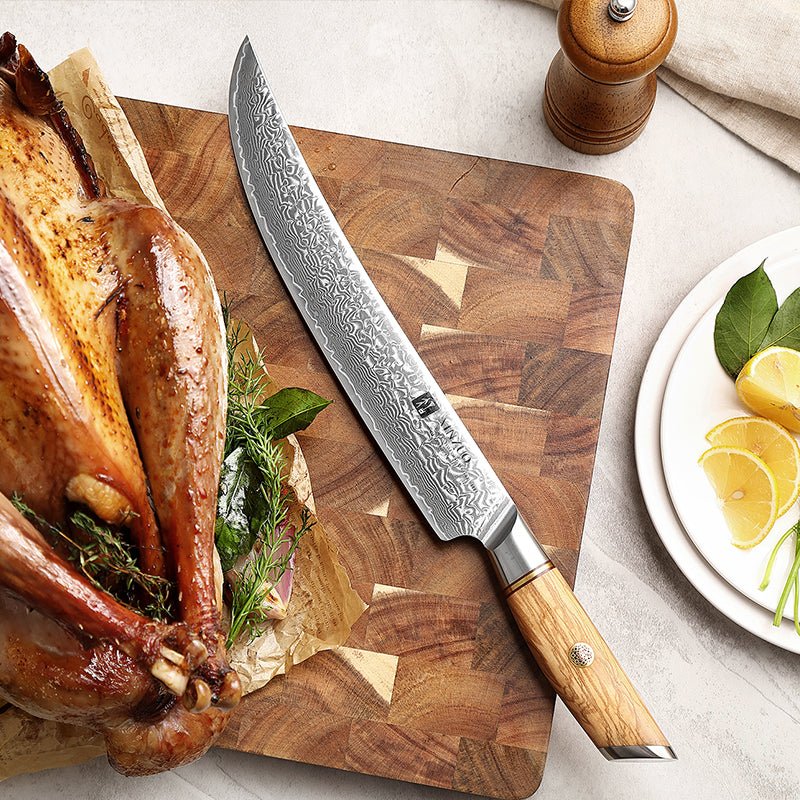
A 10-inch blade does require a bit more confidence to wield. The extra length amplifies every wobble in your technique, which is why a proper grip and a steady drawing motion matter more as blades get longer. Once you adjust, though, a 10-inch carving knife feels like it was always what the job required.
12-Inch Blades
Professional territory. Barbecue pitmasters, commercial kitchens, and anyone regularly carving whole briskets (point and flat together), full bone-in hams, or whole roast legs of beef. A 12-inch blade handles these with room to spare. For home cooks, this length is only worth it if you regularly cook for large groups or if you do whole-animal cookery.
When Should a Carving Blade Bend and When Should It Stay Rigid?
This is the factor most people overlook, and it makes a real difference depending on what you are carving.
Flexible blades have thinner steel that gives slightly under lateral pressure. When you carve around a bone, the blade flexes to follow the contour of the bone surface rather than fighting against it. This is why boning knives are flexible, and it is the same reason a flexible carving knife works well for bone-in roasts. Carving a leg of lamb where the femur curves through the meat? A flexible blade lets you trace along that bone and separate the meat without leaving chunks behind.
Rigid blades do not flex at all. They travel in a straight line from the moment you start the cut to the moment you finish. For boneless roasts, this is exactly what you want. Straight slices, consistent thickness from one end to the other. A brisket flat, a pork loin, a beef eye fillet, a turkey breast. All boneless. All best served in perfectly uniform slices. A rigid blade delivers that.
Most carving knives sold today fall into the semi-rigid category, meaning they have a very slight flex but mostly track straight. This is a reasonable compromise if you only want one carving knife. If you can afford two, get a rigid one for boneless work and a flexible one for bone-in jobs.
How Do Carving Knives, Slicing Knives, and Chef Knives Differ?
These three knives overlap in certain tasks, but they are designed for different jobs. Using the wrong one is not dangerous, it just gives you worse results.
A carving knife has a pointed tip for navigating around joints and bones. A slicing knife (like a sujihiki) prioritises length and thinness for pure portioning work, and the tip is less aggressive. A chef knife is too short, too wide, and too curved for either job.
Can you carve with a chef knife? Yes. People do it every Christmas. But it is like using a screwdriver as a pry bar. It works, sort of, but the tool is fighting the task the entire time.
What Are the Fundamentals of Carving Technique?
Good technique with a carving knife is surprisingly simple. There are only a few things to get right, and they all make an obvious difference from the first slice.
Rest the Meat First
This is not optional. A roast straight from the oven has all of its internal moisture under pressure from the heat. Cut into it immediately and that moisture floods out onto the board. You lose flavour, you lose juiciness, and you end up with dry slices sitting in a puddle.
Rest times vary by size. A chicken breast needs 5 minutes. A full beef rib roast needs 20 to 30. A whole brisket can rest for up to an hour wrapped in butcher paper inside a cooler. The general guideline is about 5 minutes per 500 grams of meat. During this time, the internal temperature will continue to rise by a few degrees (carryover cooking) and then begin to drop. As the meat cools slightly, the muscle fibres relax and reabsorb some of the moisture that was squeezed toward the surface during cooking. When you finally cut, the juice stays in the slice.
Identify the Grain and Slice Against It
Muscle fibres in a roast all run in the same direction. That direction is called the grain. If you slice parallel to the grain (with the grain), each piece contains long, intact fibres that are tough to chew through. If you slice perpendicular to the grain (against the grain), you are cutting those fibres short, and each piece is tender.
Finding the grain is easy on most cuts. Look at the surface of the meat. You will see lines running in one direction, like wood grain. Position your knife at a 90-degree angle to those lines and slice. On brisket, the grain direction changes between the flat and the point, which is why competition barbecue cooks rotate the brisket 90 degrees when they reach the transition point between the two muscles.
Single-Stroke Pull Cuts
This is the technique that separates good carving from acceptable carving. Place the heel of the blade (the part closest to your hand) at the top of the roast. Draw the knife toward you in one smooth motion, letting the full length of the blade do the work. The knife should move backward and slightly downward in a single stroke, and the slice should separate cleanly.
Do not saw. Sawing means pushing the blade forward and pulling it back, which tears the surface. If you cannot complete a slice in one stroke, your knife is too short for the roast, or it is not sharp enough. Both are fixable problems.
Let the weight of the knife do the cutting. You should not be pressing down hard. A sharp carving knife only needs gentle downward guidance while the pulling motion does the actual work.
Consistent Thickness
Aim for slices about 5 to 6mm thick for most roasts. This is thin enough to be tender but thick enough to hold together on the plate. For brisket, competition style is slightly thicker, about the width of a pencil (roughly 6 to 8mm). For cold cuts and charcuterie, go as thin as your knife and skill allow.
Why Is a Carving Fork Essential?
A carving knife and a carving fork are designed to work as a pair. The fork does two things. First, it anchors the roast so it does not slide across the board while you slice. Second, it gives you control over the angle and position of the meat without your fingers ever getting near the blade.
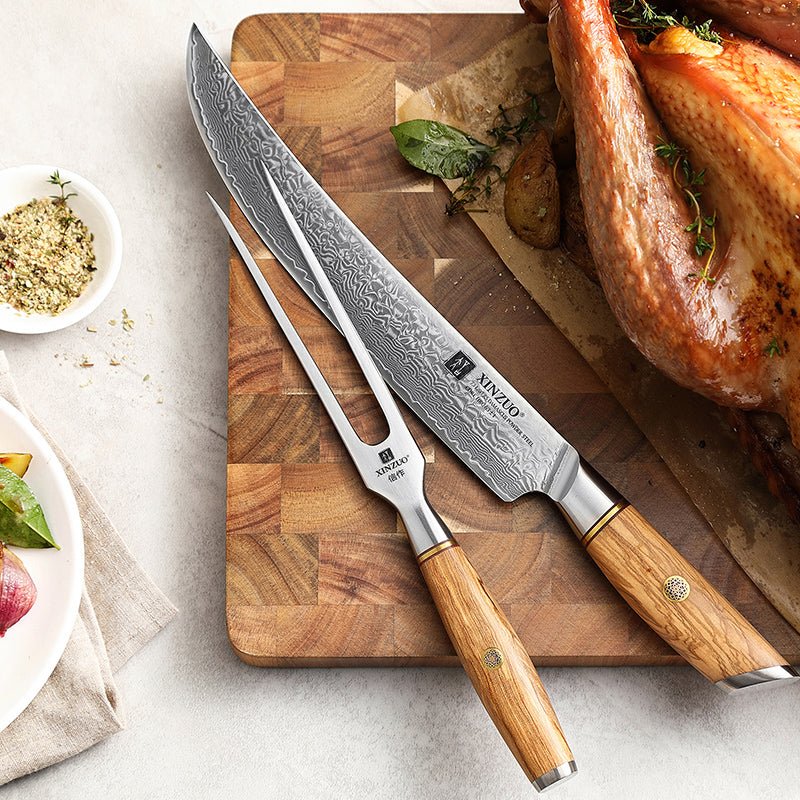
A good carving fork has two long, sturdy tines and a comfortable handle. You insert it into the top of the roast at least an inch deep, angled slightly away from where you are cutting. This gives you a solid grip on the meat while keeping the fork well clear of the knife path.
There is a common habit of holding the meat with your free hand. This is a bad idea with a carving knife. The blade is long, sharp, and moving in a pulling motion toward your body. If your hand is on the meat, you are one slip away from a very serious cut. The fork exists to prevent this. Use it.
What Steel and Edge Properties Matter for Carving?
Carving is probably the kitchen task where sharpness matters most. When you are slicing cooked protein, you want the blade to glide through with almost no resistance. A dull carving knife will compress the meat before it actually starts cutting, which squeezes out moisture and tears fibres. You see the damage as ragged surfaces and a juice-covered cutting board.
High-carbon steel and powder metallurgy steel are the best options for carving knives because they hold an acute edge angle for longer. A blade that can maintain a 12 to 15 degree bevel per side will always outperform one that requires 20 degrees to resist rolling. The total included angle determines how easily the blade enters the meat, and a difference of 10 degrees is the difference between sliding and pushing.
Hardness matters here. Steel hardened to 60+ HRC holds a keen edge through an entire carving session. Softer steels (below 56 HRC) start sharp but dull quickly, especially on proteins with rendered fat and collagen that coat the edge. If you notice your knife getting grabby halfway through carving a large roast, the edge has already started to degrade.
Damascus cladding is worth mentioning because it actually has a functional benefit for slicing tasks. The layered construction creates microscopic texture on the blade surface that reduces friction and sticking. When you slice through a fatty roast like pork belly or brisket, a Damascus blade releases from the cut surface more easily than a plain-finished blade. The food does not cling to the steel, which makes each slice separate more cleanly.
Stainless steel versus carbon steel is mostly a maintenance preference for carving knives. Carving work involves a lot of moisture, rendered fat, and acidic juices. A reactive carbon steel blade will need to be wiped down frequently during use and oiled after cleaning. A stainless or high-carbon stainless blade (like VG-10 or SG2) handles the wet environment without reacting. For a dedicated carving knife, stainless is the practical choice.
How Should You Approach Different Types of Roasts?
Every protein has its own structure, and the carving technique changes to match. Here is how to handle the most common roasts you will face.
Beef Rib Roast (Standing Rib Roast)
Rest for 20 to 30 minutes. Cut the bones away first by running your knife along the rib bones from top to bottom, following the bone contour. Then set the boneless roast cut-side down on the board and slice across the grain into portions about 1 to 1.5 cm thick. Serve a rib bone alongside for anyone who wants it. A 10-inch carving knife is ideal for this.
Beef Brisket
This is where blade length earns its keep. A whole packer brisket can be 40 cm or more across the flat. Slice the flat against the grain (the grain runs the long way on a flat, so you slice across the short dimension) in pencil-thick slices. When you reach the point where the flat meets the point muscle, rotate the brisket 90 degrees. The grain direction changes between these two muscles. If you do not rotate, your point slices will be tough.
Lamb Leg (Bone-In)
This is the trickiest common roast because the femur runs through the centre at an angle. Rest for 15 to 20 minutes. Hold the shank bone with a towel or grip it with your carving fork. Start slicing from the meaty side, angling the knife down toward the bone. When you hit the bone, use the knife tip to release the slices. Turn the leg over and repeat on the other side. A semi-flexible carving knife helps here because you can follow the bone contour.
Pork Loin (Boneless)
One of the easier carving jobs. Rest for 10 to 15 minutes. The grain runs lengthwise, so slice across the short dimension. A boneless pork loin is typically narrow enough for an 8-inch carving knife. Slice into medallions about 1 cm thick. The key is consistent thickness. Uneven slices mean some are overcooked (thin parts) and some are undercooked (thick parts) even though they came from the same roast.
Roast Chicken or Turkey
Rest for 10 to 15 minutes (chicken) or 30 to 45 minutes (turkey). Start by removing the legs and thighs at the joint. Then carve the breast by slicing downward along the breastbone, following the rib cage. Slice the breast meat against the grain into thin slices. For turkey, the breast is large enough that you should remove the entire breast half first, then slice it on the board. A pointed carving knife tip is useful for separating the breast from the carcass.
Glazed Ham
A whole bone-in ham is a big piece of meat. Start by cutting a flat base from the bottom so the ham sits stable. Then slice downward from the top to the bone, working in thin slices. When you have a section sliced, run the knife horizontally along the bone to release all the slices at once. Work your way around the ham, taking slices from each side. A 10 to 12 inch carving knife is the right tool. Keep a cloth nearby because the glaze gets sticky and will gum up the blade.
Which Xinzuo Carving Knives Are Available?
Xinzuo makes two carving knives and a matched carving fork, all in 67-layer Damascus with VG-10 cutting cores hardened to 60 ± 2 HRC.
The Lan Series 10" Carving Knife is the workhorse option. The 10-inch blade handles everything from brisket to bone-in lamb, and the VG-10 core holds a working edge through extended carving sessions. The blade is thin behind the edge, which means less resistance through fatty, collagen-rich proteins. It pairs with the Lan Series 6" Carving Fork, which has the same Damascus-clad construction and a handle that matches the knife.
The Supreme Series 8" Carving Knife is built for home cooks who mostly carve smaller roasts. The 8-inch blade is easier to control and stores more conveniently, while the same VG-10 core steel provides the sharpness and edge retention you need for clean cuts. If your typical carving job is a Sunday roast chicken or a pork loin, this is the right size.
Both knives benefit from the Damascus cladding's reduced friction during slicing work. The 67-layer pattern is not just decorative here. It genuinely helps with food release on fatty proteins, which is where carving knives spend most of their time.
Related Reading
- Steak and Carving Knife Buying Guide
- Brisket Knife Guide: Long Blades for BBQ
- Best Knife for Meat: Buying Guide
- Sujihiki Knife Guide
- Knife Technique: Rock Chop, Push Cut, Pull Slice
- Carving Knife Guide
- How to Sharpen Knives with a Whetstone
- Knife Steel and Hardness Guide
Frequently Asked Questions
What is the best carving knife for a Sunday roast?
A 10-inch (250mm) carving knife with moderate flex and a pointed tip. This length covers lamb legs, pork loins, and turkey breasts in a single pull stroke. For bone-in roasts, slight blade flex helps follow the bone contour. For boneless cuts, a stiffer blade gives straighter slices. Japanese-style carving knives at 58 to 60 HRC hold a sharper edge than softer Western alternatives.
Do I need a carving knife or can I use my chef knife?
A chef knife will carve a roast, but the wide blade creates more friction and the shorter length forces you to saw on anything bigger than a small chicken. A carving knife's narrow profile and longer reach produce cleaner slices in a single pull stroke, with less juice loss. If you roast meat a few times a year, your chef knife is fine. If you carve roasts monthly or host holiday dinners, a dedicated carving knife makes a real difference.
How do you stop meat from tearing when carving?
Let the roast rest for 15 to 20 minutes before carving so the juices set and the muscle fibres relax. Use a razor-sharp carving knife and cut with long, smooth pull strokes from heel to tip, never saw back and forth. Slice against the grain for tenderness. A narrow blade (25 to 35mm wide) creates less friction than a chef knife and produces cleaner cuts with less juice loss.
What size carving knife should I buy?
Match the blade to the largest roast you carve regularly. An 8-inch blade handles chicken, pork tenderloin, and small beef roasts. A 10-inch blade covers lamb legs, full pork loins, brisket flats, and turkey breasts, making it the best all-round choice for most home cooks. A 12-inch blade is for whole briskets, full hams, and commercial volumes.
Do I need a carving fork?
Yes, if you carve at the table or work with large, heavy roasts. The fork anchors the meat so it does not slide while you slice, and keeps your fingers away from the blade during long pull strokes. For smaller roasts carved on a cutting board, you can steady the meat with a folded tea towel instead, but a fork gives better control on anything over about 2 kg.