


Use a santoku knife to chop vegetables and slice boneless meat or fish fillets, raw or cooked. Its fairly straight edge suits short cuts down and forward, such as dicing onion or slicing cucumber. Avoid bones and food that is still frozen.
Which foods suit a santoku knife?
A santoku is most useful for chopping and slicing ingredients on a board, especially food that fits comfortably beneath its edge.
| Food | Useful santoku jobs |
|---|---|
| Vegetables | Dice onion for a sauce or slice mushrooms. For carrot matchsticks, cut stable flat slices first, then cut those into strips. |
| Boneless meat | Cube chicken thigh or slice beef across the grain into stir fry strips. It also suits slicing a cooked chicken breast. Remove any bones before using the santoku. |
| Fish fillets | Cut a boned salmon fillet into portions. Check for pin bones first. Removing fillets from a whole fish is a separate job that suits a filleting knife. |
| Fruit | Slice apples or dice melon that has already been peeled and divided into manageable pieces. Use a smaller knife for peeling and coring. |
| Herbs and garlic | Slice a small stack of basil leaves or mince garlic with repeated short cuts. Work in small batches so the food stays under the blade. |
Santoku means three virtues. The name is commonly associated with its use for vegetables, meat and fish, or with slicing, dicing and mincing.
For raw meat and food eaten without further cooking, Food Standards Australia New Zealand recommends separate boards and knives. Keep raw meat juices away from salad ingredients.
How do you cut with a santoku knife?
Lower the edge through the food with a small forward slide, then lift and reset for the next cut.
- Steady the board with a non slip mat or damp cloth underneath. Give round vegetables a flat base before continuing.
- Hold the handle close to the blade. For a pinch grip, place your thumb and bent forefinger on opposite blade faces just ahead of the handle, both safely above the cutting edge.
- Curl the fingertips of your guiding hand under, with your thumb tucked behind them. Move that hand back a little between cuts.
- Cut down and slightly forward until the edge reaches the board. Lift only as far as needed to clear the food, keeping the blade aligned with the cut.
The curled guiding hand follows Virginia Cooperative Extension's claw grip guidance. Practise slowly before increasing speed.
If spring onion slices stay joined underneath, check that the edge finishes each stroke against the board. For moving chopped food, use a bench scraper or gather it with the knife's spine so the sharp edge does not scrape sideways across the board.
What should you avoid cutting with a santoku?
Avoid bones and frozen food, and stop whenever a cut needs heavy force or sideways twisting.
- Use a boning knife to work around bones. Chopping through bone needs equipment made for that job.
- Thaw frozen ingredients before cutting them with a santoku.
- A large pumpkin or watermelon can exceed the blade's reach. Choose a suitable longer knife and a stable setup. Change tools if a hard rind resists the cut, and never lever a stuck blade sideways.
- Use a serrated bread knife for a crusty loaf. Its teeth make it easier to cut through the crust without pressing down on the soft centre.
Should you use a santoku or a chef knife?
Choose a santoku if you prefer short cuts with a lift between strokes. A chef knife with a curved edge suits a rocking motion and offers more reach in a longer size.
When I demonstrate cutting styles, I use a curved chef knife for rocking and a flat nakiri for pushing straight down.
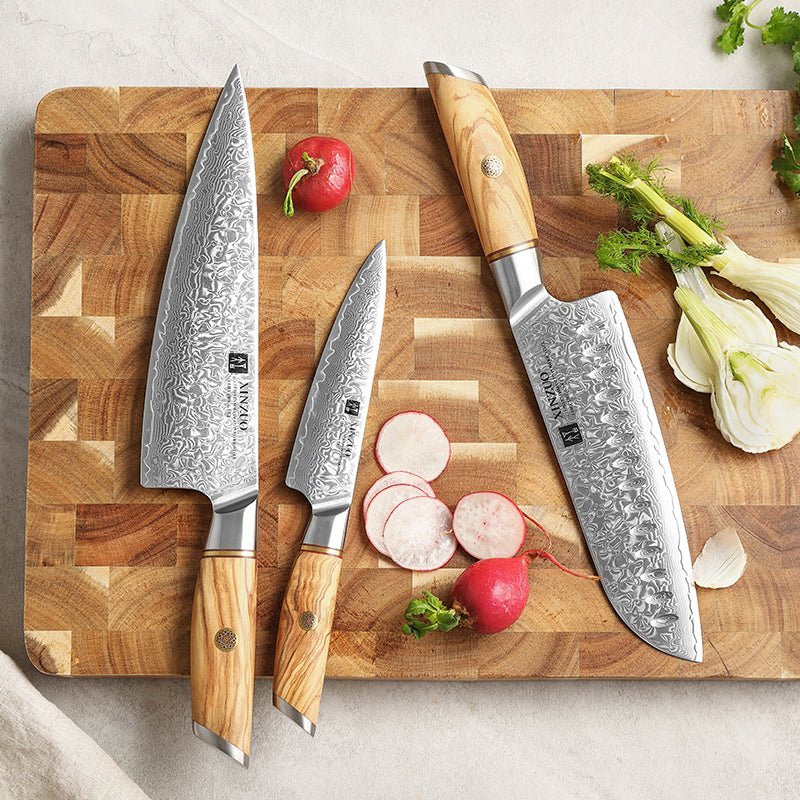
A chef knife can also make forward slicing cuts. Some santokus have enough curve near the tip for a small rock, so compare the actual blade shape. Neither shape makes a thin kitchen knife suitable for chopping bones.
A gyuto is a Japanese-style chef knife, usually with a more pointed tip than a santoku.
I reach for a 210 mm gyuto for about 80% of my home prep.
For a fuller comparison, see santoku versus chef knife. If your current chef knife already feels comfortable for dinner prep, adding a santoku is optional.
What size santoku is useful at home?
For general dinner prep, consider a blade around 7 inches, about 18 cm. Check that the handle feels secure and your knuckles clear the board.
A shorter model, such as the Retro Series 5.5 inch santoku, suits small ingredients on a compact board. It gives up reach for larger food. Compare prices, blade lengths and handle shapes in the santoku knife collection.

Do the dimples stop food sticking?
Expect some sticking even on a dimpled blade, especially with potatoes or soft cheese. The shallow blade hollows are intended to help slices separate, but they do not guarantee that food will fall away.
With potato, I still get sticking on a scalloped santoku. That's when I turn to a bunka, tilt it up and glide the K-tip through with less blade touching the potato.

Dimples sit in the blade face above the edge. Serrations are teeth along the cutting edge itself. A knife with a toothed cutting edge uses a sawing motion. Check the edge before treating it like a smooth santoku.
How do you care for a santoku after use?
Hand wash and dry it straight away. Store it with the edge protected. Use a wooden or suitable plastic chopping board, and avoid glass or stone cutting surfaces.
Keep it out of the dishwasher and do not leave it soaking in the sink. The daily knife care guide covers cleaning and storage in more detail. When the edge needs sharpening, follow how to use a knife sharpener, checking that the sharpener suits your knife's edge angle.
Frequently asked questions
What is a santoku knife best for?
It handles repeated cuts through vegetables and boneless ingredients well. Its broad blade and straighter edge are useful for small dice and even slices on a board.
Can you use a santoku knife for everything?
It can be your main prep knife, but bread crust and work around bones call for different tools. A smaller knife is easier for peeling fruit or cutting out a small blemish.
How does a santoku differ from a chef knife?
A santoku suits short forward cuts, while a curved chef knife makes rocking easier. Choose by the cutting motion and blade length you find comfortable.
How does a santoku differ from a utility knife?
A santoku has a broad blade for repeated cuts on a board. A utility knife is narrower and usually shorter, useful for small ingredients and trimming where the santoku feels bulky. For peeling or coring fruit, use a paring knife.
What are the three knives that everyone should have?
Start with either a santoku or a chef knife as your main board knife. Add a small paring knife for peeling and close work, plus a serrated bread knife.
For a first practice session, halve a cucumber lengthways and set the flat side down. Cut slowly into half moons, concentrating on control before speed.

Written by Dylan Tollemache
Dylan visited the Xinzuo factory in Yangjiang, China to verify production standards. He has personally tested every knife in the Xinzuo and Hezhen ranges sold in Australia.


